Discover the top white label reporting software to save time and build client trust. We compare 11 tools on data reliability, AI insights, and scalability.
Let’s talk about that feeling.
That stomach-dropping, cold-sweat-inducing moment when the client’s CEO calls you directly. It’s not to praise your latest campaign. It’s because the beautiful, branded report you sent them shows a 20% drop in revenue, but their Shopify dashboard is screaming a 10% increase.
Suddenly, all your hard work is overshadowed by one question: "Can we even trust your data?"
Sound familiar? It’s the agency horror story that’s becoming all too common. The connector failed, the data was stale, and now trust is shattered. In essence, white label reporting software allows agencies to create professional, branded reports for their clients using a third-party platform. This guide reviews the top tools that go beyond aesthetics to ensure data integrity and build lasting client trust.
Here’s the thing: a staggering 42.86% of clients are already unsatisfied with their agency's reports. In today's market, a pretty dashboard with your logo on it just doesn't cut it anymore. This isn't a branding issue; it's a data integrity crisis.
You need reports that are reliable, insightful, and so seamlessly integrated that they feel like an extension of your own agency. This guide is your new playbook. We're going beyond feature lists to show you how to choose a platform that turns reporting from your biggest liability into your strongest client retention tool.
Let's dive in.
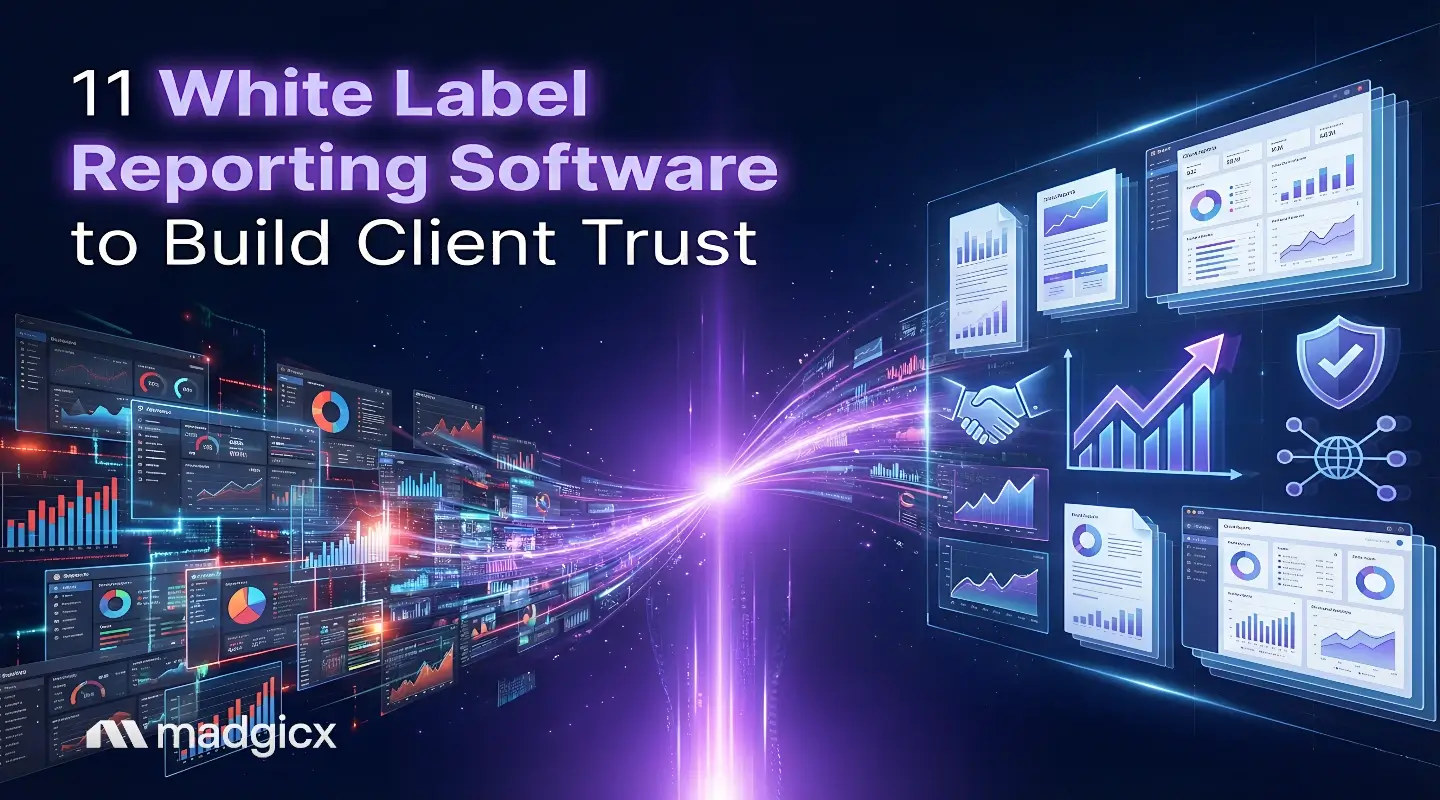
Madgicx’s One-Click Report lets you generate fully white-labeled, client-ready reports in seconds, pulling live data from Meta, Google, TikTok, GA4, Shopify, and Klaviyo into one unified dashboard. Use built-in templates to standardize your reporting and deliver clear cross-channel insights without touching a spreadsheet.
What You'll Learn
- How to use our "Data Trust Checklist" to vet any reporting tool's reliability.
- Why a professional, branded experience is the new standard for agencies.
- How to calculate the true ROI of a reporting platform vs. manual labor costs.
- Bonus: How to use AI to generate executive summaries for your reports.
Manual Reporting Costs More Than Just Your Time (A Lot More)
Let's be honest, pulling together manual reports is a soul-crushing time suck. We've all been there: downloading CSVs, wrestling with spreadsheets, and copy-pasting screenshots until our eyes glaze over.
But the real cost isn't just the 10-15 hours you lose per client every single month.
For a mid-sized agency, that manual labor can easily add up to a $60,000–$100,000 annual drain on your payroll. That’s a senior media buyer’s salary spent on glorified data entry.
But the hidden costs are even scarier:
- The Risk of Human Error: One wrong copy-paste can lead to that dreaded CEO call and a massive loss of client confidence.
- Client Churn: Inaccurate or late reports are one of the fastest ways to lose a client who feels they aren’t getting the transparency they pay for.
- The Inability to Scale: You can't grow your agency if your top talent is bogged down in spreadsheets instead of strategy.
Here’s a little secret: automating your client reporting isn't just about cutting costs; it's a growth strategy. A study found that agencies that outsource 40–60% of their service delivery grow about 2.3 times faster than those that don’t. Automating your reporting is the first, easiest step on that path to explosive growth.
What Professional Agency Reporting Actually Means
Look, the term "white label" gets thrown around a lot. For some platforms, it just means you can slap your logo on the top-left corner of a dashboard. That's a start, but it's not enough.
The gold standard is a seamless client experience. Your reporting tool should feel like a natural extension of your agency, reinforcing your brand and professionalism at every touchpoint. This isn't about vanity; it's about owning the client experience from end to end.
And it’s becoming the norm. The same report notes that around 73% of agencies have already integrated white label services, with the entire industry projected to hit a massive $99.19 billion worldwide.
Key elements of a professional reporting experience include:
- Custom Branding: The ability to add your agency's logo and brand colors to reports and dashboards.
- Shareable Links: Providing clients with a live, branded link to their data instead of a generic login portal.
- Branded Communications: Ensuring any automated email alerts or notifications appear to come from your agency, not a third-party tool.
The Data Trust Checklist: 5 Questions to Ask Before You Buy
Alright, this is the most important part of this entire article. Before you even think about signing up for a free trial, you need to vet any potential reporting software for data reliability.
These five questions will save you from support ticket nightmares and fragile data connectors.
1. Is it a Direct API or a Scraper?
A direct, official API connection means the tool has been approved by the platform (like Meta or Google) and is less likely to break. Scrapers, on the other hand, "scrape" data from the front end and are incredibly fragile. Always, always choose direct APIs.
2. How fast does the data refresh?
For performance marketing agencies, data that's 24 hours old is useless. You need to know what's happening now. Ask for the data refresh rate. Anything over an hour is a red flag. Real-time or near-real-time (every 15-30 minutes) is the goal.
3. Can I see your historical uptime?
Don't just take their word for it. Ask for a link to their public status page. This will show you their history of outages and how quickly they resolve issues. Consistent downtime for a specific connector (like Facebook Ads) is a major warning sign.
4. How are blended metrics calculated?
This is a big one for e-commerce agencies. If you're blending data from Shopify and multiple ad platforms, you need to know how the tool calculates metrics like blended ROAS or MER (Marketing Efficiency Ratio). Understanding the logic is key to trusting the numbers.
5. What happens when a connector breaks? (Because it will.)
When a data source inevitably breaks, how fast can you get help? Is support only available via a 48-hour email ticket, or do they have live chat with engineers who can actually fix the problem? Your clients won't wait two days for their data, and neither should you.
Pro Tip: When you're on a demo call, don't just ask for the status page link. Ask the sales rep to show you the status page live and explain a recent outage. Their comfort level with this question tells you everything you need to know about their transparency.
11 Top White Label Reporting Software for Agencies
We analyzed dozens of reporting tools for data analysis based on the Data Trust Checklist, feature sets, and scalability for agencies. Here are the leading contenders.
1. Madgicx
- Best For: Performance marketing and e-commerce agencies needing to blend ad platform data with sales data.
- Key Features: One-Click Report & Business Dashboards, AI Chat for data narratives, deep ad platform integration with AI Marketer, and agency-focused branding.
- Pricing: Based on ad spend, starting at $45/mo, with a free trial.
- The Catch: Focused primarily on paid media and e-commerce.
2. AgencyAnalytics
- Best For: Full-service digital agencies needing a wide range of integrations (75+).
- Key Features: Automated scheduling, SEO tools like rank tracking and site audits.
- Pricing: Tiered based on "client campaigns."
- The Catch: Costs can increase significantly as you add more client campaigns.
3. Swydo
- Best For: Agencies looking for flexible, cost-effective solutions and Google Looker Studio integration.
- Key Features: Workflow automation, custom metrics, and per-data-source pricing.
- Pricing: Flexible based on usage.
- The Catch: More traditional UI; potential learning curve for high customization.
4. DashThis
- Best For: Small to mid-sized agencies needing simple, beautiful dashboards quickly.
- Key Features: Preset report templates and a drag-and-drop interface.
- Pricing: Based on the number of dashboards.
- The Catch: Lacks deep customization for technically demanding agencies.
5. Databox
- Best For: Data-savvy agencies needing to pull data from virtually any source, including SQL.
- Key Features: Large template library and direct SQL database querying.
- Pricing: Free tier available; paid plans for advanced features.
- The Catch: High complexity; requires technical setup to maximize value.
6. Whatagraph
- Best For: Large agencies and enterprise clients needing high customization.
- Key Features: Cross-channel data blending and advanced white-labeling.
- Pricing: Custom pricing (contact sales).
- The Catch: Premium pricing; key features often reserved for higher tiers.
7. SE Ranking
- Best For: SEO-focused agencies requiring rank tracking and site auditing.
- Key Features: Comprehensive SEO toolkit and white-label reporting.
- Pricing: Based on the number of keywords tracked.
- The Catch: Strength is limited to SEO; not a full performance marketing dashboard.
8. Reporting Ninja
- Best For: PPC-focused agencies wanting a budget-friendly tool for ad networks.
- Key Features: Simple setup and specialized PPC reporting templates.
- Pricing: Several affordable entry-point plans.
- The Catch: Limited scope; cannot blend data with sales platforms like Shopify.
9. Improvado
- Best For: Enterprise-level agencies with complex ETL (Extract, Transform, Load) needs.
- Key Features: 300+ integrations and managed data warehousing.
- Pricing: Custom pricing only.
- The Catch: Requires significant technical expertise and high budget.
10. Supermetrics
- Best For: Agencies building reports in Google Sheets, Looker Studio, or Excel.
- Key Features: Powerful data connector that pulls raw data into destination tools.
- Pricing: Varies by destination/connector.
- The Catch: You still have to build and design the reports manually.
11. Oviond
- Best For: Agencies prioritizing modern UI and project organization.
- Key Features: Clean design, client grouping, and unlimited users.
- Pricing: Based on the number of clients.
- The Catch: May lack the depth of data blending found in performance-focused tools.
From Data Dumps to Actionable Narratives: Using AI in Reporting
Okay, so you've got reliable data. Now what? This is where things get really cool.
The best automated reporting for agencies doesn't just show what happened. It helps you explain why it happened. This is the "Narrative Automation" gap, and it's where AI is changing the game.
Instead of hunting for insights, you can now simply ask for them. With a tool like Madgicx's AI Chat, your account manager can type, "Why did ROAS drop last week for Client X?" and get an instant, data-backed answer.
The AI might respond:
"ROAS for Client X decreased by 15% last week. This was primarily driven by a 40% increase in CPMs in your top-performing 'Lookalike 1% - Purchasers' audience... I recommend a creative refresh to improve its relevance score."
This transforms your agency's role from a simple data provider to an invaluable strategic advisor.
Decision Matrix: Which Reporting Tool is Right for Your Agency?
Frequently Asked Questions
1. Okay, but is this software really worth the price?
Absolutely. At a $50/hour rate, manual reporting (10 hours) costs $500 per client. Software pays for itself instantly through efficiency and error reduction.
2. How do these tools even charge?
Models include "per client," "per data source," or "per dashboard." Madgicx bases tiers on ad spend, so you aren't penalized for having many small clients.
3. What are the hidden costs they don't tell you about?
The biggest cost is client churn from unreliable data. Watch for premium features locked behind enterprise tiers or overage charges.
4. Is it safe to connect my clients' ad accounts?
Yes, provided they use OAuth 2.0. This protocol lets you access data without ever handling the client's actual password.
Conclusion: Make White Label Reporting Software Your Strongest Retention Tool
Choosing from available client reporting tools is an infrastructure decision. To scale, you must prioritize data trust, professional branding, and AI-driven narratives.
Before starting a trial, run your top picks through the Data Trust Checklist. For performance agencies tired of explaining the "why," Madgicx offers the reliable, blended metrics needed to prove value every month.