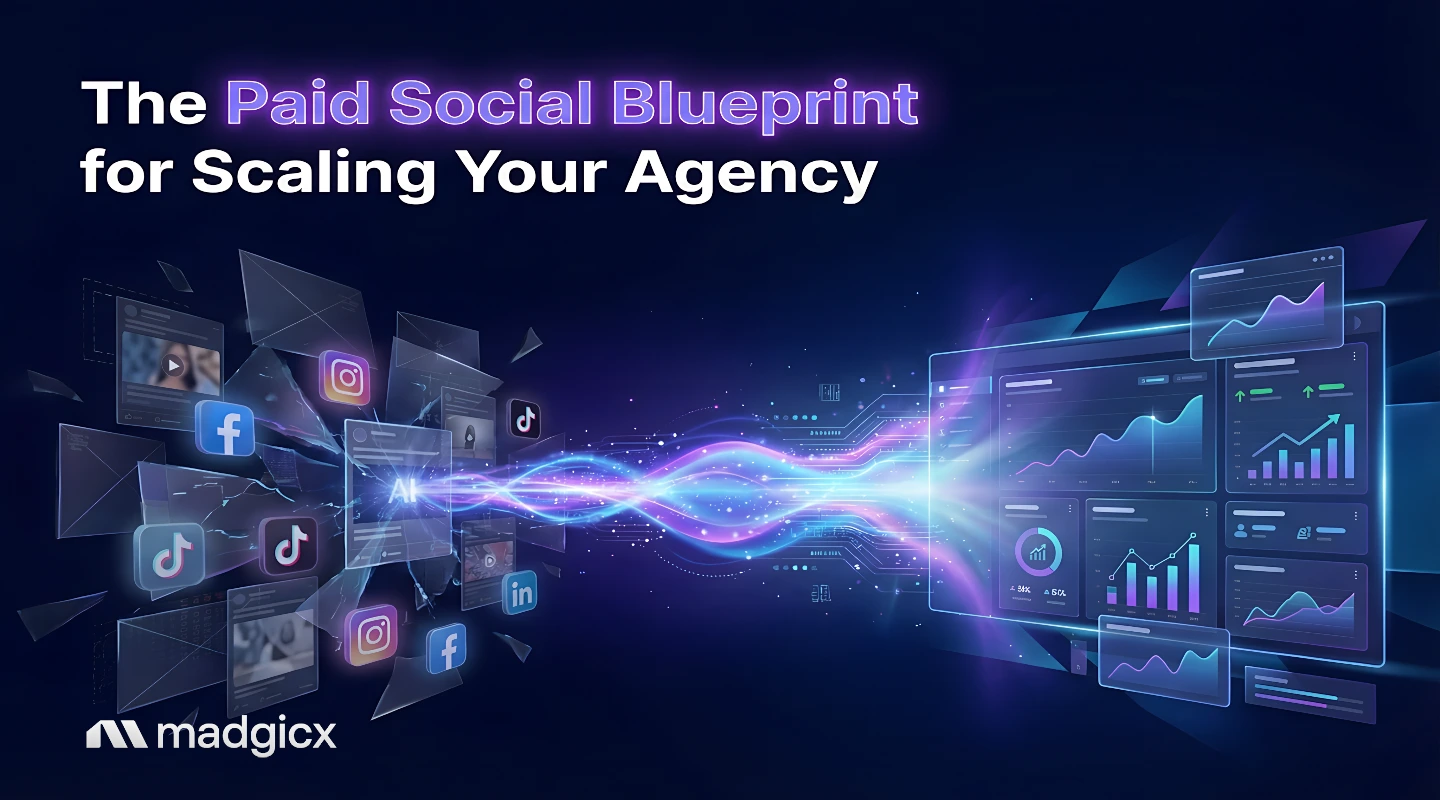
Discover our paid social blueprint for marketing agencies. Learn to adopt an operator mindset, master data, and scale your business profitably.
Juggling 15 client accounts, drowning in manual reporting spreadsheets, and watching a winning campaign suddenly tank for no reason. Yeah, that feeling in the pit of your stomach? Sound familiar?
This is the daily reality for most paid social agencies. We've all been there: constantly putting out fires, trying to prove your worth on a client call, and wondering if you’ll ever get ahead of the chaos.
Let’s be honest: the old agency model is broken. Success is no longer about frantic manual tweaks and hoping for the best. With global social ad spend projected to rocket past $276.72 billion in 2025, the stakes are just too high for guesswork.
The modern solution is to adopt the "Operator Mindset"—a strategic shift where agencies use AI-driven systems and a data-first approach to manage client accounts for profitability, not just performance metrics. It’s about building a scalable, predictable machine designed to deliver results. And with 83% of all paid social revenue expected to come from mobile, that machine needs to be incredibly fast and efficient.
This blueprint isn't another fluffy, high-level guide. It’s the actual, in-the-trenches operational framework you need to transform your agency from a reactive service provider into a profit-driven performance operator. Together, we're going to streamline your workflows, deliver results that make you indispensable, and finally get you focused on scaling your agency.
Your team jumps between platforms, manually testing creatives, adjusting budgets, and hunting for winning audiences. Madgicx’s AI-powered workflow centralizes creative generation, analysis, budget optimization, and performance insights in one place—so you can move from scattered execution to systematic growth.
What You'll Learn
Ready to level up? Good, because we’re not just talking theory here. We’re handing you the actual keys to the kingdom. In this playbook, we’re going to pull back the curtain on:
- How to adopt the "Operator Mindset" to drive real profit for clients and your agency.
- The essential technical infrastructure you need to thrive in the cookieless, AI-driven landscape.
- A step-by-step framework for building a "High-Velocity Creative Engine" to finally beat ad fatigue.
- How to use "Client Health Scores" to improve retention and fire unprofitable clients with confidence.
- The 70/20/10 budget model that will de-risk client portfolios and make you look like a strategic genius.
The Big Shift: From Marketing Agency to Performance Operator
For years, the standard playbook for social media advertising has kept agencies stuck in a loop: run campaigns, report on vanity metrics like CPM or CTR, and just hope the client is happy. The "Operator Mindset" throws that out the window. It’s about shifting your focus from being a campaign manager to a business operator.
So, what does that actually mean in practice? It means you stop caring about platform ROAS in a vacuum and start obsessing over profit-driven outcomes like Blended ROAS (your total revenue divided by total ad spend) and Gross Profit per Transaction. It means you build systems, not just run campaigns.
This shift is essential because mastering paid social is no longer optional for your clients. With social platforms like TikTok and Instagram now accounting for over 60% of product discovery, your ability to perform here directly impacts their bottom line. You’re not just a line item on their budget; you’re the engine for their growth.
Pro Tip: Start Grading Your Clients
Seriously. Here's a game-changer you can put into action this week: Introduce a "Client Health Score" based on a few simple criteria:
- Budget Realism: Do they understand what it takes to win?
- Trust & Autonomy: Do they let you do your job, or do they micromanage every ad?
- Payment Reliability: Do they pay on time, every time?
Your Agency's Foundation: The Data & Attribution Stack
Let's talk about the one thing that keeps every agency owner up at night: bad data. You can't operate effectively on it. Today, relying on the browser-based Facebook pixel is like navigating with a treasure map where half the landmarks are missing. Frankly, it’s obsolete.
To feed Meta’s and Google’s AI algorithms the clean, accurate data they need for effective ad campaign optimization, server-side tracking is absolutely non-negotiable. This is your foundation. Without a solid server-to-server connection like Meta's Conversions API (CAPI), you’re flying blind, and your clients' campaigns will suffer. That's why Madgicx includes robust Server-Side Tracking to help you address iOS tracking challenges and send more accurate conversion data back to the platforms.
But even with improved tracking, you’ll run into the classic "Attribution Paradox." You know the one: Meta says ROAS is 5x, Google claims it’s 4x, and your client’s Shopify dashboard says the real number is 3x. It's enough to make your head spin. Who do you believe?
The operator’s answer: none of them, and all of them. The source of truth is your Blended ROAS. This is the only metric that matters for judging overall business health.
Quick Tip: Unify Your Dashboard
Instead of juggling five different tabs to calculate this, use a unified dashboard. The Madgicx Business Dashboard pulls in data from Meta, Google, TikTok, and Shopify, giving you a real-time view of blended metrics. It’s your single source of truth for client performance, allowing you to make decisions based on reality, not platform-inflated numbers.
The High-Velocity Creative Engine: Your Newest Competitive Edge
Here’s a hard truth: creative is the new targeting. With broad targeting and Advantage+ campaigns dominating the landscape, the single biggest lever you can pull to improve performance is the quality and volume of your ad creative.
The old model of spending two weeks to produce one polished, perfect ad is dead. Ad fatigue is real, and audiences get bored faster than ever. To win, you need to build a "High-Velocity Creative Engine."
This means your agency should aim for 5-10 new, raw, UGC-style ad creatives per week, per client. 🚀 If you need a refresher on the fundamentals, our guide on how to make an ad can get your team up to speed.
I know what you’re thinking: "My team can't possibly handle that!" And you’re right, they can’t—not if they’re doing it the old, manual way. This is where you leverage technology. Tools like Madgicx's AI Ad Generator are built for this exact purpose. It allows a junior account manager to generate dozens of high-quality image ad variations in minutes, not hours. You can scale winning concepts, test new angles, and feed the algorithm fresh content without burning out your team or relying on extensive design resources.
But velocity alone isn’t enough.
That’s where Madgicx’s AI Marketer becomes your unfair advantage. It continuously analyzes performance data, detects early signs of creative fatigue, and delivers actionable optimization recommendations — from budget reallocations to creative swaps — before performance declines spiral out of control.
Pro Tip: Obsess Over the Hook Rate
Stop obsessing over click-through rates. Your new primary creative KPI is the "3-second hook rate." According to a recent study, UGC-style ads with strong retention in the first 3 seconds can double conversion rates compared to overly polished brand content. If you don't grab their attention immediately, you've already lost.
The Operator's Playbook for Client Management & Reporting
One of the biggest client complaints is the "Agency Proactivity Deficit." They feel like they’re always the ones asking "What happened?" or "What's next?" The operator flips this script. Your goal is to become the hero who brings insights to the client, not just the messenger who reports numbers.
This starts with killing the manual spreadsheet. Your team is wasting precious, billable hours every week copying and pasting data. It’s inefficient, prone to error, and a problem that should have been solved yesterday.
With Madgicx's One-Click Report, you can quickly generate a comprehensive, professional, and even white-labeled report for your clients. It combines data from all their advertising channels into one clean dashboard. This not only saves you countless hours but also creates a consistent, professional experience that builds client trust.
But reporting is just half the battle. The real magic is being proactive. Imagine your client sends that dreaded email: "Hey, looks like ROAS dropped yesterday. Any idea why?"
Instead of scrambling for an hour, the operator uses a tool like AI Chat. You can simply ask, "Why did Client X's ROAS drop by 30% yesterday?" and get a quick diagnosis. AI Chat might tell you, "The 'High-Intent Retargeting' ad set saw a 200% increase in frequency, indicating audience saturation. I recommend pausing it and launching a new creative."
You then get to go to your client with the problem and the solution before they even finish typing their email. That’s not just being proactive; it’s practically a superpower. That’s how you become indispensable.
Winning the New Frontier: Social Search & Generative Engine Optimization (GEO)
Think social platforms are just for scrolling? Think again. TikTok is the new Google for Gen Z. Instagram is a visual search engine for products, and studying successful Instagram ads examples is key to understanding what works. Facebook is where people ask for local recommendations.
Social platforms are now search engines, and you need to start treating them that way. This is where "Social SEO" comes in. It’s about optimizing your ad copy, creative, and captions not just for persuasion, but for discovery.
Here are a few actionable tips you can start using today:
- Write Like They Google: Craft your ad captions to answer specific user queries. Instead of "Shop our new collection," try "The most comfortable linen pants for summer vacation."
- Use Spoken Keywords: In your video ads, make sure the speaker verbally mentions key search terms. The algorithms are listening.
- Optimize On-Screen Text: Use clear, bold text overlays that include keywords. This helps with silent viewing and makes your content more easily indexable.
This strategy is more important than ever because of Google's AI Overviews and the rise of Generative Engine Optimization (GEO). By making your social content "AI-extractable," you’re not just running an ad; you’re creating an asset that can be surfaced in new search environments, giving your clients a massive—and seriously underrated—competitive advantage.
The 70/20/10 Budget Model: De-Risking Client Portfolios
Alright, let's talk about the final piece of the puzzle. A true operator doesn't just manage the budget they're given; they advise on how to allocate it strategically across the entire online advertising landscape. The 70/20/10 model is a simple yet powerful framework that demonstrates your strategic value and helps de-risk your clients' investments.
Here’s how it works:
- 70% - Proven Performers: Allocate the majority of the budget to what’s already working. This is your bread and butter—think Meta Advantage+ Shopping Campaigns or Google PMax. This ensures consistent, predictable returns.
- 20% - Scaling & Discovery: Dedicate a portion of the budget to testing new but promising channels or campaign types. This could be TikTok Shop, YouTube Shorts ads, or expanding into new lookalike audiences. This is your growth engine.
- 10% - The Experimental Edge: Use a small slice of the budget for emerging, high-potential channels. For a B2B client, this might be testing LinkedIn Document Ads. For e-commerce, it could be Reddit ads or a new influencer collaboration. This is where you find your next big win.
Frequently Asked Questions (FAQ)
How do I explain blended ROAS vs. platform ROAS to a client?
Keep it simple. Say, "Meta and Google both want to take credit for every sale. Blended ROAS is our source of truth. It’s your total store revenue divided by our total ad spend across all platforms. It tells us if the entire advertising ecosystem is profitable, which is what really matters."
What's the best way to handle Meta's algorithm 'throttling' my client's best ads?
First, don't panic. Algorithm throttling is often temporary. The best defense is a good offense: a high-velocity creative engine. When one ad gets throttled, you should already have 3-5 new variations ready to launch. This diversification prevents you from being reliant on a single "golden ad."
How can my small agency afford to produce 5-10 new videos per week for each client?
Shift your mindset from "production" to "curation and creation." Encourage clients to send you raw, behind-the-scenes iPhone footage. Use simple editing apps to add captions and music. For static ads, leverage tools like the AI Ad Generator to create dozens of image variations from a single product photo. It’s about being scrappy and efficient, not hiring a film crew. You can totally do this.
Is it better to use interest targeting or Lookalike Audiences from first-party data?
Today, the answer is increasingly "neither." The most powerful approach is broad targeting combined with a rock-solid data foundation (via CAPI) and killer creative. Let Meta's AI do the heavy lifting on audience finding. Your job is to feed it accurate conversion data and compelling ads that stop the scroll.
Conclusion: Become the Operator Your Clients Need
Look, the world of paid social is getting more complex, not less. But that’s a huge opportunity for you. The agencies that thrive will be the ones that stop acting like frazzled service providers and start thinking like calm, collected performance operators.
The transformation boils down to three key shifts:
- Adopt the Operator Mindset: Focus on profit, not vanity metrics.
- Build a Creative Velocity Engine: Make creative your primary performance lever.
- Master Your Data: Use a unified stack to get a true picture of performance.
So here’s your next step: Don't just read this and forget it. This week, pick one client and run their data through a One-Click Report. See how many hours you save and what new insights you can find in minutes. In a world of increasing complexity, platforms like Madgicx provide the operational leverage agencies need to scale profitably.
The future of your agency starts with the systems you build today.