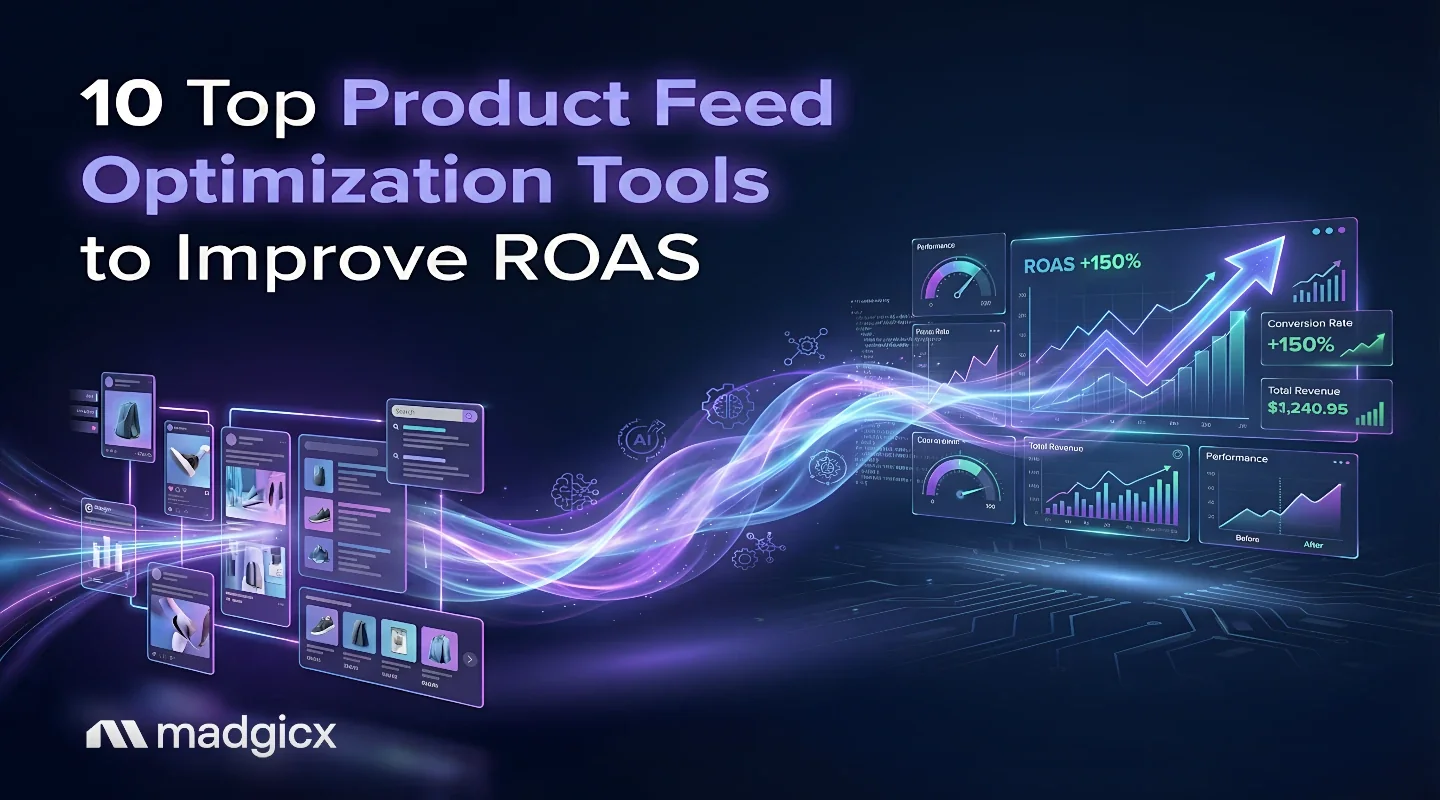
Discover 10 top product feed optimization tools to boost ecommerce sales. Compare features from Madgicx, Feedonomics, and DataFeedWatch to improve ROAS.
Let's be real: if you've ever felt like your product feed is just a giant, unruly spreadsheet you have to wrestle with every Monday morning, you're definitely not alone. For years, we all treated feeds as a simple data file—a necessary evil to get our products listed on Google Shopping or Meta.
But here's the thing: that mindset is leaving a ton of money on the table. A messy, incomplete, or unoptimized feed can be a silent killer of ROAS.
Today, your product feed is a strategic asset. It's the very foundation of your entire ecommerce advertising strategy. This guide will help you choose the right tool for the job. We'll compare the leading options on the market based on your business size, technical needs, and, most importantly, your performance goals.
Let's turn that data into dollars. 💰
Your product data is ready. Now, Madgicx turns it into high-performing ads. Let the AI Marketer handle routine optimization tasks 24/7 so you can focus on strategy. Ask the AI Chat for instant performance diagnostics and turn insights into smarter ad decisions in seconds.
What is Product Feed Optimization (And Why It's a Strategic Imperative)
Product feed optimization is the strategic process of enriching, structuring, and sanitizing product data to meet the specific requirements of advertising channels like Google Shopping, Meta, and Amazon, with the goal of improving ad visibility, relevance, and performance.
Think of it this way: your product feed is your digital salesperson. If it shows up to a meeting (a user's search query) with a wrinkled shirt (a truncated title), mismatched shoes (a blurry image), and no business card (a missing GTIN), it’s not going to close the deal.
Optimizing your feed is like giving that salesperson a tailored suit, a confident pitch, and perfect answers to every customer question. The connection between data quality and ad performance is direct and undeniable.
Better data leads to:
- Higher Relevance Scores: Algorithms love clean, structured data.
- Lower CPAs: When your ads are more relevant, you pay less for clicks.
- Higher ROAS: Better targeting and relevance mean more conversions from the same ad spend.
For any store with more than a handful of products, managing this manually is, as noted by Shopstory, "nearly impossible." This complexity is exactly why a new category of software has popped up: Product-to-Consumer (P2C) platforms.
A Product-to-Consumer (P2C) platform is an advanced system that manages the entire journey of product information from its source to the end consumer, encompassing data enrichment, syndication, and performance analytics. It’s the evolution of simple feed management, acknowledging that the average customer journey is wild. According to Feedonomics, it involves almost six different touchpoints before a purchase. A P2C approach ensures your product story is consistent and compelling everywhere.
How We Evaluated the Top Product Feed Tools
Alright, before we dive into the list, let's pull back the curtain on how we selected these tools. We didn't just throw darts at a board (though that might have been fun). We evaluated each tool based on the criteria that actually matter to performance marketers and ecommerce managers like you.
- Channel Integration & Syndication Scope: How many channels can it push your feed to? Does it cover the big ones (Google, Meta, Amazon, TikTok) and niche marketplaces? Having the right Facebook marketing tools integrated is key.
- Data Transformation & Enrichment Rules: How powerful are its "if-then" rules? Can you easily merge fields, fix errors, and add missing attributes without begging a developer for help?
- AI & Automation Capabilities: Does the tool use AI to automate tedious tasks? Can it generate creative assets or provide optimization insights? This is where the game is changing, and the right automated ad launch tools can make all the difference.
- Performance Analytics & Attribution: Can you see which products or channels are driving results? Does it help you connect feed changes to performance lifts? So many tools fall short here.
- Ease of Use & Technical Support: How steep is the learning curve? Is there a team of experts ready to help you when you inevitably get stuck?
- Pricing Transparency & Scalability: Is the pricing clear, or is it hidden behind a "Request a Demo" wall? Can the tool grow with you from 1,000 to 1,000,000 SKUs?
10 Top Product Feed Optimization Tools for Ecommerce
Here they are—the top contenders ready to whip your product data into shape and boost your bottom line.
1. Madgicx
- Superlative: Specialized in AI Ad Creative & Performance Optimization
- Positioning: Full disclosure, this is us. But we built Madgicx to solve a very specific problem we saw everywhere: a great feed is useless if you can't turn it into great ads that actually make money. So, think of Madgicx not as a traditional feed tool, but as the essential performance layer that sits on top of your ad platforms. It answers the critical "what's next?" question after your feed is built, turning that clean data into a powerful advertising engine designed for better ROAS. It’s the perfect partner to a well-managed feed from Shopify or a tool like DataFeedWatch.
Features & Benefits:
- AI Ad Generator: According to DataFeedWatch, approximately 75% of online shoppers use product photos to make purchasing decisions, so your visuals are everything. The AI Ad Generator creates hundreds of on-brand, thumb-stopping image ad variations from your product feed in minutes, making it one of the best AI tools for Meta ads. This allows for massive multivariate testing without needing a design team on standby.
- AI Chat: Ever wonder why a specific product set is tanking? AI Chat gives you instant, conversational diagnostics. Just ask, "Why is my ROAS so low?" and get actionable insights on audience saturation, creative fatigue, or bidding issues. It helps you finally bridge that frustrating attribution gap that most feed tools leave wide open.
- One-Click Report + Business Dashboard: See the blended impact of your feed-driven campaigns across Meta, Google, and TikTok in a single, unified dashboard. No more jumping between tabs to stitch together a performance narrative.
2. Feedonomics
- Superlative: A Strong Choice for Enterprise Full-Service Management
- Positioning: Feedonomics is the go-to for large enterprises with massive, complex catalogs and a desire for a "done-for-you" service. They combine a powerful platform with a dedicated team of feed specialists who handle the entire setup and ongoing management for you. It's powerful, but it comes with an enterprise-level price tag.
3. DataFeedWatch
- Superlative: A Leading All-in-One Tool for SMEs & Agencies
- Positioning: DataFeedWatch hits the sweet spot for small-to-medium businesses and agencies. It's a powerful, self-service platform that's intuitive enough to master without a computer science degree. With over 2,000 channel integrations and robust rule-based optimization, it’s a reliable and affordable workhorse for getting your feed in order.
4. Channable
- Superlative: A Top Option for European Markets & CSS Bidding
- Positioning: If you sell in Europe, Channable should be on your radar. Beyond its solid feed management, it’s a premium Google CSS Partner. This means that, according to Channable, you can get up to a 20% bidding advantage on Google Shopping ads—a massive competitive edge that can help pay for the tool many times over.
5. GoDataFeed
- Superlative: Ideal for Fast Deployment & Budget-Conscious Brands
- Positioning: GoDataFeed is built for speed and simplicity. It’s designed for DTC brands that need to get their feeds up and running on major channels quickly and without a hefty price tag. While it may not have the deep customization of enterprise tools, its streamlined interface and affordable plans make it a fantastic starting point.
6. Productsup
- Superlative: Built for Tackling "Commerce Anarchy" at a Global Scale
- Positioning: Productsup coined the term "commerce anarchy" to describe the chaos of managing product data across countless global touchpoints. Their P2C platform is built to solve this for the world's largest brands. It offers immense power for data transformation and syndication, but it's a complex, enterprise-grade solution.
7. Optmyzr
- Superlative: Designed for PPC Specialists Managing Google Ads Portfolios
- Positioning: Optmyzr is less of a pure feed tool and more of a comprehensive PPC management suite that includes strong feed optimization capabilities, particularly for Google Ads. It’s built by and for PPC pros, offering advanced scripts, bidding automation, and reporting tools that go beyond the feed itself.
8. AdNabu
- Superlative: Focused on Shopify-Native Feed Error Resolution
- Positioning: AdNabu offers a suite of Shopify apps focused on making Google Shopping easier. Their feed tool lives right inside your Shopify dashboard and excels at one thing: finding and fixing errors in your Google Merchant Center feed. It's a simple, focused solution for Shopify merchants.
9. Shopstory
- Superlative: A Newcomer for AI Content Enrichment & Automation
- Positioning: Shopstory is a newer player that leans heavily into AI. It helps you automate workflows across your marketing stack and uses AI to enrich your product data, suggesting better titles and descriptions. It’s a glimpse into the future of automated ecommerce operations.
10. Marpipe
- Superlative: A Creative-First Approach to Visual Feed Testing
- Positioning: Marpipe approaches the feed from a creative-first perspective. It allows you to rapidly test different visual elements (like backgrounds, overlays, and copy) against your product images to find winning combinations at scale. It’s a fantastic tool for brands that live and die by their creative.
Product Feed Optimization Tool Comparison
Feeling a little overwhelmed? We get it. This simple table breaks down how the top tools stack up for different needs.
How to Optimize Your Product Feed: A 3-Step Framework
Okay, you've seen the tools. But how do you actually do the optimization? It boils down to a simple, three-step framework.
Step 1: Foundational Sanitization
This is the "eat your vegetables" part—boring but absolutely essential. Before you can get creative, you have to ensure your feed is compliant with each channel's rules.
This means:
- Using the right templates: Every channel (Google, Meta, etc.) has a specific format. Use your feed tool to map your store's data to the correct fields.
- Fixing critical errors: This includes missing GTINs, invalid URLs, or incorrect pricing. Most tools will flag these for you automatically.
- Ensuring data consistency: Make sure your prices, availability, and product IDs match what's on your website.
Step 2: Algorithmic Relevance
Now for the fun part. This is where we optimize for the algorithms. If you listen to nothing else, listen to this: the single most important element here is your product title.
According to Optmyzr, product titles and product types are heavily weighted for search relevance by Google's algorithm. This is your biggest lever for visibility, period.
Pro Tip: The Title Optimization Formula A simple, powerful formula for optimizing your titles is: Brand + Product Type + Key Attribute + Size/Color
- Bad: Nike Shoes
- Good: Nike Air Zoom Pegasus 40 Men's Running Shoe Blue Size 11
This formula front-loads the most important information for both algorithms and humans. Research from Optmyzr shows that users typically see only the first 70 characters of a title, so make them count!
Step 3: Visual & Creative Optimization
Your feed isn't just text; it's a visual catalog. In a world of infinite scrolling, your images have to work hard. Really hard. Consider this: according to SevenAtoms, the human brain processes images 60,000 times quicker than text.
This is where you move beyond a clean feed and start thinking like a performance marketer.
- Use High-Quality Images: This is non-negotiable. No blurry, low-res photos.
- Test Lifestyle vs. Product-on-White: Does your product sell better with a clean background or shown in a real-world context? Test it!
- Automate Creative Variations: This is where a tool like Madgicx's AI Ad Generator becomes a game-changer. Instead of manually creating one or two images, you can generate hundreds of variations with different backgrounds, overlays, and callouts.
Pro Tip: Test Your Visuals Seasonally Use your creative automation tool to add seasonal overlays (like snowflakes for winter or sun flares for summer) to your product images. This small change can dramatically increase relevance and click-through rates during peak shopping seasons without requiring a full photoshoot.
This allows you to find a powerful visual combination that resonates with your audience, turning a good feed into a great ad campaign with the help of the right campaign tools.
The Future of Feeds: Optimizing for AI Shopping Agents
Just when you thought you had it all figured out, the landscape is shifting again. The rise of AI shopping agents like Amazon Rufus and conversational search in ChatGPT means we need to think beyond simple keyword matching.
In the near future, AI-powered discovery engines will interpret listings through structured data and contextual relevance, not just keywords. They will understand that "water-resistant jacket for hiking" is a better match for a user's query than a product simply titled "Raincoat."
This means the structured data you're building in your feed today is no longer just for Google's algorithm—it's for every AI agent that will crawl the web on behalf of a consumer. A well-optimized feed is your ticket to being discovered in this new era of "agentic commerce."
This is why an AI-first approach to advertising, like the one we're building at Madgicx, is so critical. It's designed to leverage this rich, structured data to deliver the right product and the right creative to the right person, no matter how they're shopping.
Frequently Asked Questions (FAQ)
1. How do product feed managers and ad optimization platforms work together?
Product feed managers (like DataFeedWatch) are foundational. They clean, structure, and syndicate your product data to various channels. Ad optimization platforms (like Madgicx) are the performance layer. They take that clean feed and use it to create, test, and automate high-performing ad campaigns, which is the core function of the best Facebook ad optimization platforms. They are two sides of the same coin: one builds the perfect foundation, the other builds a skyscraper on top of it.
2. What is a Google CSS partner and do I need one?
A Comparison Shopping Service (CSS) is a website that collects product offers from online retailers and sends users to the retailers' websites to make a purchase. In Europe, Google allows certified CSS partners to place Shopping ads on its results page. Using a CSS partner (like Channable) can give you up to a 20% discount on your cost-per-click, according to Channable's documentation. If you advertise heavily in the EU or UK, it's a significant advantage.
3. How much do product feed tools cost?
Pricing varies widely. Self-service tools like GoDataFeed, DataFeedWatch, and Madgicx typically have plans starting under a hundred dollars per month, scaling with SKUs and channels. Full-service, enterprise solutions like Feedonomics and Productsup operate on a custom pricing model, often starting in the thousands per month.
4. Can I optimize my product feed for free?
Yes, to an extent. You can manually create a spreadsheet for Google Merchant Center, and Shopify has basic native apps. However, these free methods lack the powerful rule-based optimization, error correction, and multi-channel syndication of paid tools. For any store with more than a few dozen products, the time saved and performance lift from a dedicated tool easily justifies the cost.
Your Feed is Just the Beginning
Whew, we covered a lot! Here are the key takeaways:
- Your product feed has evolved from a simple file to a P2C powerhouse.
- The Brand + Product Type + Key Attribute title formula is your best friend for algorithmic relevance.
- A visual-first creative strategy is non-negotiable for stopping the scroll.
Look, a clean, optimized feed is the perfect launchpad. But a launchpad is useless without a rocket. The real growth comes from what you do with that data—how you turn it into compelling ads, diagnose performance, and automate optimizations.
Ready to see what your feed is truly capable of? Try Madgicx for free today and get an instant AI-powered diagnostic of your current catalog ad performance.