Explore 7 powerful social media ads examples and the proven frameworks behind them. Learn how to systemize creative wins for your clients and scale results.
Tired of searching for effective social media ads examples only to find random inspiration with no strategy? Managing creative for a dozen clients can feel like a content treadmill. You find a winning ad, but by the time you've reported on it, it's already fatigued.
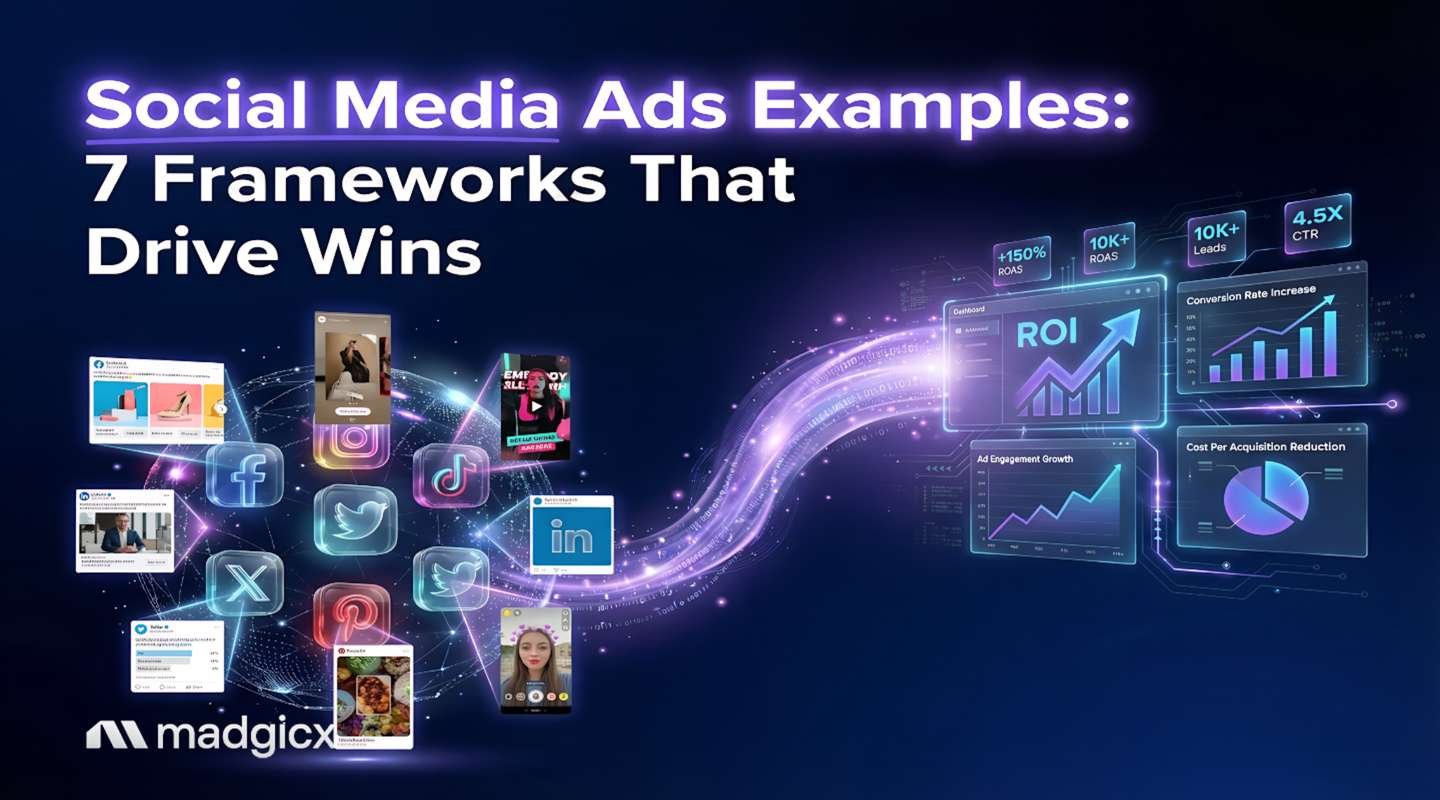
The most effective social media ads examples follow proven psychological frameworks. These systems include the 'Pattern Interrupt' to stop scrolling, 'Product Proof' to build trust, and 'UGC at Scale' to provide social proof. By understanding these frameworks, agencies can move beyond one-off hits and create consistently high-performing ads.
Here’s the thing: with total spend on social media advertising projected to reach a staggering $276.7 billion in 2025, just "getting by" isn't an option. The best ad frameworks combine psychological triggers with AI-driven tools designed to deliver killer results.
This isn't about one-off viral hits; it's about building a machine that produces high-performing creative, again and again. In this guide, we're breaking down the exact frameworks used by top brands and, more importantly, giving you the step-by-step AI-assisted workflow to use them across your entire client portfolio.
It's time to turn creative chaos into a predictable revenue driver for your agency.
Generate dozens of stunning Facebook ads in minutes with AI Ad Generator and eliminate creative bottlenecks. Let AI Marketer monitor performance and surface smart budget and bidding recommendations, while AI Chat delivers instant diagnostics and scaling insights.
What You'll Learn
- How to use the "Pattern Interrupt" framework to stop the scroll on saturated feeds.
- The "Meta Integration" trick that makes your ads feel native to the platform.
- A B2B framework that combines professionalism with personality to win on LinkedIn.
- The "Product Proof" framework that builds trust through authentic demonstration.
- Bonus: How to use Madgicx's AI Marketer to streamline testing and scaling these frameworks for every single client.
7 Frameworks That Ensure Agency Wins
1. The "Pattern Interrupt" Framework
What It Is: This framework is your secret weapon against "ad blindness." It's designed to break a user's mindless scrolling habit with a visually jarring, unexpected, or downright "ugly" creative that looks nothing like a typical ad.
Case Study Example: MUDWTR's famous "Warning Ad" concept. It uses a stark black screen and bold, alarming text to grab your attention before revealing the product. It’s impossible to ignore.
Why It Works (Psychology & Algorithm): Our brains have developed a filter to ignore anything that looks like an ad. This framework bypasses that filter completely. On the platform side, Meta rewards ads with high "Hook Rates" (the percentage of people who watch the first 3 seconds). A strong pattern interrupt sends your hook rate through the roof. 🚀
Pro Tip: This is a must-try for clients in visually saturated markets like supplements, jewelry, or fashion, where every ad starts to look the same.
Agency Execution Workflow:
- Use Madgicx's AI Ad Generator to create 5 variations of a "Warning" or "Ugly Ad" concept for your client. Think bold text, clashing colors, or even a deliberately low-fi advertising design.
- Launch them in a CBO (Campaign Budget Optimization) campaign with broad targeting. Let Meta’s algorithm do the heavy lifting for you.
- After a day or two, open AI Chat and simply ask, "Which of my new creatives has the highest hook rate?" You'll get an instant, data-backed answer without digging through Ads Manager.
- Set up an automation rule in AI Marketer to get recommendations for scaling the budget for any ad in this campaign that achieves a CTR above 2% and maintains a positive ROAS for 48 hours. This way, you scale winners efficiently.
2. The "Meta Integration" Framework
What It Is: This is a clever, fourth-wall-breaking approach where the ad creative appears to interact with the social media platform's user interface itself. It’s surprising, engaging, and feels incredibly native.
Case Study Example: The brilliant ad from Maids.cc where a cleaner appears to wipe the user's Facebook ad box clean from the inside. It makes you do a double-take and immediately understand the service.
Why It Works: It’s thumb-stopping because it shatters the user's expectations. It doesn't feel like a corporate ad dropped into their feed; it feels like a clever piece of content made for the feed. This leads to higher engagement, more shares, and a halo effect for the brand.
Agency Execution Workflow:
- Brainstorm 2-3 "meta" concepts for a client. Could a character in the ad point directly to the "Shop Now" button? Could the ad look like a DM notification from a friend?
- Create these as short video ads or animated GIFs.
- Use Madgicx's Business Dashboard to monitor real-time engagement metrics (like shares and comments) right alongside your conversion data (ROAS, CPA). This gives you and your client a full picture of the ad's impact.
3. The "Product Proof" Framework
What It Is: Show, don't tell. This framework is all about demonstrating a product's core value proposition in an extreme, authentic, or humorous way that provides undeniable proof of its quality.
Case Study Example: Rise Tents ran an ad showing their tent holding up in torrential rain… while strapped to a speeding trailer. They humorously admitted they "don't have a wind tunnel." The result? Instant credibility.
Why It Works: This approach builds immense trust. The DIY, authentic feel resonates far more than a polished studio shot because it proves the product works in the real world. With around 78% of people preferring to learn about a product via short video, this is the perfect format. You can find more powerful Facebook ad examples that leverage this authentic feel.
Pro Tip: Ask your client for their most surprising customer feedback or warranty claim. Often, the most extreme use cases that customers discover make for the most compelling "Product Proof" ads.
Agency Execution Workflow:
- Get together with your clients to brainstorm "stress tests" for their products. How can you push it to the limit to prove its main benefit?
- Launch the video proof as a Top-of-Funnel ad with broad targeting. Let the power of the creative do the work.
- If performance isn't what you expected, use AI Chat for a quick diagnosis. Ask: "Why is the CTR on my 'Product Proof' ad high but conversions are low?" AI Chat might analyze your funnel and suggest that the landing page doesn't continue the story—an insight that could take hours to find on your own.
4. The "Approachable Professionalism" Framework (for B2B)
What It Is: Let’s be honest, most B2B advertising is a snooze-fest. This framework pairs a relatable human problem with approachable, non-corporate imagery to make complex solutions feel simple and accessible.
Case Study Example: Fi, a financial software company, ran a LinkedIn carousel ad that started with a picture of a cute dog in a beanie. The headline? "Where did I spend my money last month?" It’s human, it’s relatable, and it stands out.
Why It Works: In a sea of stuffy stock photos and jargon, being human wins. This approach leads with a pain point everyone understands and uses a simple, guided format like a carousel to walk the user through the solution. This reduces friction and makes the brand feel like a helpful guide, not a faceless corporation.
Agency Execution Workflow:
- For your B2B client, identify the core "human question" their software or service answers. Forget features; focus on the frustration they solve.
- Use text generating tools like ChatGPT or Claude to create 10 copy variations for the headline and body text. Prompt it to use conversational, problem-oriented language.
- Run a Dynamic Creative test on LinkedIn or Meta, letting the platform’s algorithm find the winning combination of a relatable image and your problem-focused copy.
5. The "UGC at Scale" Framework
What It Is: This is modern-day word-of-mouth, systemized. It involves using authentic user-generated content (UGC)—like customer reviews, unboxing videos, and testimonials—as your primary creative asset.
Case Study Example: Thousands of e-commerce brands are now prioritizing raw, unpolished video clips from their customers. This content often outperforms high-production studio ads because it’s real. ✨
Why It Works: It’s instant social proof. When a potential customer sees someone just like them loving a product, the trust is immediate. This content also looks native to the feed, especially on TikTok and Instagram Reels, so it doesn't trigger the "ad-skip" reflex.
Agency Execution Workflow:
- Work with your clients to build a system for collecting UGC. This could be a post-purchase email flow offering a discount for a video review or a simple QR code in the packaging. If sourcing content becomes a bottleneck, many agencies turn to specialized ad creative services to maintain a steady flow of assets.
- Use AI Marketer to set up a "Creative Refresh" rule. This rule can automatically pause ads with declining performance (ad fatigue) and notify your team to swap in fresh UGC. It's one of the most powerful advertising tools in marketing for maintaining campaign health.
- Use the One-Click Report to show clients the big picture. Create a report that shows how your UGC campaigns are impacting their blended ROAS across all platforms, proving your strategy's value.
6. The "US vs. THEM" Framework
What It Is: This is a classic positioning framework that works wonders on social media. You position your client's brand or product against a common enemy, an outdated industry standard, or a flawed alternative.
Case Study Example: A coffee alternative brand comparing their "clean energy without the jitters" (US) to traditional coffee's "anxiety and afternoon crash" (THEM). The enemy is clear, and the value proposition is instantly understood.
Why It Works: It creates a clear, memorable value proposition and builds a sense of community with the audience who shares the same frustration. It simplifies the buying decision by framing it as a choice between the old, flawed way and the new, better way.
Agency Execution Workflow:
- First, define the "THEM" for each of your clients. What is the common frustration or inferior alternative that their customers hate?
- Use Madgicx's AI Ad Generator to create ad copy that highlights this contrast. Prompt it with something like: "Write 5 Facebook ad headlines using an 'Us vs. Them' framework for a brand that sells natural deodorant. The 'enemy' is aluminum-based antiperspirants."
- Launch A/B tests comparing a positive, "benefit-only" ad against an "US vs. THEM" ad. Use the data to prove the framework's effectiveness to your clients.
7. The "Cultural Relevance" Framework
What It Is: This is about tapping into a current event, cultural moment, or meme to align the brand with a larger conversation. It’s high-risk, high-reward, but when it lands, it’s magic.
Case Study Example: Nike's "What the Football" campaign during the Women's World Cup. It tapped into the global excitement and conversation, allowing the brand to ride the wave of a massive cultural moment.
Why It Works: It allows the brand to borrow the emotional weight and reach of a major event, making the message feel timely, important, and relevant. It shows that the brand is "in on the joke" or part of the conversation, not just shouting from the sidelines.
Pro Tip: The key to this framework is speed and authenticity. If you're a day late, you've missed it. Have a "rapid response" process ready with your client for pre-approved concepts around major events.
Agency Execution Workflow:
- This is a high-effort framework, so be strategic. Reserve it for your largest clients who can move quickly.
- Plan campaigns around predictable cultural moments relevant to the client's brand (e.g., major sporting events, holidays, seasonal trends).
- Use the Business Dashboard to monitor real-time social sentiment and engagement spikes during the campaign launch. You can even share a live link to this dashboard with your client, showcasing the campaign's immediate impact.
Frequently Asked Questions (FAQ)
How do I convince my clients to test "ugly" or unconventional ads?
The secret? Use data, not just your opinion. Frame it as a "Pattern Interrupt Test" and show them case studies. Use a tool like Madgicx to run a small budget test against their current best-performing ad. Let the ROAS numbers do the talking.
How much budget do I need to test these frameworks?
Less than you think! With a CBO campaign, you can start testing 3-5 creative concepts with as little as $50-$100 per day. The key is to let Meta's algorithm find the winner for you. Then, once a concept is proven, use AI Marketer to get recommendations on when to scale the budget.
How can I report on the success of these creative tests to my clients?
This is where you shine as an agency. Use the Madgicx One-Click Report. Create a custom dashboard page dedicated to "Creative Framework Testing." Showcase metrics like Hook Rate, CTR, and ROAS for each framework side-by-side. This way, your clients can clearly see how your strategic testing translates directly into better results.
Conclusion: Stop Guessing, Start Systemizing
The most successful agencies won't be the ones with the biggest creative teams; they'll be the ones with the best systems. Instead of just looking at random social media ads examples, you now have a playbook. Relying on flashes of advertising inspiration is a recipe for burnout and inconsistent client results.
When you start using these seven frameworks—from the scroll-stopping "Pattern Interrupt" to the trust-building "Product Proof"—you build a more systematic approach to creating high-performing ads.
The real magic happens when you layer in AI-powered assistance. This is how you truly scale. After all, with 75% of Instagram users taking action after seeing an ad, having a system to produce effective creative is non-negotiable.
Use Madgicx to test, scale, and report on these frameworks, freeing up your team to focus on high-level strategy. Start by picking one framework and running a test for your next client campaign. You might be surprised by what you discover. 😉