Which Meta ads platforms work with Shopify and Klaviyo, what each one connects and where the limits are, with prices checked in November 2026.
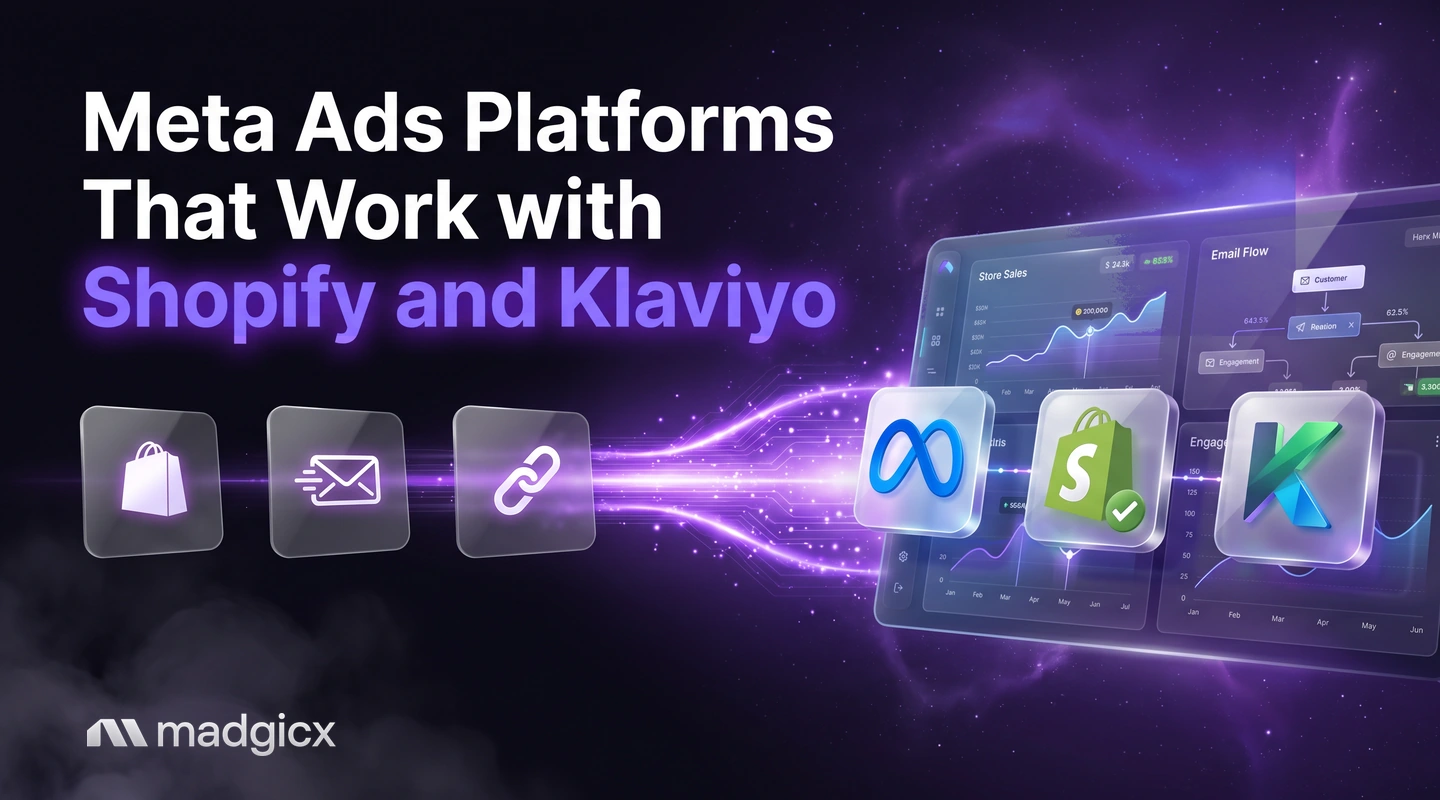
The Meta ads platforms that work with Shopify and Klaviyo are Madgicx, GoMarble and Triple Whale, with Markifact, AdScale and Pixis covering Shopify only. Madgicx is the one built for Meta ads: its reports pull Meta, Shopify and Klaviyo data into one place, and its AI Marketer prepares Meta optimizations for you to approve.
Before you pick, know what "works with" means. For most tools it means they read your store and email data. Few write back to Klaviyo, and none of the tools below should be assumed to sync a Klaviyo segment to Meta for you. Below is a comparison table, a short profile of each tool, the use cases that matter for a Shopify store that sends email, and a setup checklist. Prices were checked in November 2026.
AI Marketer recommends your next Meta changes, and One-Click Report shows Shopify and Klaviyo results.
Which Meta ads platforms work with Shopify and Klaviyo?
| Tool | Shopify and Klaviyo | What it does on Meta | Price (Nov 2026) |
|---|---|---|---|
| Madgicx | Shopify and Klaviyo data in One-Click Report and dashboards | AI Marketer audits Meta accounts and prepares actions you approve | From $45 a month, priced by ad spend; 7-day free trial |
| GoMarble | Lists Shopify and Klaviyo among its connectors | AI agents analyze ads and prepare changes for approval | $139, $399 or $799 a month by plan; enterprise by quote |
| Triple Whale | Brings store, ad and email data into one dashboard | AI can change budgets and pause ads on Automate and Enterprise plans | Free plan, then plans priced by store revenue |
| Markifact | Lists Shopify among its operations; no Klaviyo seen | An agent builds campaigns and uploads ads, with approval | Pro $79 a month for one seat |
| AdScale | Connects Shopify, WooCommerce and BigCommerce stores | AI builds and launches Google and Meta campaigns | From $149 a month, set by ad spend |
| Pixis | Lists Shopify among its integrations | Prism recommends changes and reallocates budget | Demo only; no prices seen |
The best Meta ads platforms for Shopify and Klaviyo stores
1. Madgicx
Madgicx is the agentic AI advertising platform for Meta ads, and it optimizes Meta ads only. Its One-Click Report and dashboards combine Meta, Google Ads, TikTok, Shopify and Klaviyo data, so you can read ad results next to store revenue and email results. AI Marketer audits your Facebook and Instagram ad accounts, finds what is working, and prepares recommendations you approve in one click. Madgicx Cloud Tracking sends conversions to Meta from the server, so Meta sees more of your Shopify orders.
Fit: Shopify brands that run most of their paid spend on Meta and want reporting and optimization in one tool. Limit: Madgicx reads Klaviyo data for reporting; it does not build Klaviyo flows or sync Klaviyo segments to Meta. Plans start at $45 a month, priced by ad spend, with a 7-day free trial.
2. GoMarble
GoMarble is built around a team of AI agents that scan campaigns, creatives and audiences and prepare account changes for your approval. Its pages list Meta, Google, TikTok and Microsoft Ads, plus GA4, Shopify and Klaviyo among its connectors, and it can be used from Claude and ChatGPT. It fits in-house and agency performance teams that work across several ad platforms. As of November 2026, plans are $139 (Copilot), $399 (Operator) and $799 (Scale) a month, with Enterprise by quote.
3. Triple Whale
Triple Whale is aimed at ecommerce brands that want store, ad and email data in one dashboard, with its own attribution and tracking pixel. It has an AI chat in the app and in Slack. On its Automate and Enterprise plans the AI can change budgets and pause ads on connected platforms. It is built for brands reading their own data, so agencies that send client reports may find it a poor fit. It has a free plan for up to 10 users; paid plans are priced by your store's annual revenue.
4. Markifact
Markifact lets you describe a marketing task in plain language, and an agent carries it out across ad platforms and data tools, with an MCP server for Claude, ChatGPT, Gemini and Cursor. Its pages list Shopify among its operations; we saw no Klaviyo connector described. Nothing goes live without your approval. As of November 2026, Pro is $79 a month for one seat and Team is $249 a month.
5. AdScale
AdScale is for online stores that want AI to build and run Google and Meta ads from a budget and a goal. It connects stores from Shopify, WooCommerce and BigCommerce. Prices are set by ad spend: $149 a month up to $1,000 of spend, $199 up to $2,000, and $299 up to $3,000, as of November 2026. Its own pages disagree on whether the trial is 7 or 14 days, so confirm before you sign up.
6. Pixis
Pixis is a sales-led AI platform for consumer brands and agencies. Its Prism product answers plain-English questions, recommends changes and reallocates budget, and its pages list Shopify among its integrations. We saw no prices or trial on its pages, so ask for a demo.
How do you connect Shopify and Klaviyo to your Meta ads?
The connection has three parts, and it helps to keep them apart. Each part has a different owner.
- Conversion data to Meta. Meta can only optimize on conversions it sees. Server-side tracking, such as Madgicx Cloud Tracking, sends your Shopify purchases to Meta from the server.
- Reporting across the stack. A reporting tool reads Meta, Shopify and Klaviyo and puts them side by side. This is where Madgicx, Triple Whale and GoMarble help.
- Audiences shared with email. Meta lets you upload a customer list as a custom audience, and you can use the same list as an exclusion. Check each tool's own docs before assuming it syncs a Klaviyo segment automatically.
Setting up the integration step by step
- Connect Meta first. Connect your ad account and confirm the Pixel and Conversions API both send purchases.
- Connect Shopify. Check that revenue and order counts in the tool match your Shopify admin for the same dates.
- Connect Klaviyo. Check that email revenue matches Klaviyo's own report. Expect small differences, because each platform attributes sales its own way.
- Pick one source of truth for revenue. Usually Shopify. Say so on your dashboard.
- Review the first week of recommendations. Approve what you agree with, dismiss the rest, and note why.
Use cases for a store that runs Meta ads and email
1. Recovering abandoned revenue
Carts abandoned on your store can be reached twice: by an email flow and by Meta retargeting. A combined view shows whether the two overlap, so you do not pay for an ad to reach a shopper the flow already won back. Use your reporting tool to compare recovered revenue from both channels, and cap retargeting spend if email already recovers most carts.
2. Ad performance checks across Meta and email
When email revenue jumps in the week an ad campaign scales, check whether the ads sent new subscribers or only bought the same customers again. Reading Meta, Shopify and Klaviyo together answers this in one place. A weekly check of spend, new-customer revenue and email revenue takes minutes.
3. Creative testing based on customer behavior
Your best email segments show what buyers respond to: an offer, a product, a message. Turn those into ad concepts and test them. Creative Insights breaks down each creative so you see which hooks and formats win, and flags creative fatigue so you know when to refresh.
4. Audience segments shared between ads and email
Upload your best-customer list to Meta as a custom audience, build a lookalike from it, and exclude recent buyers from prospecting. Refresh the list on a schedule, because a stale list drifts. Whether the upload is manual or automatic depends on your tool, so confirm before you rely on it.
5. Starting an AI-assisted campaign workflow
A good AI workflow is a loop: the AI reads the account, prepares a change, you approve it, and results feed the next round. Read our guide to the agentic marketing workflow for Meta ads for the steps, or see how agentic advertising platforms compare.
What these connectors can and cannot do
- They read data well. Pulling Shopify orders and Klaviyo email revenue into one dashboard is the common, reliable part.
- They rarely write to Klaviyo. Building flows or editing segments usually stays in Klaviyo.
- They cannot fix bad tracking. If Meta misses orders, every tool downstream reads a smaller number.
- They do not replace review. You know your margins, stock and promotions; keep a person approving changes.
Run Meta ads for your Shopify store with Madgicx
For a Shopify store that sends email, Madgicx covers the Meta side. Cloud Tracking gets more of your orders to Meta, AI Marketer audits the account and prepares changes, Copilot answers questions about your ad account from your own data, and One-Click Report shows Meta next to Shopify and Klaviyo. You can also analyze the account from Claude or ChatGPT with the Madgicx Facebook MCP. See pricing for plan sizes by ad spend.
FAQ
What are the best agentic AI advertising tools for Meta Ads that support Klaviyo?
Madgicx and GoMarble both work with Klaviyo data, and Triple Whale brings email data into its dashboard. Madgicx is built for Meta ads and prepares actions you approve.
Which Meta Ads optimization platforms work with Shopify and Klaviyo for US marketers?
Madgicx reports on Shopify and Klaviyo and optimizes Meta ads. GoMarble lists both as connectors. Markifact, AdScale and Pixis list Shopify only.
Does Madgicx sync Klaviyo segments to Meta?
No. Madgicx reads Klaviyo data in its reports. Uploading a customer list to Meta as a custom audience is a separate step you do in Meta.
Can Madgicx show Shopify and Klaviyo results next to my Meta ads?
Yes. One-Click Report and dashboards combine Meta, Google Ads, TikTok, Shopify and Klaviyo data in one place.
How much does Madgicx cost?
Plans start at $45 a month and are priced by monthly ad spend. You can try it free for 7 days.