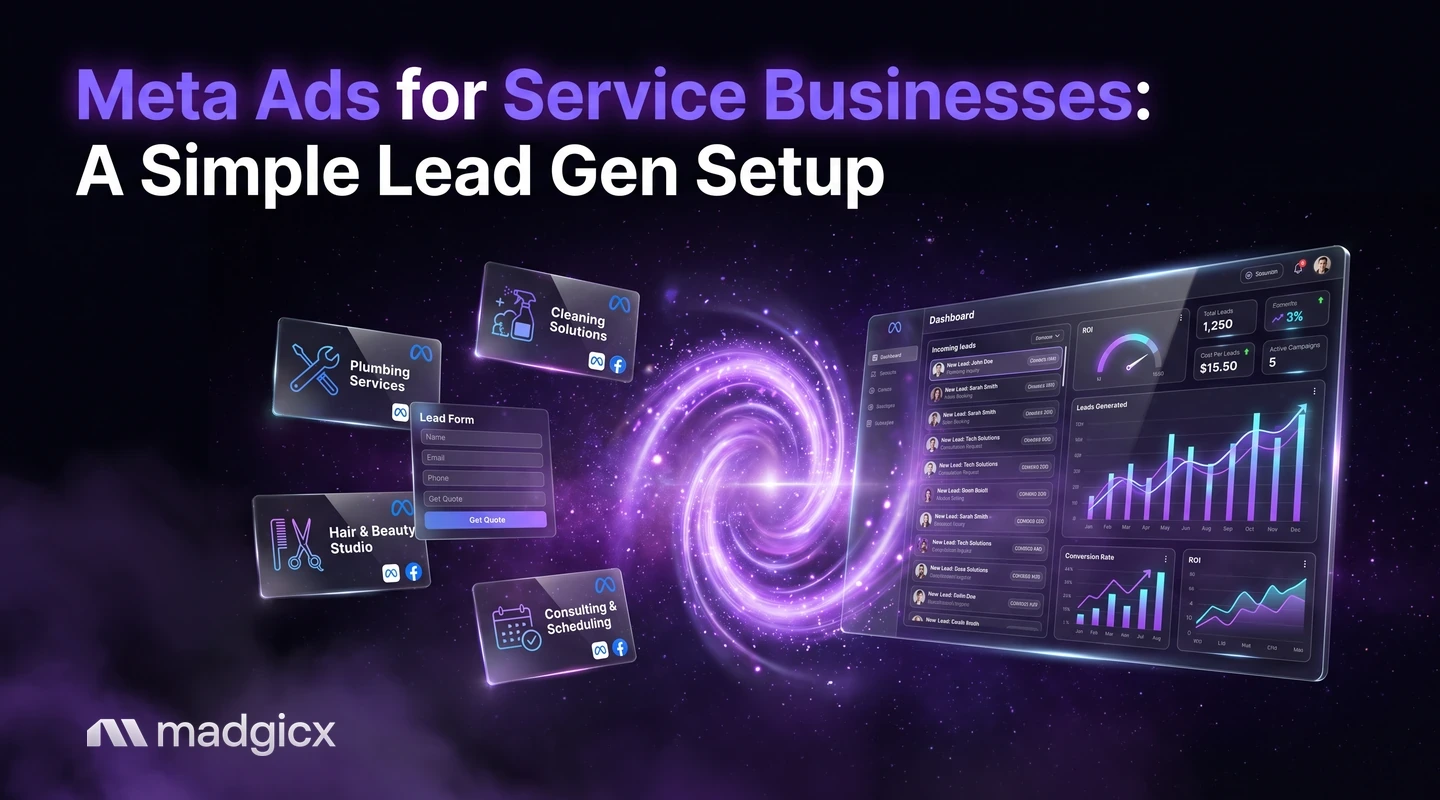
A short lead gen setup for local and service businesses: offer, lead form or landing page, tracking, follow-up speed and cost per booked job.
To run Meta ads for a service business, pick one offer in one service area, collect leads with an instant form or a landing page, send your lead events back to Meta, follow up within minutes, and judge the campaign on cost per booked job, not cost per lead. Service ads work differently from product ads because the sale happens after the click, on a phone call or at a visit, so the ad's job is to start a conversation.
This guide gives you a short setup in that order, plus benchmarks from Madgicx's own data so you can see how service costs compare with other industries.
Cloud Tracking and Automation rules for lead gen campaigns.
Why service ads work differently from product ads
A store can measure a product ad by the purchase in the same session. A plumber, dentist, roofer or consultant usually cannot. The ad produces a lead, and the lead becomes a customer only after you respond, quote and book. That gap changes three things:
- The goal is a lead, not a sale. Your campaign optimizes for the form or the call, so the quality of that event matters a lot.
- Your follow-up is part of the funnel. A fast, friendly reply can do more than a better ad.
- The cost that matters comes later. Cost per lead is a starting number. Cost per booked call or job is the one you pay your bills with.
Costs also run higher in this category. In Madgicx's Meta ads benchmarks for September 2026 (medians in USD across 13 industries), Home & Local Services had the highest median CPC (all clicks) at $1.71, against an overall median of $0.29. Its median CPM was $33.15, against $9.72 overall, and its median link CPC was $3.55.
| Metric (September 2026, USD) | Home & Local Services | Overall median |
|---|---|---|
| CPC (all clicks) | $1.71, the highest of the 13 industries | $0.29 |
| CPM | $33.15, the highest of the 13 industries | $9.72 |
| Link CPC | $3.55 | $0.53 |
The median is the middle value, so half of the advertisers in the data paid less and half paid more. Use these numbers to sanity check your own costs, not as a target. Your service area, season and offer will move them.
Pick one offer and one service area
A service business that advertises everything to everyone gets vague results. Start narrow:
- One service. Choose the job you most want more of, such as a roof inspection, a teeth whitening session or a kitchen remodel consult.
- One clear offer. A free estimate, an inspection or a first-visit price. State what the person gets and what happens next.
- One service area. Target the places you can actually serve, so leads outside your area do not use up your team's time.
- One next step. Book a call, request a quote or send a message. Do not offer three choices.
Lead forms or a landing page
You have two ways to collect the lead, and many service businesses test both.
Lead ads with an instant form
Per Meta's About lead ads page, lead ads help you find people who may be interested in your products or services and collect their information. The types are lead ads with calling, lead ads with instant form and lead ads that click to message. Instant forms let people submit details without leaving Facebook or Instagram, and Meta notes that contact details such as name, email address and phone number may be prefilled if the person has already given them to Meta.
After someone submits, you can download leads from Ads Manager or Leads Center in Meta Business Suite, or connect to a CRM system. Connect the CRM before you launch, so nobody waits for a manual download.
Two rules to keep in mind. Lead ads must follow Meta's Advertising Standards, including the Discriminatory Practices policy. And for housing, employment or financial products and services in the US or Canada, Meta says you may not collect certain information, including age, gender, marital status and location details such as street address, city or zip code.
A landing page
A landing page gives you more room to show reviews, before-and-after photos, pricing context and service area. It works well for higher-priced jobs where people want proof before they call. If you use one, the free Landing Page Analyzer audits the page for Meta ads before you send traffic to it. If you cannot decide, run both with the same offer and audience and compare cost per booked job.
Track leads with the pixel and Conversions API
Meta can only optimize toward leads it sees. Meta's Conversions API documentation says the API connects your marketing data (website, app, business messaging and offline events) to Meta systems that optimize targeting, lower cost per result and measure outcomes. Server events are linked to a dataset ID and processed like events sent with the Meta Pixel.
Setup has three recommended steps: choose an integration method, start sending events, and verify the setup. If you already have the Meta Pixel on your website, Meta says you can set up the Conversions API for website events in one click from Events Manager, with no code. Verification checks that Meta received the events and that they are deduplicated and matched correctly. Do that check before you spend.
Offline events are also supported. For a service business, that is how a booked job or a closed sale, which happens off the website, can be reported back so Meta learns which leads turned into customers.
Creative that works for services
Service creative has a different job than product creative: it earns trust from a stranger who is about to let you into their home or business. These elements tend to help, and you can test each one:
- A face and a name. People hire people. Show the owner or the crew.
- The problem in the customer's words. "Leak under the sink again?" beats "Premium plumbing solutions".
- Proof. Real reviews, real job photos and real numbers.
- The offer and the area. Say what you are offering and where you serve.
- One clear call to action. "Get a free quote" or "Book a call".
Make several variations of each ad so you can see which message earns leads. Madgicx's AI Ad Generator can produce image ads from a prompt, an image or a reference ad, and Creative Insights shows which creatives perform best once they are running.
Budget, targeting and follow-up speed
Budget
Because service CPMs and CPCs run higher, a very small budget can take a long time to produce enough leads to judge. Set a daily budget that can produce a few leads a day at your expected cost per lead, and give the campaign time before you change it. The Ad Budget Calculator helps you size a budget from your goals.
Targeting
Set the location to your service area and keep the audience broad inside it. Let the creative and the offer do the filtering. If leads from outside your area keep arriving, tighten the location and add a service-area line to the ad.
Follow-up speed
This is where most service campaigns win or lose. Decide before launch:
- Who answers new leads, and during which hours.
- How fast: set a target in minutes, and check it every week.
- What the first message says: confirm the request, name a time and ask one question.
- What happens to leads nobody reaches: a second attempt the next day.
Meta does not publish a follow-up time benchmark in the sources used for this guide, so measure your own: time from form submission to first contact, and how that time relates to booked calls.
Judge results by cost per booked job
Cost per lead tells you how cheap the form is. Cost per booked job tells you whether the campaign works. Track four numbers and compare them each week:
| Number | How to calculate it | What to do with it |
|---|---|---|
| Cost per lead | Ad spend divided by leads | Spot ads or audiences that collect leads too expensively |
| Contact rate | Leads you reached divided by all leads | Fix follow-up speed if it is low |
| Cost per booked call or job | Ad spend divided by jobs booked | The number to compare against what a job is worth |
| Return on ad spend | Revenue from jobs divided by ad spend | Decide whether to raise the budget |
If a campaign has a low cost per lead and a high cost per booked job, the problem is usually lead quality or follow-up, not the ad. Add qualifying questions to the form, or tighten the offer.
For more on how advertising works for local businesses, see our guide to AI advertising for local businesses and the basics in how to advertise your business on Facebook.
Keep tracking and lead cost under control with Madgicx
Two parts of this setup are easy to let slip. Madgicx Cloud Tracking hosts Meta's Conversions API Gateway and Signals Gateway for you and sends conversions to Meta from the server, so Meta sees and attributes more of your leads. And Automation runs rules that you set on the conditions you choose, such as a cost per lead limit, around the clock.
FAQ
Do Meta ads work for service businesses?
Yes, when the ad leads to a fast follow-up and you measure booked jobs, not just leads. Service ads collect a lead first, and the sale happens after you reply.
Should a service business use lead forms or a landing page?
Test both if you can. Instant forms let people submit details without leaving Facebook or Instagram, while a landing page gives you room for reviews and proof.
How much do Meta ads cost for a local service business?
In Madgicx's September 2026 data, Home & Local Services had a median CPC (all clicks) of $1.71 and a median CPM of $33.15, the highest of 13 industries. Your costs will vary by area and offer.
Do I need the Conversions API for lead ads?
Instant form leads are collected inside Meta. If you send people to a website form, the Conversions API sends those conversions from your server, and Meta says you can set it up in one click from Events Manager if you already have the pixel.
What is a good metric for service business ads?
Cost per booked call or job. It includes both the ad's results and your follow-up, so it matches what the business actually pays for.