What attribution counts, what incrementality proves, a worked example with simple numbers, Meta's lift test steps and a rule for when to use which.
Attribution tells you which ads got credit for a conversion. Incrementality tells you whether the ads caused it. Attribution is a daily accounting method built on clicks and views; incrementality is a controlled experiment that compares people who could see your ads with people who could not.
Use attribution to run your account day to day, and use incrementality to check whether the results it shows are real. This guide explains each one with Meta's own settings and tests, a worked example with simple numbers, and a rule for when to use which.
Cloud Tracking sends conversions to Meta from the server.
The short answer
| Attribution | Incrementality | |
|---|---|---|
| Question it answers | Which ads get credit for the conversions I see? | How many conversions did the ads cause? |
| How it works | Counts conversions within a window after a click or view | Compares a group that can see ads with a group that cannot |
| Speed | Daily, in your reports | A planned test with a start and an end |
| Best for | Running and optimizing campaigns | Judging whether a campaign is worth the spend |
| Weak spot | Credits conversions that would have happened anyway | Needs spend, volume and clean data to read |
Attribution: what it counts
Meta's attribution settings are chosen at the ad set level in Ads Manager. Meta offers the standard and incremental attribution models, plus custom attribution for sharing data from an external analytics tool. For standard attribution only, you can also choose the settings:
- Click-through: counts events within 1 day or 7 days after a link click on your ad.
- View-through: counts events within 1 day after an impression of your ad.
- Engage-through: counts events within 1 day after a non-link click action on your ad. For video ads, this also includes a video played for 5 seconds, or for 97% of the video if it is shorter than 5 seconds.
Two practical points. Meta says results cannot be compared in the Campaign Overview table across ad sets that use different attribution models, and points to the Compare Attribution Settings feature for an accurate comparison. And the setting you choose changes the numbers you see, not what actually happened. If you want the longer background, read our explainer on Facebook ads attribution, the answer to what ad attribution is and the glossary entry on the attribution window.
Notice what attribution does not do. It looks at people who converted and works out which ad they touched. It has no group of people who were kept from seeing the ad, so it cannot show how many of them would have converted anyway.
Incrementality: what it proves
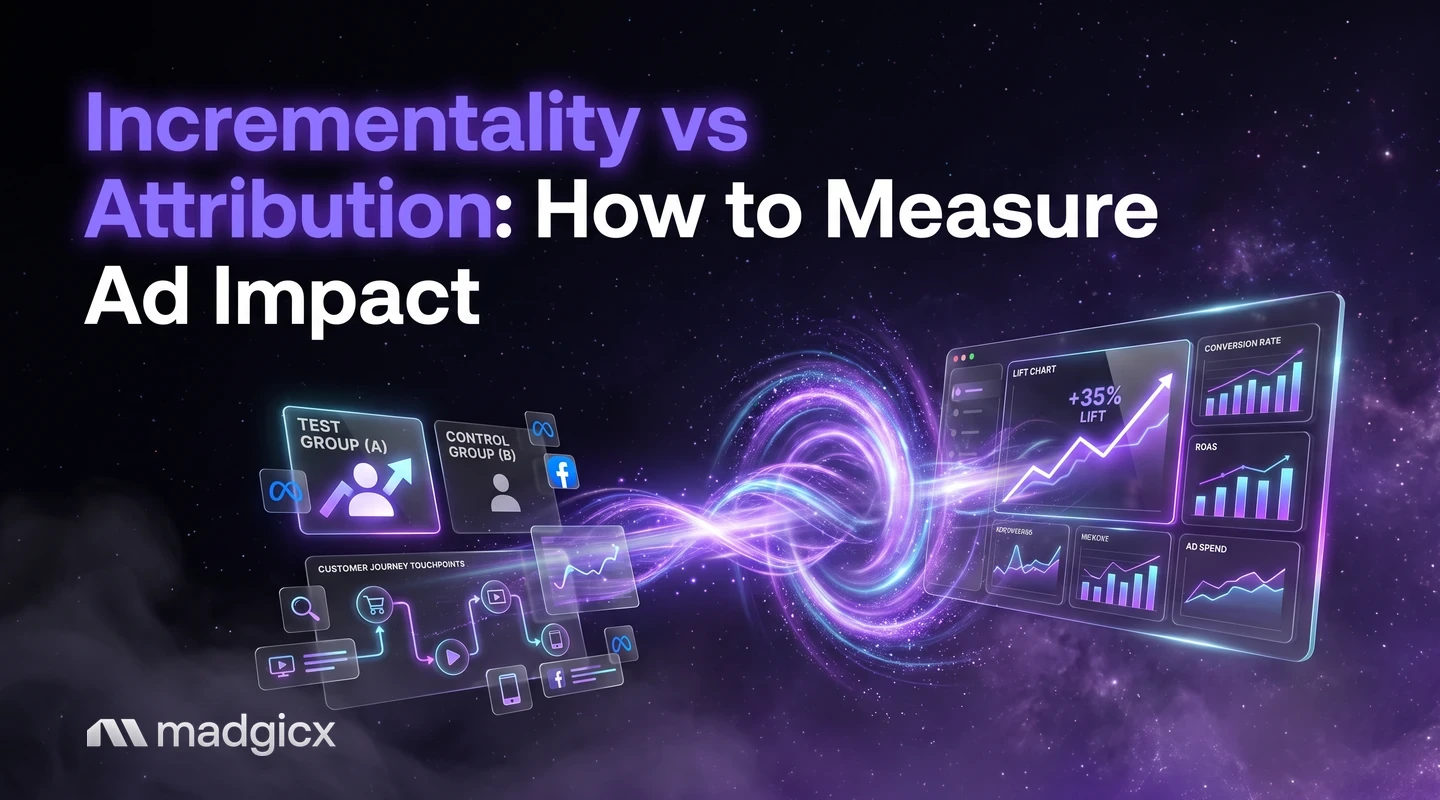
Incrementality measures lift: the difference in conversions caused by your ads. On Meta, the method is Conversion Lift, which Meta describes as its controlled-experiment method for measuring the incremental effect of your ads.
It works by splitting your audience into two groups. The test group is the people who have the opportunity to see your ads. The control group is the people who do not. Meta uses an intent-to-treat approach, so everyone in the test group counts as eligible whether or not they ever saw the ad. The difference in conversions between the two groups is the lift.
One term to keep straight: Meta also has an incremental attribution model. It is an attribution setting that optimizes delivery for incremental conversions using models that predict whether an ad caused a conversion. A Conversion Lift test is different: it is an experiment you run to measure lift. The first changes how Meta delivers your ads; the second measures what they did.
Side by side comparison with a worked example
These numbers are invented to show the arithmetic. A store spends $20,000 on a Meta campaign. Ads Manager, using 7-day click attribution, reports 2,100 purchases. The store then runs a Conversion Lift test.
- The test group, 1,000,000 people, places 2,400 orders.
- The control group, 1,000,000 people, places 2,000 orders.
The lift is 400 orders, 20% above the control group. Here is how each method reads the same campaign:
| Measure | Attribution | Incrementality |
|---|---|---|
| Purchases credited to the campaign | 2,100 | 400 caused by the ads |
| Cost per purchase | $9.52 ($20,000 / 2,100) | $50 ($20,000 / 400) |
| What it tells you | Which ads and ad sets get the credit | Whether the spend creates new orders |
Both rows are right. The $9.52 helps you choose between ads inside the campaign. The $50 helps you decide whether the campaign as a whole is worth running. A product that earns $120 gross profit per order makes the campaign clearly worthwhile at $50 per incremental order, but a product that earns $30 does not, even though attribution made both look good.
How to run a lift test on Meta
- Check eligibility. As a guide, Meta asks for a campaign that started in the past year with spend of $5,000 USD or more and at least 500 conversions with a 1-day click, 7-day click or 1-day view attribution setting. Campaigns over 90 days are prorated, so a 180-day campaign needs $10,000 USD and 1,000 conversions.
- Check your signal. Self-serve Conversion Lift needs signal quality too: the Conversions API adopted, sending any event with an Event Match Quality score greater than 5. Meta says Conversions API is the recommended data source.
- Create the test. Set it up in Experiments, or contact your Meta account representative if you have one. There is no additional cost for the test, but the campaigns or ad sets you use may have budget requirements.
- Let it finish, then read the lift. Compare conversions between the test and control groups and work out cost per incremental conversion.
When to use which
Use this rule: attribution for decisions inside a campaign, incrementality for decisions about a campaign.
- Choosing which ad or ad set to scale or pause: use attribution. You need a fast, daily signal, and the comparison is between similar things measured the same way.
- Deciding whether to keep, cut or raise a channel or campaign budget: use incrementality. This is the question attribution cannot answer.
- Reporting to a boss or client: show attribution for trends and one lift result for proof.
- When results seem too good: test. If a campaign's attributed return is high but sales overall do not move, a lift test can explain why.
- When you cannot meet the spend and conversion minimums: stay with attribution, and compare periods carefully. Our guide to measuring digital marketing ROI covers other ways to judge business impact.
Common mistakes when comparing the two
- Treating attributed results as proof of cause. Attribution reports credit. A high number tells you where credit landed, not what the ads added.
- Comparing ad sets that use different attribution models. Meta warns that Campaign Overview results cannot be compared across them. Use the Compare Attribution Settings feature.
- Judging a lift test by clicks. The test measures conversions in the test and control groups, not who clicked.
- Running a test on thin data. If you are under Meta's spend and conversion guide, the result is hard to trust, so wait until you qualify.
- Ignoring tracking quality. Missing conversions shrink both the credit attribution gives and the lift a test can detect.
Madgicx: Cloud Tracking improves the data attribution uses
Both methods depend on Meta seeing your conversions. Madgicx Cloud Tracking hosts Meta's Conversions API Gateway and Signals Gateway for you and sends conversions to Meta from the server, so Meta sees and attributes more of them. That improves the signal attribution depends on, and it covers the Conversions API step that self-serve lift tests ask for. Copilot, the AI assistant inside Madgicx, can run dataset quality and Event Match Quality checks. See the Cloud Tracking page for details.
FAQ
What is the difference between incrementality and attribution?
Attribution assigns credit for conversions to the ads people interacted with. Incrementality measures how many conversions the ads actually caused, by comparing a test group that can see them with a control group that cannot.
Is incrementality better than attribution?
Neither is better in general. Attribution is faster and fits daily decisions. Incrementality is slower and answers whether the spend creates new conversions.
Is Meta's incremental attribution the same as a lift test?
No. Incremental attribution is an attribution model that optimizes delivery for incremental conversions using models that predict whether an ad caused a conversion. A Conversion Lift test is a controlled experiment that measures lift.
What attribution settings does Meta offer?
Standard attribution has click-through (1 day or 7 days), view-through (1 day) and engage-through (1 day) settings. Meta also offers an incremental model and custom attribution for data from an external analytics tool.
How much does a Meta Conversion Lift test cost?
Meta says there is no additional cost for the test, but the campaigns or ad sets used may have budget requirements. As a guide, it asks for a campaign with $5,000 USD or more in spend and at least 500 conversions.
Can I trust attribution without incrementality?
Yes for day-to-day comparisons between ads. For the bigger question of whether a campaign adds sales, a lift test gives you evidence attribution cannot.