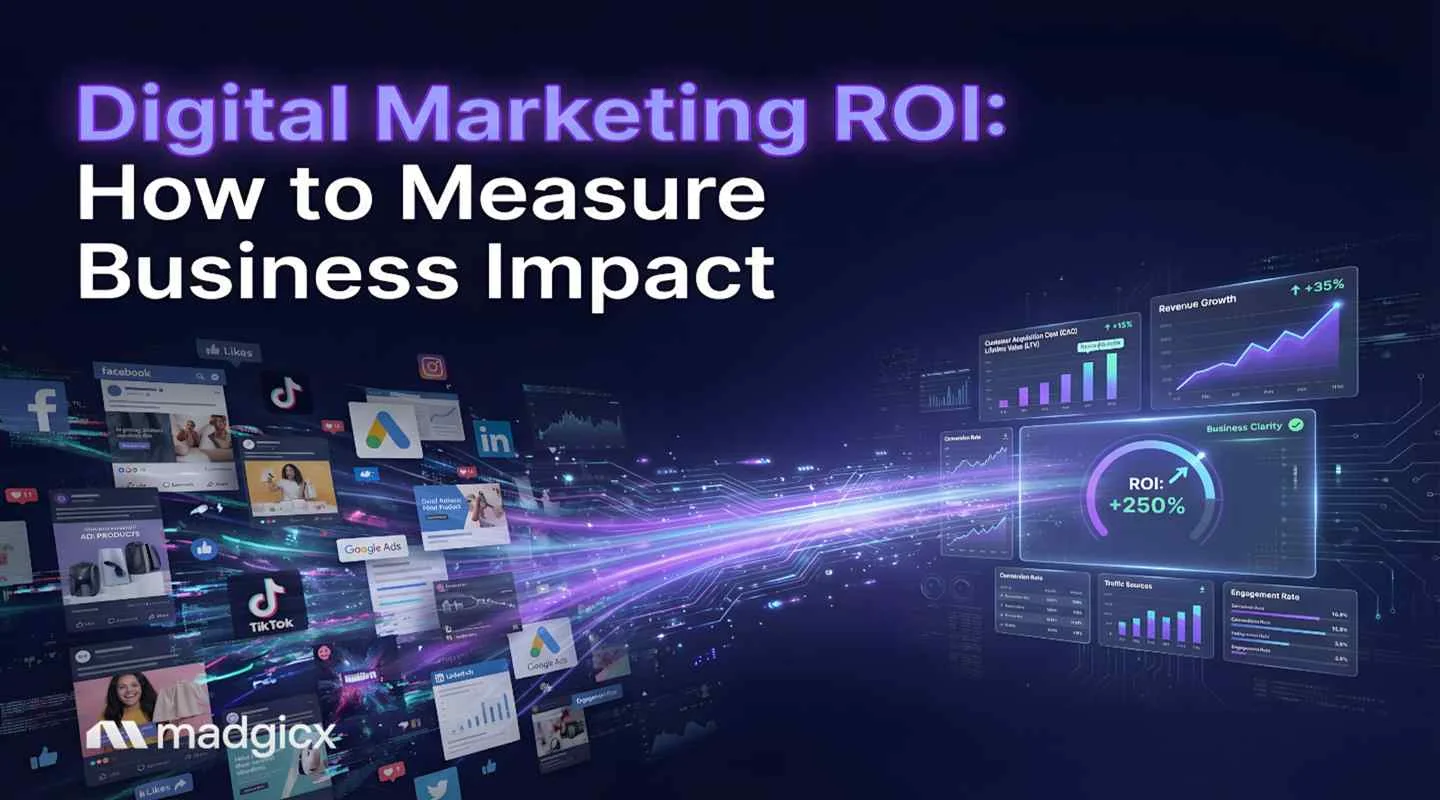
Learn to calculate and prove digital marketing ROI for your clients. This guide provides the formulas and reporting tools to demonstrate your agency's value.
Let's be honest. We've all been there. Every client, at some point, asks that dreaded question about their digital marketing ROI: "What are we getting for our money?"
In a world of tightening budgets and skeptical stakeholders, proving your agency's value isn't just a nice-to-have—it's a core survival mechanism.
But you already know that. You're the one buried in a mountain of spreadsheets, trying to stitch together a coherent story from Meta Ads, Google Ads, TikTok, GA4, and Klaviyo data for a dozen different clients into a single, effective key metrics dashboard. It feels less like strategic marketing and more like forensic accounting.
This guide is your way out of the spreadsheet maze. We're going to give you the benchmarks, formulas, and frameworks to not only calculate ROI but to confidently prove and improve it. We'll help you turn those defensive client conversations into strategic, forward-looking partnerships.
After all, while benchmarks vary, some channels deliver impressive results. For example, according to recent data, top-tier email marketing can deliver a staggering $36 for every $1 invested. Now that's a number that gets a CEO's attention.
Madgicx consolidates data from Meta, Google, TikTok, GA4, and Shopify into a single, shareable dashboard. Generate comprehensive, client-ready reports in one click and spend your time on what matters: strategy and growth.
What You'll Learn
- How to calculate ROI vs. ROAS (and explain it to clients like a pro)
- The latest ROI benchmarks for every major digital marketing channel
- How to choose the right attribution model to report ROI accurately
- A deep-dive into maximizing ROI specifically for your clients' Meta Ads
- Bonus: A toolkit of the best platforms for tracking and reporting ROI
What is Digital Marketing ROI? (And Why It's Your Agency's #1 Metric)
Before we dive into the nitty-gritty, let's get our definitions straight. When a client asks for "ROI," they're asking a business question, not a campaign question. Your ability to answer it clearly is a massive competitive advantage.
Digital Marketing ROI (Return on Investment) is the ultimate scorecard for your marketing. It measures the profit or loss generated by all your efforts relative to the total cost. In plain English, it tells us for every dollar we put into marketing as a whole, how many dollars in actual profit we got back.
The Critical Difference: ROI vs. ROAS Explained
This is where so many agencies trip up. You report a 4x ROAS, but the client is still wondering if they're actually making money. That's because ROAS (Return on Ad Spend) and ROI are two very different beasts.
Here's the quick version:
Pro Tip: Frame it for your clients this way: ROI is the "CEO metric." It measures the overall health and profitability of the marketing function. ROAS is the "Marketer metric." It measures the efficiency of a specific ad campaign. A high ROAS is great, but if your client's profit margins are thin, a 3x ROAS could still result in a negative ROI. Speaking the language of ROI shows you're thinking about their entire business, not just your ad campaigns. Understanding the difference between these two is one of the most important key performance indicators for marketing your agency can master.
Digital Marketing ROI Benchmarks: A Channel-by-Channel Comparison
"Is this good?" It's the second question every client asks right after they see the numbers.
Without benchmarks, your results exist in a vacuum. Using industry-wide data helps you manage client expectations and frame your performance in a broader context.
Of course, benchmarks vary by industry (B2B SaaS is a different world from D2C e-commerce), but these figures give you a powerful starting point for your next quarterly business review.
Sources: Verified 2024-2025 data from Website Builder Expert, DesignRush, GrowthPep, Intero Digital, and OrangeSEO.
Pro Tip: Use these numbers to educate your clients on the strategic purpose of each channel. SEO has a phenomenal ROI, but it requires patience. PPC delivers faster results but at a lower average return. Your job as their strategic partner is to build a marketing mix that balances these short-term and long-term goals.
Deep Dive: How to Maximize Meta Ads ROI for Your Clients
Saying you'll improve "social media ROI" is too generic. For most agencies, the real money is made or lost inside Facebook Ads Manager. Let's get specific.
Improving Meta Ads ROI isn't just about bid strategies and audience targeting anymore. The game has changed. The agencies that win are the ones who master Meta's AI and understand the science of creative.
Leverage Advantage+ for Higher Returns
If you're still manually building dozens of ad sets with tiny, overlapping audiences, you're working too hard and leaving money on the table.
Meta's Advantage+ Shopping Campaigns use machine learning to find the most likely buyers across the entire platform. By feeding the algorithm good creative and clear conversion data, you empower it to do the heavy lifting—often finding pockets of customers you would have never thought to target. This increased efficiency directly translates to a better return on your client's investment.
The Untapped ROI Lever: Creative Performance
Here's a secret that top-tier agencies know: creative is the single biggest lever you can pull to improve Meta Ads ROI.
You can have the perfect audience and a flawless funnel, but if your ad creative is stale, you're doomed. This isn't about guesswork; it's about data. You need a systematic approach to analyzing paid ad performance to see which creative formats, hooks, and calls-to-action are driving actual results.
This is where a tool like Madgicx becomes a powerful asset. Instead of manually tagging campaigns and crunching numbers in a spreadsheet, you can see at a glance which creatives are winners and which are draining the budget. Our internal data shows that agencies who get serious about systematic creative testing often see a huge jump in their Meta Ads performance.
Struggling to produce enough creative to test effectively? The AI Ad Generator can help you create dozens of high-quality image ad variations in seconds, giving you the fuel you need to find those winning combinations.
How to Calculate Digital Marketing ROI: A Step-by-Step Framework
Alright, let's get down to the math. And don't worry, it's simpler than you think—no advanced calculus required.
The Simple ROI Formula:
ROI = ( (Sales Growth - Total Marketing Investment) / Total Marketing Investment ) * 100
Let's break that down with a realistic e-commerce client scenario.
Step 1: Tally Your Total Marketing Investment
This is the part everyone gets wrong. You have to include everything.
- Ad Spend: $10,000 (across Meta, Google, etc.)
- Agency Retainer Fee: $5,000
- Software Costs: $500 (Madgicx, Klaviyo, etc.)
- Creative Production: $1,000 (freelancers, stock photos)
- One-Time Costs: $0 (for this month)
- Total Marketing Investment = $16,500
Step 2: Calculate Your Net Profit
First, you need the sales growth attributable to marketing. Let's say your client's baseline revenue is $50,000/month. This month, with your marketing efforts, they hit $100,000.
- Sales Growth: $100,000 - $50,000 = $50,000
Now, you need the Net Profit from that growth. This requires knowing your client's Cost of Goods Sold (COGS) or profit margin. Let's assume a 60% profit margin.
- Gross Profit from Growth: $50,000 * 60% = $30,000
- Net Profit: $30,000 (Gross Profit) - $16,500 (Total Investment) = $13,500
Step 3: Put It All Together
Now we just plug our numbers into the formula.
ROI = ($13,500 / $16,500) * 100
ROI = 0.818 * 100
ROI = 81.8%
You can now confidently tell your client: "For every dollar we invested in marketing this month—including our fee—we generated 82 cents in pure profit for your business." That's a conversation that secures contracts.
Choosing the Right Attribution Model to Accurately Report ROI
Okay, here's where the world of marketing analytics can get a little tricky, but stick with us. Getting this right is a total game-changer. The ROI you just calculated can change dramatically depending on how you give credit for a sale. This is called an attribution model.
What is an Attribution Model? It's the rule that decides which touchpoint gets credit for a conversion. Did the first ad a customer ever saw get the credit? The last one they clicked? Or something in between?
Your choice of model can paint two very different pictures. Imagine a customer journey:
- Sees a Facebook ad (Awareness)
- Searches on Google and clicks an organic link (Consideration)
- Gets a retargeting ad on Instagram and clicks (Decision)
- Types the URL directly and buys (Conversion)
A Last-Click model would give 100% credit to the direct visit, while a First-Click model would give it all to the initial Facebook ad. Your reported ROI for Facebook would be wildly different in each scenario. So which one is right?
Decision Tree: Which Model is Right for Your Client?
There’s no single “best” model. The right choice depends on your client’s business and sales cycle.
- If it's SHORT (less than a day, e.g., impulse-buy e-commerce): A Last-Click model is often sufficient. The final touchpoint is likely the most influential.
- If it's LONG (weeks or months, e.g., B2B, high-ticket items): You need a multi-touch model.
- Use a Linear model if you want to value all touchpoints equally. This is great for showing the value of the entire funnel.
- Use a U-Shaped (Position-Based) model if you want to give more credit to the first and last touches. This credits the ad that brought the customer in and the one that closed the deal.
- Use a Data-Driven model (available in GA4) if you have enough data and want the most sophisticated view. It uses machine learning to assign credit based on what actually drives conversions.
Choosing the right model and explaining why you chose it elevates your agency from a simple service provider to a true strategic partner.
The Agency Toolkit: Top Platforms for Tracking & Reporting ROI
Doing all of this manually across multiple clients is a recipe for burnout. The right tools make this entire process scalable, accurate, and dare I say, even enjoyable.
Here are the top platforms your agency should have in its stack:
1. Madgicx: The All-in-One Agency Command Center
We built Madgicx as a comprehensive platform designed for agencies like yours. It unifies reporting, optimization, and diagnostics into a single, beautiful interface.
The One-Click Report and Business Dashboard pull data from Meta, Google, TikTok, GA4, and Shopify so you can stop wasting a full day building reports. When a client asks "Why did CPA go up yesterday?", you can use AI Chat to get a quick analysis instead of spending an hour digging through Ads Manager.
See how Madgicx works for your agency.
2. HubSpot Marketing Hub: The CRM-Centric Powerhouse
For clients heavily focused on inbound marketing and lead nurturing, HubSpot is a fantastic choice, often considered a top-tier piece of customer analytics software. It excels at tracking the full customer journey from first blog post view to final sale, making it ideal for B2B or service-based businesses with long sales cycles.
3. Google Analytics 4 (GA4): The Free Foundation
GA4 is non-negotiable. It's the source of truth for website behavior and conversion tracking. While incredibly powerful, it can be complex. Many agencies use GA4 as the foundational data layer and then plug in a tool like Madgicx to make the data easier to interpret and share. For a deeper dive, check out our guide to GA4 for agencies.
4. SEMrush: The SEO & PPC Strategy Tool
Calculating ROI is one thing; improving it is another. SEMrush is a competitive intelligence powerhouse. Use it to analyze competitors' top keywords, ad copy, and backlink strategies to find new opportunities and build a data-backed strategy for improving client ROI.
5. Ahrefs: The Backlink & SEO Specialist
While SEMrush is a great all-rounder, Ahrefs is widely considered the gold standard for backlink analysis. If your agency offers serious SEO services, Ahrefs is essential for conducting site audits, tracking keyword rankings, and building a roadmap to project and deliver long-term SEO ROI.
Frequently Asked Questions (FAQ)
How do I explain a negative ROI to a client?
Transparency is key. Don't hide it. Frame it as the "data-gathering phase."
Explain that the initial investment was used to learn what doesn't work, which is just as valuable as learning what does. Present the key learnings (e.g., "We learned Audience X is not responsive, but Audience Y has a promising CPA") and your pivot strategy for the next month.
What is a "good" ROI for a new client in their first 3 months?
Set realistic expectations from day one. For many businesses, achieving breakeven (0% ROI) in the first 90 days is a huge win.
This period is about collecting baseline data, testing creative, and optimizing the funnel. Anything above that is a bonus.
How can I prove my agency's fee is worth the investment?
Use the ROI formula! Show them the calculation with and without your agency's involvement.
For example: "Based on your previous results, your marketing generated X. With our strategies, we generated Y. The difference, even after accounting for our fee, is a net profit lift of Z for your business." This reframes your fee from a cost to an investment with a clear return.
How does Madgicx help improve client ROI?
Madgicx is designed to improve ROI in three core ways:
- AI-Powered Optimization: Our AI Marketer works 24/7 to analyze performance and provide one-click recommendations, helping you reduce wasted ad spend around the clock.
- Cross-Channel Insights: By seeing data from all your platforms in one place, you can make smarter budget allocation decisions, shifting spend to the channels that are truly driving results.
- Creative Intelligence: We make it easy to identify your winning ad creatives and understand why they work, so you can stop guessing and start scaling what is performing well.
Conclusion: Start Proving Your Agency's Value Today
Proving your agency's worth isn't about flashy presentations or vague promises. It's about cold, hard numbers.
But ROI isn't just a formula; it's a story you tell with data. It's about choosing the right channels, using the right attribution model, and having the right tools to bring it all together without losing your mind.
Here's your next step: don't just let this be another article you read. Pick one client this week. Just one. Run them through the ROI calculation framework we outlined. Use the benchmarks in this guide to set the stage for your next client call.
And when you're ready to make this your new normal—getting these results across all your clients and getting countless hours back in your week—we're here to help you scale.