Meta's travel ads product versus ordinary ads for travel brands, with a playbook for funnels, seasonality and booking budgets and 5 real ads to learn from.
"Facebook travel ads" can mean two things: Meta's travel ads product, which builds ads from a hotel, flight or destination catalog, or ordinary Meta (Facebook) ads that a travel brand makes with photos, offers and copy. The best results usually combine both: a catalog for the dynamic parts, and strong creative for the story.
This guide explains how Meta's travel ads work, how to plan the funnel and the seasons, and what 5 real hotel and tour ads running in November 2026 do well. It ends with how to track bookings and how to set a budget by booking window.
Send conversions to Meta from the server and run rules on cost per booking.
Two things called Facebook travel ads
| Meta's travel ads | Ordinary ads for a travel brand | |
|---|---|---|
| What builds the ad | A hotel, flight or destination catalog | You: a photo or video, a headline and text |
| Price and availability | Pulled in from your website in real time | Written by you, so it needs updating by hand |
| Setup | Meta Pixel and mobile SDK, plus a catalog | A Meta Pixel and your creative |
| Best for | Many properties, routes or destinations | A tour, a package, a seasonal offer or a brand story |
You do not have to pick one. Meta's guide to travel ads says that once core campaigns are set up, travel ads can also promote ancillary products, features or tiers and test creative such as image overlays.
Meta's travel catalog ads
Meta's travel ads let a business set up and present offers and serve ads with real-time availability and pricing, based on where and when people want to go. Here is what the help center says they do:
- Retargeting. Travel ads for retargeting match visitors from your site and app with the properties, flights and destinations that interest them most, pulling availability and pricing from your website.
- Prospecting. Travel ads for prospecting expand your audience beyond your own site visitors, using machine learning to find potential travelers at different stages of trip planning.
- One setup. You set up the campaign once to promote all of your inventory, without creating each ad separately, and you can use the same catalog for retargeting and prospecting.
- Every screen. The ads appear on computer, mobile and tablet.
Setup needs a Meta Pixel and mobile SDK, plus a hotel, flight or destination catalog. If you have a handful of products (one tour, one retreat), ordinary ads are usually enough and faster to launch.
Funnel and objectives for travel
Trips are planned over weeks, so one ad rarely does the whole job. A simple funnel has three layers:
- Dream. Prospecting ads that sell the place or the feeling to people who have not visited your site. Judge them on cost per landing page view and video views, not bookings.
- Plan. Ads to people who looked at a property or itinerary: the specific hotel, dates and what is included. This is where catalog retargeting fits.
- Book. Offers with a deadline for people who got close: a perk, a price, a "book by" date.
Choose the campaign objective that matches the action you want from that layer (bookings, leads or traffic), and make the button match it. The ads below use Book now and Learn more.
Audiences and seasonality
Audiences for travel follow the same layers. Start broad for the dream layer, then narrow to people who showed interest. In Meta's terms, a website custom audience targets people who visited your site, tracked via the Meta Pixel, and a video custom audience targets people who watched your video content on Meta platforms. A custom audience can also be the seed for a lookalike audience.
Seasonality changes the timing more than the targeting. Work backward from the trip:
- Peak travel dates. Find the dates guests actually stay or depart, not the dates they book.
- Booking window. Estimate how many weeks before the trip your customers usually book. A beach resort and a weekend city break have very different windows, so use your own booking data.
- Start earlier than feels natural. Begin the dream layer well before the booking window opens, so the retargeting pools are filled when people are ready to book.
- Put deadlines in the ads. "Book by 5 Nov for stays until 31 Dec" (Hyatt, below) ties the offer to both the booking date and the stay dates.
Offer-led ads for hotels and destinations
Three of the 5 ads below lead with a concrete offer for a named place or room type. They show how to make a stay or a package feel like a specific trip.
Hyatt: stacked perks for suite bookings
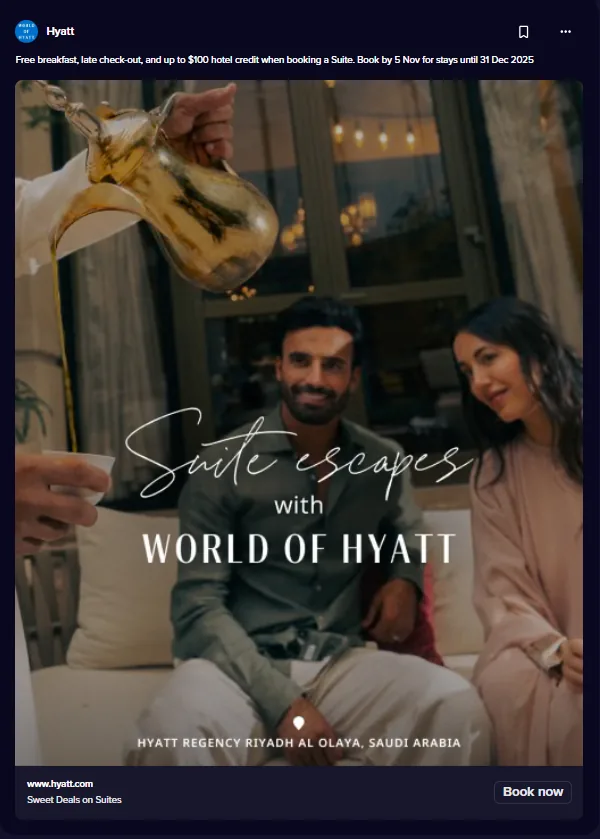
The first line reads: "Free breakfast, late check-out, and up to $100 hotel credit when booking a Suite. Book by 5 Nov for stays until 31 Dec 2025". The headline is "Sweet Deals on Suites" and the button is Book now.
Why it works: concrete, stacked perks in the copy and a bright suite photo make the offer clear at a glance. The "book by" and "stay until" dates tell people exactly when the deal ends.
What to copy: list the perks, not just the discount, and give both a booking deadline and a stay window.
Hyatt ads in the Meta Ad Library
American Express: a card-holder perk at a named resort
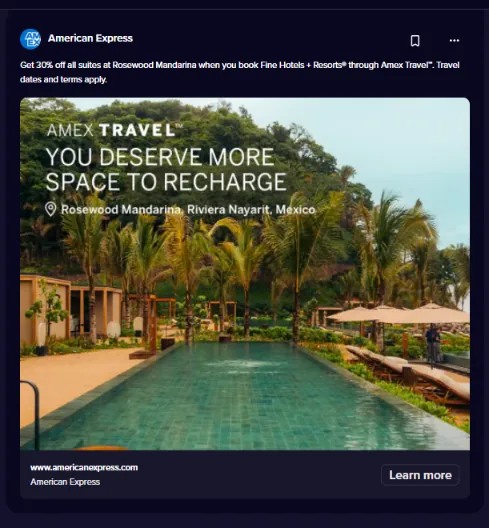
The first line reads: "Get 30% off all suites at Rosewood Mandarina when you book Fine Hotels + Resorts through Amex Travel. Travel dates and terms apply." The headline is "YOU DESERVE MORE SPACE TO RECHARGE (Amex Travel, Rosewood Mandarina, Mexico)" and the button is Learn more.
Why it works: a named property, a clear 30% discount and a poolside photo make a card-holder perk feel like a specific trip. The headline speaks to a feeling (space to recharge) before the offer.
What to copy: name the property and the place, then give one number. If terms apply, say so in the first line, as this ad does.
American Express ads running now
TripCorner: lead with a low deposit
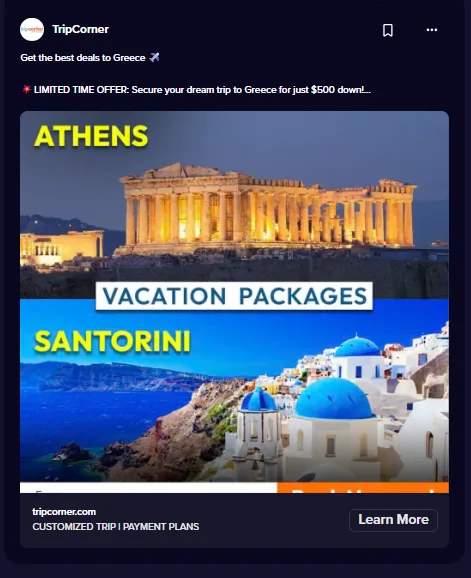
The first line reads: "Get the best deals to Greece ✈️". The headline is "ATHENS / SANTORINI - VACATION PACKAGES", and the text describes a Greece trip for just $500 down, with flexible monthly payment plans and customizable packages. The button is Learn More.
Why it works: two landmark photos with the destination names in big type say where you are going at a glance, and the copy leads with a low deposit so the trip feels affordable.
What to copy: if payment plans are part of your offer, show the entry price (the deposit) next to the destination names.
Creative that sells the trip
The other two ads sell the feeling first and the offer second. Travel buyers are choosing an experience, so the image has to make the place look like somewhere they want to be.
St. Regis Hotels & Resorts: let one photo do the selling
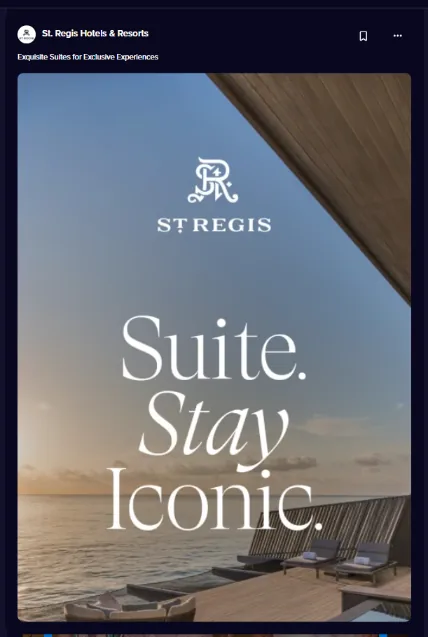
The first line reads: "Exquisite Suites for Exclusive Experiences". The image is an overwater-villa photo with a three-word tagline, "Suite. Stay Iconic.", and almost no other copy. The collected ad lists no button.
Why it works: an overwater-villa photo and a short tagline sell the destination feel with almost no copy. For a luxury brand, restraint reads as confidence.
What to copy: for premium offers, use one hero image and one short line. Save the detail for the landing page.
St. Regis ads in the Meta Ad Library
Contiki: put the perk in big type over a group photo
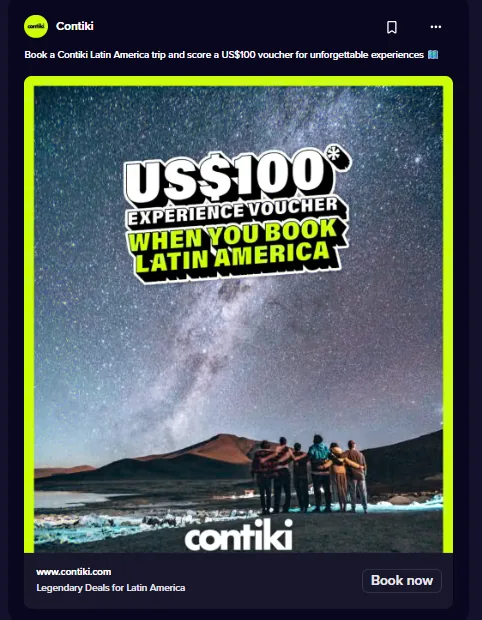
The first line reads: "Book a Contiki Latin America trip and score a US$100 voucher for unforgettable experiences". The headline is "US$100 EXPERIENCE VOUCHER WHEN YOU BOOK LATIN AMERICA (Legendary Deals for Latin America)", the text says you can secure a spot for $200, and the button is Book now.
Why it works: a starry-sky group photo shows who the trip is for, and the offer is in big type, so the perk reads in one glance. The Book now button is clear. (Contiki is a global tour operator, not a US company.)
What to copy: put the offer in the image itself, and pair a people photo with a perk that matters on the trip, like an experience voucher.
Track bookings
A booking can happen on your site, in an app, over the phone or at a partner's checkout, so cover each path:
- Pixel and server events. Meta's Conversions API connects website, app, business messaging and offline events to Meta systems that optimize targeting, lower cost per result and measure outcomes. If you already use the Meta Pixel on your website, you can set it up for website events in one click from Meta Events Manager, with no code.
- Phone and offline bookings. Offline events can be used for attributed offline events measurement and offline custom audience creation, so a booking taken over the phone can still be credited to an ad.
- Booking value, not just booking count. A $400 weekend and a $4,000 package are not the same conversion. Pass the booking value so you can optimize on revenue.
- Tagged links. Add UTM tags with the Facebook UTM builder so your analytics shows which ad sent each booking.
Meta can only optimize on the conversions it can see. Madgicx Cloud Tracking sends conversions to Meta from the server, so Meta sees and attributes more of them, which matters when the booking happens days after the click.
Budget by booking window
Match spend to where customers are in their window, not to the calendar month. This table is a planning frame, not a benchmark:
| Where you are | What to run | How to weight budget |
|---|---|---|
| Well before the booking window | Dream-layer video and photo ads to new people | Smaller and steady, to fill retargeting pools |
| Booking window is open | Offer ads and retargeting to site visitors | Largest share, since intent is highest |
| Last weeks before departure | Deadline offers for remaining inventory | Short bursts tied to open rooms or seats |
| After the season | Review what booked, refresh creative | Low, while you plan the next season |
Before you set a budget, work out the most you can pay per booking. Illustrative numbers: a $2,400 trip with 12% margin leaves $288 per booking. If an ad costs $288 to win a booking, you break even on the first trip, so aim well below that. The break-even ROAS calculator turns your margin into a target ROAS, and the ad budget calculator helps size spend. For creative inspiration beyond travel, see this playbook for Instagram ads.
Run travel ads with Madgicx
Travel demand moves with dates, so the account needs watching more often than a monthly review. In Madgicx, Automation runs rules on conditions you set, such as pausing an ad set when cost per booking passes your limit. Creative Insights shows which images and offers drive results and flags creative fatigue, and AI Marketer prepares daily recommendations that you complete or dismiss.
Start your 7-day free trial of Madgicx and connect your travel ad account.
FAQ
What are Meta travel ads?
Meta travel ads serve ads with real-time availability and pricing, based on where and when people want to go, using a hotel, flight or destination catalog. They need a Meta Pixel and mobile SDK, and they come in versions for retargeting and prospecting.
Do I need a catalog to advertise travel on Facebook?
No. Meta's travel ads use a catalog, but ordinary image or video ads work for a single tour, package or seasonal offer. A catalog pays off when you have many properties, routes or destinations.
When should I start running travel ads?
Before your customers' booking window opens. Start with prospecting, so your retargeting audiences have people in them when the window opens, and put a deadline in the offer.
How do I track bookings made by phone?
Send offline events to Meta with the Conversions API, which supports attributed offline events measurement. Log the call or booking against the ad click so it can be credited.
What should a travel ad show?
The place first, then one offer. The ads in this post use a named property or destination, a clear perk or price, and a button that matches the action: Book now or Learn more.