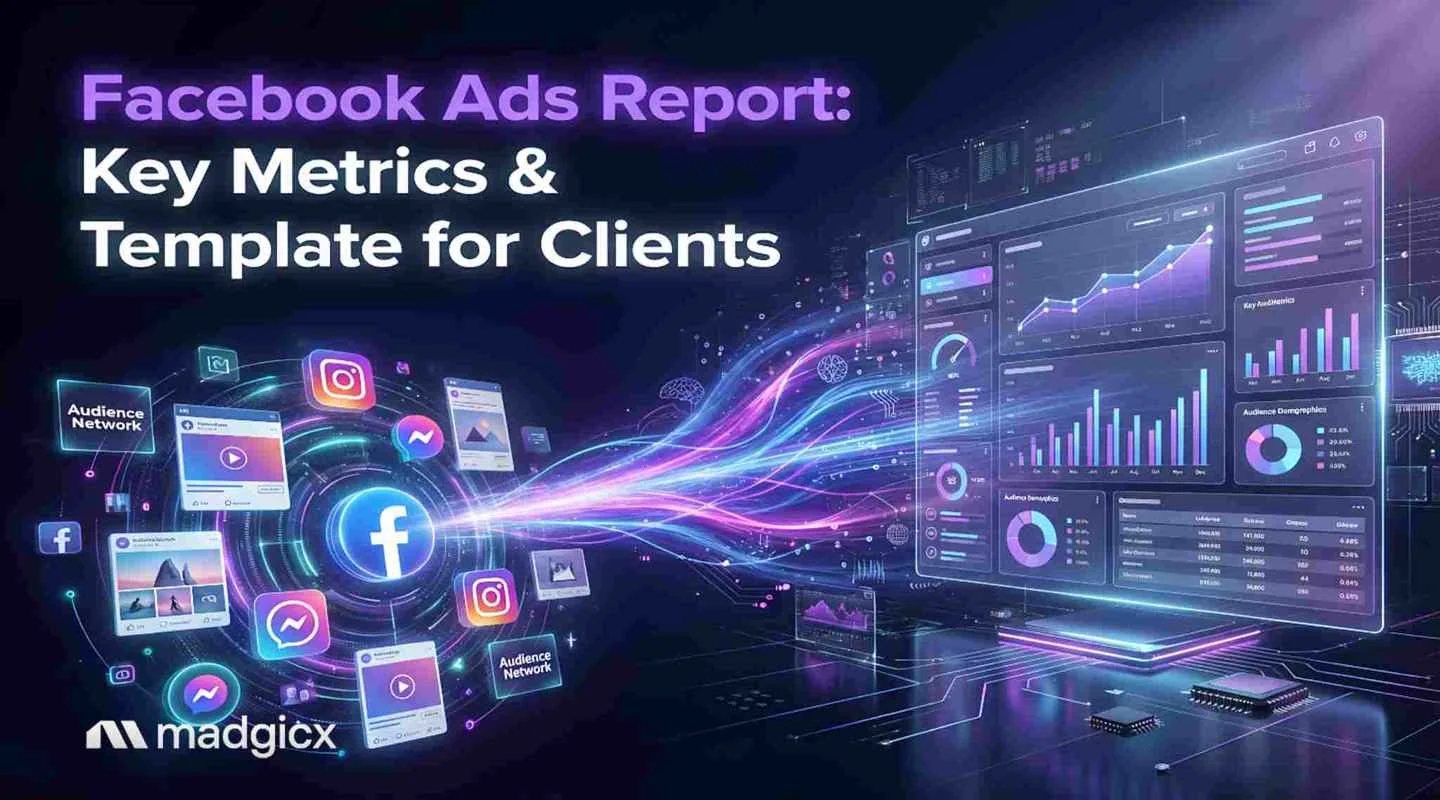
Learn what to include in your Facebook Ads client reports. Get key metrics, benchmarks, a template, and the best tools to deliver actionable insights.
A Facebook ads client report must include key performance metrics (ROAS, CPA, Conversion Rate), cost efficiency metrics (CPC, CPM), audience engagement data (CTR, Frequency), and a summary of strategic insights with actionable next steps. The best reports connect ad performance directly to the client's business goals and are tailored to the audience, like an executive summary versus a tactical deep-dive.
Let’s be honest, creating client reports can feel like a total chore. You spend hours buried in Ads Manager, wrestling with spreadsheets, and trying to translate a mountain of data into a story that actually makes sense.
You know the value is there, but communicating it clearly—while also justifying your fee and building trust—is a whole other ball game. A great report isn't just a data dump; it's a strategic tool that tells a story, proves your worth, and guides the next big move.
It’s time we stop dreading report day and start delivering insights that make our clients say, "Wow, I get it now."
Clients don’t need raw data — they need clear answers. Madgicx’s One-Click Report turns your Facebook Ads performance (plus Google, TikTok, GA4, Shopify, and Klaviyo) into a clean, visual report that shows what’s working and what’s not. Send clients a live, branded link they can check anytime.
What is a Facebook Ads Report?
A Facebook Ads report is a curated document or dashboard that summarizes the performance, cost, and outcomes of advertising campaigns on Meta's platforms for a specific period.
But really? Think of it as the ultimate communication tool between you and your client. It’s not just about showing numbers; it’s about demonstrating the value you’re bringing to their business, justifying the ad spend, and collaboratively planning the strategy for the weeks and months ahead.
A good report builds confidence. A great report builds partnerships. It transforms the conversation from "How much did we spend?" to "What did we learn, and where do we go next?"
The goal is clarity, not complexity. As digital marketing consultant Amanda Caven puts it, "The simpler the report, the more likely the client is to use and understand the information provided, and the more likely they are to see the value in the services you are providing." Your job is to be the expert who can simplify the complex, and a well-structured report is your best friend in that mission.
Key Facebook Ad Metrics to Include in Your Reports
Alright, let's get into the meat and potatoes. Staring at the dozens of columns in Ads Manager can be overwhelming. Which metrics actually matter to your client?
We like to break them down into four essential categories. This framework helps you tell a complete story, from the high-level business impact all the way down to the nitty-gritty campaign details.
Performance Metrics (The Bottom Line)
These are the metrics your client really cares about because they tie directly to their business goals and revenue. This is the "did we make money?" part of the story.
- ROAS (Return on Ad Spend): ROAS is a marketing metric that measures the amount of revenue earned for every dollar spent on advertising. It's the king of e-commerce metrics. A 4:1 ROAS means for every $1 you put in, you got $4 back. Simple as that.
- CPA (Cost Per Acquisition): CPA is the total cost an advertiser pays to acquire a single new customer. For lead gen or service businesses, this is your North Star. It answers the critical question: "How much does it cost us to get one person to sign up or buy?"
- Conversion Rate (CVR): This is the percentage of people who clicked your ad and then completed a desired action (like a purchase or lead form submission). A high CVR is a great sign that your landing page and offer are a perfect match for the ad traffic you're sending.
Cost & Efficiency Metrics (Budget Health)
These metrics show how efficiently you're using the client's budget. They provide crucial context for the performance metrics above and answer the question, "Are we spending the money wisely?"
- Amount Spent: The total budget spent during the reporting period. Simple, but absolutely essential for every report.
- CPC (Cost Per Click): The average cost you pay for each click on your ad. Lower CPCs generally mean your ad is relevant and engaging, but always weigh it against the quality of the conversions you're getting.
- CPM (Cost Per Mille): CPM is the cost an advertiser pays for one thousand views or impressions of an advertisement. Think of it as the "rent" you pay for ad space. It’s a great indicator of auction competitiveness and how expensive your audience is to reach.
Engagement Metrics (Audience Connection)
These metrics tell you how your audience is responding to your ads. Are they stopping the scroll, or are they swiping right past you?
- CTR (Click-Through Rate): CTR is the percentage of people who saw your ad (impressions) and then clicked on it. It’s a primary indicator of your creative and copy effectiveness. A low CTR is often the first sign that it's time for a creative refresh.
- Frequency: The average number of times each person in your target audience has seen your ad. If frequency gets too high (say, above 3-4 in a short period), you risk ad fatigue, which can absolutely tank your performance. We've all been there.
Delivery Metrics (Campaign Reach)
These are the foundational metrics that show the scale of your campaigns.
- Impressions: The total number of times your ad was displayed on screen.
- Reach: The number of unique people who saw your ad.
To give these numbers some real-world context, here are some common benchmarks we can all aim for.
Facebook Ad Benchmarks to Aim For
| Metric | Industry Average | E-commerce Target | Notes |
|---|---|---|---|
| ROAS | 3x – 4x | 4:1+ | Highly dependent on profit margins. |
| CPA | Varies by industry | < $30 | Goal should be well below customer LTV. |
| Conversion Rate | Varies by industry | 2% – 5% | Varies based on offer price and industry. |
| CTR (Link) | Varies by industry | 1% – 2% | Anything above 2% is excellent. |
| CPC (Link) | $0.58 | < $1.50 | Can fluctuate based on audience and competition. |
| CPM | $10.61 | $10 – $25 | Can be higher for valuable audiences (e.g., retargeting). |
| Frequency | 1 – 3 (weekly) | 1 – 3 (weekly) | Monitor closely to avoid ad fatigue. |
Pro Tip: Navigating iOS 14+ Attribution. Ever had a client ask why Shopify shows 50 sales but Facebook is only reporting 35? Welcome to the post-iOS 14 world. It's crucial to explain attribution windows (e.g., 7-day click vs. 1-day click) in your reports. Be upfront about potential data discrepancies due to privacy changes. We recommend using a server-side tracking solution like the one included in Madgicx to send more accurate conversion data back to Meta. It helps close this frustrating gap and gives the algorithm better signals for optimization.
How to Structure Your Report by Campaign Objective
Not all metrics are created equal for every campaign. A brand awareness campaign has very different goals than a conversion campaign, and your report needs to reflect that. Trust us, reporting on the wrong Facebook ad metrics can make a successful campaign look like a failure.
For upper-funnel campaigns, experts like agency owner Akvile DeFazio emphasize reporting on metrics such as reach, frequency, and ad recall lift to show that you are reaching a new, relevant audience that is remembering your brand.
Tailor your client reporting by focusing on the primary KPIs for each campaign objective. Here’s a simple framework we use.
Metrics by Campaign Objective
| Campaign Objective | Primary Metrics (Tier 1) | Secondary Metrics (Tier 2) | Tertiary Metrics (Tier 3) |
|---|---|---|---|
| Awareness | Reach, CPM, Frequency |
Video Views, Ad Recall Lift |
CTR, CPC |
| Traffic | Link Clicks, CPC, CTR |
Landing Page Views, Cost per LP View |
Impressions, Frequency |
| Engagement | Post Engagements, Cost per Engagement |
Page Likes, Event Responses |
Reach, Impressions |
| Leads | Leads, CPA (Cost per Lead) |
Conversion Rate, CTR |
CPC, CPM |
| Sales / Conversions | ROAS, CPA, Purchase CVR |
Add to Carts, Checkouts Initiated |
CTR, CPC, CPM |
Pro Tip: Reporting on Advantage+ Campaigns: Advantage+ Shopping Campaigns (ASC) are a different beast, aren't they? Since Meta controls the targeting and placements, your reporting focus needs to shift. Lean heavily on the bottom-funnel metrics that matter most: ROAS and CPA. Because creative-level data is limited, you can't easily say "this ad drove X sales." Instead, we report on the campaign's overall performance. Monitor blended CTR and Frequency to watch for creative fatigue across the entire campaign, and use post-purchase surveys to ask customers what prompted them to buy—it's a great way to get qualitative insights on which creative themes are working.
How to Create a Client-Winning Report in 6 Steps
Ready to build a report that actually wows your clients? Follow this proven 6-step process to move from a blank page to an insight-packed deliverable.
Step 1: Define KPIs with the Client
Before you build anything, have a kickoff meeting to align on goals. What does success look like for them? Is it a specific ROAS target? A certain number of leads per month? A target CPA? Get these numbers in writing. This alignment is the foundation of your entire reporting strategy and saves you from so many headaches down the line.
Step 2: Connect Your Data Sources
This is where the magic (and the headache, if done manually) happens. You need to pull data from Facebook Ads, Google Analytics 4, and your client’s e-commerce platform (like Shopify) or CRM. Manually exporting CSVs is a recipe for errors and wasted time. This is where a dedicated Facebook ads reporting tool becomes a lifesaver, consolidating all your data into one place.
Step 3: Choose a Template or Build From Scratch
Seriously, don't reinvent the wheel! Start with a proven digital marketing report template. A good template will already have placeholders for the key metrics we've discussed. For example, Madgicx's One-Click Report offers pre-built templates for e-commerce, lead gen, and agencies, giving you a professional starting point in seconds.
Step 4: Customize with Metrics, Branding, and Visuals
Now, make it your own. Add the client's logo and brand colors. Most importantly, organize the data visually. We're all visual creatures. According to research, we remember 65% of visual information three days later, compared to just 10% of written information. Use charts and graphs to show trends. A line graph showing ROAS climbing month-over-month is far more powerful than a number in a table.
Step 5: Add a Narrative Summary & Recommendations
This is the most important step. Data is just data until you give it meaning. At the top of your report, include a short executive summary that makes you look like the strategic genius you are:
- What We Did: (e.g., "This month, we focused on scaling our top-performing prospecting audience and launched a new creative test.")
- What Happened: (e.g., "This resulted in a 15% increase in ROAS, from 3.5x to 4.1x, while keeping CPA stable.")
- What's Next: (e.g., "Next month, we will reallocate the budget from the losing creative test to the winning one and launch a new lookalike audience based on our top customers.")
This narrative turns your report from a passive document into an active strategic plan.
Step 6: Streamline and Share Your Report
Your time is too valuable to spend manually creating the same report every week or month. Use a tool to streamline the reporting process. Once set up, you can generate a fresh, data-rich report to share with your client (and yourself) via a link on a recurring basis. This ensures consistency and frees you up to focus on what really matters: strategy and optimization.
Pro Tip: Go Beyond Simple Reporting: In Step 6, don't just generate a report. Use a tool like Madgicx's AI Marketer to set up AI-powered monitoring that alerts you to sudden drops in ROAS or spikes in CPA. This way, you can be proactive and fix issues before the report is even due, turning a potentially bad report into a story of how you saved the day. Try Madgicx free today.
The Best Facebook Ads Reporting Tools for Agencies
The right tool does more than just display data—it saves you dozens of hours, uncovers hidden insights, and helps you communicate your value more effectively. While many tools can create a dashboard, the best platforms integrate reporting with optimization.
We'll be straight with you: we built Madgicx because we believe reporting shouldn't be a separate, standalone task. It should be part of a holistic advertising platform that helps you analyze, optimize, and report from one place. Our One-Click Report and Business Dashboard are designed for performance marketers who need answers, not just charts.
Here’s how Madgicx stacks up against other popular Facebook ads reporting tools for agencies.
Reporting Tool Comparison
| Tool | Key Feature | Best For |
|---|---|---|
| 1. Madgicx |
AI Chat for instant diagnostics & One-Click Report templates. |
E-commerce brands and agencies needing insights, not just data. |
| 2. AgencyAnalytics |
All-in-one reporting with 75+ integrations. |
Agencies managing clients across many platforms. |
| 3. DashThis |
Unlimited users and easy-to-use templates. |
Teams that need to give many people dashboard access. |
| 4. Swydo |
Strong workflow and task management features. |
Agencies integrating reporting with project management. |
| 5. Coupler.io |
Data pipeline tool to sync data into spreadsheets. |
Analysts building reports in Google Sheets or Excel. |
| 6. ReportGarden |
SEO, PPC, and social media reporting combined. |
Full-service digital marketing agencies. |
While tools like AgencyAnalytics and DashThis are excellent for creating a comprehensive client reporting dashboard, Madgicx is different. It's an AI-powered optimization suite that includes robust reporting. You can go from seeing a drop in ROAS in your One-Click Report to asking AI Chat, "Why did my ROAS drop yesterday?" and getting an instant, actionable answer. That’s the future of reporting.
How to Present Performance Insights (The Good and The Bad)
The moment of truth: presenting the report to your client. Your delivery is just as important as the data itself. This is where you build trust, manage expectations, and reinforce your role as a strategic partner.
According to a study by Borne, one-third of senior marketers regard poor communication as the most significant barrier to a successful client-agency relationship. Nailing your report presentation is how we overcome that barrier.
When Performance is Great
This is the fun part! But don't just take a victory lap. Use strong performance as a launchpad for even bigger growth.
- Reinforce the Strategy: "Remember our hypothesis that Audience X would respond to Creative Y? It was correct, and that's what led to our 4.5x ROAS. This confirms our customer persona research."
- Focus on Scaling: "Given these strong results, we recommend increasing the budget by 20% next month to scale this winning combination and maximize revenue while it's hot."
- Suggest New Tests: "Now that we have a stable, high-performing campaign, it's the perfect time to test a new lookalike audience or a new creative angle to find our next winner."
When Performance is Declining
This is where the best media buyers earn their keep. Don't hide from bad numbers. Address them head-on with a clear, confident plan. It shows you're in control.
- Frame it as a Diagnosis: "This month, we saw a dip in ROAS from 3.2x to 2.8x. Our analysis points to early signs of ad fatigue, as frequency has crept up to 3.5. We caught it early."
- Present a Clear Action Plan: "To combat this, we've already paused the ads with the highest frequency and lowest CTR. Our plan is to launch three new creative concepts based on our previous winners to bring CTR back up and improve efficiency."
- Reiterate Long-Term Goals: "Dips like this are a normal part of the testing and scaling process. Our proactive adjustment plan is designed to get us back on track toward our quarterly goal of a 3.5x blended ROAS."
By presenting a plan, you transform a problem into an opportunity to showcase your expertise and problem-solving skills.
Frequently Asked Questions (FAQ)
1. How often should I send Facebook Ads reports?
It really depends on the client and the campaign maturity. Here's a good rule of thumb we follow:
- Weekly: For new clients, new campaigns, or high-spend accounts where you're actively testing and optimizing. This keeps everyone in the loop and allows for quick pivots.
- Bi-Weekly: For stable, evergreen campaigns that are performing consistently. This strikes a good balance between staying informed and avoiding information overload.
- Monthly: For executive summaries and high-level performance reviews. As marketing director Lorianna Sprague suggests, a monthly cadence is often perfect for "a high-level overview of how we’re pacing towards our goals."
2. How do I report on Advantage+ Shopping Campaigns?
Focus your report on the big-picture business metrics: overall ROAS, CPA, and total conversion value. Since Meta automates so much of the targeting and creative delivery, creative-level data is limited. Be sure to explain this to your client. We like to supplement the quantitative data with qualitative insights from post-purchase surveys to understand which creative themes are resonating with customers.
3. What if my Facebook data doesn't match my website analytics (e.g., Shopify)?
Ah, the classic question. This is a very common and frustrating issue. The key is to explain the "why" to your client proactively so you look like the expert you are. The discrepancy is usually due to three things:
- Attribution Windows: Facebook might be using a 7-day click window, while Shopify reports sales on the day they happen.
- Cross-Device Tracking: Facebook is great at tracking a user who sees an ad on their phone and later buys on their desktop. Most analytics tools can't do this.
- iOS/Privacy Impacts: Data loss from tracking opt-outs can cause underreporting in Facebook.
Position it as normal, and establish a single "source of truth" (we recommend the platform data, like Shopify) for final revenue numbers, while using Facebook's data for directional optimization. Using a server-side tracking solution like Madgicx's Signals Gateway can significantly improve the data alignment between platforms.
4. What's a good ROAS for Facebook Ads?
While it depends heavily on your client's profit margins, a general benchmark for a "good" ROAS is 4:1 (or $4 back for every $1 spent) for e-commerce brands. For service-based or lead-gen businesses, a 2:1 ROAS can be highly profitable. The most important thing is to make sure the ROAS target is well above their break-even point.
From Reporting Chores to Strategic Wins
A winning Facebook Ads report is so much more than a spreadsheet. It's a story that combines key metrics like ROAS, CPA, and CTR with your strategic insights and clear, actionable next steps. It builds trust, proves your value, and transforms you from a service provider into an indispensable strategic partner.
The key is to move from tedious, manual data-pulling to a streamlined, insight-driven workflow. Madgicx provides the tools to not only build beautiful reports with our templates but also to get instant answers from your data with AI Chat, helping you pack every report with the value your clients deserve.