Stop wasting hours on manual reports. Discover the best client reporting dashboard for your agency. We compare 12 tools, revealing hidden costs and setup times.
Ever feel like "client reporting" has sneakily become a full-time job you never even applied for?
One minute you're a savvy Meta Ads strategist, crafting brilliant campaigns. The next, you're lost in a sea of spreadsheets, trying to stitch together data from a dozen different sources. If you're nodding along, you know the struggle of building reports without a proper client reporting dashboard. Small agencies often spend a staggering 20-30 hours per month just wrestling with manual reports.
That’s not just lost time; it’s opportunity slipping through your fingers. It’s strategic time you could be using to optimize campaigns, dream up killer creative, or—let's be real—actually win new clients.
Manual reporting isn't just a time-suck. It's error-prone, inconsistent, and frankly, it doesn't exactly scream "we're a cutting-edge agency" to your clients.
But what if you could get all that time back? What if you could slash your reporting workload by a whopping 80%? Imagine turning hours of painful data-pulling into a task that takes less than 45 minutes. That’s the power of a great client reporting dashboard.
We built this guide specifically for Meta Ads agencies like yours. We're going to break down 9 popular reporting tools, helping you choose the right one to save time, build client trust, and get back to the work you actually love.
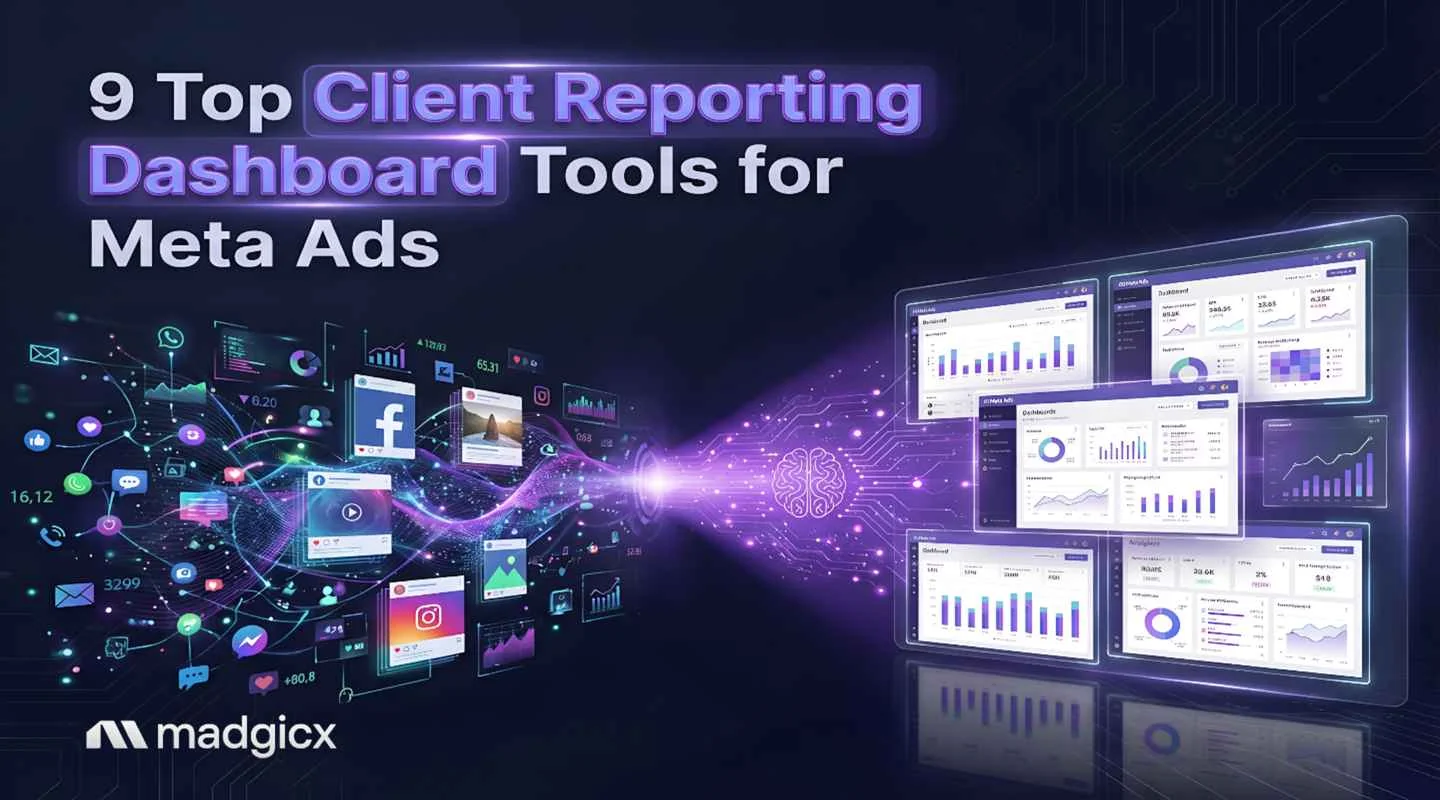
Madgicx’s One-Click Report connects Meta, Google, TikTok, Shopify, GA4, and Klaviyo into a single, client-ready dashboard and shareable report link. Get a clear, unified view of performance across every major channel — without manual exports or multiple tools.
What You'll Learn
- How to choose the right reporting dashboard for your agency's size and budget.
- The 6 must-have features for any serious Meta Ads reporting tool.
- A side-by-side comparison of 9 top tools with fresh insights.
- Bonus: How to pair your dashboard with an AI intelligence layer to deliver game-changing insights, not just data.
What Is a Client Reporting Dashboard (and Why Your Agency Desperately Needs One)
Let's get on the same page. A client reporting dashboard is your agency's command center for client data. It’s a tool that automatically pulls all your marketing data—from Facebook Ads, Google Analytics, Shopify, you name it—and puts it all into one clean, visual, and easy-to-understand interface.
Instead of drowning in spreadsheets, you get a professional, always-up-to-date view of what's working (and what's not).
For Meta Ads agencies, this isn't a nice-to-have; it's a necessity for three huge reasons:
- Massive Time Savings: This is the big one. Automated tools can take a task that eats up 2.5-5 hours of your week and shrink it down to under 45 minutes. That's hours back in your pocket, every single week.
- Radical Transparency & Trust: Clients want to see where their money is going. A clear, professional dashboard does more than just show numbers; it builds unshakable confidence and proves you’re on top of their account.
- True Scalability: You can't scale your agency if your best people are bogged down with admin tasks. Automating reports frees up your team to focus on high-value work like strategy and optimization, allowing you to take on more clients without hiring more report-builders.
Pro Tip: It's super helpful to know the difference between a live dashboard and a static report. A live dashboard is interactive and updates in real-time—perfect for your internal team to keep a pulse on things. A static report (like a PDF) is a snapshot in time, which is ideal for sending to clients with your expert analysis and commentary.
6 Must-Have Features for a Meta Ads Reporting Tool
Not all dashboards are created equal. When you're evaluating tools, make sure they check these six non-negotiable boxes for a modern Meta Ads agency.
- Native Meta Ads Integration: This sounds obvious, but you'd be surprised. The tool must have a deep, reliable, and API-based connection to Meta. If it can't pull in all your custom conversions, campaign names, and ad-level data accurately, it's a non-starter.
- White-Label Capabilities: Your clients hired your agency, not some software company. Your reports should feature your logo, your brand colors, and your voice. White-labeling is essential for looking professional and owning your client experience.
- Automated Scheduling & Delivery: The whole point is to set it and forget it, right? A great tool lets you automatically generate and email reports to your clients on a weekly or monthly basis, so you're not the bottleneck.
- Customizable KPI Tracking: Every client is different. One might be obsessed with ROAS, while another only cares about Cost per Lead. Your dashboard must let you build reports that track the specific KPIs that matter to each client's business goals.
- Multi-Channel Data Blending: Your Meta Ads don't exist in a vacuum. To show the true impact of your work, you need to blend data from other channels. Look for a tool that seamlessly integrates with Google Ads, GA4, Shopify, and Klaviyo to calculate blended metrics like Marketing Efficiency Ratio (MER).
- Transparent Pricing: Watch out for hidden fees! Some platforms charge extra for each data connector, for adding more users, or for going over a certain number of reports. Look for clear, straightforward pricing that scales with your agency, not against it.
Pro Tip: Before you commit to any platform, use their free trial to connect your actual Meta Ads account. This is the only way to truly test the reliability of the data connection and see if it pulls all your custom events and metrics correctly. Don't skip this step!
The 9 Top Client Reporting Dashboards Compared
We've done the homework for you. Here’s our breakdown of the top reporting dashboards out there, designed to help you find the perfect fit for your agency.
1. Madgicx
- Overview: We'll start with us! Madgicx is more than a reporting tool; it's a comprehensive advertising platform built for performance marketers. Our built-in One-Click Report and Business Dashboard are designed to give you a 360-degree view of performance across all your major channels.
- Best for: Marketing agencies that want a solution for cross-channel reporting without juggling a dozen different subscriptions.
Key Features:
- One-Click Report Generation: Creates comprehensive, client-ready reports with templates for e-commerce, lead gen, and agencies.
- Cross-Channel Blending: Connects Meta, Google Ads, TikTok, GA4, Shopify, and Klaviyo to show blended ROAS, MER, and net profit.
- Fully Customizable: Drag-and-drop widgets to build the exact dashboard your client needs.
- AI Intelligence Layer: Goes beyond what happened to tell you why with AI Chat and AI Marketer.
- Pros: All-in-one platform (reporting + optimization), no extra fees for connectors, built-in AI provides actionable insights you can actually use, shareable live links.
- Cons: No white-labeling with custom branding (yet!), no automated email scheduling (reports are shared via link or PDF).
- Pricing: Included in the Madgicx Pro Complete plan, starting at $45/mo. Free trial available.
- Meta Ads Integration: Deep, API-based integration is the heart and soul of our platform.
2. Looker Studio (formerly Google Data Studio)
- Overview: You know this one. Looker Studio is Google's free and seriously powerful data visualization tool. It's incredibly flexible, but here's the catch: you need to use third-party connectors to pull in Meta Ads data, and those aren't free.
- Best for: Agencies on a tight budget with some technical know-how, especially if you're already deep in the Google ecosystem.
- Key Features: Unlimited customization, direct integration with Google products (GA4, Google Ads), huge library of community visualizations.
- Pros: It's free (mostly), highly customizable, and perfect for visualizing Google-centric data.
- Cons: Requires paid third-party connectors for Meta Ads, has a steep learning curve, and can get sluggish with large data sets.
- Pricing: The tool is free. Connectors for Meta Ads are required and come at an additional cost, typically ranging from $20-$350/month.
- Meta Ads Integration: Relies entirely on third-party connectors, so the quality (and cost) can vary.
3. Databox
- Overview: Databox is a super popular, user-friendly dashboarding tool known for its clean interface and ridiculously easy setup. It's a fantastic choice for agencies that need to get up and running fast.
- Best for: Small to mid-sized agencies that prioritize ease of use and mobile access.
- Key Features: Large template library, goal tracking and alerts, easy-to-use query builder for custom metrics.
- Pros: Very intuitive and easy to learn, great mobile app, solid selection of native integrations.
- Cons: Can become costly as you add more data sources, and customization is more limited compared to a beast like Looker Studio.
- Pricing: Offers a free-forever plan. Paid plans with more features start at $47/month.
- Meta Ads Integration: Strong native integration that is generally reliable and easy to set up.
4. AgencyAnalytics
- Overview: As the name suggests, this tool is built from the ground up for marketing agencies. It combines reporting with other handy agency management tools like an SEO auditor and rank tracker.
- Best for: Agencies that want an all-in-one client management and reporting platform that goes beyond just paid ads.
- Key Features: Fully white-labeled, automated scheduling, custom dashboards with comments, built-in SEO tools.
- Pros: Excellent white-labeling options, great for full-service SEO/PPC agencies, user-friendly interface.
- Cons: Can be more expensive than some alternatives, and some users find the widget customization a bit rigid.
- Pricing: Plans for freelancers start at $79/month, with more comprehensive agency plans available.
- Meta Ads Integration: Robust and reliable, designed with agency needs in mind.
5. Klipfolio
- Overview: Klipfolio is a powerful and flexible BI tool that can handle complex data visualizations and custom metrics. It's definitely a step up in complexity from tools like Databox.
- Best for: Data-savvy agencies that need to create highly customized, complex dashboards and aren't afraid of a learning curve.
- Key Features: Powerful data modeling, ability to combine multiple data sources in a single visualization, highly customizable formulas.
- Pros: Extremely powerful and flexible, great for creating unique KPIs, and handles large data sets well.
- Cons: Steep learning curve, setup can be time-consuming, and it's much less "plug-and-play" than other options.
- Pricing: Agency-focused plans start at $110/month.
- Meta Ads Integration: Solid native connector, but leveraging its full power requires understanding Klipfolio's data modeling.
6. Whatagraph
- Overview: Whatagraph's whole game is turning data into visually appealing, easy-to-understand reports. Its main strength is in its aesthetics and simplicity.
- Best for: Agencies that want to produce beautiful, simple reports for clients who get easily overwhelmed by too much data.
- Key Features: Strong white-labeling, automated report delivery, ability to add comments and insights directly to reports.
- Pros: Creates gorgeous, easy-to-read reports; very user-friendly; good customer support.
- Cons: Less customizable than more powerful BI tools, and can be pricey for the features offered.
- Pricing: Contact Whatagraph for current pricing.
- Meta Ads Integration: Good native integration focused on presenting the most important metrics clearly.
7. DashThis
- Overview: DashThis is another agency-focused tool that prioritizes simplicity and speed. A huge plus? It offers unlimited users on all plans, which is great for growing teams.
- Best for: Agencies that need a simple, no-fuss reporting tool that the whole team can use without extensive training.
- Key Features: Unlimited users, preset report templates, easy white-labeling, comment widgets.
- Pros: Very easy to set up and use, great value with unlimited users, and perfect for straightforward reporting needs.
- Cons: Limited advanced customization, so it's not ideal for complex data analysis or blending.
- Pricing: Plans are based on the number of dashboards. Contact DashThis for current pricing.
- Meta Ads Integration: Solid and straightforward, perfect for standard KPI reporting.
8. Power BI
- Overview: This is Microsoft's answer to the BI world. Power BI is an enterprise-grade tool that offers immense power, especially if you're living in the Microsoft stack (Excel, Azure). Think of it as the final boss of BI tools.
- Best for: Large agencies or those with dedicated data analysts who need maximum power and have the technical skills to wield it.
- Key Features: Advanced data modeling (DAX language), AI-powered visuals, deep integration with Excel.
- Pros: Incredibly powerful, relatively inexpensive for its capabilities, and excellent for complex data analysis.
- Cons: Very steep learning curve, really requires a data analyst to use effectively, and Meta Ads integration needs third-party connectors.
- Pricing: A free desktop version is available. The Pro version, required for sharing, costs $14/user/month.
- Meta Ads Integration: Similar to Looker Studio, it relies on third-party connectors, adding cost and complexity.
9. Tableau
- Overview: Tableau is a legend in data visualization and a favorite among data scientists. It can create stunning, interactive dashboards but is probably overkill for most standard client reporting.
- Best for: Enterprise-level agencies with a data science team that needs to perform deep exploratory analysis.
- Key Features: High-quality data visualization, powerful exploratory features, handles massive data sets with ease.
- Pros: Unmatched visualization capabilities, creating highly interactive and beautiful dashboards.
- Cons: Can be expensive, has a massive learning curve, requires a dedicated analyst, and is likely way more than you need.
- Pricing: Pricing starts at $75/user/month for the Creator plan.
- Meta Ads Integration: Requires paid third-party connectors and significant setup.
Quick Decision Framework: Which Tool Is Right for You?
Feeling overwhelmed by the options? We get it. Let's simplify.
- If you want an all-in-one platform for optimization and reporting... Madgicx's built-in reports offer a streamlined, cost-effective solution.
- If you prioritize ease of use and a quick setup... Databox or AgencyAnalytics are your best friends.
- If your main goal is creating visually stunning, simple reports... DashThis or Whatagraph are designed for beauty and simplicity.
- If you're comfortable with a technical setup and want max customization on a budget... give Looker Studio a shot (with a third-party connector).
- If you have a data analyst on your team... you can unlock the beastly power of Power BI or Tableau, but be prepared for the complexity.
Frequently Asked Questions (FAQ)
1. What should a client reporting dashboard include?
At a minimum, it should include the key KPIs your client cares about (like ROAS, CPA, Clicks, and conversion value), trend lines to show progress over time, and—most importantly—your agency's commentary on what the data means and what you're doing next.
2. How often should agencies send client reports?
The industry standard is monthly, with 58% of agencies sending reports once a month. However, we're big fans of supplementing this with a shareable live dashboard that clients can access anytime for real-time data. It builds major trust.
3. What is the difference between dashboards and reports?
Think of it this way: a dashboard is a live, interactive workspace, like the cockpit of a plane, used for real-time monitoring. A report is a static snapshot, like a printed flight summary, that provides a summary of a specific period with your expert analysis.
4. How much does client reporting software cost?
It's all over the map. Pricing varies widely, from free versions to agency-focused platforms with monthly subscriptions based on features, users, and the number of data sources you connect.
Stop Wasting Hours on Manual Reports
Choosing the right reporting tool is more than just a nice-to-have; it's a core part of building a scalable agency. It's the engine that can save you 8+ hours a week, build rock-solid client trust, and free your brilliant mind to focus on strategy and growth. 🚀
But remember the key takeaway: don't just pick a tool—pair it with an intelligence layer. A dashboard shows you the data; an intelligence platform like Madgicx tells you the story behind it.
Whether you use our all-in-one solution or integrate our AI insights into another tool, Madgicx is your fastest path from being a report-builder to becoming an indispensable strategic partner.