Each ecommerce funnel stage mapped to a Meta campaign objective, an audience, creative and the metric to watch, with tracking tips and benchmarks.
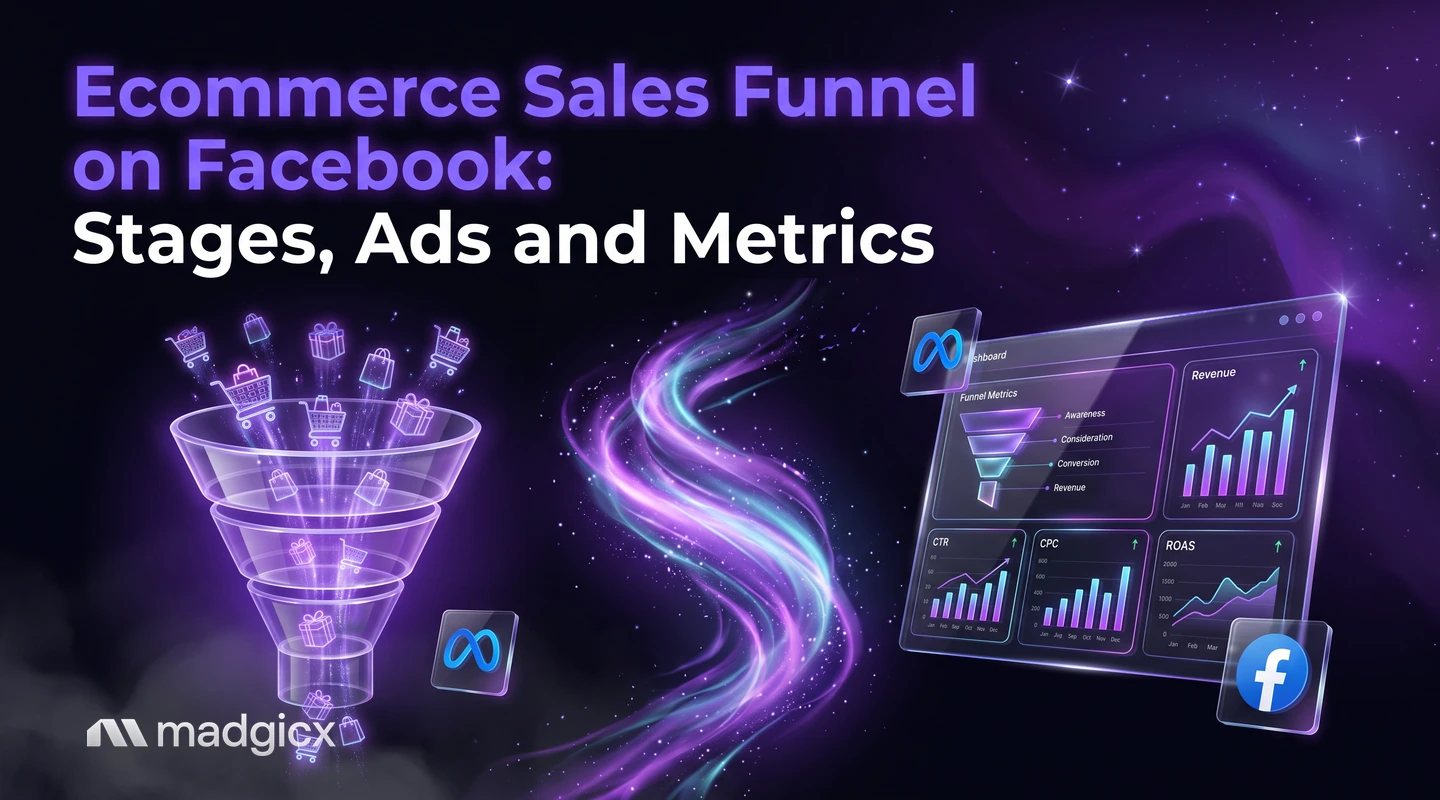
An ecommerce sales funnel on Meta (Facebook) ads has four stages: reach people who do not know you, engage the ones who show interest, convert the ones who are ready to buy and keep customers buying again. Each stage gets its own campaign, its own audience, its own creative and its own metric.
This guide maps each stage to the Meta campaign objective that fits it, the creative to run and the number to watch, then covers the tracking that makes the numbers trustworthy.
The Funnels view shows results by stage, and AI Marketer recommends what to do next.
Funnel stages
A funnel is the path a stranger takes to become a customer. In ads, you split that path into stages so that each ad speaks to where the person already is. Someone who has never heard of your store needs a different message from someone who left a product in their cart yesterday. For the general idea, see our glossary entry on the marketing funnel and its stages in Meta ads.
Meta's own guidance fits this shape. Its guide to choosing an ad objective says that a growing business may first focus on building awareness and acquiring new customers, and later encourage people to make a purchase or sign up. The six objectives are Awareness, Traffic, Engagement, Leads, App promotion and Sales, and the campaign objective, the conversion location and the performance goal are set separately in Ads Manager.
| Stage | Goal | Meta objective | Metric to watch |
|---|---|---|---|
| Top: reach | Get in front of new people | Awareness | CPM, reach, frequency |
| Middle: engage | Bring interested people to your store | Traffic or Engagement | Link CTR, CPC, cost per landing page view |
| Bottom: convert | Get the purchase | Sales | Cost per purchase, ROAS |
| Retention | Bring buyers back | Sales | Repeat purchase rate, ROAS on past buyers |
Top of the funnel: reach
At the top, the job is attention. Meta says its Awareness objective helps you reach the largest number of people who are most likely to remember your ad.
- Audience: broad. Meta often recommends Advantage+ placements and broad audiences for more flexibility, according to its ad delivery explainer.
- Creative: short, clear and about the problem you solve, not about your logo. Show the product in use in the first second.
- Metrics: CPM, reach and frequency. A rising frequency with flat reach means the same people keep seeing the ad.
Do not judge this stage by purchases. It exists to feed the stages below, and its results show up there.
Middle of the funnel: engage
In the middle, the job is to move interested people closer. Meta says the Traffic objective sends people to a destination such as a website, an app, a Facebook Page or shops on Instagram, and that Engagement finds people most likely to engage with your business online, send a message or take actions on your ad or Page.
- Audience: people who watched your videos or engaged with your ads or Page, plus a broad audience for new reach.
- Creative: proof. Reviews, before and after, comparisons, a product demo, a founder explaining why it exists.
- Metrics: link CTR and CPC. In Madgicx's Meta ads benchmarks for September 2026, the overall median link CTR was 1.53% and the overall median link CPC was $0.53.
Send traffic to a page that matches the ad. A strong click to a weak page wastes the spend of the stage above it. Our free landing page analyzer scores a page before you send traffic to it.
Bottom of the funnel: convert
At the bottom, the job is the sale. Meta says the Sales objective finds people likely to purchase goods or services, and can also optimize for other actions, such as adding an item to a cart. If you use a product catalog, Meta recommends Advantage+ catalog ads with the Sales objective. For more on dynamic product ads, see our guide to AI dynamic product ads for ecommerce.
- Audience: people who visited a product page, added to cart or started checkout.
- Creative: remove the last doubt. Shipping times, returns, a guarantee, a clear offer and a single button.
- Metrics: cost per purchase and ROAS. Judge ROAS against your break-even point, which you can find with our break-even ROAS calculator.
Meta's delivery system reminds advertisers that the ad set with the most results is not always the one with the lowest cost per optimization event. Look at volume and cost together before you scale one ad set.
Retention: bring buyers back
The cheapest sale is often the second one. After a purchase, run ads aimed at your buyers: a related product, a refill, a new arrival or a loyalty offer. These ads usually use the Sales objective with an audience of past buyers.
- Creative: thank them, then show what goes with what they bought.
- Metrics: repeat purchase rate and ROAS on past buyers, read next to your store's reports.
Exclude recent buyers from your bottom-of-funnel campaigns so you do not pay to show a purchase ad to someone who just ordered.
Metrics by stage
Each stage has one result and one diagnosis. If the result slips, the diagnosis tells you where to look.
| Stage | Result metric | Diagnosis metrics |
|---|---|---|
| Reach | Reach at a steady CPM | Frequency, CPM against your industry median |
| Engage | Landing page visits at a steady cost | Link CTR, CPC |
| Convert | Purchases at or above break-even ROAS | CPA, conversion rate, creative fatigue |
| Retention | Repeat purchases | ROAS on past buyers, email revenue |
Compare each result with your own history first, and with a benchmark second. Madgicx's September 2026 medians vary a lot by industry: CPM runs from $0.93 for Food & Beverage Products to $33.15 for Home & Local Services. For a closer look at the rest of the ad side of ecommerce, see our guides to Facebook ads for ecommerce and how ads connect to sales.
Tracking: make the funnel measurable
A funnel is only as good as the conversions Meta can see. Meta's Ads Insights API documentation recommends setting up the Conversions API or the Meta Pixel so the actions you care about are measured. Each stage needs its own event: a view of content for the middle, add to cart and checkout for the bottom, purchase for the end.
Also tag your links so you can follow each click in your store analytics. Our free UTM builder creates consistent tags. And if you want Meta to see more of your conversions from the server, Madgicx Cloud Tracking hosts Meta's Conversions API Gateway and Signals Gateway for you and sends conversions to Meta from the server. Meta's AI can only optimize on the conversions it can see.
Run each funnel stage with Madgicx
Ads Manager is the baseline: it builds campaigns for every objective and reports on each. Madgicx helps you read and act on the whole funnel.
- The Funnels view shows results by funnel stage, so you can see which stage is leaking.
- AI Marketer audits the account and recommends actions that you review and approve.
- Automation runs rules 24/7 on the conditions you set, such as pausing an ad set that passes a cost limit.
- Copilot answers questions about your account in plain language, with charts, such as which stage got more expensive this week.
- Creative Insights flags creative fatigue, so a tired ad does not quietly drag a stage down.
For a store, the practical test is simple: pick your weakest stage, ask Copilot what changed, and review what AI Marketer recommends for it.
FAQ
What are the stages of an ecommerce sales funnel?
Reach (awareness), engage (interest and consideration), convert (the purchase) and retention (repeat purchases). Each stage has its own audience, creative and metric.
Which Facebook campaign objective is best for each funnel stage?
Awareness for the top, Traffic or Engagement for the middle and Sales for conversion and retention. Meta lists six objectives: Awareness, Traffic, Engagement, Leads, App promotion and Sales.
What metrics should I track at each funnel stage?
CPM, reach and frequency at the top, link CTR and CPC in the middle, cost per purchase and ROAS at the bottom, and repeat purchase rate for retention.
Do I need separate campaigns for each stage?
Separate campaigns make results easier to read, because each has one objective and one metric. Meta also says a campaign's objective is the overall result you want from it.
How do I track a Facebook ad funnel?
Set up the Conversions API or Meta Pixel for the events at each stage, and tag every link with UTM parameters so your store analytics can follow each click.
Can Madgicx show my funnel results by stage?
Yes. The Funnels view in Madgicx shows results by funnel stage.