
Eleven paid media automation tools ranked on rules, AI agents, chat-built campaigns, bulk editing, alerts and channel coverage. Madgicx ranks first for Meta ads.
Which paid media automation tools come out on top?
How do the 11 tools compare side by side?
| Tool | Tool score | Best for | What it does for you | Starting price | Free trial |
|---|---|---|---|---|---|
| Madgicx | 9.6/10 | Automating Meta ads with rules, agents and AI you approve | Yes.AI media buyer prepares actions you approve. | From $45/mo | 7-day free trial |
| Markifact | 9.2/10 | One agent and workflow builder for 14 ad platforms | Yes.Agents carry out tasks; links Claude, ChatGPT and Cursor. | from $79 a month | Start free with trial credits. |
| Optmyzr | 9.2/10 | PPC teams that run Google Ads first and Meta second | Yes.AI Sidekick for account questions and optimization. | from €209 a month, billed annually | 14-day free trial. |
| Bïrch | 9.1/10 | Rules you write once and run on four ad platforms | Partly.AI chat reviews results and acts when you ask. | from $49 a month | 14-day free trial. |
| Adkit | 8.5/10 | A review screen between your AI agent and live ads | Yes.AI agents run your ads; every change is a draft you approve. | from $29 a month | 7-day free trial. |
| Go |
8.4/10 | Agents that explain results and line up fixes for approval | Yes.Specialist agents prepare account changes for approval. | from $139 a month | 7-day trial on paid plans. |
| Skai | 8.4/10 | Enterprise budgets spread across search, social and retail media | Yes.Celeste AI gives recommendations across media channels. | from $114,000 a year | No trial. Review commitment at 3 months. |
| Pipeboard | 8.2/10 | Running ad accounts from Claude, ChatGPT or Cursor | Yes.Connects Claude, ChatGPT and Cursor to ad accounts via MCP. | from $29.90 a month | Free plan; 7-day trial on monthly plans. |
| Ad |
8.2/10 | Launching and editing ads in bulk across 15 channels | No.Bulk launch tool; no AI media buyer. | from £199.99 a month | No free trial. Money-back guarantee. |
| Smartly.io | 7.9/10 | Large creative teams that run campaigns from blueprints | No.Budget moves by predicted performance, no AI agent. | by quote | No trial. Book a demo to get started. |
| Albert.ai | 7.1/10 | Large budgets optimized by AI across search, social and video | Yes.AI optimizes campaigns; shifts spend as performance changes. | by custom quote | No trial. Request an estimate. |
Our 11 picks for the best paid media automation tools
Madgicx Best overall
9.6/10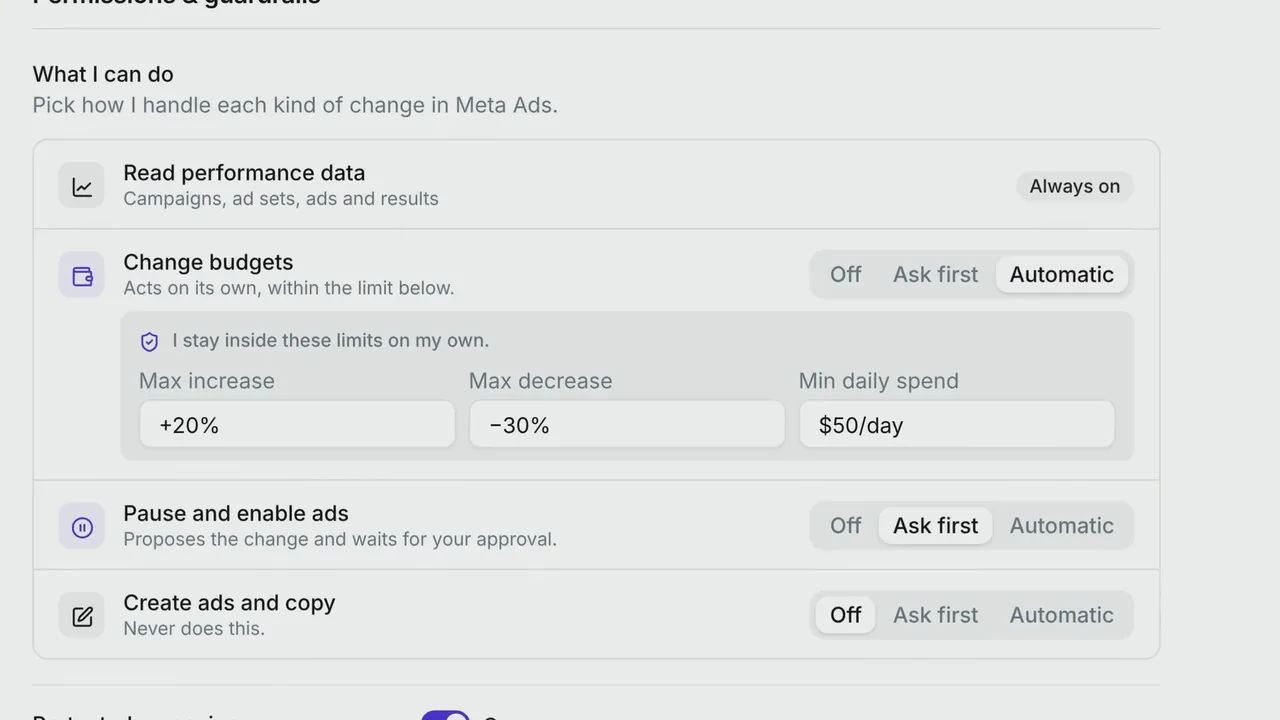
Madgicx splits Meta ad automation into three layers. First come automation rules: you write a condition once, and the rule makes that move every time the condition is met. Next are Madgicx agents, which run on a schedule for an ad account and email a summary of each run. Then there is the AI media buyer, which audits your Facebook and Instagram accounts and lines up actions on budgets, bids, ad settings and fresh creatives, ready to run. Rules act by themselves; whatever the AI lines up, and anything its AI chat builds, stays pending until you say yes.
Its natural home is an ecommerce brand, agency or media buyer with most of the paid budget on Meta and little patience for busywork there. Reporting pulls Google Ads, TikTok, Shopify, Klaviyo and Google Analytics in beside Meta, with a link or PDF for each client, and both MCP servers, one for Meta and one for Google Ads, are part of Madgicx plans, so Claude or ChatGPT can study both accounts and change the Meta one. What separates one plan from the next is the monthly ad spend it covers.
- Best for
- Automating Meta ads with rules, agents and AI you approve
- Starting price
- From $45/mo
- Free trial
- 7-day free trial
How it scores
- Yes.Rules and automationAutomation rules run Meta campaigns 24/7 on the conditions you set.
- Yes.AI actions and agentsMadgicx's AI media buyer prepares actions you approve or dismiss, and agents run on a schedule.
- Yes.Campaign creation from a chatMadgicx's AI chat builds campaigns, ad sets and ads, every change published after your approval.
- Yes.Bulk editingMadgicx edits your campaigns, ad sets and ads in bulk, with smart filters to find the ones to change.
- Yes.Alerts on your ad accountMadgicx alerts you when an account moves away from the targets you set, and suggests alerts on your Home page.
- Partly.Ad platforms coveredMadgicx optimizes Meta ads. Reporting covers Meta, Google Ads, TikTok, Shopify, Klaviyo and Google Analytics.
Pros
- Find out what your winning ads share, video included, and get told when a creative tires
- New image ads start from a prompt or an Ad Library ad; video ads start from footage you have
- Server-side tracking hosts Meta's two gateways, so more of your conversions reach Meta
- Put any question about your account to the AI chat and get answers from your own numbers
Cons
- Automates Meta only; other channels stay manual
Prices checked 23 November 2026
Markifact
9.2/10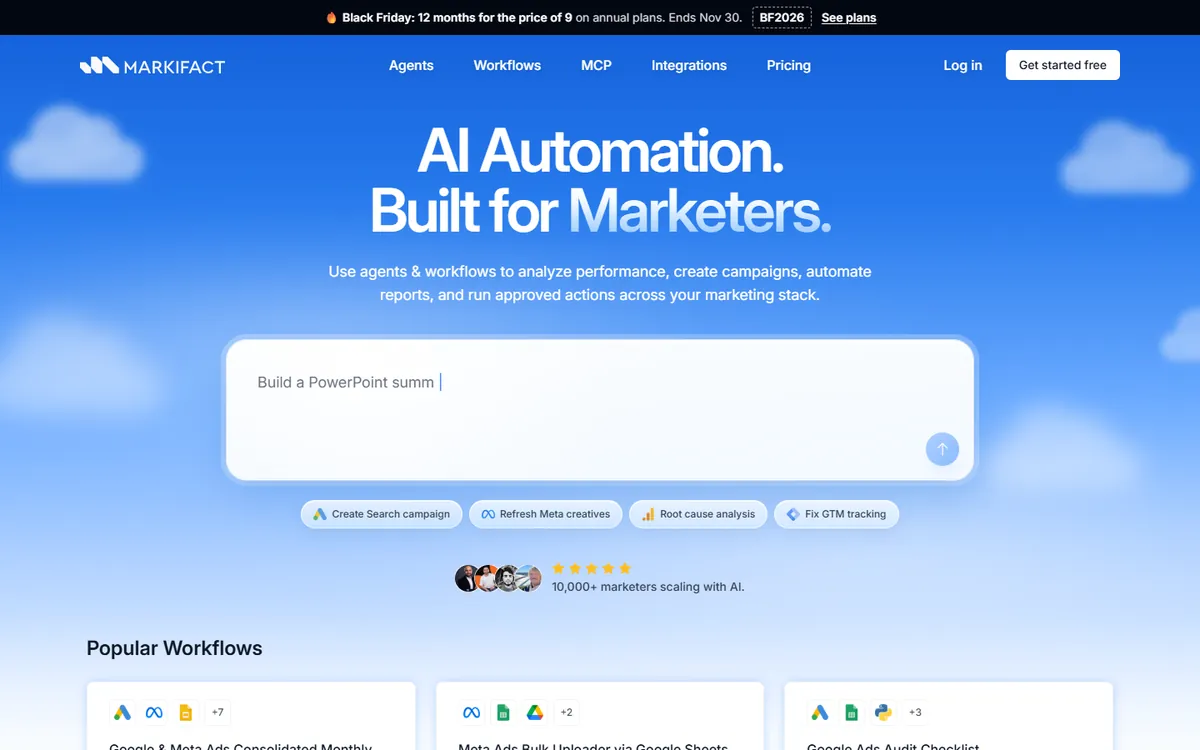
Markifact turns repeat work into workflows. You draw the steps on a canvas yourself, or let its AI copilot sketch them, then rerun the workflow whenever the job comes round again; one ready template, for example, turns a single Google Sheet into dozens of Meta ads and has TikTok and Google versions. Quick one-off jobs go to its agent as a typed task. Nothing it builds goes live until someone approves it, either in the chat or in Slack.
Solo marketers, freelancers and agencies whose work spans ad platforms and data tools like Shopify, HubSpot, GA4 and Google Sheets get the most from it. The Pro plan is a single seat; Team, at $249 a month, spans 10 to 50 seats and adds API access and priority support; and on the custom Managed plan, Markifact's own team builds and tunes your workflows.
- Best for
- One agent and workflow builder for 14 ad platforms
- Starting price
- from $79 a month
- Free trial
- Its pricing page says to start free with trial credits. We saw no free plan in its plan table.
How it scores
- Partly.Rules and automationWorkflows run manually, on a schedule or from a trigger, with templates for reporting, audits and bulk ad creation. We saw no rule builder for ad performance described.
- Yes.AI actions and agentsYou describe a marketing task in plain language and an agent carries it out, such as building campaigns or adding negative keywords. An MCP server brings its tools into Claude, ChatGPT, Gemini and Cursor.
- Yes.Campaign creation from a chatIts agent builds campaigns from natural language tasks, with approval before anything goes live.
- Partly.Bulk editingWorkflows and its agent can pause campaigns or shift budgets across many at once; we saw no bulk ad editor.
- Yes.Alerts on your ad accountWorkflow templates email you when campaign spend passes a pacing limit you set.
- Yes.Ad platforms coveredIt lists 1000+ operations across Google Ads, Meta Ads, TikTok, LinkedIn, Shopify, HubSpot, GA4, Sheets and Slack, with 14 ad platforms in total.
Pros
- Each plan on its price list comes with unlimited ad accounts, useful with many brands
- A Meta creative analysis template finds fatigue and proposes new hooks and formats
- Competitor ads from the Meta, Google, TikTok and LinkedIn libraries land in a Sheet
Cons
- No rule builder for ad results is listed; automation runs as scheduled or triggered workflows
- No standalone dashboard is described; reports go out as Slides decks, Slack briefs and email alerts
Markifact alternatives, compared · Prices checked 23 November 2026
Optmyzr
9.2/10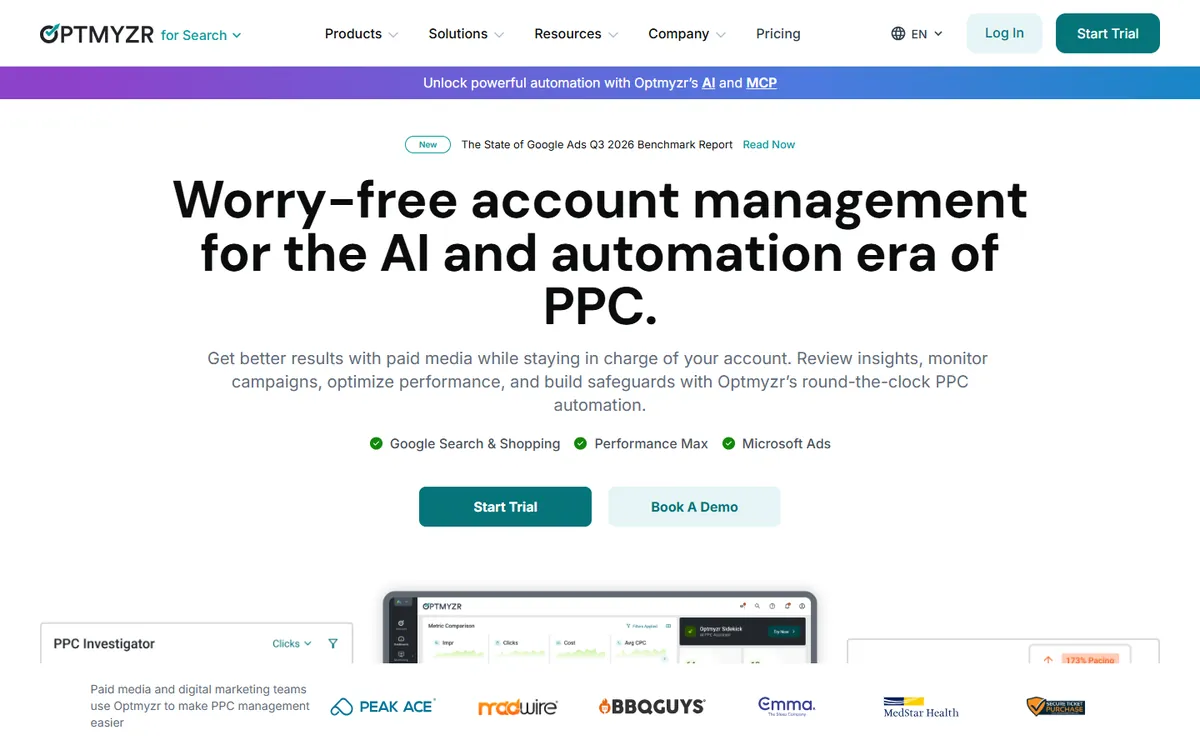
Optmyzr works on a set-and-schedule model: rules, reports and optimizations are configured once and then run on their own timetable. Its depth is in Google Ads; on the Meta side it offers a Social Rule Engine, Social Reports and, for portfolios of accounts, a Social Campaign Manager. Rules act by themselves whenever they run, and the Optmyzr MCP lets Claude or ChatGPT pull Google, Meta and other ad data while making keyword changes only.
The core buyer is a PPC specialist or agency juggling lots of Google Ads accounts with Meta on the side. Essentials stops at 25 ad accounts and core social tools; Premium lifts the account cap and brings the complete social tool set plus the whole AI Sidekick; Enterprise contributes API access, custom integrations and a dedicated account manager. Pricing tracks monthly ad spend in euros, and paying annually cuts it by 30%.
- Best for
- PPC teams that run Google Ads first and Meta second
- Starting price
- from €209 a month, billed annually
- Free trial
- A 14-day free trial on Essentials and Premium, according to its pricing page.
How it scores
- Yes.Rules and automationA Rule Engine runs weekly or monthly on Essentials, daily on Premium and hourly on request on Enterprise. Its pricing page also lists a Social Rule Engine.
- Yes.AI actions and agentsAn AI Sidekick assistant, limited on Essentials and full on Premium and Enterprise, plus AI performance summaries and account insights.
- No.Campaign creation from a chatAI Sidekick gives account insights; we saw no chat-based campaign builder on its pages.
- Yes.Bulk editingChanges budgets, bids and statuses across many Meta campaigns in a few clicks.
- Yes.Alerts on your ad accountEmail alerts when Meta CPA, CTR, ROAS or spend cross thresholds you set, plus AI spend pacing.
- Yes.Ad platforms coveredGoogle Ads is the core platform. Its pages also list Meta, LinkedIn, Microsoft Ads and Amazon Ads, and say Meta and LinkedIn tools come with every plan.
Pros
- Clusters Meta ads by their underlying creative and spots the ones wearing out
- The Rapid Campaign Launcher is part of every plan
- G2 reviewers rate it 4.7 across 143 reviews
Cons
- Essentials runs rules only weekly or monthly; daily runs need Premium, hourly ones Enterprise
- Its AI Sidekick explains accounts, but building campaigns from a chat isn't shown on its pages
Optmyzr alternatives, compared · Prices checked 23 November 2026
Bïrch
9.1/10
Bïrch, the tool once called Revealbot, puts rules at the center: publish one and it carries out its action by itself every time the conditions line up. Its AI will write a draft rule for you to review before publishing, and the chat checks with you before taking any action, unless you change that default.
Seasoned media buyers and agencies who want one set of logic on every platform, and who launch ads in volume, are its users: its Stage tool sends ads from Google Drive and Sheets out to many Meta, TikTok and Snapchat accounts at once. Essential has no rules and Pro does, either plan is priced on your combined ad spend across connected platforms, and going past a plan's limit means paying a fee.
- Best for
- Rules you write once and run on four ad platforms
- Starting price
- from $49 a month
- Free trial
- A 14-day free trial with all features. We saw no free plan.
How it scores
- Yes.Rules and automationRules with nested conditions that pause or start campaigns, change budgets and bids and send alerts, checked as often as every 15 minutes, plus a library of ready-made strategies.
- Partly.AI actions and agentsBïrch AI reads performance and, with Meta MCP connected, edits ads or builds paused campaigns when you ask.
- Yes.Campaign creation from a chatWith Meta MCP connected, Bïrch AI creates campaigns, ad sets and ads from a chat; all start paused.
- Partly.Bulk editingBïrch AI makes bulk changes to Meta campaigns, ad sets or ads you name; we saw no bulk editor.
- Yes.Alerts on your ad accountCustomizable Slack and email alerts on your campaigns, and rules that send alerts when conditions are met.
- Yes.Ad platforms coveredRules run on Meta, Google Ads, TikTok and Snapchat. The bulk ad builder covers Meta, TikTok and Snapchat.
Pros
- Ready-made reports surface your best and declining ads
- Launch several ad sets in one go, up to 50 ads in each
- Claude or ChatGPT can read and adjust your Bïrch rules through its MCP
Cons
- Its AI works on request: Bïrch AI reads results and edits ads when you ask in chat
- You supply every creative; image or video ad creation isn't shown on its pages
Madgicx vs Bïrch · Prices checked 23 November 2026
Adkit
8.5/10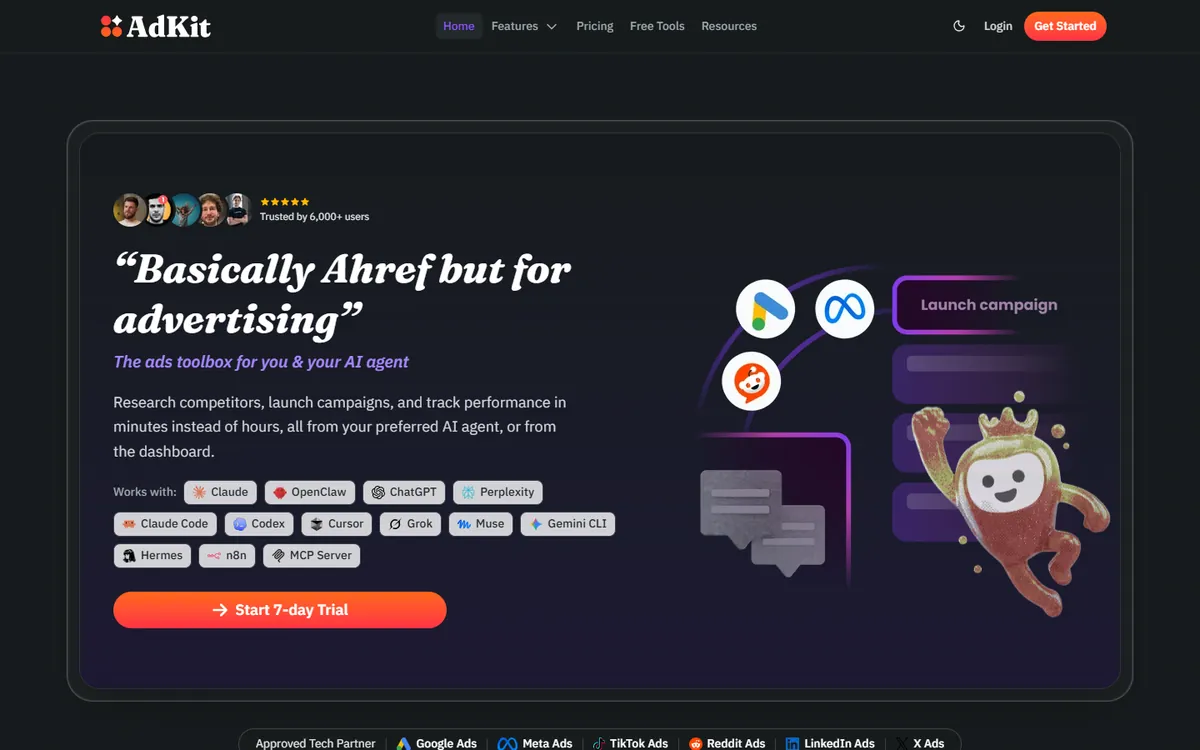
Adkit starts where your AI agent already lives. You ask Claude, ChatGPT or Cursor for something, the agent carries it out through Adkit's MCP server or command line, and the result sits in Adkit's dashboard as a draft until you sign off, so nothing reaches a running campaign unseen. Its Meta page shows drafts of new campaigns next to paused ads and budget shifts.
The fit is marketers, freelancers and agencies already delegating to an AI agent who want a checkpoint before anything changes. Plans split on scope: the entry Single Project plan allows one project with one ad account on each platform, and the $49 Multiple Projects plan removes both limits. A yearly toggle on its pricing page claims savings of 30% or more without showing yearly prices.
- Best for
- A review screen between your AI agent and live ads
- Starting price
- from $29 a month
- Free trial
- A 7-day free trial on both plans. We saw no free plan.
How it scores
- No.Rules and automationWe saw no rule-based automation on its pages. It lists activity alerts and a weekly competitor digest.
- Yes.AI actions and agentsIts MCP server and CLI let agents such as Claude, ChatGPT and Cursor run your ads. Every change is saved as a draft and nothing goes live until you approve it.
- Yes.Campaign creation from a chatIts MCP server and CLI let AI agents build campaigns as drafts for your approval.
- Yes.Bulk editingOne prompt changes many campaigns, such as budgets on every campaign under 1.5 ROAS, as drafts you approve.
- No.Alerts on your ad accountWe saw no alerts on your own ad results; its Activity Alerts flag new competitor campaigns.
- Yes.Ad platforms coveredIts pricing page lists Meta, Google, TikTok, Reddit, LinkedIn, X and Microsoft Ads.
Pros
- Its AI builds static ads from nothing, or starts from a competitor's ad as a template
- Search 1M+ ads, follow competitors' new campaigns and save finds to a swipe file
- Ask the agent for Meta numbers and it explains what's working
Cons
- Every change starts with a prompt; rules that act on results by themselves aren't on its pages
- Its alerts track competitors' new campaigns; alerts on your own results aren't shown
Adkit alternatives, compared · Prices checked 23 November 2026
GoMarble
8.4/10
GoMarble's agents pull ad platform and analytics data into one view, work out what changed in performance and why, then queue the actions that follow. According to its pages, nothing in your account moves without a yes; on the upper plans, an audit trail and approval policies let you set which teammate signs off on which kind of change.
Its buyers are in-house performance teams and agencies with several ad accounts and data sources. The main choice is read or write: on Copilot the agents can only read, for up to $50K of monthly spend across 5 ad accounts, while Operator at $399 lets them make approved changes and launch campaigns for up to $500K across 15. Scale, at $799, stretches to $1.5M, and extra credits, accounts and seats are add-ons.
- Best for
- Agents that explain results and line up fixes for approval
- Starting price
- from $139 a month
- Free trial
- A 7-day trial on each paid plan. Its FAQ also describes a free option with 100 one-time AI credits, but that option is not in the plan table.
How it scores
- Partly.Rules and automationAgents run continuously and can flag changes such as creative fatigue in Slack. We saw no rule builder described on its pages.
- Yes.AI actions and agentsA team of specialist agents scans campaigns, creatives, audiences and search terms, and prepares account changes for approval. It can also be used from Claude and ChatGPT through a connector.
- Partly.Campaign creation from a chatIts agents build and launch campaigns as plays on higher plans, via its Claude and ChatGPT connector.
- No.Bulk editingWe saw no bulk editor; its agents pause ads and adjust budgets you approve, on Operator and up.
- Yes.Alerts on your ad accountMonitoring agents flag issues such as creative fatigue; Slack alerts start on the Operator plan.
- Yes.Ad platforms coveredMeta, Google, TikTok and Microsoft Ads, plus GA4, Shopify and Klaviyo, with 80+ more connectors listed.
Pros
- Breaks results down by hook, format, message and visual, and spots fatigue
- Scheduled reports for your team or clients on every paid plan
- Competitor ad research on every plan, plus a free Meta ad library
Cons
- Your own if-then rules aren't described; agents watch the account and flag issues instead
- Makes no image or video ads on its pages; it reviews your creatives and writes briefs
GoMarble alternatives, compared · Prices checked 23 November 2026
Skai
8.4/10
Skai is a single enterprise platform for paid search, paid social and retail media, from planning and activation through optimization and measurement. Celeste AI suggests what to do next while your team makes the call, and Agent Connect opens Skai to outside assistants such as ChatGPT, Claude and Gemini, which can read its data and create or update campaigns over MCP.
Its buyers are large advertisers and agencies; anyone smaller is pointed to reseller partners on its pricing page. The yearly fee climbs with media volume: $276,000 covers up to $10M on Advanced, $504,000 up to $20M on Enterprise and $756,000 up to $35M on Enterprise Premier, and media beyond that is priced individually.
- Best for
- Enterprise budgets spread across search, social and retail media
- Starting price
- from $114,000 a year
- Free trial
- We saw no free plan or trial on its pricing page. It mentions reviewing your commitment after the first three months.
How it scores
- Partly.Rules and automationIts Standard plan lists automation and optimization. Its pages do not describe rule-based automation in detail.
- Yes.AI actions and agentsCeleste AI gives recommendations while you plan, activate, optimize and measure media. Skai Studio builds your own agents and Agent Connect links outside agents through MCP.
- No.Campaign creation from a chatCeleste AI gives recommendations; we saw no natural-language campaign builder on its pages.
- Yes.Bulk editingBulk edits campaigns, ad groups and ads in the platform, or through uploaded spreadsheets.
- Partly.Alerts on your ad accountAI alerts flag unusual spend and performance shifts; its notification examples are for search and retail media.
- Yes.Ad platforms coveredIt says it covers 300+ channels, naming Amazon, Walmart, TikTok, Google and Meta.
Pros
- Its Creative AI labels Meta images and videos and shows which creative traits perform
- Every plan includes a dedicated client success team
- Upper tiers bring competitive insights, search term analysis and journey intelligence
Cons
- How its rules work isn't explained on its pages; the Standard plan just lists automation
- Its alert examples cover search and retail media, with none shown for paid social
Skai alternatives, compared · Prices checked 23 November 2026
Pipeboard
8.2/10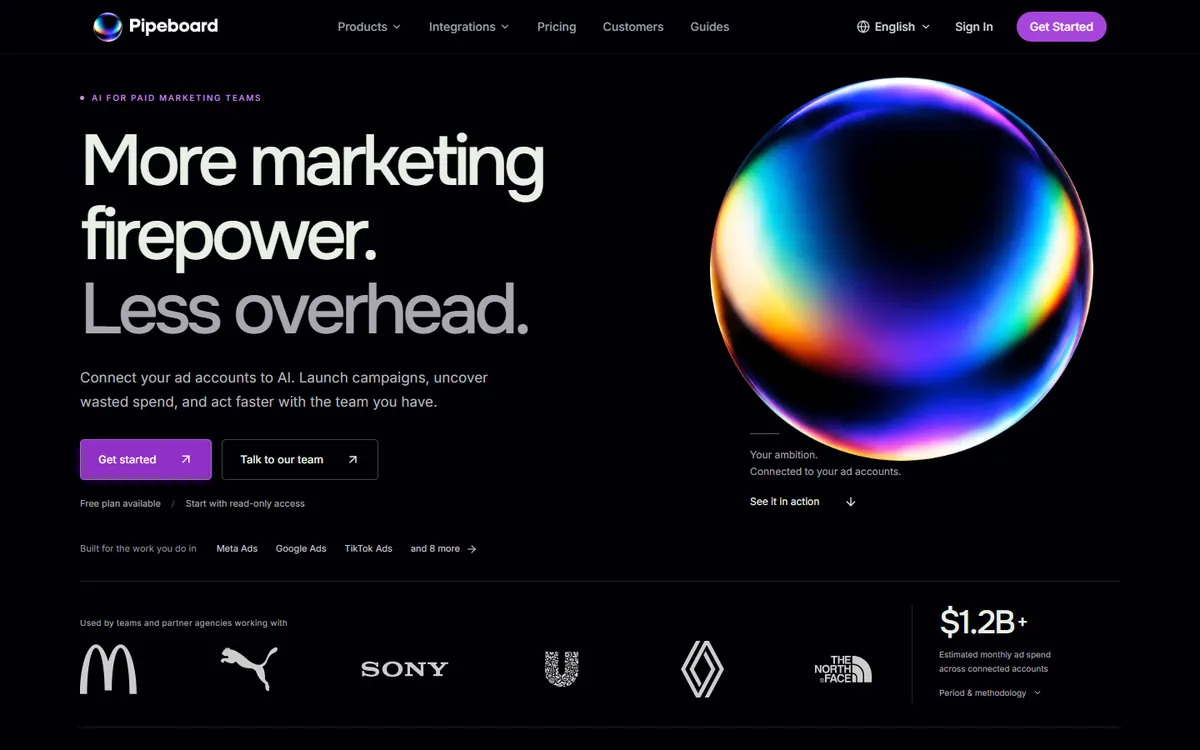
Pipeboard doesn't give you another app to work in. It hands your AI assistant, whether Claude, ChatGPT, Claude Code, Cursor or Codex, access to your ad accounts over MCP, with tokens you can keep read-only or narrow to chosen accounts and tools. Campaigns it creates begin paused, and its own pages tell you to check what you're asking the assistant to do.
It's made for marketers and agencies whose working day already runs through an assistant; how much it can do differs from one platform to the next, and some platforms are still previews. Paid tiers are sized by ad account slots: three and a single user on Pro, ten on Premium ($99) with bulk operations and room for five team accounts, 25 on Agency ($199) with token scoping per account, plus $10 a month for every extra slot.
- Best for
- Running ad accounts from Claude, ChatGPT or Cursor
- Starting price
- from $29.90 a month
- Free trial
- A free plan with 30 AI tool executions a week and 2 ad account slots. The 7-day free trial covers monthly Pro and Premium only; annual plans have a 30-day money-back guarantee instead.
How it scores
- No.Rules and automationWe saw no rule-based automation on its pages. They mention reusable prompts for repeatable work and n8n as a supported tool.
- Yes.AI actions and agentsIt connects assistants such as Claude, ChatGPT, Claude Code, Cursor and Codex to your ad accounts through MCP, so the assistant reviews performance and acts on your instructions.
- Yes.Campaign creation from a chatIts core purpose is letting Claude, ChatGPT or Cursor build and change campaigns through MCP.
- Partly.Bulk editingYour AI assistant can change budgets, bids or status across many ads at once, on Premium and Agency.
- No.Alerts on your ad accountWe saw no alerts on its pages; your AI assistant checks performance when you ask.
- Yes.Ad platforms coveredIts home page lists Meta, Google, TikTok, LinkedIn, Microsoft, Pinterest, Snap and Reddit Ads, plus Google Analytics, Search Console and Merchant. It says some are previews and what you can do varies by platform.
Pros
- Your assistant can look up other advertisers' ads in Meta's Ad Library
- Batch uploads take up to 100 creatives at once on Premium
- Annual billing gives twelve months for the price of ten
Cons
- Automation waits on your prompts; rules and alerts aren't part of it on its pages
- The judgment comes from the assistant you connect; Pipeboard adds access, not analysis
Pipeboard alternatives, compared · Prices checked 23 November 2026
AdManage
8.2/10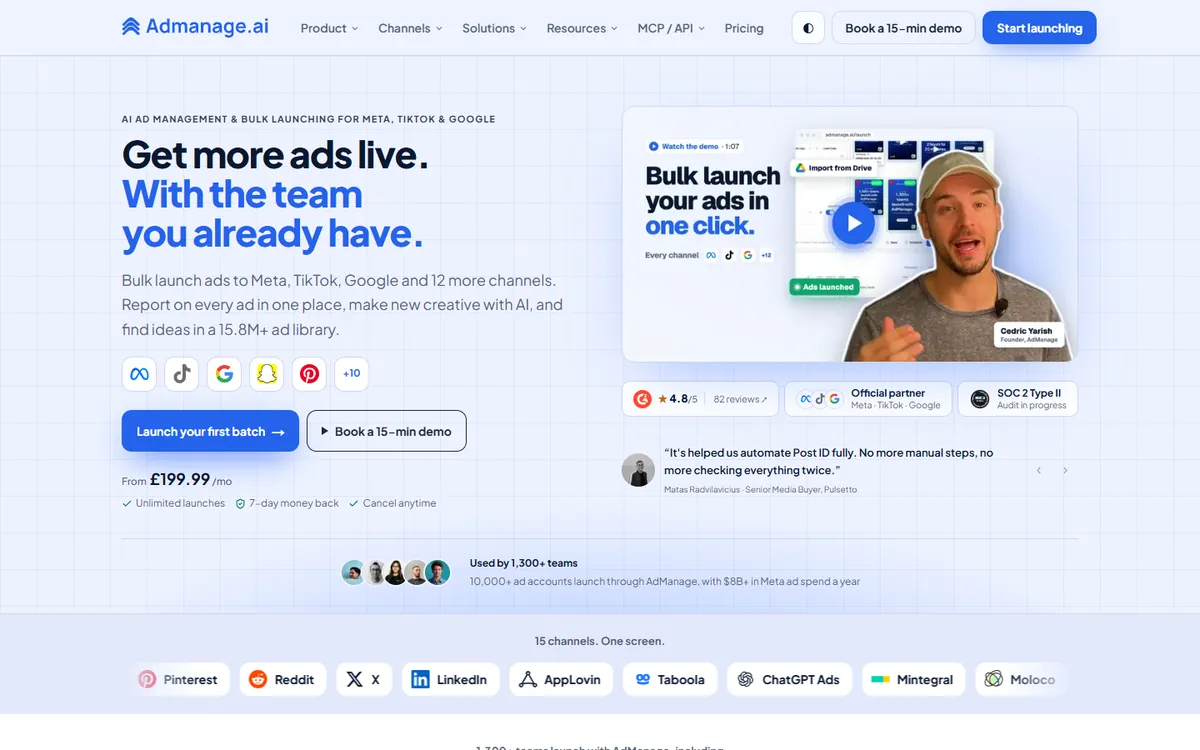
AdManage exists to launch. Point it at creatives stored in Google Drive, Dropbox, Frame.io, Canva or Google Sheets, define naming, copy and UTMs one time, and it ships batches of ads to whichever channels you choose. On Google, TikTok and the rest it creates the campaigns as well, while on Meta it adds ads to ad sets you already have or to copies of them. Through its MCP, Claude, ChatGPT or Cursor can pull reports and draft, launch or edit ads, but can only read until you grant write access.
Media buyers, in-house teams and agencies pushing large ad volumes across several channels are the audience. Plans, priced in GBP, scale with ad accounts: Essential includes one account and one automation rule, with each extra account at £99.99 a month; In-house (£499.99) has 5 accounts and 10 rules; Agency (£999.99) has 10 accounts and no cap on rules.
- Best for
- Launching and editing ads in bulk across 15 channels
- Starting price
- from £199.99 a month
- Free trial
- We saw no free plan or free trial on its pricing page. It offers a 7-day money-back guarantee on Essential and 30 days on the larger plans.
How it scores
- Partly.Rules and automationRules can pause weak ads, scale strong ones and hide comments. Essential includes 1 monitoring or comments rule; performance automations start on In-house with 10 rules; Agency has unlimited.
- No.AI actions and agentsIt is a bulk launch tool; we saw no AI media buyer on its pages.
- Yes.Campaign creation from a chatIts MCP connection lets Claude or Perplexity launch ads from a chat.
- Yes.Bulk editingIts home page says you can change status, budgets, copy and URLs on hundreds of live ads at once, and duplicate ads, ad sets and campaigns.
- Yes.Alerts on your ad accountSlack alerts when an ad crosses CPA, ROAS, CTR or other thresholds you set.
- Yes.Ad platforms coveredIts pricing page lists 15 platforms, including Meta, TikTok, Google, Snapchat, Pinterest, Reddit, X and LinkedIn.
Pros
- Compares creative results across Meta, TikTok and Google, with hit-rate and fatigue reports
- Client preview links before launch, and shareable reports after it
- Turns product images or a prompt into video ads with AI video models
Cons
- No AI media buyer on its pages; it launches and edits what you tell it to
- Performance rules start on In-house; Essential's single rule covers monitoring or comments
AdManage alternatives, compared · Prices checked 23 November 2026
Smartly.io
7.9/10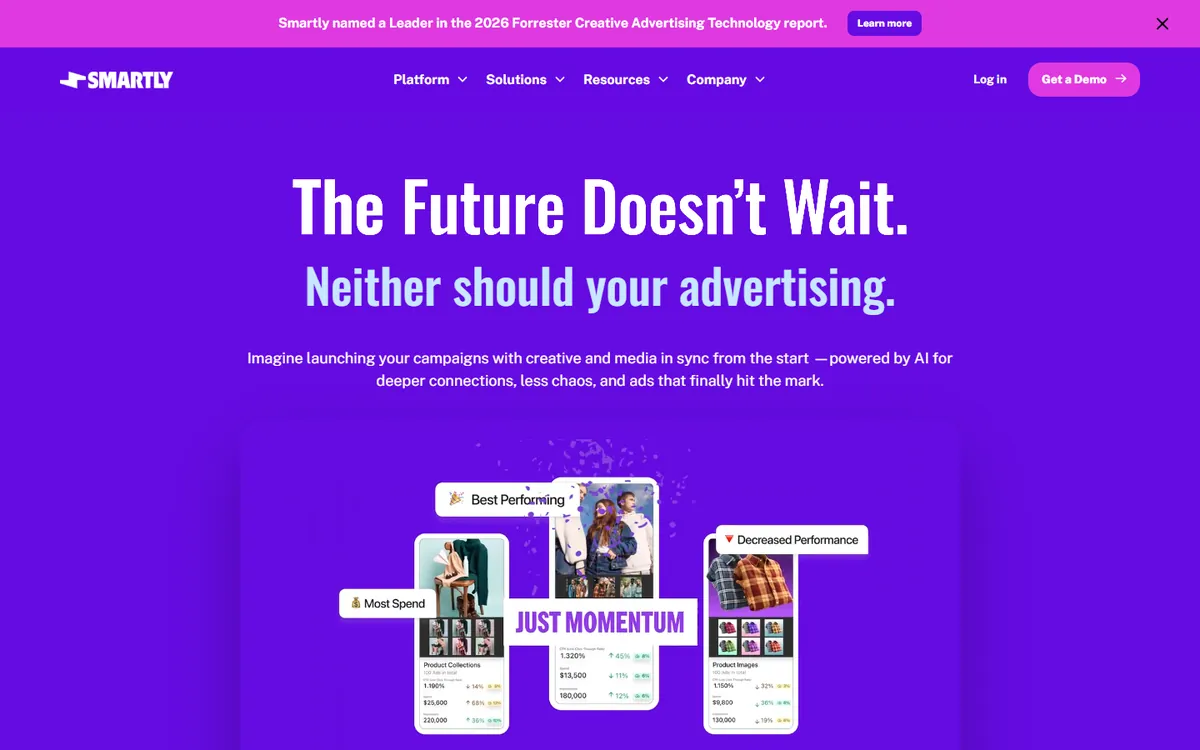
Smartly.io asks your team to build the automation first. Link a campaign blueprint to a product feed and it spins out many campaigns; dynamic templates reshape each image or video ad for other formats and channels; and a shared workspace is where teammates approve ads before launch.
Its customers are enterprise brands and agencies with big creative teams, signed by contract after a demo. Plan for an implementation project, not a quick start: G2 lists two months as the average implementation time, and 12 of its 20 latest G2 reviews single out the support team for praise.
- Best for
- Large creative teams that run campaigns from blueprints
- Starting price
- by quote
- Free trial
- We saw no free plan or trial on its pages. Its site asks you to book a demo.
How it scores
- Yes.Rules and automationTriggers switch ads on or off by performance, weather or time of day, and budget moves between selected campaigns by predicted performance.
- No.AI actions and agentsBudget moves between campaigns by predicted performance, run from the blueprints and triggers you set.
- No.Campaign creation from a chatBlueprint-based creation; we saw no natural-language campaign builder on its pages.
- Yes.Bulk editingAutomated Ads creates, updates and archives ads at scale from a synced sheet or feed.
- Yes.Alerts on your ad accountTriggers can email you when conditions are met, such as ad sets not spending; catalog alerts too.
- Yes.Ad platforms coveredIts product pages name Meta, TikTok, Snapchat, Pinterest and YouTube. It describes itself as cross-channel; check with its team for the full list.
Pros
- AI Studio makes and edits images; its video templates can add an AI voiceover
- Its creative insights link content, CTAs and visuals to performance KPIs
- Predicts how creative will perform before launch, then tracks reach and frequency
Cons
- Automation is only what you design in blueprints and triggers; no AI agent is on its pages
- Campaigns come from blueprints and feeds; a chat builder or AI assistant connector isn't shown
Madgicx vs Smartly.io · Prices checked 23 November 2026
Albert.ai
7.1/10
Albert.ai plugs into the ad accounts you already run. Once you hand it goals and limits, its AI shifts budgets, bids, audiences and creative rotation to meet them, assembling campaigns, ad sets and ad variations out of assets your team provides. Creative itself stays with you: by its own FAQ, Albert.ai neither develops creative nor writes ad copy.
Large brands and agencies that prefer to buy through a sales team are the market. Its estimate form opens with a question about your yearly ad budget, whose smallest band is $100k to $500k and whose largest is over $10M, and engagements usually begin, per its FAQ, with a proof of concept lasting three months.
- Best for
- Large budgets optimized by AI across search, social and video
- Starting price
- by custom quote
- Free trial
- Its pricing page mentions no free plan or trial, only a form to request an estimate.
How it scores
- Not described.Rules and automationIts home page describes self-optimizing campaign management toward your goals. We saw no rule builder described.
- Yes.AI actions and agentsIts site describes self-optimizing campaign design and management that shifts spend between audience segments as performance changes.
- No.Campaign creation from a chatAutonomous budget and bid optimization; we saw no chat-based campaign interface on its pages.
- No.Bulk editingWe saw no bulk editing tool; its AI adjusts bids, budgets and audiences on its own.
- No.Alerts on your ad accountWe saw no alerts on its pages; its AI makes changes on its own within the guardrails you set.
- Yes.Ad platforms coveredIts home page shows Bing, Instagram, Facebook, YouTube, TikTok and DV360, and says it covers 90% of the biddable universe.
Pros
- Runs on Bing, YouTube, TikTok and DV360 as well as Facebook and Instagram
- Tests creative elements one at a time and says when an ad is due for a refresh
- Creative reports and insights sit next to weekly, monthly and quarterly campaign reports
Cons
- Whether changes wait for your sign-off before going live isn't stated on its site
- Alerts aren't described; its AI adjusts campaigns by itself inside your guardrails
Albert.ai alternatives, compared · Prices checked 23 November 2026
What should the best paid media automation tools do for you?
Paid media automation means software doing the repeat work of running ads: switching off spend that isn't paying back, moving budget to what converts, launching new ads, reporting across channels and warning you when results drift. Madgicx ranks first in our list with 9.6/10. On Meta, its automation rules act the moment your conditions are met, its agents follow a schedule you set for the account, and its AI media buyer queues up the next actions, each of which runs only after you approve it.
We scored six capabilities that separate the strong tools from the rest: rules that act on conditions you define, AI that prepares or takes actions, campaigns built from a chat request, changes to many ads at once, alerts when results cross a threshold, and the ad platforms each tool can act on. For a budget split across channels, that last one decides a lot: some tools go deep on a single platform, others reach 14 platforms or more.
The eleven tools below run from self-serve apps with a trial you can start today up to enterprise platforms on annual contracts. They also split on who makes the final call: a rule you wrote, a person approving what the AI suggests, or an optimizer working within limits you set.
Which parts of paid media work can you automate?
Paid media work breaks down into six jobs that come back every week. Here is which tools take on each one, and how, from rules you write to AI that asks first. For a shorter list of ideas to start from, see seven Meta ad automation examples.
Pausing spend that isn't paying back
A rule is the classic tool here: once an ad set has spent past a set amount with nothing to show, turn it off. Bïrch (9.1/10) evaluates nested conditions as often as every 15 minutes; Optmyzr (9.2/10) schedules its Rule Engine anywhere from weekly to hourly, depending on plan; Smartly.io (7.9/10) offers triggers keyed to weather and time of day as well as results. On Madgicx, automation rules keep watch over your Meta campaigns day and night, and AdManage (8.2/10) can pause weak ads and scale strong ones once you are on its In-house or Agency plan.
Moving budget toward what converts
Budget moves are where AI does more than a rule can. Madgicx's AI media buyer prepares budget and bid changes across your Meta account for you to approve. Albert.ai (7.1/10) shifts spend between audience segments as results change, Smartly.io moves budget between the campaigns you select by predicted performance, and Adkit (8.5/10) lets one prompt change many campaigns at once, such as the budget on every campaign under 1.5 ROAS, saved as drafts.
Building and launching campaigns and ads
Launching takes the most hours on a busy account, and the tools split here. Madgicx's AI chat builds campaigns, ad sets and ads on Meta, including video ads from an MP4 or MOV file, and creates each one only after you approve it. The agent in Markifact (9.2/10) creates campaigns and uploads ads across channels, AdManage pushes batches of ads to 15 channels from your storage tools, and Bïrch's Stage launches ads in bulk to Meta, TikTok and Snapchat accounts.
Watching results and raising alerts
An alert does the watching, so a person only steps in when something moves. Madgicx lets you set targets for the metrics you judge an account on and tells you when the account moves away from them. Optmyzr emails you when a threshold you set on Meta CPA, CTR, ROAS or spend is crossed, AdManage posts Slack alerts on CPA, ROAS and CTR, GoMarble (8.4/10) has monitoring agents that flag issues such as creative fatigue, with Slack alerts from its Operator plan, and Skai (8.4/10) has AI alerts for unusual spend and performance.
Reporting across every channel
Reports are often the first job teams automate, because they repeat every week. Madgicx brings Meta, Google Ads, TikTok, Shopify, Klaviyo and Google Analytics data into one place and shares reports with each client by link or PDF. GoMarble includes scheduled reports on every paid plan, Markifact's workflows turn Google and Meta results into Google Slides decks, and AdManage compares creative results across Meta, TikTok and Google. Channels only line up in a report if your links are tagged the same way everywhere; the Facebook UTM builder tags Meta ad links with Meta's dynamic values, or a whole sheet of links at once.
AI that runs on a schedule
The newest kind of automation needs no prompt at all. Madgicx agents run on a schedule for an ad account and email a summary of each run, so the update comes to your inbox. Markifact runs workflows on a schedule, and GoMarble's agents run continuously and flag issues in Slack. Pipeboard (8.2/10) works the other way round: your assistant looks at the account when you ask it to.
Which automation comes with your Meta ad account?
Before paying for anything, know what Meta already automates in every ad account, with no extra plan required. For each feature below: what it does, the limits Meta's own pages state, and the gap a paid media tool fills.
Automated rules
In Ads Manager, an automated rule looks at your campaigns, ad sets or ads and then either changes them or tells you something. The moves on offer: switch items on or off, push a daily or lifetime budget up or down, change a manual bid, scale a budget or bid, or simply notify you and anyone else on the ad account. Meta runs each rule no less than once every 30 minutes, or on days and times you choose, and allows 250 rules per ad account, the inactive ones counted.
Meta's stated limits: a condition may appear only once in a rule, and a rule covers a single level, so campaigns or ad sets but never both together. Ads about social issues, elections or politics are out of scope for rules, as is pausing a reservation campaign. Changing a manual bid works only where the ad already uses a manual bid, and Meta still tells you to keep an eye on overall performance. Our answer on automating Facebook ads includes a table of example rules.
What a tool adds: one rule set that also covers Google Ads, TikTok and Snapchat, as Bïrch's does, plus AI that looks beyond the conditions you thought of. In Madgicx, the AI media buyer scans the whole account for optimization opportunities and turns each into an action ready for review.
Budget scheduling
Budget scheduling lets you plan budget increases ahead for chosen days or times, such as a weekend sale; a campaign or ad set can carry as many as 50 of these high-demand periods. Meta's limits: it is only for campaigns on a daily budget, every period runs 3 hours or longer, and no scheduled increase may exceed 8 times the daily budget. A schedule reacts to the calendar, while rules and AI react to results, for example adding budget for as long as ROAS stays above target.
Advantage+ campaign budget
Advantage+ campaign budget holds the budget at campaign level and reallocates it in real time to the ad sets showing the best opportunities, inside any per-ad-set minimum or maximum you set. Meta lists its conditions: spend across ad sets may not be even, it works best with at least two ad sets, and all ad sets must share one budget type, one bid strategy and standard delivery. It stops at the campaign's edge, so shifting money between campaigns, ad accounts or channels is still your job or a tool's.
Advantage+ sales, app and leads campaigns
Pick a sales, app promotion or leads objective and Ads Manager switches to its Advantage+ setup, in which AI runs across the whole campaign. For leads, that setup is the default; for apps, Meta's AI handles bidding, audiences and placements; and the manual campaign options remain available throughout. The limits Meta gives: set the budget, audience or placements too narrowly and that section drops out of Advantage+, and campaigns in a special ad category may miss some features. Automation tools sit around these campaigns rather than inside them, deciding budgets across campaigns, feeding in new ads and reporting on results beside your other channels.
Scheduled reports in Meta Ads Reporting
Meta Ads Reporting lets you assemble a custom report from breakdowns, metrics and filters, then export it to .xlsx or .csv, share a link, or have a recurring copy emailed to you or a colleague. A cross-account report sets several ad accounts side by side, cumulative unique reach and frequency included. Meta's limits: cross-account reports can't go out on an email schedule, hold at most 24 months of data, skip some metrics and can't mix time zones, and any report opens only for people who have permissions on that ad account. The gap a tool fills is the rest of your channels: Madgicx's reports show Google Ads, TikTok, Shopify, Klaviyo and Google Analytics beside Meta.
Delivery and spending notifications
Meta's own notifications carry status updates, results and tips, and they warn you when delivery or performance shifts suddenly; a campaign spending limit also triggers a notice once it is reached. A tool lets you pick the threshold: Madgicx flags an account that drifts from the targets you entered, and Optmyzr and AdManage alert on CPA or ROAS levels of your choosing.
Meta's ads AI connectors
Since 29 April 2026, Meta's ads AI connectors have been in open beta: Meta hosts an MCP server that any MCP-compatible agent can connect to, and its setup guides cover Claude Code and ChatGPT. Through it, an agent can pull results and create or edit campaigns, ad sets and ads; anything it creates starts paused, and the AI client asks you before switching it on. A July 2026 update let admins limit what agents may do in each ad account, a feature still in limited availability, and Meta notes that not every tool may be open to you yet. Our guide to the Facebook ads MCP covers setup and everyday use.
Meta frames the connector as a secure, authenticated path between your ad account and an AI agent; insights across channels and custom workflows are left to whatever AI tools you bring. Madgicx fills that space for Meta: its MCP server gives Claude or ChatGPT Madgicx's own analysis plus actions on status, budgets, bids, spending limits and names, and its Google Ads server adds analysis of Google Ads accounts in the same assistant.
What a paid media automation tool adds
Meta's automation works inside Meta. What a paid media tool brings is everything around it: rules and AI spanning campaigns and accounts, alerts tied to your own targets, high-volume launches, reports that include your other channels and, with some tools, changes on Google, TikTok and beyond. For Meta, Madgicx is that layer, with Google Ads, TikTok, Shopify, Klaviyo and Google Analytics in the reports; Madgicx vs Meta Ads Manager sets out what it adds on top of Ads Manager.
How much do paid media automation tools cost?
| Tool | Starting price | How you pay | Free trial | Prices checked |
|---|---|---|---|---|
| Madgicx | From $45/mo | Priced by monthly ad spend, from $45 a month, billed monthly, quarterly or annually. | 7-day free trial | 23 November 2026 |
| Markifact | from $79 a month | A monthly plan: Pro $79 a month for one seat, Team $249 a month, and a custom Managed plan. Credits and seats scale with the option you pick. | Its pricing page says to start free with trial credits. We saw no free plan in its plan table. | 23 November 2026 |
| Optmyzr | from €209 a month, billed annually | Essentials and Premium plans, priced by your monthly ad spend in euros. At the lowest spend bracket (up to €25K), Essentials is €209 a month billed annually or €299 billed monthly, and Premium is €272 or €389. Enterprise is custom. | A 14-day free trial on Essentials and Premium, according to its pricing page. | 23 November 2026 |
| Bïrch | from $49 a month | A monthly plan priced by your ad spend across connected platforms: $49 or $99 a month, with Enterprise by quote. | A 14-day free trial with all features. We saw no free plan. | 23 November 2026 |
| Adkit | from $29 a month | A monthly plan: Single Project $29 a month or Multiple Projects $49 a month, both with a 7-day free trial. A yearly toggle says it saves 30% or more, without yearly prices. | A 7-day free trial on both plans. We saw no free plan. | 23 November 2026 |
| Go |
from $139 a month | Monthly plans sized by ad spend: Copilot $139, Operator $399 and Scale $799 a month, with Enterprise by quote. | A 7-day trial on each paid plan. Its FAQ also describes a free option with 100 one-time AI credits, but that option is not in the plan table. | 23 November 2026 |
| Skai | from $114,000 a year | Yearly plans: Standard $114k, Advanced $276k, Enterprise $504k, Enterprise Premier $756k. Over $35M of media a year is custom. | We saw no free plan or trial on its pricing page. It mentions reviewing your commitment after the first three months. | 23 November 2026 |
| Pipeboard | from $29.90 a month | A free plan, then monthly plans: Pro $29.90, Premium $99 and Agency $199 a month. Extra ad account slots cost $10 a month each. Secure Enterprise is custom. | A free plan with 30 AI tool executions a week and 2 ad account slots. The 7-day free trial covers monthly Pro and Premium only; annual plans have a 30-day money-back guarantee instead. | 23 November 2026 |
| Ad |
from £199.99 a month | A monthly plan priced in GBP, from £199.99 for one ad account. Plans differ by ad accounts, AI credits and automation rules. | We saw no free plan or free trial on its pricing page. It offers a 7-day money-back guarantee on Essential and 30 days on the larger plans. | 23 November 2026 |
| Smartly.io | by quote | Quote only. Its site asks you to book a demo and lists no plans, prices or free trial. | We saw no free plan or trial on its pages. Its site asks you to book a demo. | 23 November 2026 |
| Albert.ai | by custom quote | A custom quote. Its pricing page publishes no plans or prices and asks you to request an estimate. | Its pricing page mentions no free plan or trial, only a form to request an estimate. | 23 November 2026 |
How does the price grow with spend, accounts and channels?
The table above shows where each tool starts. For a team automating several channels, what matters more is what makes the bill grow, and which plan unlocks the automation itself.
- Ad spend: Madgicx plans track your monthly ad spend. Bïrch also prices on spend, counted across all connected platforms, keeps rules for its $99 Pro plan and charges extra past a plan's limit. Optmyzr's euro prices follow spend brackets that start at €25K and run beyond €500K, and paying yearly takes 30% off.
- Spend band plus write access: GoMarble's price rises with monthly ad spend, and its agents only get write access from the $399 Operator plan up.
- Seats: Markifact's Pro is one seat with unlimited ad accounts, Team ($249) runs from 10 to 50 seats, and the credit allowance depends on the option chosen.
- Ad accounts: each extra account adds £99.99 a month on AdManage's Essential plan and each extra slot $10 a month on Pipeboard, while Adkit's $49 plan removes the limit on projects and ad accounts.
- Media under management: Skai's annual price grows with the media you run, from Standard (up to $4M a year) to Enterprise Premier ($756,000, up to $35M).
- Quote: Smartly.io signs contracts after a demo, and Albert.ai's estimate form asks for a yearly ad budget, starting from a $100k to $500k band.
Meta's own automation, covered above, comes with your ad account; what you pay Meta is the ad spend you decide on.
Which features does each tool cover?
| Tool | Score | Rules and automation | AI actions and agents | Campaign creation from a chat | Bulk editing | Alerts on your ad account | Ad platforms covered |
|---|---|---|---|---|---|---|---|
| Madgicx | 9.6/10 | Yes. | Yes. | Yes. | Yes. | Yes. | Partly. |
| Markifact | 9.2/10 | Partly. | Yes. | Yes. | Partly. | Yes. | Yes. |
| Optmyzr | 9.2/10 | Yes. | Yes. | No. | Yes. | Yes. | Yes. |
| Bïrch | 9.1/10 | Yes. | Partly. | Yes. | Partly. | Yes. | Yes. |
| Adkit | 8.5/10 | No. | Yes. | Yes. | Yes. | No. | Yes. |
| Go |
8.4/10 | Partly. | Yes. | Partly. | No. | Yes. | Yes. |
| Skai | 8.4/10 | Partly. | Yes. | No. | Yes. | Partly. | Yes. |
| Pipeboard | 8.2/10 | No. | Yes. | Yes. | Partly. | No. | Yes. |
| Ad |
8.2/10 | Partly. | No. | Yes. | Yes. | Yes. | Yes. |
| Smartly.io | 7.9/10 | Yes. | No. | No. | Yes. | Yes. | Yes. |
| Albert.ai | 7.1/10 | Not described. | Yes. | No. | No. | No. | Yes. |
Which ad platforms can each tool act on?
A cross-channel team needs two answers per tool: which platforms it can change, and which it only reports on. Here is what each tool's own pages list.
- Madgicx: makes changes on Meta (Facebook and Instagram) ads; reports also cover Google Ads, TikTok, Shopify, Klaviyo and Google Analytics, and its Google Ads MCP server lets an assistant analyze Google Ads data, custom GAQL queries included.
- Markifact: 14 ad platforms, among them Google Ads, Meta, TikTok and LinkedIn, plus data tools such as Shopify, HubSpot, GA4, Sheets and Slack.
- Optmyzr: Google Ads at the core, with Meta, LinkedIn, Microsoft Ads and Amazon Ads; Meta and LinkedIn tools come with every plan.
- Bïrch: rules on Meta, Google Ads, TikTok and Snapchat; its bulk ad builder covers Meta, TikTok and Snapchat.
- Adkit: Meta, Google, TikTok, Reddit, LinkedIn, X and Microsoft Ads.
- GoMarble: Meta, Google, TikTok and Microsoft Ads, plus GA4, Shopify, Klaviyo and 80+ more connectors.
- Skai: 300+ channels across search, social and retail media, including Amazon, Walmart, TikTok, Google and Meta.
- Pipeboard: Meta, Google, TikTok, LinkedIn, Microsoft, Pinterest, Snap and Reddit Ads, plus Google Analytics, Search Console and Merchant.
- AdManage: 15 channels, including Meta, TikTok, Google, Snapchat, Pinterest, Reddit, X, LinkedIn, Taboola, AppLovin and Apple Ads.
- Smartly.io: its product pages name Meta, TikTok, Snapchat, Pinterest and YouTube.
- Albert.ai: its home page shows Bing, Instagram, Facebook, YouTube, TikTok and DV360.
A long list doesn't mean the same depth everywhere. Optmyzr calls Google Ads its core platform, Pipeboard says some platforms are previews and what you can do varies by platform, and AdManage builds full campaigns on Google and TikTok but only adds ads to existing or copied ad sets on Meta. If Meta carries most of your spend, depth on Meta counts for more than the length of the list.
Who approves the changes once automation is on?
Every tool here can change your live ads, so the useful question is who presses the button. The eleven tools fall into four groups, and many mix two of them.
- Approval first: Madgicx's AI media buyer lines up actions that wait for your yes or no, and its AI chat builds nothing until you approve. Adkit parks changes as drafts, GoMarble writes only after sign-off, Markifact collects approval in chat or Slack, and AdManage's MCP can only read until you enable writes.
- Rules on their own: Madgicx's automation rules, Bïrch's published rules, Optmyzr's Rule Engine, Smartly.io's triggers and AdManage's rules all fire whenever their conditions are met.
- Your assistant acts when you ask: Pipeboard's assistant follows your instructions through read-only or scoped tokens, with new campaigns paused, and Bïrch's AI chat asks before each action by default.
- The AI acts inside your limits: Albert.ai adjusts budgets, bids and audiences toward the goals and limits you set, and its site doesn't say whether you approve changes first. Skai's Celeste AI recommends actions for your team to take.
A split that works for most teams: hand rules the small, reversible moves you would sign off on anyway, like pausing an ad set that crosses your cost ceiling, and route new campaigns, new ads and any budget increase through approval.
Limits Meta enforces under every tool
Underneath every tool, Meta's own budget controls still apply, and three are worth setting before your first rule runs. An account spending limit caps lifetime spend for the whole ad account and pauses everything when it is hit. Campaign spending limits cap single campaigns and can be changed at any time; under Advantage+ campaign budget, a campaign lifetime budget replaces that limit. And keep daily budgets at a level you can live with, because on a given day Meta may spend up to 75% more than the daily figure. On top of these, Meta applies its own daily spending limit to most advertisers, set from their history of advertising and payments.
Where you see what changed
Check where each change is recorded before you rely on it. Madgicx agents email you after every run, GoMarble adds an audit trail on higher plans, Markifact and Bïrch can post to Slack, and Meta's automated rules can notify you or others on the ad account when they change something. Put one weekly slot in the calendar to read them.
How do you automate your Meta ads with Madgicx?
Before you connect anything, list the changes your team makes in a normal week: ads paused, budgets moved, campaigns launched, reports sent. Note how long each takes, plus the last 30 days of cost per result and ROAS. The list tells you which jobs become rules, which go to the AI, and what you will compare against later.
Open Madgicx's 7-day free trial and link just one Meta ad account to begin, preferably the one whose data you trust most, using a login with permission to manage it. A single account is enough to see whether the rules and prepared actions match your own judgment before the others join.
Every rule and AI action works from the conversions Meta records, so confirm that purchases or leads arrive server-side and not only through the Pixel. Madgicx's server-side tracking handles this, either as a standalone product or as part of a Madgicx plan.
Enter targets for the numbers you judge the account on, such as ROAS or cost per purchase; once the account drifts from them, Madgicx sends an alert. Base the floor on your break-even point rather than a guess.
Take the clearest items from your list, such as pausing an ad set that has spent past your limit without enough purchases, and write each one as a rule with a minimum age or spend before it can act. Start with two or three rules and give each a name that says what it does.
Each day, go through the AI media buyer's prepared actions and approve or dismiss them, turn to the AI chat whenever the account needs a new campaign or ad, and put an agent on a schedule for the account. Read the summaries it emails; after two weeks, measure results and hours against the list from step 1.
Which automation mistakes cost the most?
Automation repeats whatever you set up, good or bad, as often as it runs. Here are five common mistakes, each with a simple check.
Rules that judge too little data
A rule that looks at a few hours or a few dollars reacts to noise. Give every rule a floor before it can act, such as a minimum age, spend or number of results, like the 120-hour and spend conditions in the Madgicx rule pictured near the top of this page. In Meta's rules, every condition must be met before a rule triggers, so pairing a spend condition with a result condition is how you build that floor. Our explainer on Meta's automated rules traces a single rule across three ad sets.
Two systems moving the same budget
Advantage+ campaign budget already moves money between ad sets in real time. Add a rule that also changes that campaign's budget, an AI action and a teammate's manual edit, and nobody can tell which change caused a result. Decide which system owns each budget, and use ad set minimums and maximums when you want Meta's shifting kept in bounds.
Targets that come from guesses
Rules and AI optimize toward the numbers you give them. A target ROAS set below break-even lets the automation keep scaling ads that lose money. Work out the floor from your margins first, as the next section shows, and write it into every rule and alert.
Too many rules, named badly
Meta allows up to 250 rules per ad account, inactive ones included, and each rule works on one level only, so rules pile up quickly. Keep a short list, name each rule after what it does and when, and switch off any rule nobody on the team can explain.
Nobody reads what changed
Rules and agents keep working after the person who set them up moves on. Give one person the job of reading the change log, alert emails and agent summaries each week, and of comparing results with the baseline you noted before you started.
Which questions should you ask before you buy?
- Which jobs you want off your plate first: pausing waste, moving budget, launching ads, alerts or reports.
- Which ad platforms the tool can change, and which it only reports on.
- Which changes wait for your approval, and which rules or AI act on their own.
- How often its rules check results, and whether faster checks need a higher plan.
- Where each change is recorded: an emailed summary, an audit trail, Slack or a log.
- What makes the price grow: ad spend, seats, ad accounts or yearly media.
What does paid media automation still leave to you?
Automation takes the repeat work. Five decisions stay with you whichever tool you pick, and the tools work only as well as you make them.
What a sale is worth
Your margins are invisible to every tool here. Plug your costs into the break-even ROAS calculator to get the ROAS your Meta ads need just to pay for each order, then use that number as the floor in every rule and alert. Meta adds a budgeting rule of thumb of its own: when you set a cost per result goal, keep the daily budget at no less than five times that goal.
How the budget splits between channels
Albert.ai works toward one goal across search, social and video for large budgets, and Skai runs search, social and retail media in one platform. With most other tools here, the split between Meta, Google and TikTok is a decision you make from your own numbers. Madgicx handles the Meta share and puts Google Ads and TikTok in the same reports, so you compare channels in one view.
The offer and the raw creative
Madgicx's AI makes image ads and turns your own videos into video ads, and AdManage and Smartly.io generate creative too. The product, the offer and the raw footage still come from you, and Albert.ai's FAQ leaves creative development and copywriting to your team.
Data the automation can trust
Rules and AI can only act on conversions the ad platforms actually record. By Meta's account, events sent through its Conversions API suffer less than Pixel events from ad blockers, unstable connections and pages that fail to load. Confirm that purchases or leads also reach Meta server-side before handing budgets to automation; server-side tracking for Meta ads explains what it fixes, what it doesn't and what it costs.
Ads that Meta's rules can't touch
Meta's rules are off limits for ads about social issues, elections or politics, a rule can't pause a reservation campaign, and some Advantage+ features may be missing for special ad category campaigns. Advertisers in those categories should ask every vendor what its automation can still do there and set aside time for manual checks.
How did we score each tool?
We scored each tool on AI actions and agents, automation rules, campaign creation from a chat, the ad platforms it covers, bulk editing and alerts. AI agents and rules carry the most weight because they do the work you would otherwise repeat by hand; chat-built campaigns and platform coverage come next because this page is about automating paid media across channels, and alerts count least because most tools here offer them.
Every tool on this list starts at 5 out of 10. The other 5 points are split across the criteria by the shares in the table below: a tool that fully covers every criterion scores 10, and a criterion it only partly covers earns half its share.
| Capability | Share of the 5 points |
|---|---|
| Rules and automation | 21% |
| AI actions and agents | 25% |
| Campaign creation from a chat | 17% |
| Bulk editing | 13% |
| Alerts on your ad account | 8% |
| Ad platforms covered | 16% |
The Madgicx team wrote this page and scored every tool, Madgicx included, with the same rubric.
Which tool fits the way your team runs paid media?
Two questions decide most of this: where does the money go, and how much of the work do you want to keep? When Meta takes most of the budget, Madgicx, ranked first with 9.6/10, is the default choice; the cases below add the tool that suits a particular need alongside it.
Most of your budget runs on Meta
Go with Madgicx. Every capability we scored is there for Meta: rules on your conditions, agents on a schedule, an AI media buyer you approve, campaigns and ads built in a chat, bulk actions and alerts on your targets. Run the 7-day free trial on one ad account with two or three rules, then compare the prepared actions with what you would have done yourself.
You split budget between Meta and Google Ads
Run Meta through Madgicx and keep Google Ads data in the same reports; its Google Ads MCP server also lets Claude or ChatGPT analyze those accounts. If Google Ads carries most of your budget, Optmyzr is built around it and brings a Social Rule Engine for Meta, while Bïrch runs the same rules on both. Bïrch vs Optmyzr compares the two rule engines.
You want one agent acting on every channel
Use Madgicx for depth on Meta. If one agent must also change Google and TikTok campaigns, Markifact carries out plain-language tasks across 14 ad platforms, and GoMarble's agents prepare changes on Meta, Google, TikTok and Microsoft Ads and wait for a yes. GoMarble vs Markifact sets their plans side by side.
You run paid media for clients
Madgicx suits agencies whose clients spend mostly on Meta: the AI prepares changes account by account and nothing it prepares runs until you approve it, and each client's report brings Meta, Google Ads, TikTok, Shopify, Klaviyo and Google Analytics together, shared by link or PDF. For launching at volume on clients' other channels, AdManage sends client preview links before launch and pushes batches to 15 channels, and every Markifact plan on its price list comes with unlimited ad accounts. Our list of the best Facebook ads reporting tools for agencies goes deeper on client reports.
You already work in Claude or ChatGPT
Madgicx's MCP servers come with its plans: the Meta one analyzes your ad accounts and acts on status, budgets, bids, spending limits and names, and the Google Ads one analyzes your Google accounts. For a connector that spans more ad platforms, Pipeboard narrows the assistant's reach with scoped tokens, and Adkit stops every change at a draft you must approve.
You buy media at enterprise scale
Madgicx stays the self-serve pick for the Meta share of the budget. When search, social and retail media sit under one contract, Skai covers 300+ channels with dedicated success support, Smartly.io generates campaigns from blueprints and product feeds for large creative teams, and Albert.ai optimizes toward your goals across search, social and video. Skai vs Smartly.io compares the two enterprise platforms.
So which one should you choose?
Madgicx is our top pick for paid media automation, ranked first with 9.6/10. On Meta it brings rules that act at any hour, agents that run on a schedule for an ad account and email a summary of each run, an AI media buyer whose prepared actions wait for your approval and an AI chat that builds the campaigns and ads you request, all on a 7-day free trial, with Google Ads, TikTok, Shopify, Klaviyo and Google Analytics data alongside Meta in one set of reports. Need one tool that changes Google, TikTok and Meta campaigns alike? Markifact's agents and workflows cover 14 ad platforms. Is Google Ads your biggest channel? Optmyzr is built around it and includes Meta tools in every plan.
Frequently asked questions
What is the best paid media automation tool?
Madgicx is the best paid media automation tool overall and ranks first here with 9.6/10. Its automation rules keep acting on your Meta campaigns day and night, its agents work to a schedule and report back by email, and nothing its AI media buyer prepares runs before you approve it. Markifact, in second place, suits teams that want one agent working across 14 ad platforms.
What is paid media automation?
Paid media automation is software that does repeat work in your ad accounts, such as pausing ads, moving budget, launching ads, sending alerts and building reports. It runs on rules you write, on AI that prepares changes for your approval, or on optimizers that act inside limits you set. Ad platforms have their own automation too, such as Meta's automated rules and Advantage+ campaign budget.
Can one tool automate Meta, Google and TikTok ads?
Yes, several can change all three: Markifact reaches 14 ad platforms, GoMarble covers Meta, Google, TikTok and Microsoft Ads, Bïrch applies its rules on Meta, Google Ads, TikTok and Snapchat, and AdManage launches ads to 15 channels. Madgicx automates Meta and brings Google Ads and TikTok data into its reports, which suits teams whose spend runs mostly on Meta. Depth varies, so check what each tool can change on every platform you use.
What is the difference between automation rules and AI agents?
A rule acts when conditions you wrote are met, for example pausing an ad set once it spends twice your target cost per purchase without a sale; it is predictable and does nothing you didn't define. An AI agent reads the account, decides what to look at and prepares or takes actions, so it covers situations you never wrote a rule for. Many teams use both: rules for the moves they would approve every time, and AI with an approval step for the rest.
How much do paid media automation tools cost?
Madgicx starts from $45 a month, with the price set by your monthly ad spend. Of the other self-serve tools, Adkit begins at $29 a month and Pipeboard's paid plans at $29.90, Bïrch's entry plan is $49, Markifact's $79 and GoMarble's $139, while AdManage starts at £199.99 and Optmyzr at €209 a month billed annually. Enterprise pricing is another scale: Skai's annual plans begin at $114,000, and Smartly.io and Albert.ai quote each deal.