
Twelve platforms that run paid ads inside limits you set, ranked on AI agents, rules, campaign building, alerts and video ads. Madgicx ranks first for Meta ads.
Which paid ads autopilot platforms come out on top?
How do the 12 tools compare side by side?
| Tool | Tool score | Best for | What it does for you | Starting price | Free trial |
|---|---|---|---|---|---|
| Madgicx | 9.6/10 | Meta ads on autopilot, with you approving every change | Yes.AI agents run on a schedule and email you a summary. | From $45/mo | 7-day free trial |
| Markifact | 9.2/10 | Agents and scheduled workflows across 14 ad platforms | Yes.Agents carry out tasks; links Claude, ChatGPT and Cursor. | from $79 a month | Start free with trial credits. |
| Trapica | 9.0/10 | Agents that tune bids and budgets inside your guardrails | Yes.Agents tune bids, budgets and targeting within your limits. | by quote | No trial; book a demo. |
| Go |
8.9/10 | Agents with approval gates across Meta, Google and TikTok | Yes.Specialist agents prepare account changes for approval. | from $139 a month | 7-day trial on paid plans. |
| Skai | 8.9/10 | Search, social and retail media on yearly budgets | Yes.Celeste AI gives recommendations across media channels. | from $114,000 a year | No trial. Review commitment at 3 months. |
| Pixis | 8.8/10 | A conversational campaign manager that moves budgets and bids | Yes.Prism recommends changes and moves budgets and bids. | from $200 a month | 14-day free trial. |
| Smartly.io | 8.7/10 | Campaigns generated from blueprints and product feeds | No.Budget moves by predicted performance, no AI agent. | by quote | No trial. Book a demo to get started. |
| Bïrch | 8.7/10 | Rules you write, checked as often as every 15 minutes | Partly.AI chat reviews results and acts when you ask. | from $49 a month | 14-day free trial. |
| Ad |
8.4/10 | Meta ads from a product link, launched after you approve | Yes.AI Media Buyer proposes changes you approve. | from $39 a month | No trial; first month paid up front. |
| Adkit | 7.8/10 | An AI agent that runs your ads as drafts you approve | Yes.AI agents run your ads; every change is a draft you approve. | from $29 a month | 7-day free trial. |
| Pipeboard | 7.8/10 | Putting Claude or ChatGPT in charge of your ad accounts | Yes.Connects Claude, ChatGPT and Cursor to ad accounts via MCP. | from $29.90 a month | Free plan; 7-day trial on monthly plans. |
| Albert.ai | 7.5/10 | Self-optimizing budgets and bids across many channels | Yes.AI optimizes campaigns; shifts spend as performance changes. | by custom quote | No trial. Request an estimate. |
Our 12 picks for the best paid ads autopilot platforms
Madgicx Best overall
9.6/10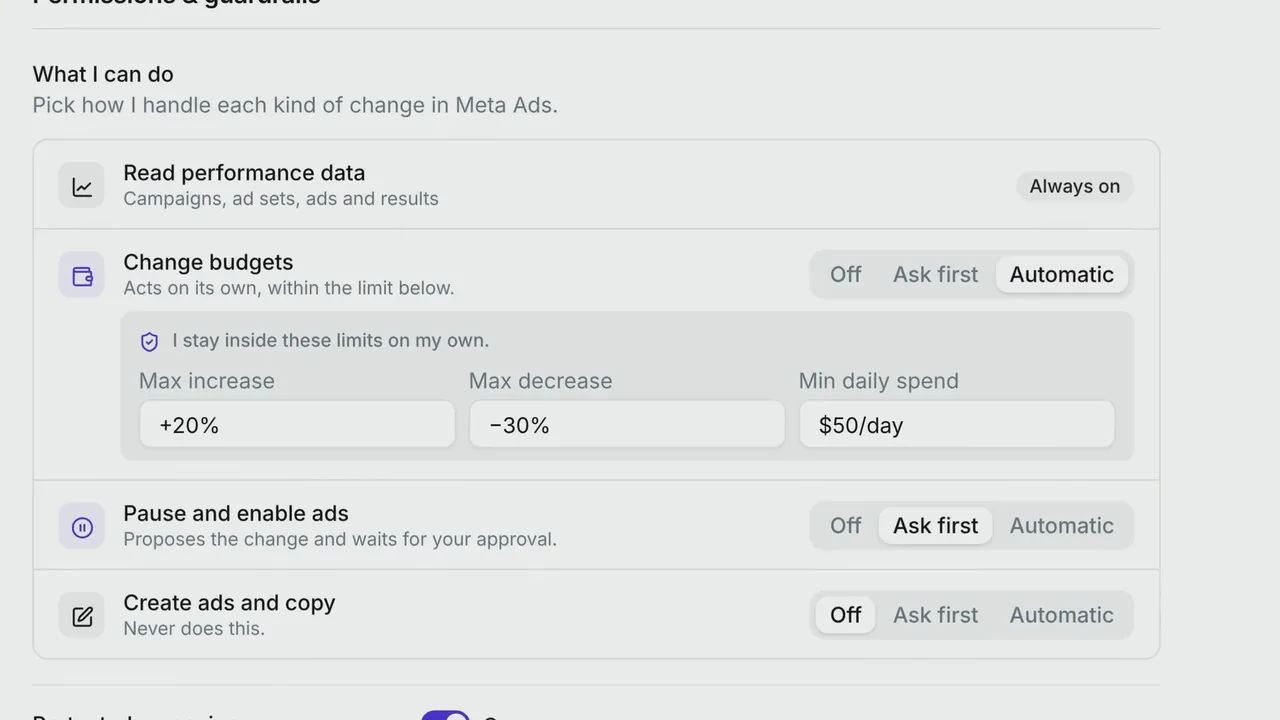
Madgicx is the agentic AI advertising platform for Meta ads, and for autopilot it leads with agents: Madgicx agents run on a schedule for an ad account and email a summary of each run. The decisions stay with you through its AI media buyer, which reviews the Facebook and Instagram account, spots optimization opportunities and lines up each next action, from a budget change to a new creative, for your approval. Creative analysis covers every ad, video included, showing why the winners win and when fatigue sets in.
New campaigns, image ads and video ads made from your own videos come out of its AI chat, and each one is shown for approval before anything is created. Its MCP server brings Madgicx's intelligence and actions into Claude and ChatGPT. Madgicx suits brands and agencies whose spend runs mostly on Meta and who want the AI to do the work while they keep the final say.
- Best for
- Meta ads on autopilot, with you approving every change
- Starting price
- From $45/mo
- Free trial
- 7-day free trial
How it scores
- Yes.AI actions and agentsMadgicx agents run on a schedule for an ad account and email a summary of each run, and its AI media buyer prepares actions you approve or dismiss.
- Yes.Rules and automationAutomation rules run Meta campaigns 24/7 on the conditions you set.
- Yes.Building and launching campaignsMadgicx's AI chat builds campaigns, ad sets and ads from a chat, and every change runs after you approve it.
- Yes.Alerts on your ad accountMadgicx alerts you when an account moves away from the targets you set, and suggests alerts on your Home page.
- Yes.Video adsMadgicx builds Facebook and Instagram video ads from your own videos, ready to publish after your approval.
- Partly.Ad platforms coveredMadgicx optimizes Meta ads. Reporting covers Meta, Google Ads, TikTok, Shopify, Klaviyo and Google Analytics.
Pros
- Agents run on a schedule for your ad account and email you a summary of each run
- The AI media buyer prepares the next actions, and you approve or dismiss each one
- Rules run your Meta campaigns 24/7 on the conditions you set
- Builds campaigns and video ads from a chat, published only after you approve
Cons
- Runs Meta ads; other channels stay in their own ad managers
Prices checked 23 November 2026
Markifact
9.2/10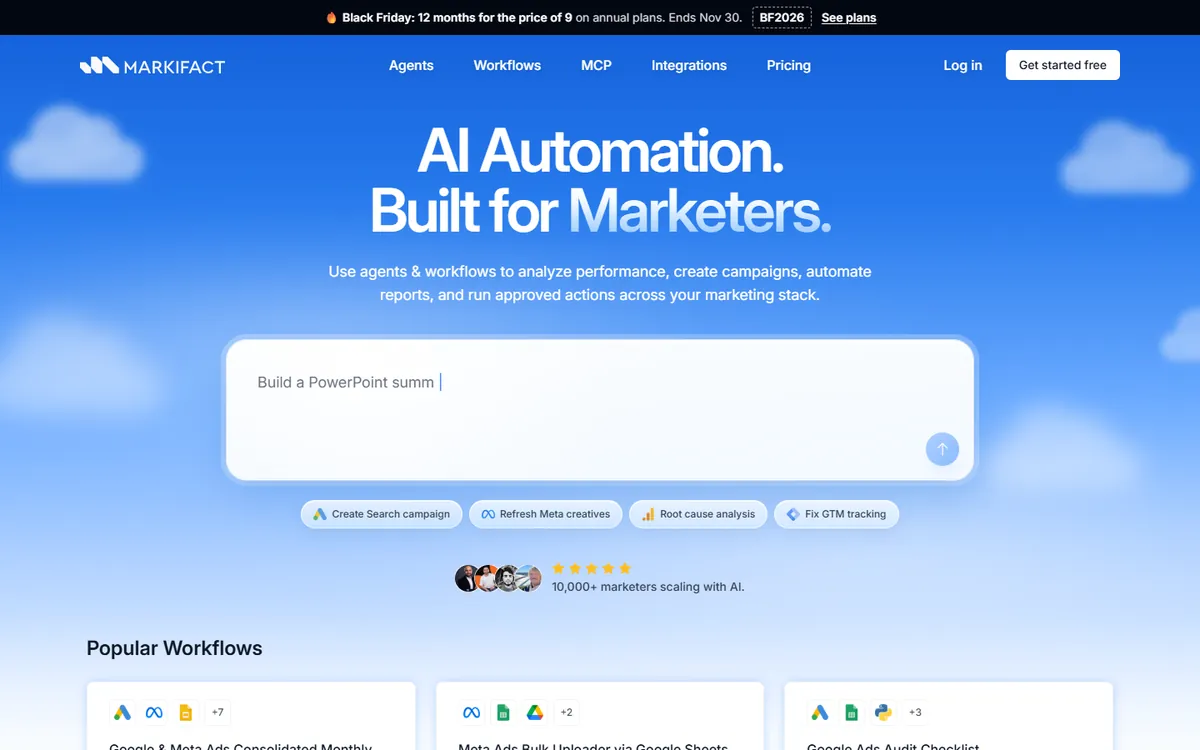
Markifact combines an AI agent with a workflow builder. You hand the agent a task in plain words, or build a repeatable workflow on a visual canvas or ask its AI copilot to build it, and templates cover jobs such as budget pacing checks, Meta creative analysis in Google Slides and bulk ad uploads from a Google Sheet. Give its image template a prompt and a picture to work from, and it returns as many as 10 variations to upload to Meta as ads.
It suits solo marketers, freelancers and agencies that want one place to automate work across ad and data tools, and every listed plan includes unlimited ad accounts. Where Madgicx goes deep on Meta, Markifact spreads across channels. The $79 Pro plan covers one seat.
- Best for
- Agents and scheduled workflows across 14 ad platforms
- Starting price
- from $79 a month
- Free trial
- Its pricing page says to start free with trial credits. We saw no free plan in its plan table.
How it scores
- Yes.AI actions and agentsYou describe a marketing task in plain language and an agent carries it out, such as building campaigns or adding negative keywords. An MCP server brings its tools into Claude, ChatGPT, Gemini and Cursor.
- Partly.Rules and automationWorkflows run manually, on a schedule or from a trigger, with templates for reporting, audits and bulk ad creation. We saw no rule builder for ad performance described.
- Yes.Building and launching campaignsIts agent can create campaigns, upload ads and handle setup across channels. Its pages say nothing goes live without approval, handled in chat or Slack.
- Yes.Alerts on your ad accountWorkflow templates email you when campaign spend passes a pacing limit you set.
- Partly.Video adsA workflow step makes videos with OpenAI's Sora 2 from a prompt; we saw no ready video ad template.
- Yes.Ad platforms coveredIt lists 1000+ operations across Google Ads, Meta Ads, TikTok, LinkedIn, Shopify, HubSpot, GA4, Sheets and Slack, with 14 ad platforms in total.
Pros
- One agent and workflow builder for 14 ad platforms and your data tools
- Unlimited ad accounts on every listed plan, handy when you run many brands
- Approve agent changes in chat or Slack before anything goes live
Cons
- No rule builder for ad performance; automation runs as scheduled or triggered workflows
- Video ads need a Sora 2 workflow step; there's no ready video ad template
Markifact alternatives, compared · Prices checked 23 November 2026
Trapica
9.0/10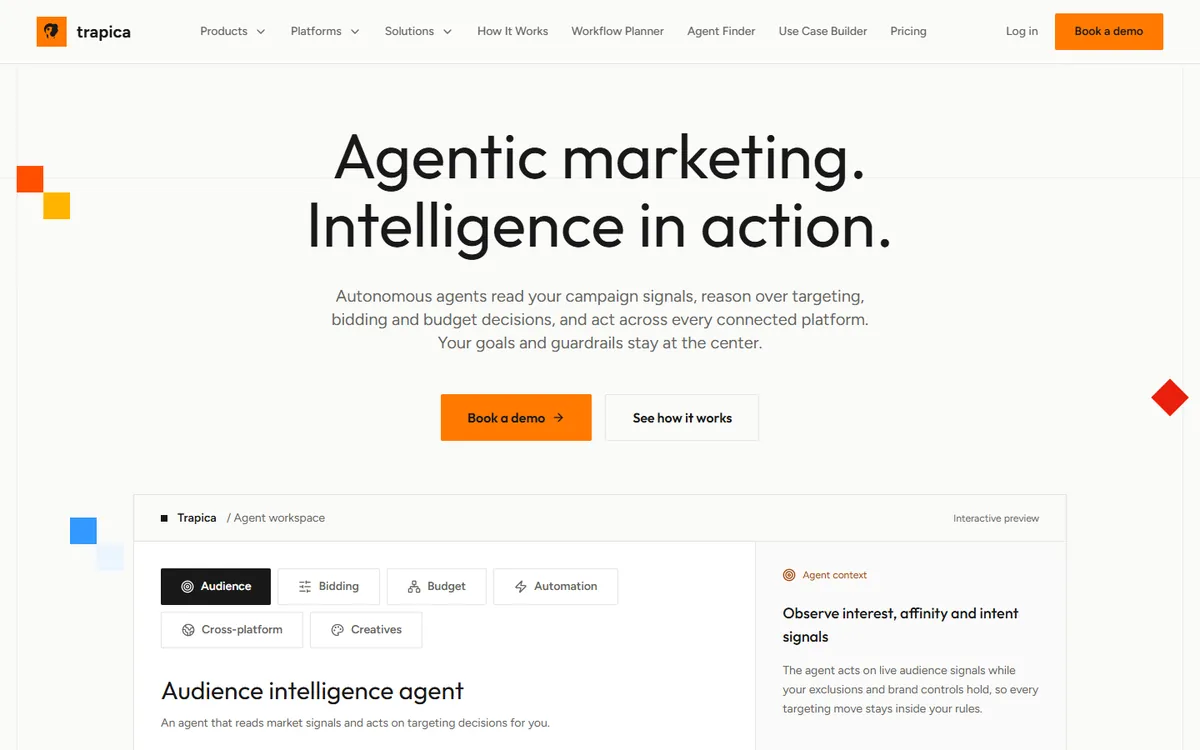
Trapica sells autonomous AI agents for bidding, budgets and targeting. You connect your ad accounts and set goals and guardrails, then its agents watch, decide and act. You choose whether a budget shift waits for your review or goes through on its own, and plans can be routed to an approval queue for sign-off. Its Orchestrator acts on many campaigns from one prompt, such as pausing everything over budget, and its creative studio turns a brief or product photo into ad images sized for each platform.
It is built for brands and agencies spending $10K or more a month on several platforms, from ecommerce and DTC to B2B and SaaS, and its team helps set goals, KPIs and guardrails during onboarding. All three plans are sold by quote after a demo.
- Best for
- Agents that tune bids and budgets inside your guardrails
- Starting price
- by quote
- Free trial
- We saw no free trial or free plan. Every plan, including the entry Automation plan, starts by booking a demo.
How it scores
- Yes.AI actions and agentsBidding, budget, audience, creative and cross-platform agents adjust targeting, bids and budgets around the clock within limits your team sets. Every action shows in its dashboard, where you can override it.
- Yes.Rules and automationAn agent builder lets you write your own if-this-then-that rules across ad and analytics data and test them before they act. Its pages also describe rules that pause underperformers and scale winners.
- Partly.Building and launching campaignsA campaign planner turns goals, budget and platforms into an agent plan with checks before launch, and its pages describe automated A/B test creation. Its FAQ says it works with your existing campaign structure.
- Yes.Alerts on your ad accountReal-time KPI alerts and anomaly detection flag falling CTR, rising costs and tracking gaps.
- No.Video adsWe saw no video ad generation on its pages; it generates ad images and copy.
- Yes.Ad platforms coveredIts FAQ lists Meta (Facebook and Instagram), Google Ads, TikTok, LinkedIn, Pinterest, Snapchat, Amazon Ads, Microsoft Advertising and programmatic platforms, 30+ in all. Its integrations page says availability is confirmed with its team.
Pros
- Hands day-to-day bid, budget and targeting changes to agents, within your limits
- Write your own if-this-then-that rules and check them before they act
- You can override any agent decision, or pause the AI at any time
Cons
- No video ad creation; its creative studio makes ad images and copy
- Campaigns start from a planner that turns goals into an agent plan, not from a chat
Trapica alternatives, compared · Prices checked 23 November 2026
GoMarble
8.9/10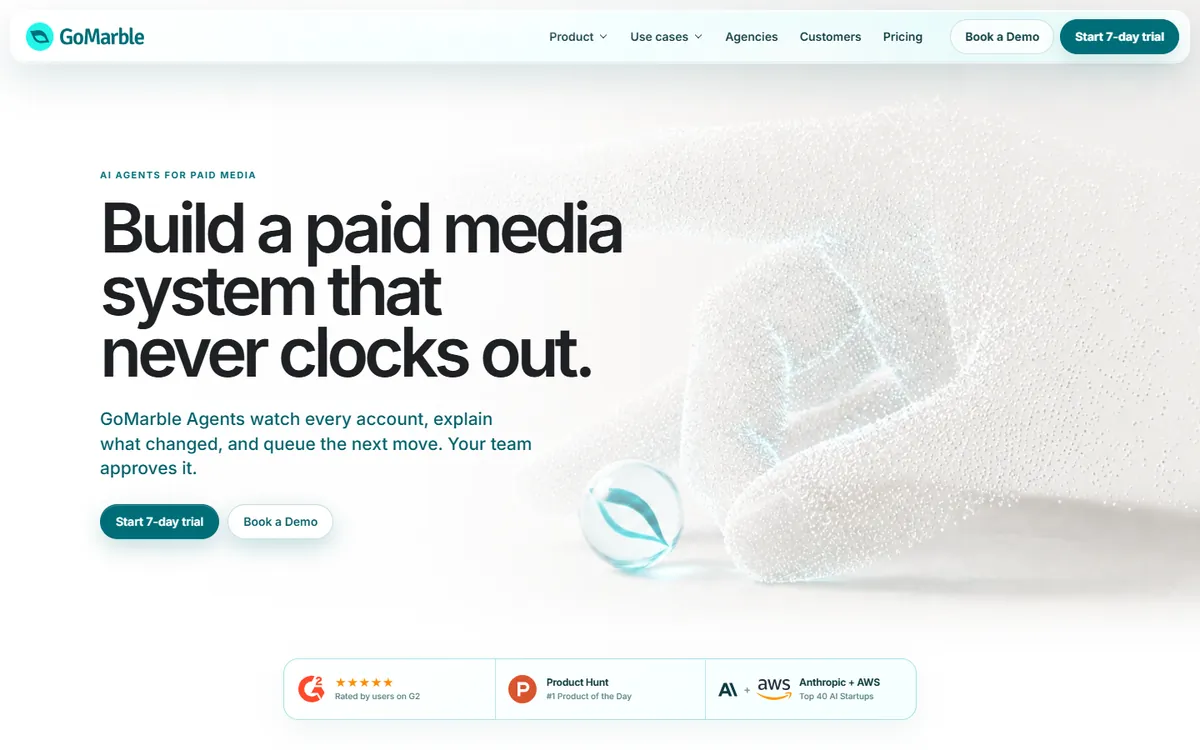
GoMarble sells AI agents for paid media with approval gates. The agents read ad and analytics data side by side, work out why performance moved and draft the fix, and GoMarble's pages state that no change goes through without your yes. Its Creative Analytics maps hooks, formats, messages and visuals against results and catches fatigue, and competitor ad research comes with every plan.
In-house performance teams and agencies juggling many ad accounts and data sources get the most from it, since the agents take on the analysis. Pricing tracks your monthly ad spend, with extra AI credits, ad accounts and seats sold as add-ons.
- Best for
- Agents with approval gates across Meta, Google and TikTok
- Starting price
- from $139 a month
- Free trial
- A 7-day trial on each paid plan. Its FAQ also describes a free option with 100 one-time AI credits, but that option is not in the plan table.
How it scores
- Yes.AI actions and agentsA team of specialist agents scans campaigns, creatives, audiences and search terms, and prepares account changes for approval. It can also be used from Claude and ChatGPT through a connector.
- Partly.Rules and automationAgents run continuously and can flag changes such as creative fatigue in Slack. We saw no rule builder described on its pages.
- Yes.Building and launching campaignsIts pages list building and launching campaigns as agent plays on the Operator plan and above. Nothing goes live until you approve it.
- Yes.Alerts on your ad accountMonitoring agents flag issues such as creative fatigue; Slack alerts start on the Operator plan.
- No.Video adsWe saw no video ad generation on its pages. It analyzes video ads frame by frame.
- Yes.Ad platforms coveredMeta, Google, TikTok and Microsoft Ads, plus GA4, Shopify and Klaviyo, with 80+ more connectors listed.
Pros
- Specialist agents read Meta, Google, TikTok and analytics data together
- Every write waits for your approval, with an audit trail on higher plans
- Use its agents from Claude, ChatGPT or Cursor through its MCP server
Cons
- No rule builder for your own conditions; agents flag issues and prepare changes instead
- Creative stays with your team: it reviews ads and writes briefs, with no ad generation shown
GoMarble alternatives, compared · Prices checked 23 November 2026
Skai
8.9/10
Skai is an enterprise platform that plans, activates, optimizes and measures paid search, paid social and retail media in one place. Its Creative AI tags your Meta images and videos and breaks down performance by creative attribute, its paid social tools handle bulk ad creation and editing, and higher plans add competitive insights, search term analysis and customer journey intelligence.
It is built for large advertisers and agencies, and its pricing page sends smaller budgets to reseller partners. Plans are yearly, from Standard at $114,000 for up to $4M of media to Enterprise Premier at $756,000 for up to $35M, each with dedicated client success support. It fits best when retail media carries real spend next to search and social.
- Best for
- Search, social and retail media on yearly budgets
- Starting price
- from $114,000 a year
- Free trial
- We saw no free plan or trial on its pricing page. It mentions reviewing your commitment after the first three months.
How it scores
- Yes.AI actions and agentsCeleste AI gives recommendations while you plan, activate, optimize and measure media. Skai Studio builds your own agents and Agent Connect links outside agents through MCP.
- Partly.Rules and automationIts Standard plan lists automation and optimization. Its pages do not describe rule-based automation in detail.
- Yes.Building and launching campaignsLaunches and manages campaigns across 300+ publishers, with bulk ad creation for paid social.
- Partly.Alerts on your ad accountAI alerts flag unusual spend and performance shifts; its notification examples are for search and retail media.
- Partly.Video adsCreates video ads at scale through a Genius Sports partnership; we saw no other video generation.
- Yes.Ad platforms coveredIt says it covers 300+ channels, naming Amazon, Walmart, TikTok, Google and Meta.
Pros
- Search, social and retail media in one platform across 300+ channels
- Build your own agent workflows in Skai Studio, or connect outside agents
- Dedicated client success support comes with every plan
Cons
- Writing your own rules isn't shown on its pages; its Standard plan only lists automation
- Celeste AI recommends actions, but campaigns aren't built from a chat on its pages
Skai alternatives, compared · Prices checked 23 November 2026
Pixis
8.8/10
Pixis pairs an AI campaign manager, Prism, with a creative tool, Adroom. Prism is conversational: it returns insights, recommendations and optimizations, and its Meta Creative agent analyzes hooks, messages and formats and detects creative fatigue. Adroom turns prompts into on-brand image ads such as product shots and lifestyle creatives, many at once.
Pixis names consumer brands, performance teams, creative teams and agencies in retail, packaged goods, healthcare and telecoms as its audience, and lists Shopify, HubSpot and Salesforce as integrations. Its main pricing page lists Prism pricing as custom, set with its team.
- Best for
- A conversational campaign manager that moves budgets and bids
- Starting price
- from $200 a month
- Free trial
- Its signup page offers a 14-day free trial to start, with plans starting at $200 a month.
How it scores
- Yes.AI actions and agentsPrism answers plain-English questions, recommends changes, reallocates budget, adjusts bids and models likely outcomes before you act.
- No.Rules and automationWe saw no rule-based automation described on its pages. Prism sends alerts and executes budget and bid changes you approve.
- Partly.Building and launching campaignsIts Adroom product generates on-brand ad creative. We saw no description of how campaigns are launched.
- Yes.Alerts on your ad accountPrism sends notifications on campaign issues so you can act before performance slips.
- Yes.Video adsAdroom makes video ads from prompts, plus UGC-style video in Turbo, Advance and Talking Humans modes.
- Yes.Ad platforms coveredPrism's page names Meta and Google, with a link to an integrations page. Shopify, HubSpot and Salesforce are listed as integrations.
Pros
- Chat with Prism about any campaign in everyday language
- Model likely outcomes before you change budgets or bids
- Adroom makes image and video ads, including UGC-style video, from prompts
Cons
- Rules you write yourself and the campaign launch flow aren't described on its pages
- Prism's chat changes budgets, bids and status; campaign creation from chat isn't shown
Pixis alternatives, compared · Prices checked 23 November 2026
Smartly.io
8.7/10
Smartly.io is enterprise software for producing and running creative at very large scale. Its AI Studio generates and edits images, dynamic templates resize image and video ads across formats and channels, and Automated Ads creates, updates and archives ads from a synced sheet or feed. Creative Insights breaks ads into content, CTAs and visuals and links each one to performance KPIs.
It is built for enterprise brands and agencies with large creative teams that want a dedicated team behind them. It publishes no prices and sells by contract after a demo, G2 lists an average implementation time of two months, and 12 of its 20 most recent G2 reviews praise its support team.
- Best for
- Campaigns generated from blueprints and product feeds
- Starting price
- by quote
- Free trial
- We saw no free plan or trial on its pages. Its site asks you to book a demo.
How it scores
- No.AI actions and agentsBudget moves between campaigns by predicted performance, run from the blueprints and triggers you set.
- Yes.Rules and automationTriggers switch ads on or off by performance, weather or time of day, and budget moves between selected campaigns by predicted performance.
- Yes.Building and launching campaignsCampaign blueprints linked to a product feed generate many campaigns, and a shared space lets teams approve and launch ads.
- Yes.Alerts on your ad accountTriggers can email you when conditions are met, such as ad sets not spending; catalog alerts too.
- Yes.Video adsAI video assembly, image-to-video animation and video templates with AI voiceovers.
- Yes.Ad platforms coveredIts product pages name Meta, TikTok, Snapchat, Pinterest and YouTube. It describes itself as cross-channel; check with its team for the full list.
Pros
- One blueprint tied to a product feed can spawn many campaigns
- Triggers act on performance, weather or time of day without manual checks
- Image and video generation plus templates that resize ads across formats
Cons
- No AI agent on its pages; budget moves follow the blueprints and triggers you build
- No AI assistant connector or chat campaign builder appears on its pages
Madgicx vs Smartly.io · Prices checked 23 November 2026
Bïrch
8.7/10
Bïrch (formerly Revealbot) is a rule engine for media buyers. Once you publish a rule, it acts on its own whenever its conditions are met, and its AI can draft rules for you to review first. Preset reports show your top and declining ads, and its Stage tool launches ads in bulk from Google Drive and Sheets across many Meta, TikTok and Snapchat accounts.
It suits experienced media buyers and agencies who want to set every condition themselves. Its chat asks for approval before each action by default, everything Bïrch AI creates starts paused, and its price follows your ad spend across connected platforms.
- Best for
- Rules you write, checked as often as every 15 minutes
- Starting price
- from $49 a month
- Free trial
- A 14-day free trial with all features. We saw no free plan.
How it scores
- Partly.AI actions and agentsBïrch AI reads performance and, with Meta MCP connected, edits ads or builds paused campaigns when you ask.
- Yes.Rules and automationRules with nested conditions that pause or start campaigns, change budgets and bids and send alerts, checked as often as every 15 minutes, plus a library of ready-made strategies.
- Yes.Building and launching campaignsA bulk ad builder launches several ad sets at once with up to 50 ads each, and builds ads from Google Drive or Sheets.
- Yes.Alerts on your ad accountCustomizable Slack and email alerts on your campaigns, and rules that send alerts when conditions are met.
- No.Video adsWe saw no video ad generation on its pages; it builds ads from your own media.
- Yes.Ad platforms coveredRules run on Meta, Google Ads, TikTok and Snapchat. The bulk ad builder covers Meta, TikTok and Snapchat.
Pros
- Write rules with nested conditions, checked as often as every 15 minutes
- Run the same rules across Meta, Google Ads, TikTok and Snapchat
- Hear about changes in Slack or email, from alerts or from your own rules
Cons
- Ads are built from your own media, with no image or video ad creation on its pages
- Its AI acts when you ask in chat, and campaign building needs Meta's connector linked
Madgicx vs Bïrch · Prices checked 23 November 2026
AdRiseLab
8.4/10
AdRiseLab is an AI workspace for Meta ads that starts from your product link. It turns the link into image ads in feed, square and vertical formats, AI video ads and creator-style clips, then builds the campaign through a three-step builder. Its AI Media Buyer compares hooks, formats and angles in your results, and a weekly report suggests next steps and compares Meta's revenue numbers with Shopify and Stripe.
It is built for ecommerce brands, agencies, software companies and dropshippers that advertise on Meta, and its FAQ says it complements Ads Manager rather than replacing a media buyer. Plans differ by credits, not features: Starter is $39 a month for 100, Pro $99 for 300 and Scale $249 for 750.
- Best for
- Meta ads from a product link, launched after you approve
- Starting price
- from $39 a month
- Free trial
- We saw no free plan or trial on its page. It charges the first month up front and says you can cancel anytime.
How it scores
- Yes.AI actions and agentsAn AI Media Buyer answers questions about your account and proposes changes that you review and approve before anything happens.
- No.Rules and automationWe saw no rule-based automation described on its page.
- Yes.Building and launching campaignsCampaigns, ad sets and ads go live in your Meta account only after you approve. Ads can be made from a product URL as image, video and creator-style formats.
- Partly.Alerts on your ad accountFatigue Guard flags tiring ads with in-app warning statuses; we saw no email or Slack alerts.
- Yes.Video adsAI video ads with avatar presenters in vertical, square and landscape, plus AdFlow UGC clips.
- Partly.Ad platforms coveredMeta only, Facebook and Instagram, through the Marketing API.
Pros
- Starts from a product link, so you need no finished creative to launch
- Nothing launches in your Meta account until you approve it
- A weekly report compares Meta's revenue numbers with Shopify and Stripe
Cons
- Its pages describe no automation rules you write yourself; changes come as AI proposals
- Fatigue warnings show in the app; we saw no email or Slack alerts on its pages
AdRiseLab alternatives, compared · Prices checked 23 November 2026
Adkit
7.8/10
Adkit is a toolbox for running ads through the AI agent you already use, with Claude, ChatGPT and Cursor among them, via its MCP server or a command line. Every change lands as a draft that you approve in its dashboard, and a single prompt can rework many campaigns at once, for example the budgets on every campaign below 1.5 ROAS.
It suits marketers, freelancers and agencies who already run ads through an AI agent, and the unlimited projects on its $49 plan suit people who manage several brands. It also includes a library of 1M+ ads, competitor tracking and a swipe file, and its Single Project plan covers one ad account per platform.
- Best for
- An AI agent that runs your ads as drafts you approve
- Starting price
- from $29 a month
- Free trial
- A 7-day free trial on both plans. We saw no free plan.
How it scores
- Yes.AI actions and agentsIts MCP server and CLI let agents such as Claude, ChatGPT and Cursor run your ads. Every change is saved as a draft and nothing goes live until you approve it.
- No.Rules and automationWe saw no rule-based automation on its pages. It lists activity alerts and a weekly competitor digest.
- Yes.Building and launching campaignsThe agent drafts campaigns, ad sets and ads in its dashboard for you to approve. Its Meta page also shows pausing ads and shifting budgets.
- No.Alerts on your ad accountWe saw no alerts on your own ad results; its Activity Alerts flag new competitor campaigns.
- No.Video adsWe saw no video ad generation on its pages; it writes briefs for video contractors.
- Yes.Ad platforms coveredIts pricing page lists Meta, Google, TikTok, Reddit, LinkedIn, X and Microsoft Ads.
Pros
- A draft screen holds every agent change until you approve it
- Drive your ads from Claude, ChatGPT or Cursor through MCP or a command line
- Generates static ads from scratch, or clones competitor ads, in the same plan
Cons
- No automation rules: every change comes from a draft your agent prepares
- We saw no alerts on your own ad results; its Activity Alerts track competitors
Adkit alternatives, compared · Prices checked 23 November 2026
Pipeboard
7.8/10
Pipeboard is a connection service: your own AI assistant, such as Claude, ChatGPT, Claude Code, Cursor or Codex, does the work in your ad accounts through its MCP servers. The assistant can also search Meta's Ad Library for other advertisers' ads and upload creatives in batches, and Pipeboard's pages advise you to review what you ask it to do.
It suits teams that want their assistant, not a new dashboard, to run the work. The Agency plan ($199 a month) gives 25 ad account slots, per-account token scoping and unlimited team accounts.
- Best for
- Putting Claude or ChatGPT in charge of your ad accounts
- Starting price
- from $29.90 a month
- Free trial
- A free plan with 30 AI tool executions a week and 2 ad account slots. The 7-day free trial covers monthly Pro and Premium only; annual plans have a 30-day money-back guarantee instead.
How it scores
- Yes.AI actions and agentsIt connects assistants such as Claude, ChatGPT, Claude Code, Cursor and Codex to your ad accounts through MCP, so the assistant reviews performance and acts on your instructions.
- No.Rules and automationWe saw no rule-based automation on its pages. They mention reusable prompts for repeatable work and n8n as a supported tool.
- Yes.Building and launching campaignsWith the right permissions the assistant can create campaigns, upload creatives and update budgets. Duplication and carousel ads need Pro, and bulk operations need Premium.
- No.Alerts on your ad accountWe saw no alerts on its pages; your AI assistant checks performance when you ask.
- No.Video adsWe saw no video ad generation on its pages; it uploads large video files for ads.
- Yes.Ad platforms coveredIts home page lists Meta, Google, TikTok, LinkedIn, Microsoft, Pinterest, Snap and Reddit Ads, plus Google Analytics, Search Console and Merchant. It says some are previews and what you can do varies by platform.
Pros
- Work in your ad accounts from Claude, ChatGPT or Cursor, not a new dashboard
- Read-only or scoped tokens limit what the assistant can change
- New campaigns start paused, so nothing spends before you switch it on
Cons
- Nothing runs until you ask your assistant; no rules or alerts are described
- Analysis comes from your own AI assistant, not from Pipeboard itself
Pipeboard alternatives, compared · Prices checked 23 November 2026
Albert.ai
7.5/10
Albert.ai adjusts budgets, bids, audiences and creative rotation toward the goals and limits you set, working in your existing ad accounts. It checks each creative element one by one, flags when to refresh an ad and gives insights on creative items.
Its buyers are big brands and agencies: the estimate form's smallest yearly ad budget band is $100k to $500k and the bands run past $10M. Buying starts with an estimate request, and the FAQ pictures a three-month proof of concept as the usual first step.
- Best for
- Self-optimizing budgets and bids across many channels
- Starting price
- by custom quote
- Free trial
- Its pricing page mentions no free plan or trial, only a form to request an estimate.
How it scores
- Yes.AI actions and agentsIts site describes self-optimizing campaign design and management that shifts spend between audience segments as performance changes.
- Not described.Rules and automationIts home page describes self-optimizing campaign management toward your goals. We saw no rule builder described.
- Partly.Building and launching campaignsIt manages and optimizes campaigns in your existing ad accounts. Its FAQ says it doesn't develop creative or write ad copy.
- No.Alerts on your ad accountWe saw no alerts on its pages; its AI makes changes on its own within the guardrails you set.
- No.Video adsWe saw no video ad generation; its FAQ says Albert does not develop your creatives.
- Yes.Ad platforms coveredIts home page shows Bing, Instagram, Facebook, YouTube, TikTok and DV360, and says it covers 90% of the biddable universe.
Pros
- Shifts budgets, bids and audiences toward your goals across many channels
- Rotates your creative based on how each ad performs
- Weekly, monthly, quarterly and wrap campaign reports
Cons
- Its FAQ says it doesn't develop creative or write ad copy, so your team supplies every ad
- Its site doesn't say whether you approve each change before it goes live
Albert.ai alternatives, compared · Prices checked 23 November 2026
What should the best paid ads autopilot platforms do for you?
A paid ads autopilot is software that does the routine work of running ads inside limits you set: it watches results, prepares or makes budget, bid and creative changes, builds new campaigns and tells you when something drifts. Madgicx ranks first in our list with 9.6/10. Its agents run on a schedule for your ad account and email you a summary of each run, and its AI media buyer prepares the actions you approve.
The best platforms do six jobs for you. Their AI decides what to change next, rules act on your conditions without being asked, they build and launch new campaigns, alerts tell you when results move away from your targets, they make the video ads a campaign needs to keep running, and they act on the ad platforms you use. Just as important is how you stay in charge: an approval step, limits the AI can't cross and a record of what changed.
We scored twelve platforms on those six jobs. They range from self-serve tools you can try this week to enterprise suites sold on yearly contracts, and from AI that asks before every change to agents that act inside your guardrails.
What does Meta's own automation already do?
Every advertiser on Meta already has automation inside Ads Manager, and every platform on this list works on top of it. Here is what Meta's own tools cover, where Meta says each one stops, and what an autopilot platform adds.
Advantage+ campaigns: AI across the whole campaign
Choose the sales, app promotion or leads objective in Ads Manager and you get the Advantage+ setup, which applies AI across the campaign. For sales campaigns, Meta's most advanced optimizations switch on when the campaign uses Advantage+ audience, campaign budget, placements and destination together. For app campaigns, Meta AI optimizes bidding, audiences and placements, and leads campaigns run with Advantage+ on by default. Manual campaign features all stay available. Our Advantage+ guide covers the setup in more depth.
Meta's own caveats: once you narrow the budget, the audience or the placements past a certain point, Advantage+ switches off for that piece, and a campaign in a special ad category may not have every Advantage+ feature.
One campaign budget that Meta moves for you
With Advantage+ campaign budget, one budget is distributed in real time to the ad sets with the best opportunities, and ad set minimums and maximums limit how far it shifts. Meta notes that it may not spend equally across ad sets, works best with at least two ad sets, and needs the same budget type, bid strategy and standard delivery on every ad set.
Automated rules in Ads Manager
Inside Ads Manager, an automated rule watches campaigns, ad sets or ads and either changes them or tells you. Its actions are turning items on or off, raising or lowering a daily or lifetime budget, adjusting a manual bid, scaling a budget or bid, or just sending a notification, and a rule with several conditions fires only when every one is true. Meta evaluates them at least every half hour, or only on the days and times you pick, and an ad account can carry 250 of them at most, switched-off ones included.
Meta's stated limits: a condition can appear only once in a rule, a rule works at one level, issue and political ads are excluded, and the manual bid action needs ads that use manual bids. Meta still tells advertisers to watch overall performance themselves. Our answer on how Meta checks an automated rule walks one rule through three ad sets.
Opportunity score and auto-applied recommendations
Opportunity score is Meta's 0 to 100 grade for how well optimized your campaigns, ad sets and ads are, and it climbs as you apply more of Ads Manager's recommendations. The suggestions are sorted by estimated impact and fall into groups such as budget and bidding, creative and placements, and signals. A lot of them are a few clicks away, and if you switch on auto-apply in Account Overview, the kinds you select go live as soon as they appear. Meta adds that a high score says nothing about actual or future results, and that it can lag behind real time.
Meta's ads AI connectors
Since 29 April 2026, Meta has run its own MCP server for ads in open beta. It works with any MCP-compatible AI agent, and Meta's setup guide names Claude Code and ChatGPT. The agent can create and edit campaigns, ad sets and ads, and Meta's write tools create them paused, so your AI client asks for confirmation before anything goes live. Since July 2026, admins can also set rules for what agents may do in each ad account, such as editing budgets or creating campaigns, though those rules are in limited availability.
Meta says you may not have access to every tool yet, and it leaves cross-channel insights and custom workflows to your own AI tools. Our guide to managing Facebook ads through MCP explains how these connections work.
What an autopilot platform adds
Meta's tools come with your ad account, and what you pay Meta is the ad spend you set. A platform earns its place with the work around them: agents that run on a schedule, an AI that prepares the next budget, pause or creative action for you to approve, rules across campaigns, alerts on your own targets, and new image and video ads to feed Advantage+. Madgicx adds that layer for Meta ads, and our Madgicx vs Meta Ads Manager page lists what it adds to the tool you already use.
Rules, agents or approvals: which kind of autopilot do you need?
The twelve platforms here put ads on autopilot in five different ways, and many combine two or three. Knowing which way a platform works tells you more about the control you keep than any feature list.
Rules that act on conditions you set
A rule is an if-then instruction: if cost per purchase passes a limit you set, pause the ad set; if ROAS holds above target, raise the budget. Rules are predictable because you write every condition. Bïrch (8.7/10) checks rules with nested conditions as often as every 15 minutes, Smartly.io (8.7/10) adds triggers for weather and time of day, and Madgicx's automation rules run your Meta campaigns 24/7. Meta's own automated rules, checked at least every 30 minutes, are the baseline.
Agents that act inside your guardrails
Some platforms let agents make changes on their own within limits you set. Trapica (9.0/10) runs agents that adjust targeting, bids and budgets around the clock, shows every action in a dashboard where you can override it, and lets you pause the AI at any time. Albert.ai (7.5/10) shifts budgets, bids, audiences and creative rotation toward your goals, and its website doesn't say whether you approve changes before they go live. This model saves the most time and asks for the most trust, so the guardrails you set matter more than anything else.
AI that prepares changes for your approval
Here the AI does the analysis and the preparation, and a person makes the call. Madgicx's AI media buyer prepares actions you approve or dismiss, GoMarble (8.9/10) has agents that write changes after your approval on its Operator plan and above, AdRiseLab (8.4/10) launches only after you approve, Prism from Pixis (8.8/10) makes the budget, bid and status changes you approve, and Adkit (7.8/10) saves every change as a draft. It is the safest way to start, because you see each change before it runs. If agents are new to you, what an AI agent for Meta ads is covers the basics.
Agents that run on a schedule
This kind needs no prompt from you at all. Madgicx agents run on a schedule for an ad account and email a summary of each run. Markifact (9.2/10) can start its workflows by hand, at set times or when a trigger fires, and GoMarble's agents keep watching all the time and post issues such as creative fatigue to Slack.
Your own AI assistant, connected to your ad accounts
MCP connectors let Claude, ChatGPT or Cursor read and change your ad accounts from the chat you already use. Pipeboard (7.8/10) is built around this, with read-only or scoped tokens; Adkit, Markifact and GoMarble offer MCP servers too, and Skai (8.9/10) offers Agent Connect, which lets ChatGPT, Claude or Gemini create or update campaigns. Madgicx's MCP server lets an assistant analyze your Meta ad accounts and act on status, budgets, bids, spending limits and names. The assistant acts when you ask, so this model suits people who already work in a chat all day. Our Madgicx vs ChatGPT and Claude page compares an AI built for Meta ads with a general assistant.
How much do paid ads autopilot platforms cost?
| Tool | Starting price | How you pay | Free trial | Prices checked |
|---|---|---|---|---|
| Madgicx | From $45/mo | Priced by monthly ad spend, from $45 a month, billed monthly, quarterly or annually. | 7-day free trial | 23 November 2026 |
| Markifact | from $79 a month | A monthly plan: Pro $79 a month for one seat, Team $249 a month, and a custom Managed plan. Credits and seats scale with the option you pick. | Its pricing page says to start free with trial credits. We saw no free plan in its plan table. | 23 November 2026 |
| Trapica | by quote | Three plans, Automation, Intelligence and Enterprise, each set up through a demo. Its pricing page publishes no prices, and its pages say it works with businesses spending $10K a month and up. | We saw no free trial or free plan. Every plan, including the entry Automation plan, starts by booking a demo. | 23 November 2026 |
| Go |
from $139 a month | Monthly plans sized by ad spend: Copilot $139, Operator $399 and Scale $799 a month, with Enterprise by quote. | A 7-day trial on each paid plan. Its FAQ also describes a free option with 100 one-time AI credits, but that option is not in the plan table. | 23 November 2026 |
| Skai | from $114,000 a year | Yearly plans: Standard $114k, Advanced $276k, Enterprise $504k, Enterprise Premier $756k. Over $35M of media a year is custom. | We saw no free plan or trial on its pricing page. It mentions reviewing your commitment after the first three months. | 23 November 2026 |
| Pixis | from $200 a month | Its signup page shows plans starting at $200 a month; its main pricing page shows Prism pricing as custom, set with its team. | Its signup page offers a 14-day free trial to start, with plans starting at $200 a month. | 23 November 2026 |
| Smartly.io | by quote | Quote only. Its site asks you to book a demo and lists no plans, prices or free trial. | We saw no free plan or trial on its pages. Its site asks you to book a demo. | 23 November 2026 |
| Bïrch | from $49 a month | A monthly plan priced by your ad spend across connected platforms: $49 or $99 a month, with Enterprise by quote. | A 14-day free trial with all features. We saw no free plan. | 23 November 2026 |
| Ad |
from $39 a month | Monthly plans by credits: Starter $39 for 100 credits, Pro $99 for 300, Scale $249 for 750. Yearly billing lowers the monthly price. | We saw no free plan or trial on its page. It charges the first month up front and says you can cancel anytime. | 23 November 2026 |
| Adkit | from $29 a month | A monthly plan: Single Project $29 a month or Multiple Projects $49 a month, both with a 7-day free trial. A yearly toggle says it saves 30% or more, without yearly prices. | A 7-day free trial on both plans. We saw no free plan. | 23 November 2026 |
| Pipeboard | from $29.90 a month | A free plan, then monthly plans: Pro $29.90, Premium $99 and Agency $199 a month. Extra ad account slots cost $10 a month each. Secure Enterprise is custom. | A free plan with 30 AI tool executions a week and 2 ad account slots. The 7-day free trial covers monthly Pro and Premium only; annual plans have a 30-day money-back guarantee instead. | 23 November 2026 |
| Albert.ai | by custom quote | A custom quote. Its pricing page publishes no plans or prices and asks you to request an estimate. | Its pricing page mentions no free plan or trial, only a form to request an estimate. | 23 November 2026 |
Which plan lets the platform act, not just advise?
The table above shows each starting price. For an autopilot, the more useful question is which plan lets the AI or the rules actually change your ads, because on several platforms that starts above the entry plan.
- Madgicx: priced by monthly ad spend from $45 a month, billed monthly, quarterly or annually, with a 7-day free trial.
- GoMarble: Copilot ($139 a month, up to $50K of ad spend) has read-only agents. Operator ($399, up to $500K) adds agents that write changes after your approval, and Scale ($799) runs to $1.5M.
- Bïrch: Essential ($49 a month) covers reports, alerts and workspaces; automated rules start on Pro at $99. The price follows ad spend across connected platforms, and going over a plan's limit adds a fee.
- Trapica: the Automation plan covers a single ad platform; Intelligence adds cross-channel budget optimization and several platforms, and Enterprise is unlimited. All three are sold by quote.
- Markifact: Pro ($79 a month, one seat) already includes agents, workflows and the MCP server; Team ($249) covers 10 to 50 seats.
- Pipeboard: every plan connects your assistant, the free plan with 30 AI tool executions a week; duplication and carousel ads need Pro ($29.90 a month), and bulk operations need Premium ($99).
Meta's own tools need no plan: they come with your ad account, and what you pay Meta is the ad spend you set.
Which features does each tool cover?
| Tool | Score | AI actions and agents | Rules and automation | Building and launching campaigns | Alerts on your ad account | Video ads | Ad platforms covered |
|---|---|---|---|---|---|---|---|
| Madgicx | 9.6/10 | Yes. | Yes. | Yes. | Yes. | Yes. | Partly. |
| Markifact | 9.2/10 | Yes. | Partly. | Yes. | Yes. | Partly. | Yes. |
| Trapica | 9.0/10 | Yes. | Yes. | Partly. | Yes. | No. | Yes. |
| Go |
8.9/10 | Yes. | Partly. | Yes. | Yes. | No. | Yes. |
| Skai | 8.9/10 | Yes. | Partly. | Yes. | Partly. | Partly. | Yes. |
| Pixis | 8.8/10 | Yes. | No. | Partly. | Yes. | Yes. | Yes. |
| Smartly.io | 8.7/10 | No. | Yes. | Yes. | Yes. | Yes. | Yes. |
| Bïrch | 8.7/10 | Partly. | Yes. | Yes. | Yes. | No. | Yes. |
| Ad |
8.4/10 | Yes. | No. | Yes. | Partly. | Yes. | Partly. |
| Adkit | 7.8/10 | Yes. | No. | Yes. | No. | No. | Yes. |
| Pipeboard | 7.8/10 | Yes. | No. | Yes. | No. | No. | Yes. |
| Albert.ai | 7.5/10 | Yes. | Not described. | Partly. | No. | No. | Yes. |
How to switch your ads to autopilot without losing control
Before anything changes, write down the last 30 days for the account: cost per result, ROAS, spend by campaign, how many new ads you launched and the hours the team spent. Note any sale or promotion in that window. Without these numbers you can't tell later whether the platform helped.
Every platform here, and Meta's own AI, acts on the conversions Meta can see. Check that purchases or leads reach Meta through the Conversions API as well as the Pixel: Meta's built-in setup covers web events, and its Conversions API Gateway and Signals Gateway run on cloud hosting. Madgicx's server-side tracking hosts both gateways for you.
Set an account spending limit, campaign spending limits where you don't use lifetime budgets, and ad set minimums and maximums under Advantage+ campaign budget. List the campaigns the AI must leave alone, such as brand or always-on campaigns. Limits set in Meta apply whichever tool you connect.
Connect one ad account, ideally the one with the cleanest data, and keep every change on approval at first. With Madgicx, start the 7-day free trial, read each action the AI media buyer prepares and approve the ones you would have made yourself. For a controlled comparison, Meta's Experiments tool runs A/B tests of up to 5 versions at no additional cost.
Pick one weekly slot to compare results with your baseline and read what changed. If you use Madgicx agents, each run's summary arrives by email, so read that week's summaries in the same slot. Where an approved action didn't work, tighten the target or the rule rather than switching everything off.
Once the prepared actions match your judgment for a few weeks, add campaigns or accounts one at a time, and let rules handle the conditions you approve every time. Keep alerts on your targets so you hear when results drift.
Which questions should you ask before you buy?
- Which changes the AI can make on its own, and which wait for your approval.
- Which plan lets the platform write changes, not only read your account.
- Which limits you can set: targets, budgets, bids, or the accounts and campaigns it may touch.
- Where you will see what changed: an emailed summary, a dashboard or an audit trail.
- Whether it builds new campaigns and ads, or only adjusts the ones you already run.
- Which ad platforms you need it to act on, and which only need reporting.
How do you keep control once the AI can change your ads?
Handing work to an autopilot is safe when three things are in place before it acts: an approval step for the changes you want to see first, spending limits it can't cross, and a record of what it did.
Decide which changes wait for you
Every platform here lets you keep some changes behind an approval step; the useful question is which ones. In Madgicx, the AI media buyer's prepared actions and everything the AI chat builds wait for your approval, while automation rules keep working around the clock on whatever conditions you have written. A sensible split is to let rules handle small, reversible moves you would approve every time, such as pausing an ad set that passes your cost limit, and to keep new campaigns, new ads and budget increases on approval.
Elsewhere, approval sits in different places: Markifact takes it in chat or Slack, Adkit in a draft screen, and Trapica can send budget moves for review or let them run. Meta's own connector creates new items paused and has your AI client ask before activating them.
Spending limits the AI can't cross
Set the hard limits in Meta itself, where they bind every tool's spend. There are two caps: an account spending limit, a lifetime ceiling on everything the ad account spends that pauses your ads once it is hit, and an adjustable campaign spending limit for a single campaign. Under Advantage+ campaign budget, a campaign lifetime budget does the job of the campaign limit, and ad set minimums and maximums restrict how far money moves between ad sets. Two more numbers to know: Meta may spend up to 75% over a daily budget, and scheduled budget increases can't go above 8 times the daily budget.
Then limit what the tool can reach. Pipeboard's tokens can be read-only or scoped to chosen accounts and tools, and Meta's connector lets admins set rules per ad account for what agents may do (in limited availability). Madgicx's alerts tell you when an account moves away from the targets you set, so you hear about a drift without checking the account yourself.
A record of what changed
Check where you will see each change after it happens. Madgicx agents run on a schedule, and each run ends with a summary in your email. Trapica shows every agent action in its dashboard, GoMarble adds an audit trail on higher plans, and Meta's automated rules can send a notification to you or others on the ad account.
Five limits to set before the first approval
- Write down your target cost per result or ROAS, and the level at which you want an alert.
- Set an account spending limit in Meta, plus campaign spending limits on campaigns without a lifetime budget.
- Use ad set minimums and maximums on campaigns that run Advantage+ campaign budget.
- List the campaigns the AI must not touch, such as brand or always-on campaigns.
- Decide who approves changes and how quickly, so prepared actions don't sit for days.
What should you still decide yourself?
An autopilot takes over the routine work: watching results, preparing changes, building campaigns, rotating ads. A few decisions stay with you whichever platform you choose, and the AI works only as well as you make them.
Your targets and your budget ceiling
The AI optimizes toward the numbers you give it, so set them from your margins. The break-even ROAS calculator shows the ROAS you need just to break even on an order once every cost is counted, and the ad budget calculator plans the budget a goal needs. Meta's own guidance is that a daily budget should be at least 5 times your cost per result goal when you set one.
The product, the offer and the raw footage
Madgicx can turn a written prompt, a sample picture or an ad found in Meta's Ad Library into a new image ad, and it turns your own videos into video ads; AdRiseLab and Pixis's Adroom generate video too. The offer, the price and the footage of your product still come from you. Albert.ai's FAQ says it doesn't develop creative or write ad copy, and Bïrch and Pipeboard build ads from the media you upload.
Conversion data you can trust
Every platform here, and Meta's own AI, optimizes on the conversions Meta can see. Meta says data from its Conversions API is less affected than the Pixel by browser loading errors, connectivity issues and ad blockers. Before you hand over budgets, check that purchases or leads also arrive server-side; server-side tracking for Meta ads explains the options. Madgicx's server-side tracking, available on its own or inside a Madgicx plan, hosts Meta's Conversions API Gateway and Signals Gateway for you.
Political, issue and special category ads
Issue, election and political ads are off-limits to Meta's automated rules, a rule can't pause a reservation campaign, and special ad categories may lack some Advantage+ features. If you advertise in those areas, plan for more manual checks whichever platform you pick.
Which prepared actions to approve
An approval step protects you only if someone reads it. An AI reads the ad account, not your stock levels or next week's promotion, so check that each action's reason fits what you know before you approve, and dismiss what doesn't.
How did we score each tool?
We scored each platform on AI agents and actions, automation rules, the ad platforms it covers, building and launching campaigns, alerts and video ads. AI agents weigh most because an autopilot is only as good as what its AI decides and does, and rules and platform coverage come next because they set what runs without you and where.
Every tool on this list starts at 5 out of 10. The other 5 points are split across the criteria by the shares in the table below: a tool that fully covers every criterion scores 10, and a criterion it only partly covers earns half its share.
| Capability | Share of the 5 points |
|---|---|
| AI actions and agents | 26% |
| Rules and automation | 18% |
| Building and launching campaigns | 13% |
| Alerts on your ad account | 13% |
| Video ads | 13% |
| Ad platforms covered | 17% |
The Madgicx team wrote this page and scored every tool, Madgicx included, with the same rubric.
Which platform fits the way you advertise?
Start from where your spend runs and how much control you want to keep. Madgicx, ranked first with 9.6/10, is the default pick whenever Meta carries most of your budget; the situations below show when another platform fits a specific need.
Most of your budget runs on Meta
Pick Madgicx. For a budget that runs on Meta, it does every job we scored: agents that run on a schedule and actions prepared for your approval, rules that run 24/7, campaign building, alerts on your targets and video ads from your own videos. Try it on one ad account with the 7-day free trial. If ads made from a product link matter most, AdRiseLab also runs on Meta and launches after you approve.
You run Meta and Google Ads together
If Meta carries most of the spend, start with Madgicx for Meta: its reporting brings Google Ads, TikTok, Shopify, Klaviyo and Google Analytics data into the same place, and its Google MCP server lets Claude or ChatGPT analyze your Google Ads accounts. If you need one agent to change Google campaigns as well, Markifact and GoMarble act on both; GoMarble vs Markifact compares the two.
You manage an enterprise budget across many channels
For the Meta share of the budget, Madgicx gives a self-serve team agents, approvals and rules at a published price. When retail media sits next to search and social, Skai covers 300+ channels with yearly plans and dedicated success support; when creative volume is the bottleneck, Smartly.io generates campaigns from blueprints and product feeds. Albert.ai and Trapica optimize budgets across channels for teams that buy through a sales process, and Albert.ai vs Skai sets two of them side by side.
You run Meta ads for clients
Madgicx fits agencies that run Meta ads for clients: every prepared action waits for approval before it touches a client's account, and reports bring each client's Meta, Google Ads, TikTok, Shopify, Klaviyo and Google Analytics data together and can be shared by link or PDF. Markifact includes unlimited ad accounts on every listed plan, and Pipeboard's Agency plan adds per-account token scoping for 25 ad account slots. Our ranking of reporting tools for agencies goes deeper on client reporting.
You want Claude or ChatGPT to do the work
Madgicx's MCP servers come with Madgicx plans and bring Madgicx's intelligence and actions into Claude, ChatGPT and other AI agents: one works on your Meta ad accounts, the other analyzes your Google Ads accounts. Pipeboard and Adkit are built around this way of working across more ad platforms, and Meta's own connector, in open beta, creates new items paused.
You want to write every rule yourself
Madgicx's rules run Meta campaigns 24/7 on your conditions, next to its AI media buyer and agents. If rules are all you need, across Meta, Google Ads, TikTok and Snapchat, Bïrch checks nested conditions as often as every 15 minutes, with rules on its Pro plan.
So which one should you choose?
Madgicx is our top pick for putting paid ads on autopilot, ranked first with 9.6/10. Its agents run on a schedule and email you a summary of each run, its AI media buyer prepares the next actions for your approval, rules run 24/7 on your conditions and its AI chat builds campaigns and video ads you approve, all for Meta ads, with a 7-day free trial. If you need one agent that acts on Google, TikTok and other channels too, Markifact runs agents and workflows across 14 ad platforms. If retail media sits next to search and social on a yearly budget, Skai covers 300+ channels with dedicated success support.
Frequently asked questions
What is the best paid ads autopilot platform?
Madgicx is the best paid ads autopilot platform overall, ranked first with 9.6/10. Its agents run on a schedule for your ad account and email you a summary of each run, its AI media buyer prepares actions you approve, and its automation rules run Meta campaigns 24/7 on the conditions you set. Markifact, in second place, suits teams that want agents and workflows across 14 ad platforms.
Can AI run paid ads on its own?
AI can take over most of the routine work: watching results, preparing budget and bid changes, building campaigns and rotating ads. Your targets, your budget ceiling and your offer still need a person, so most platforms here keep an approval step or guardrails you set. In Madgicx, every recommended action runs after you approve it.
Does Advantage+ already put Meta ads on autopilot?
Advantage+ applies Meta's AI across a sales, app or leads campaign, and Advantage+ campaign budget moves one budget between ad sets in real time. It works inside each campaign you set up. An autopilot platform adds the work around it: agents that run on a schedule, actions prepared for your approval, rules across campaigns, alerts on your targets and new image and video ads to feed Advantage+.
Will an autopilot platform change my ads without asking?
It depends on the platform and how you set it up. Madgicx's AI media buyer and AI chat wait for your approval before each change, GoMarble writes changes only after approval, and Adkit saves every change as a draft. Rules in any tool act whenever their conditions are met, and Trapica lets budget moves run inside your guardrails or wait for review.
How much do paid ads autopilot platforms cost?
Self-serve plans on this list start at $29 a month (Adkit), and Madgicx starts from $45 a month, priced by ad spend. GoMarble's plans that write changes start at $399 a month and Skai's yearly plans at $114,000, while Albert.ai, Smartly.io and Trapica are sold by quote. Meta's own tools come with your ad account, and what you pay Meta is the ad spend you set.