Compare 10 top agency tools for seamless client account switching. Our guide reviews Madgicx, AgencyAnalytics, and more to help you save time.
If you run an agency, logging in and out of multiple client accounts is part of your daily workflow. Whether you’re checking performance, pulling reports, or making quick updates, switching between platforms takes up more time than it should. It’s one of the reasons many agency teams end up working overtime, with manual tasks eating into hours that could be spent on strategy and growth.
According to a recent industry report, a staggering 95% of agency workers report they work overtime, and a huge chunk of that comes from soul-crushing manual tasks. With a third of agencies still relying on spreadsheets for critical operations, the manual slog of managing multiple accounts is a massive bottleneck. But here's the thing, and this is the secret sauce: the best tool doesn't just make switching easier; it practically eliminates the need to switch at all.
In this guide, we'll break down 10 top tools, compare their key switching features, and give you a clear framework for choosing the platform that will save your agency the most time (and maybe even let you take a proper lunch break for once).
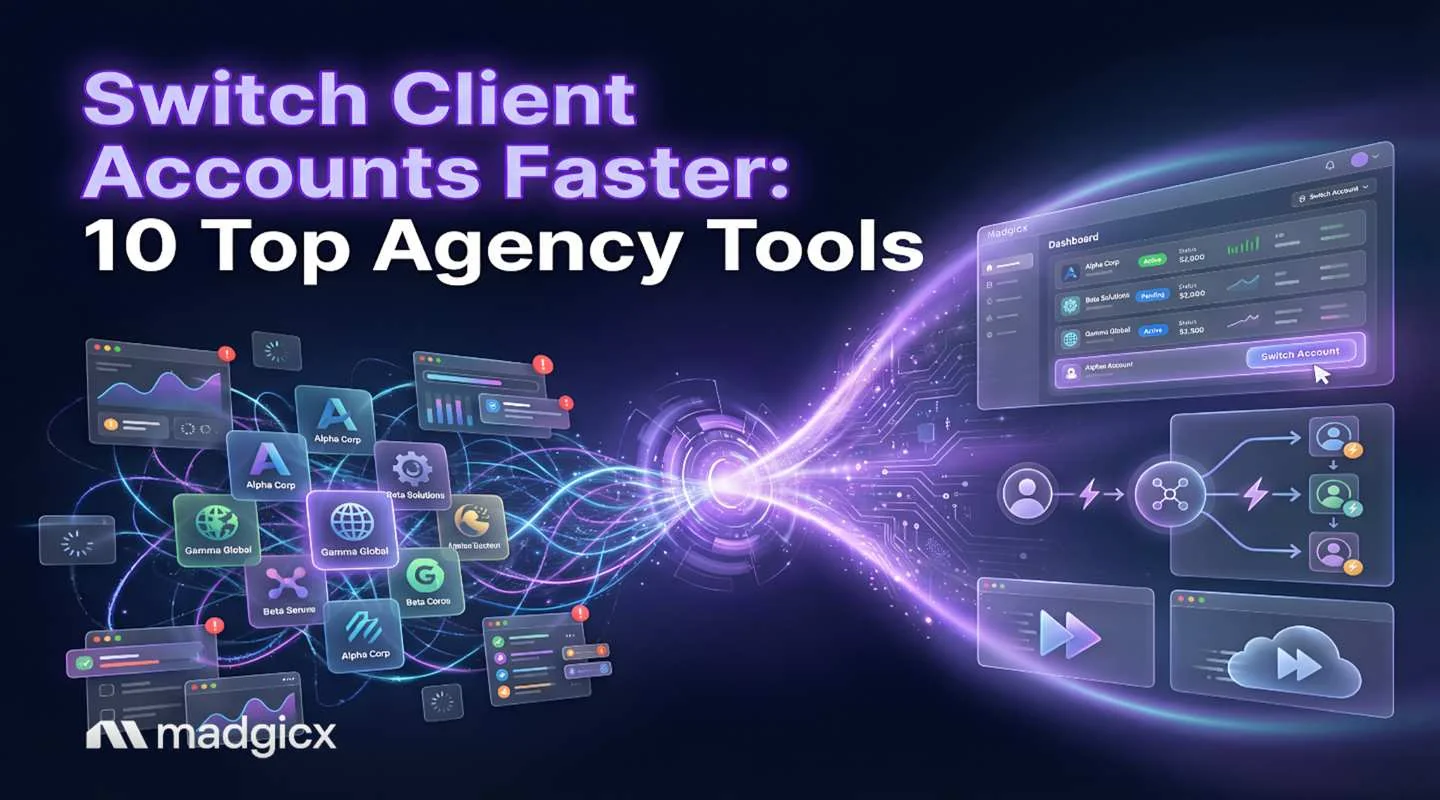
Madgicx's One-Click Report and Business Dashboard unify all your client data from Meta, Google, TikTok, and more into a single view. Diagnose performance, generate reports, and manage every account without ever leaving the platform.
How to Choose a Client Management Tool for Your Agency
So, how do you find "the one"? Choosing the right tool feels a bit like dating, doesn't it? You're looking for a partner that gets you, supports your goals, and doesn't make you want to pull your hair out.
Before we dive into the reviews, here are the five key criteria we used to judge each platform. Keep these in mind to find your agency's perfect match.
- Switching Mechanism & Speed: First up, how do you actually switch accounts? Is it a dropdown menu? A separate login? The most efficient tools make this process nearly invisible. We'll look at how fast and intuitive the switch is, because every second saved adds up across your day.
- Data Centralization: Next, does the tool just put your clients in separate digital boxes, or does it bring all that juicy data together? This is the difference between a tool that lets you switch and one that means you rarely have to.
Key Definition: A centralized dashboard is a unified interface that aggregates data and controls from multiple sources or client accounts, allowing users to monitor and manage different activities from a single screen.
- Core Functionality: Okay, what does the tool really do? Is it built for creating beautiful client reporting dashboards, managing social media posts, or optimizing ad spend? Your agency's primary service will dictate which tool is the best fit.
- Security & Error Prevention: This one's huge. Managing multiple accounts comes with a big risk: posting the right creative to the wrong client's account. We'll assess how each platform uses security features like data isolation and user permissions to prevent costly (and embarrassing) mistakes.
- Pricing & Scalability: And finally, let's talk money. Your agency is built for growth, and your tool stack should be, too. We'll look at the pricing model and whether it scales affordably as you add more clients and users to your roster.
Comparison Table: Top Agency Client Management Tools
Alright, let's get a quick lay of the land. Here's a bird's-eye view of our top 10 contenders. Think of this as the speed-dating round before we get into the deep conversations.
| Tool | Best For | Key Switching Feature | Client Switching Speed | Pricing Model |
|---|---|---|---|---|
| Madgicx | Unified Ad Optimization & Reporting | Unified Dashboard (No Switching Needed) | Instant | From $45/mo, depends on ad spend |
| AgencyAnalytics | All-in-One Agency Reporting | Campaign Dropdown & Client Folders | Fast | Per Client |
| Sprout Social | Social Media Management & Analytics | Group & Profile Switcher | Fast | Per User |
| HubSpot | CRM & Inbound Marketing | Account Dropdown Menu | Standard | Tiered (Hubs) |
| Buffer | Social Media Scheduling | Channel Dropdown | Fast | Per Channel |
| Asana | Project & Task Management | Portfolio & Team Views | Fast | Per User |
| Teamwork | Client Work & Project Management | Global Search & Project Switcher | Fast | Per User |
| Hootsuite | Social Media Management at Scale | Organization & Team Views | Fast | Per User |
| DashThis | Dedicated Reporting Dashboards | Dashboard Dropdown | Fast | Per Dashboard |
| SEMrush | SEO & PPC Campaign Management | Project-Based Switching | Fast | Tiered |
The Top 10 Agency Tools Reviewed
Now that you've seen the lineup, let's get into the details. Here's what you really need to know about each tool.
1. Madgicx
Best for: Unified Ad Optimization & Multi-Channel Reporting
What it does: Madgicx is an AI-powered advertising platform that completely changes the conversation from "how to switch accounts" to "why switch at all?"
It flips the script by unifying performance data from Meta, Google Ads, and TikTok across all your clients into a single, actionable Business Dashboard. It's designed for performance marketers who need to diagnose issues, optimize campaigns, and report on results without wasting time toggling between a million tabs.
Key Features for Agencies:
- Unified Business Dashboard: This is the star of the show. See a top-level view of every client's ad spend, ROAS, and key metrics in one place. This unified view makes it easier than ever to track performance and present ROAS to clients with clarity and confidence. You can spot a problem with Client A's Meta campaign while checking the results for Client B's Google Ads, all on one screen.
- One-Click Report: Say goodbye to hours spent building reports. Madgicx generates comprehensive, cross-channel reports for any client with a single click. It's a killer choice among client reporting tools for agencies that want to deliver value, not spreadsheets.
- AI Chat: Need to know why a client's CPA is suddenly climbing? Just ask. The AI Chat can analyze any connected ad account and give you instant diagnostics and optimization suggestions without you ever having to navigate to that client's specific workspace.
Pros:
- Dramatically reduces context switching with a unified dashboard.
- Combines creative AI with powerful optimization features.
- Strong data isolation and security built for agency peace of mind.
- Helps prevent errors by clearly segmenting client data, assets, and reports.
Cons:
- Primarily focused on paid advertising channels
- Doesn't include project management or CRM features.
Pricing: Madgicx plans start at $45/mo and scale with your ad spend. Free trial available.
2. AgencyAnalytics
Best for: All-in-One Agency Reporting
What it does: AgencyAnalytics is all about making reporting painless. It's a platform built specifically for agencies that need to create comprehensive reports for their clients, integrating with over 75 platforms.
Key Features for Agencies: Its whole design is centered around a clean client-switching interface. You can organize clients into folders and use a simple dropdown to move between their individual dashboards and reports. It's a beast at pulling data from many sources into one place for reporting.
Pros:
- Massive number of integrations.
- Offers white-labeled reports and dashboards.
- Users report huge time savings. According to one case study, an agency saved up to 66 hours per month on reporting.
Cons:
- It's a reporting and monitoring tool, not an execution platform.
- Pricing is per client campaign, which can get pricey as you scale.
Pricing: Offers several pricing tiers. Contact AgencyAnalytics for current rates.
3. Sprout Social
Best for: Social Media Management & Analytics
What it does: For agencies deep in the social media trenches, Sprout Social is a premium player that helps manage publishing, engagement, and analytics across multiple clients. It's known for its slick UI and powerful collaboration features.
Key Features for Agencies: Sprout lets you group social profiles by client. The "Group and Profile Switcher" is a handy dropdown menu that lets you quickly toggle between different client views. Its Smart Inbox unifies all incoming messages from a single client's profiles, but you still need to switch between clients to manage different inboxes.
Pros:
- Excellent publishing and content scheduling features.
- Powerful social listening and analytics tools.
- Strong team collaboration and approval workflows.
Cons:
- Can be one of the more expensive options on the market.
- Primarily focused on organic social media.
Pricing: Pricing is on a per-user basis. See their website for current plans.
4. HubSpot
Best for: CRM & Inbound Marketing
What it does: You know HubSpot. It's the big all-in-one inbound marketing platform. For agencies, its Marketing Hub and CRM are the heart of managing client leads and campaigns.
Key Features for Agencies: HubSpot's agency partner program gives you a main dashboard to see all your client portals. A simple dropdown menu at the top lets you switch between client accounts. The catch? Each client's data is heavily siloed, so there's no unified view of performance across your entire client base.
Pros:
- An all-in-one platform for the entire customer lifecycle.
- A powerful CRM is included in its free tools.
- Extensive training and resources for agency partners.
Cons:
- Can become very expensive as you add contacts or unlock more features.
- Lacks a centralized performance overview across all clients.
Pricing: Offers various plans and tiers. The Marketing Hub has its own pricing structure, available on their website.
5. Buffer
Best for: Simple Social Media Scheduling
What it does: Buffer is a classic for a reason. It's a social media scheduler known for its simplicity and clean interface, making it a great choice for agencies or freelancers who just need to get content scheduled without the fuss.
Key Features for Agencies: You can connect multiple social channels and group them by client. The left-hand navigation allows you to click between different channels instantly. It's less of a "client account" system and more of a "channel" system, but it works beautifully for managing social profiles.
Pros:
- Extremely easy to use and intuitive.
- Affordable pricing model, especially for agencies with many clients.
- Includes basic analytics and an engagement tool.
Cons:
- Lacks the deep analytics and collaboration features of more comprehensive tools.
- Not designed for managing paid ad campaigns.
Pricing: Offers plans based on the number of channels. See their pricing page for details.
6. Asana
Best for: Project & Task Management
What it does: Asana isn't a marketing tool, but for many agencies, it's the brain of the operation. It's how you manage the work for your clients—tracking tasks, deadlines, and project progress for everything from a new ad campaign to a website redesign.
Key Features for Agencies: Asana's "Portfolios" feature is a game-changer for agencies. You can create a Portfolio for each client, which groups all of their projects together. This gives you a high-level view of project status across your client base and lets you drill down into specific client work with a click.
Pros:
- Flexible and visually appealing way to manage complex projects.
- Excellent for team collaboration and assigning tasks.
- Integrates with thousands of other apps.
Cons:
- Doesn't connect to any live marketing data (e.g., ad spend, ROAS).
- Can become a hot mess if not set up with a clear, consistent structure.
Pricing: Offers multiple tiers, with features like Portfolios available on their Business plan. Contact Asana for current per-user pricing.
7. Teamwork
Best for: Client Work & Project Management
What it does: Like Asana, Teamwork is a project management platform, but it's built with a stronger focus on client-facing work. It includes features like time tracking, billing, and client portals that make it a favorite among service-based businesses.
Key Features for Agencies: The platform has a global search and a quick project switcher that makes navigating between different client projects straightforward. It's designed to help you manage the profitability and execution of client work, not their marketing data.
Pros:
- Strong focus on agency-specific needs like profitability and resource management.
- Includes features that other PM tools may charge extra for.
- Helpful for managing client communication and approvals.
Cons:
- Like Asana, it's disconnected from live marketing performance data.
- The interface can feel a bit dated compared to newer tools.
Pricing: Offers per-user pricing plans. See their website for details.
8. Hootsuite
Best for: Social Media Management at Scale
What it does: Hootsuite is another veteran of the social media management space. It's famous for its "streams" dashboard, which lets you monitor multiple feeds at once, making it a powerhouse for large organizations.
Key Features for Agencies: Hootsuite uses an "Organizations" structure. You can create an organization for your agency and add team members and client social profiles. Switching between client assets is managed through team permissions and profile selection, which is effective but can be a bit complex to set up.
Pros:
- Excellent for monitoring real-time conversations.
- Strong security and compliance features for large agencies.
- Includes paid ad campaign management features for social platforms.
Cons:
- The user interface is considered clunky by some users.
- Can be more expensive than competitors for similar features.
Pricing: Offers several plans. See their website for current pricing.
9. DashThis
Best for: Dedicated Reporting Dashboards
What it does: DashThis focuses on one thing and does it incredibly well: creating automated marketing reports. If your main bottleneck is building and sending reports, this tool is an absolute lifesaver.
Key Features for Agencies: The entire platform is built around a dashboard-centric view. A dropdown menu lets you flip between different client dashboards instantly. You can also create templates to quickly roll out new Facebook ads client reports or multi-channel summaries.
Pros:
- Incredibly easy to set up and use.
- Preset report templates and widgets save a ton of time.
- Excellent customer support.
Cons:
- Purely a reporting tool; no management or optimization capabilities.
- Pricing is based on the number of dashboards, which can add up.
Pricing: Pricing is based on the number of dashboards. Contact DashThis for current rates.
10. SEMrush
Best for: SEO & PPC Campaign Management
What it does: While it made its name in SEO, SEMrush is now a full-blown online visibility management platform. It offers powerful tools for PPC, content marketing, and competitive research that are invaluable for digital agencies.
Key Features for Agencies: SEMrush uses a "Projects" system. You create a separate project for each client, which houses all their data for site audits, position tracking, and ad campaigns. A dropdown menu lets you switch between projects, keeping all client data neatly separated.
Pros:
- Comprehensive toolset for SEO and competitive analysis.
- Agency Growth Kit provides tools for lead generation and reporting.
- Great for agencies that focus heavily on search marketing.
Cons:
- The interface can be overwhelming due to the sheer number of tools.
- Social media management tools are less robust than dedicated platforms.
Pricing: Offers several subscription tiers. See their website for current pricing.
Spotlight: What About Security & Preventing Errors?
Okay, let's talk about the agency nightmare. We're talking full-on, cold-sweat-in-the-middle-of-the-night stuff. You've just pushed a new campaign live, feeling pretty good about it, and your phone buzzes. It's a client. But it's the wrong client. You've just spent their competitor's budget on an ad with their logo on it.
This is where the conversation about client switching gets serious. Effective tools don't just make switching easy; they make it safe.
Here are the key security features to look for:
- Data Isolation: Think of this as the digital equivalent of "what happens in Vegas, stays in Vegas." When you're in Client A's dashboard, there should be a zero-percent chance of seeing, touching, or even accidentally breathing on data from Client B.
Key Definition: Data isolation is a security practice in multi-tenant software that ensures one client's data is completely segregated and inaccessible to another client, preventing data leaks and ensuring compliance.
- User Permissions: Look, your new junior account manager is awesome, but they probably shouldn't have the keys to the kingdom (aka billing details). Granular user permissions let you control who can see and do what within each client account, minimizing the risk of human error.
- Visual Cues: This sounds almost too simple, but trust us, it's a lifesaver. Platforms like Madgicx use prominent client logos and names throughout the interface, giving you a constant, clear visual confirmation of which account you're working on. This simple design choice can prevent thousands of dollars in mistaken ad spend.
While most tools offer some level of security, platforms designed with an agency-first mindset, like Madgicx, build this security into their core architecture. This offers a peace of mind that goes way beyond a simple password.
Frequently Asked Questions (FAQ)
1. How can I switch between client accounts faster?
The quickest fix is a tool with a slick dropdown switcher. But the smarter move? Use a platform like Madgicx that aggregates data from all clients into a single view. It's about working smarter, not just switching faster, which significantly reduces the need to switch at all.
2. Is it safe to manage multiple client accounts in one tool?
Yes, absolutely—as long as the tool uses essential security features like data isolation, secure logins (like 2FA), and granular user permissions. These features are non-negotiable for ensuring one client's data is not exposed to another, preventing both data leaks and accidental cross-posting.
3. What's the difference between a project management tool and a client management platform?
Think of it this way: project management tools (Asana, Teamwork) organize tasks, timelines, and team collaboration. Client management platforms (Madgicx, AgencyAnalytics) are built for handling marketing data, generating reports, and managing campaigns. One manages the work, the other manages the results.
4. Can I manage client accounts from my phone?
Many modern platforms offer mobile-friendly options for on-the-go management, so you can often check performance or pause a campaign from your phone. However, complex tasks like building a detailed report are typically much easier on a desktop.
The Smartest Switch? Not Switching at All.
So, after looking at all these tools, what's the big takeaway? A clear theme pops up: the best platforms don't just help you switch between clients faster; they make it so you barely have to switch at all.
Constantly toggling between accounts isn't the real problem—it's a symptom of siloed data. The real solution, the one that actually gives you your time back, is a unified dashboard that brings all your critical info into one command center.
While dedicated reporting and project management tools are essential, a platform like Madgicx tackles the core issue head-on for performance marketers. By unifying ad data from every client across every major channel, it saves countless hours on analysis and reporting while providing robust security to help prevent those nightmare errors.
Ready to see how a unified dashboard can transform your agency's efficiency? Start your free trial with Madgicx →