Stop wasting hours on manual reports. Learn how to build a powerful advertising dashboard that unifies data, proves ROI, and helps your agency scale.
Tired of the "10 tabs open" nightmare every time a client asks for a performance update? Drowning in a sea of spreadsheets, trying to manually stitch together data from Meta, Google, and TikTok, only for the numbers to never quite match up?
We've all been there. And you're not alone. We get it. Many agencies hit a scaling wall, not because of a lack of clients, but because their reporting process is fundamentally broken. It's a time-consuming, error-prone cycle that keeps your best people bogged down in data entry instead of strategy.
And let's be honest, the data chaos is real. Research shows that, according to a Gartner survey, 76% of marketing leaders feel overwhelmed by the volume of data they receive. You have the data, but turning it into clear, actionable insights feels like a full-time job in itself.
This article is your way out of that cycle. We're going to show you how to build a streamlined, actionable advertising dashboard that not only saves you dozens of hours a week but also provides the crystal-clear insights your clients love.
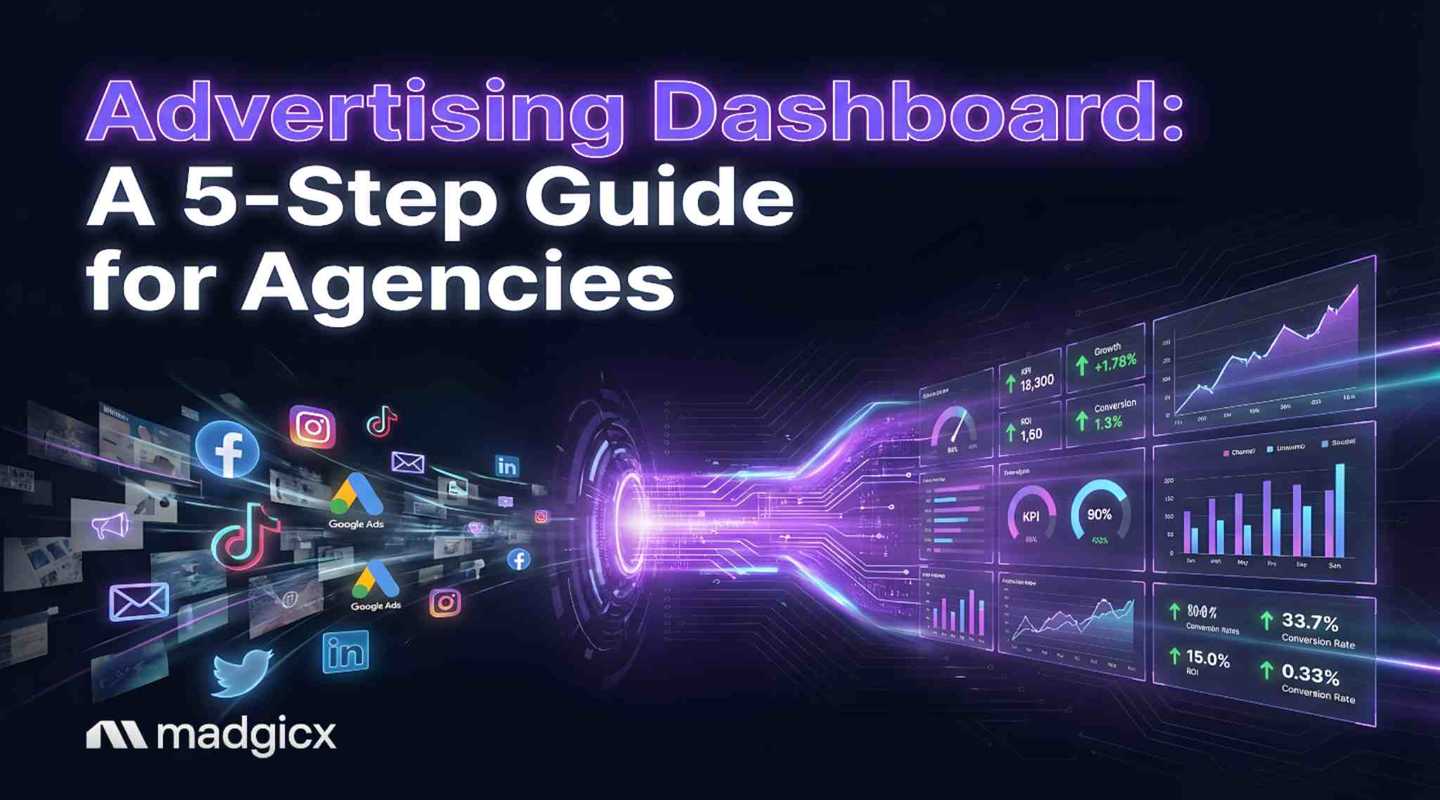
Stop building reports and start driving results. Our unified One-Click Report dashboard combines data from Meta, Google Ads, TikTok, GA4, Shopify, and Klaviyo, letting you generate comprehensive, client-ready reports in a single click.
What You'll Learn
- Why a centralized dashboard is the key to agency scaling
- The exact KPIs to include for clear, client-friendly reporting
- A 5-step process to build an actionable dashboard from scratch
- How to solve the #1 agency headache: attribution mismatches
- A "Build vs. Buy" framework to choose the right tech stack
What is an Advertising Dashboard? (And Why Your Agency Desperately Needs One)
Let's start with a simple, direct definition. An advertising dashboard is a visual interface that pulls all your key performance indicators (KPIs) from various ad platforms into a single, unified view. For agencies, it's the mission-control center for monitoring all client accounts, campaigns, and channels at a glance.
But it’s so much more than a pretty chart. It’s your agency’s centralized source of truth.
Instead of jumping between Facebook Ads Manager, Google Ads, and your client’s Shopify store, you get a holistic view of performance in one place. This isn't just about convenience; it's about survival and growth. In a world where you're constantly battling for client attention and budget, a dashboard transforms your agency from a service provider into a strategic partner.
It lets you answer the most important client questions in seconds:
- "How are my ads performing today?"
- "What's our overall return on ad spend across all platforms?"
- "Which channel is driving the most profitable customers?"
Without a centralized dashboard, answering these questions means hours of manual work, exporting CSVs, and wrestling with VLOOKUPs. With one, it’s a matter of seconds. ✨
Pro Tip: A great agency dashboard tells a story: where the budget went, what the return was, and what we should do next. It’s not just data; it’s a narrative that proves your value.
The Business Case: How Dashboards Drive Agency Profitability
Alright, let's talk money. Investing time or resources into a proper dashboard system isn't a cost; it's a direct path to higher profitability. Here’s exactly how.
Benefit 1: Reclaim Your Team's Billable Hours
Think about the time your team spends every week and month just pulling reports. Now, what if you could slash that time and give it back to them? That’s what a dashboard does. It automates the tedious data collection, freeing up your account managers to focus on what you actually bill for: strategy, optimization, and scaling client accounts.
The impact is huge. According to industry analysis, businesses using centralized, real-time dashboards achieve 25% faster campaign decision-making and a 33% higher marketing ROI. Faster decisions mean less wasted ad spend and more time spent on revenue-generating activities.
Benefit 2: Scale Your Client Load, Not Your Headcount
Hiring is expensive and time-consuming. A well-built dashboard is a force multiplier for your team. It empowers even junior account managers to spot trends, identify underperforming ads, and make smart optimizations that would typically require senior-level oversight.
By standardizing your agency's "view" of success, you create a system where everyone can monitor account health effectively. This allows your senior strategists to focus on high-level client relationships and new business. You can take on more clients without your operational costs spiraling out of control.
Benefit 3: Drastically Improve Client Retention
Here's a hard truth: clients don't churn because of one bad campaign; they churn because of a lack of communication and perceived value. A transparent, easy-to-understand digital marketing dashboard is one of your most powerful retention tools.
When you can share a live link that clearly shows Spend, Revenue, and ROAS, you build immense trust. You’re not hiding behind confusing metrics; you’re giving them a clear window into their investment's performance. This transparency turns reporting sessions from defensive justifications into collaborative strategy meetings, solidifying your role as an indispensable partner.
The Core KPIs for an Agency Advertising Dashboard
Not all metrics are created equal. A cluttered dashboard is just as useless as a spreadsheet. A great dashboard organizes KPIs into layers, so you can show the right information to the right person at the right time.
Here’s the simple framework we use to keep things clean and actionable.
Tier 1: The Executive Summary (For Your Client)
This is the top-line view for your clients. It should be dead simple, clean, and focused on business outcomes. No jargon, just results.
- Spend: How much money went out the door.
- Revenue: How much money came back in.
- ROAS (Return on Ad Spend): The most important top-level metric. For every dollar we spent, how many did we generate?
- CPA (Cost Per Acquisition): How much it costs to get one new customer.
- New Customers: The total number of new customers acquired.
Tier 2: The Diagnostic View (For Your Internal Team)
This is for your account managers. These metrics help them understand the why behind the Tier 1 results and diagnose performance issues before they become problems.
- CTR (Click-Through Rate): Are the ads compelling enough to earn a click?
- CPC (Cost Per Click): How much are we paying for traffic? Is it trending up or down?
- CVR (Conversion Rate): Of the people who click, what percentage are actually converting?
- Frequency: How many times is the average person seeing our ads? (Are we annoying them yet?)
- Blended ROAS/MER (Marketing Efficiency Ratio): Total revenue divided by total ad spend across all platforms. This is your true north for profitability.
Tier 3: Platform-Specific Metrics (For the Specialists)
These are the granular metrics your team uses for in-the-weeds optimizations. They usually don't belong on a client-facing dashboard but are crucial for your internal team's day-to-day work.
- Google Ads Quality Score: A measure of ad and landing page relevance.
- Meta Ads Outbound CTR: Differentiates between clicks to your website vs. clicks on the ad itself.
- TikTok 6s View Rate: A key indicator of creative effectiveness on the platform.
How to Build an Actionable Advertising Dashboard in 5 Steps
Ready to build? Here’s a repeatable process your agency can use to get it right every single time.
Step 1: Define Goals & KPIs (With Your Client)
First things first. Stop and ask the most important question: "What does success actually look like for this client?" Is it maximizing ROAS for an e-commerce store? Driving down cost per lead for a B2B service? Or acquiring new customers at a specific blended CPA?
The client's business objectives must define the dashboard's primary KPIs. Don't just copy and paste metrics from another account. Tailor the dashboard to tell the story that matters most to that client.
Step 2: Connect Your Data Sources
This is where the magic—and the potential for headaches—begins. You need to pull data from all the relevant platforms into one place. This typically includes:
- Ad Platforms: Meta (Facebook & Instagram), Google Ads, TikTok Ads
- Analytics Platform: Google Analytics 4 (GA4)
- E-commerce Platform: Shopify
- Email Platform: Klaviyo
Connecting these sources is what allows you to create that holistic view, blending ad performance with actual business results.
Step 3: Design a Decision-Oriented Layout
Don't just throw charts on a page and call it a day. Design with a purpose. A proven layout for agencies is:
- Top Row (The "At-a-Glance" Bar): Place your Tier 1 KPIs here (Spend, Revenue, ROAS, CPA). Use big, bold numbers so a client can understand account health in 5 seconds flat.
- Mid-Row (The "Channel Breakdown"): Use bar or pie charts to show the performance breakdown by channel (e.g., ROAS from Meta vs. Google vs. TikTok). This answers, "Where are our results coming from?"
- Bottom-Row (The "Deep Dive" Tables): Include tables with campaign-level or ad-set-level data. This is for your internal team to spot optimization opportunities without cluttering the client's view.
Step 4: Validate and Normalize Your Data
Remember: garbage in, garbage out. For your dashboard to be trustworthy, your data needs to be clean. This means establishing agency-wide best practices for:
- UTM Tagging: Use consistent UTM parameters on all your ads so you can track performance accurately in GA4. No exceptions!
- Campaign Naming Conventions: A structured naming system (e.g., `Client_Channel_CampaignObjective_Date`) makes it infinitely easier to filter and analyze data later.
- Currency & Timezone Alignment: Ensure all data sources are set to the same currency and timezone to avoid those confusing (and embarrassing) discrepancies.
Step 5: Automate Data Refresh & Streamline Sharing
The final step is to get yourself out of the manual work. A truly efficient system has data that refreshes automatically. You can then share a live dashboard link with your client for real-time updates or schedule a PDF to be sent for your weekly reports. This is how you achieve true reporting nirvana. 🚀
The Agency Tech Stack: Build vs. Buy
Okay, so how do you actually make this happen? Agencies generally face two choices: build it yourself or buy a ready-made solution.
| Approach | The “Build” (DIY) Approach | The “Buy” (All-in-One) Approach |
|---|---|---|
| Tools |
Supermetrics / Porter Metrics + Looker Studio / Power BI |
Madgicx, AgencyAnalytics, Whatagraph |
| Pros |
✅ Ultimate customization and flexibility. |
✅ Incredibly fast setup (minutes, not weeks). |
| Cons |
❌ Time-intensive; requires technical expertise. |
❌ Less customization than a full BI tool setup. |
| Best For |
Agencies with dedicated data analysts. |
Agencies focused on speed, efficiency, and scalability. |
Pro Tip: If your agency has a dedicated data analyst on staff, the "Build" approach offers maximum flexibility. For most agencies focused on speed and efficiency, the "Buy" approach is the smart shortcut—it provides 90% of the value for 10% of the effort.
Our Take: An Integrated Platform is the Smarter Choice
Here's how we see it: for most performance-focused agencies, an all-in-one platform is the winning move. This is where Madgicx shines. We built the One-Click Report and Business Dashboard specifically to solve this exact problem.
It’s not just a reporting tool; it’s part of a comprehensive advertising platform. You get the fast, multi-channel reporting you need—integrating Meta, Google, TikTok, GA4, Shopify, and Klaviyo—without the DIY headache. The real power is that the insights from your dashboard are directly connected to our AI-powered optimization tools. You can go from insight to action, all within the same platform, which is the core promise of AI-driven advertising.
Try our inclusive dashboard here.
Solving the #1 Agency Headache: Attribution Mismatches
If you've ever had a client ask, "Why does Facebook say we made $10,000 but Shopify only shows $6,000?"—this section is for you. This is the single biggest source of friction in client reporting.
Why Does This Happen?
It's not that one platform is "lying." It's that they all measure success with a different rulebook.
- Attribution Windows: Meta might take credit for a sale if someone clicked an ad within 7 days (7-day click). Google Analytics, by default, might only give credit to the last ad someone clicked before buying.
- Walled Gardens: Think of it this way: Meta knows everything that happens on its platform but has limited visibility after a user leaves. GA4 knows everything that happens on your website but has limited visibility into ad impressions. They are two different worlds with two different sets of data.
The Solution: A Blended Source of Truth
Here's the secret: stop trying to make the numbers match perfectly. It's an impossible, frustrating task. Instead, use your dashboard to create a blended, directional source of truth.
The goal isn't perfect accounting reconciliation; it's consistent, trend-based decision-making. By combining data from all your ad platforms with your store's backend (like Shopify), you can calculate a Blended ROAS or Marketing Efficiency Ratio (MER). This becomes your North Star metric. As long as your blended ROAS is above target, your overall strategy is working, regardless of what any single platform claims.
How Madgicx Helps
A more accurate data foundation makes this whole process easier. This is where Madgicx's Server-Side Tracking comes in. By creating a more reliable server-to-server connection between your website and platforms like Meta, it helps address data loss from things like iOS updates. More accurate data leads to better optimization and more reliable numbers in your dashboard to begin with, which is the primary function of a powerful Facebook Ads reporting tool.
Best Practices for Client-Ready Dashboard Reporting
Finally, a dashboard is only as good as its ability to communicate value. Here are a few pro moves to make your dashboards a client-retention machine.
- Annotate and Add Commentary: Don't just show a chart; explain what it means. Use text widgets to add context like, "ROAS dipped this week because we launched two new prospecting campaigns. We expect it to rise as we move them into retargeting." This shows you're on top of the data, not just presenting it.
- Set a Reporting Cadence: Establish clear expectations from day one. Maybe you review a live dashboard together on a weekly call and send a summarized PDF for the monthly wrap-up. A consistent rhythm builds trust and eliminates those frantic, last-minute requests.
- Focus on Trends, Not Daily Absolutes: Coach your clients to look at the trend lines over time. Is ROAS generally trending up? Is CPA trending down? A single day's performance is just noise; the trend over weeks or months is the signal that proves your strategy is working.
FAQ Section
What's the difference between an advertising dashboard and a marketing dashboard?
Think of it as specific vs. broad. An advertising dashboard focuses specifically on paid media performance (PPC, social ads), tracking metrics like ROAS, CPA, and spend. A social media report or marketing dashboard has a wider scope that can include organic social, SEO, and email marketing.
How many dashboards do I need for my agency?
Best practice is to have a detailed internal dashboard for each client and a simplified, summary version for client-facing reports. We also recommend a portfolio-level dashboard that gives you a top-level view of all clients at once, so you can see your whole agency's health at a glance.
What is the most important KPI for an advertising dashboard?
While it always depends on the client's goal, ROAS (Return on Ad Spend) or POAS (Profit on Ad Spend) is typically the most critical KPI. It directly ties the advertising budget to business revenue and profitability—the thing your clients care about most.
Can I build an advertising dashboard for free?
Yes, you can use tools like Looker Studio with its native connectors for Google Ads and GA4. However, to connect data from platforms like Meta or TikTok, you'll need third-party connectors, which usually come with a monthly cost. So, a truly multi-channel dashboard is rarely ever free.
Conclusion: From Data Chaos to Client Clarity
Building a robust advertising dashboard isn't just a technical task; it's a strategic move that unlocks your agency's ability to scale. By centralizing data, standardizing KPIs, and automating reports, you free your team to focus on high-impact strategy.
You move from being a reactive report-puller to a proactive growth partner for your clients. You'll be able to answer tough questions with confidence, prove your value with compelling data, and ultimately, build a more profitable and efficient agency.
Ready to ditch the spreadsheets for good? Madgicx's One-Click Report and Business Dashboard give you the cross-channel clarity you need, without the custom-build complexity.