Learn what a dynamic ad is and how to use it to automate personalization and improve ROAS on Meta and Google. Discover the agency playbook.
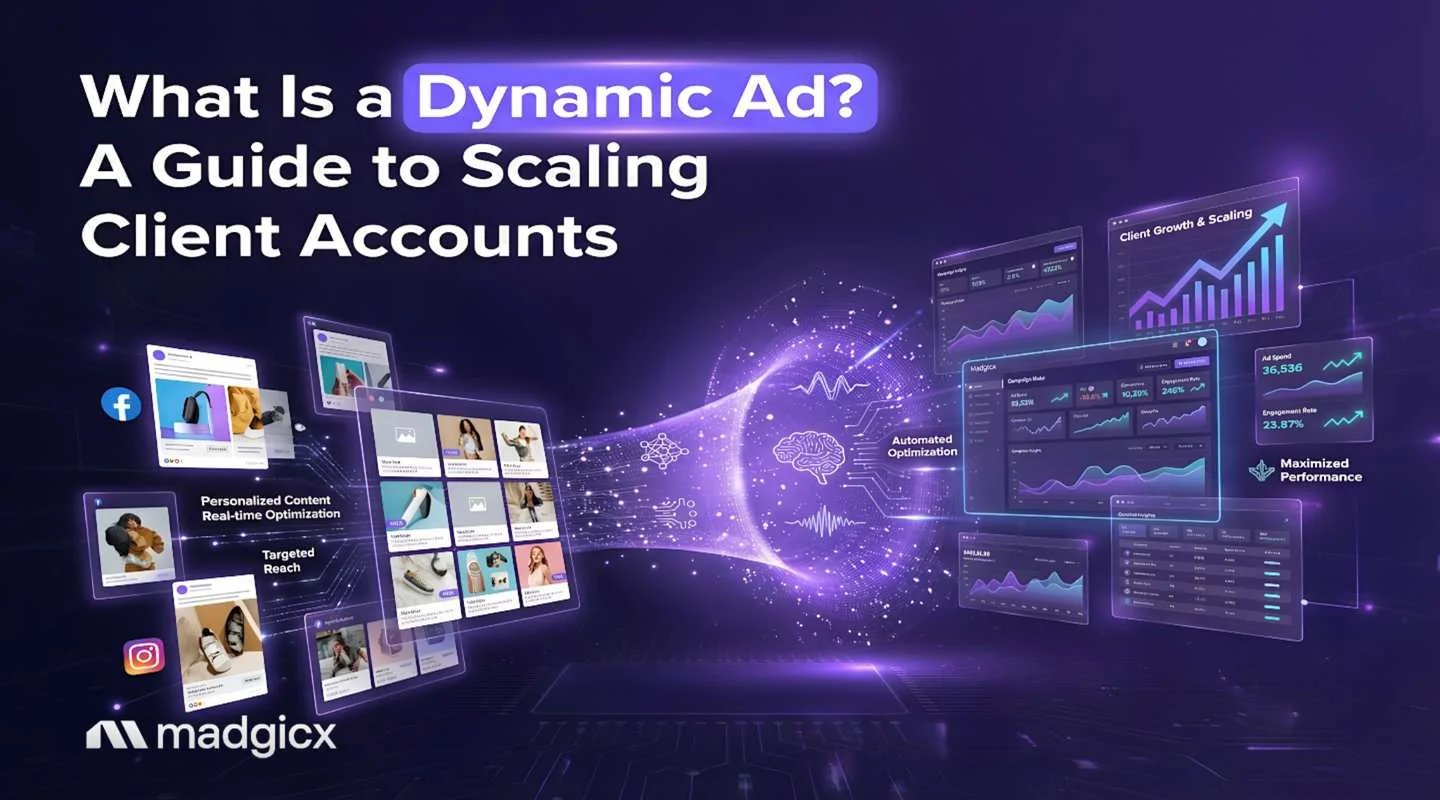
So, what is a dynamic ad? At its core, a dynamic ad is an automated advertising format that uses a product feed and user behavior data to show the right product to the right person at the right time. This system automatically personalizes ad content, making it a powerful scaling engine for agencies managing multiple e-commerce clients.
Now, picture this: It's 9 PM on the last Tuesday of the month. Your dinner is cold, and you’re staring at a spreadsheet with 12 e-commerce clients. Your mission is to manually update ad creatives for hundreds of products, trying to guess which ones will resonate. It’s a soul-crushing time-sink, and the personalization is… not very personal.
That's the problem dynamic ads solve. They streamline that entire process, delivering more relevant, timely ads to potential customers for every single client, slashing your manual workload after the initial setup.
This guide is your new playbook. We’ll break down exactly how you can use dynamic ads to drive massive efficiency, deliver the kind of results that make clients sing your praises, and finally start growing those retainers.
Madgicx’s AI Ad Generator helps you expand top-performing creatives into multiple high-quality variations in minutes. Increase testing volume, discover new winners faster, and scale campaigns without extra design work.
What You'll Learn
- How dynamic ads work as an efficiency engine for managing multiple clients.
- Current performance benchmarks for dynamic ads on platforms like Meta, Google, and Reddit.
- A data-backed design framework that has been shown to increase catalog ad ROAS.
- Bonus: How to leverage dynamic retargeting to significantly improve client conversion rates.
How Dynamic Ads Work: The Agency Efficiency Engine
Alright, let's get down to brass tacks. At its core, a dynamic ad system is a beautiful, three-part harmony:
- A Product Catalog: This is a file (think of it as a super-smart spreadsheet) that contains all the info about a client's products: images, prices, descriptions, availability, etc.
- A Pixel or SDK: This is the tracking code on your client’s website or app. It’s our "spy" that watches user behavior—what products they view, what they add to their cart, and what they purchase.
- An Ad Template: This is the design framework you create. It has placeholders for the product image, name, and price, which the platform automatically fills in from the catalog based on a user's behavior.
For an agency, this setup is a godsend. Once you’ve configured it for a client, it runs 24/7. It automatically showcases new arrivals, removes out-of-stock items, and personalizes ad impressions based on fresh user data.
This frees up your account managers from the endless cycle of manual creative swaps and tedious audience segmentation. Their time can now be spent on high-level strategy, client communication, and, you know, having a life.
Pro Tip: Create a "Dynamic Ad Onboarding Checklist" for every new client. It should include getting access to their product feed, confirming the pixel is installed and firing correctly, and getting their brand style guide so your ad templates are always on-point.
Why Dynamic Ads Are a Non-Negotiable for Agencies
If you're not pushing dynamic ads as a core service for your e-commerce clients, you're leaving a mountain of money and efficiency on the table. This isn't just a "nice-to-have" anymore; it's the standard for high-performance advertising.
The market itself tells the story. According to a recent industry analysis, the dynamic ads market is projected to hit a staggering $27 million by 2025. Your clients are hearing about this technology, and they'll be looking for agencies that can deliver it.
Plus, the performance uplift is undeniable. We know that creative performance drives a whopping 47% of sales lift from advertising, and dynamic ads are a powerful creative automation tool. When you combine this with AI, the results can be even more impactful. Studies show that AI-optimized creatives can achieve up to 2x higher click-through rates (CTRs).
This isn't just a cool stat; it's a powerful selling point for your agency's tech-forward approach.
Quick Tip: When pitching to clients, position dynamic ads as "future-proofing" their advertising. As competition gets fiercer and ad costs rise, automated personalization is the key strategy to stay competitive and profitable.
Dynamic Ads Across Platforms: A Benchmark Guide for Agencies
So, where should you be allocating your clients' budgets for the best results? Let's break down the big three platforms.
Meta (Facebook & Instagram): The Powerhouse
Meta pioneered dynamic ads and remains a dominant platform. With Advantage+ Catalog Ads, the platform is leaning even harder into automation, using its AI to find the best audiences and placements for your client's products.
- What to Use: Advantage+ Catalog Ads (formerly Dynamic Product Ads or DPA).
- Current Benchmarks: Our latest analysis shows that top-performing catalog campaigns are seeing CTRs of 1.49%. For lead generation campaigns, conversion rates are now hitting 7.72% or higher.
Google Ads: The Search & Shopping Giant
Google's ecosystem is a must for any serious e-commerce brand, and its dynamic capabilities are incredibly powerful, extending beyond just shopping.
- What to Use: Performance Max campaigns with a product feed are the new standard. Don't forget Dynamic Search Ads (DSAs), which automatically create ads based on website content.
- Current Benchmarks: The median ROAS for Search campaigns is 5.17, while Shopping campaigns come in at 2.88.
Reddit: The Emerging Opportunity
Don't sleep on Reddit. It's rapidly becoming a major player in the e-commerce space, and its users are highly engaged and ready to buy.
- What to Use: Reddit Dynamic Product Ads.
- Current Benchmarks: Reddit's Dynamic Product Ads deliver 2x higher ROAS compared to standard conversion campaigns. VistaPrint achieved a 4x ROAS here.
Strategic DPA Design: Translating Data into Client ROAS
Most agencies use default templates, but the elite ones know that strategic design is a massive performance lever.
The Brand Name Effect: +44% ROAS
Designs that prominently feature the brand name or logo see an average ROAS increase of +44%. For luxury brands, that number jumps to +62%.
The Product Name Nuance: +22% ROAS
Including the product name in the creative yields a +22% ROAS increase. We recommend A/B testing this for every client to see if the product name adds value or clutter.
The Campaign Messaging Goldmine
Designs that mention a specific offer (e.g., "Free Shipping") can perform better than those with no campaign messaging.
Beyond Prospecting: Dynamic Retargeting for Maximum Conversions
Dynamic retargeting shows people the exact products they viewed or added to their cart. It’s a high-intent strategy that just works.
- Retargeting ads have a CTR that is 10x higher than standard display ads.
- Retargeted visitors are 70% more likely to convert.
- This can lead to conversion rate boosts of up to 150%.
Pro Tip: Set up a tiered strategy:
- ViewContent (7-day window): For users who viewed but didn't add to cart.
- AddToCart (3-day window): High-intent audience; be aggressive.
- Purchase (30-day window): For dynamic cross-sell or upsell campaigns.
The Madgicx Advantage: Unifying Your Dynamic Ad Workflow
Think of Madgicx as your co-pilot for agency efficiency:
- Scale Winning Creatives Faster: Upload product photos or reuse high-performing ads, and use the AI Ad Generator to automatically generate dozens of professionally designed variations with different layouts and visual styles. This allows you to expand what’s already converting, launch more creative tests at once, and scale winning concepts faster—without relying on designers or manual production.
- Get Answers, Not Headaches: Ask Madgicx's AI Chat: "Why did my client's dynamic retargeting ROAS drop last week?" for a data-backed analysis.
- Optimize Smarter, Not Harder: The AI Marketer continuously monitors creative performance to detect early signs of fatigue, declining engagement, and rising costs, then delivers one-click optimization recommendations to help refresh ads and sustain results.
- Showcase Your Wins, Instantly: Use the One-Click Report to consolidate Meta, Google, and Shopify performance into a single dashboard.
Frequently Asked Questions (FAQ)
How do I convince a client to invest in setting up a product feed?
Frame it as a one-time setup for long-term, automated performance. Cite the performance lift and explain that this single asset unlocks advanced strategies across multiple platforms.
Can dynamic ads be used for clients without an e-commerce store?
Absolutely! You can use them for:
- Real Estate: Property listings feed.
- Travel: Flights, hotels, or vacation packages.
- Automotive: Vehicle inventory.
- Recruitment: Open job listings.
What's the best way to report DPA performance to clients?
Avoid silos. Use a blended ROAS (or MER - Marketing Efficiency Ratio) metric. Tools like Madgicx help calculate the total impact on the bottom line.
Conclusion: Make Automation Your Agency's Superpower
Dynamic ads are your key to unlocking massive digital marketing efficiency and scaling operations profitably. The data is clear: automated, feed-based advertising is the winning strategy. Audit your top clients today and find where you can implement these strategies to capture immediate results.