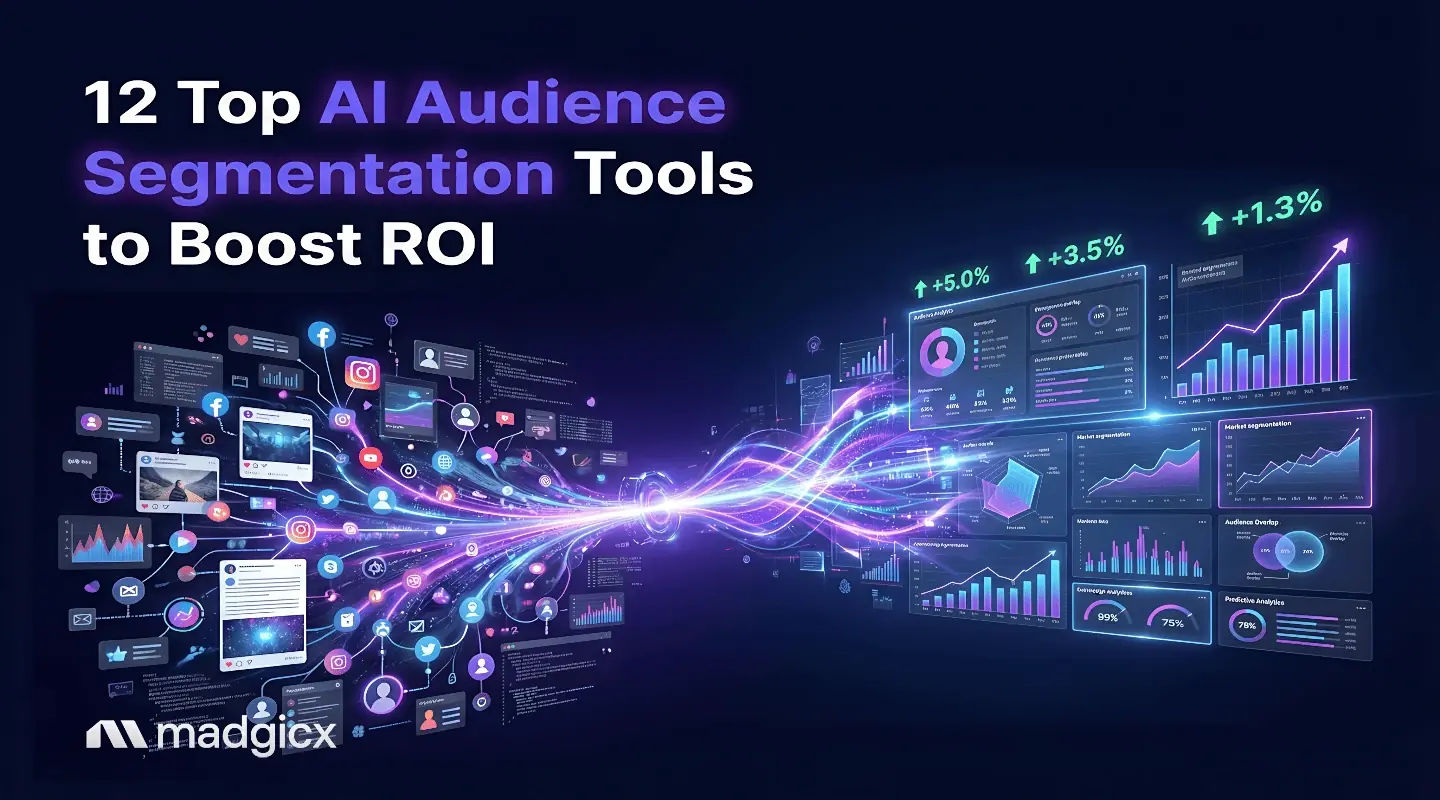
Discover the top AI audience segmentation tools available today. Our guide compares tools that help you personalize advertising and lower acquisition costs.
If you’ve ever felt like you’re just throwing spaghetti at the wall with your targeting, you’re not alone. For years, we all relied on basic demographic ad targeting—age, gender, location—and a whole lot of guesswork. It was… fine.
But let's be honest, in today’s hyper-competitive market, "fine" doesn't cut it. It gets you mediocre ROAS and a stress headache. The era of relying on intuition is officially over.
AI has stepped in, allowing us to move beyond who our customers are and finally understand why they buy. This guide breaks down the leading tools on the market that are leading this charge, helping you find the right audience, deliver the right message, and grow your business without burning through your budget.
Madgicx's Audience Launcher gives you prebuilt, high-performing audiences you can launch in one click, while the AI Marketer continuously analyzes your data to surface the people most likely to convert—from lookalikes to high-intent buyers—and automatically shifts your budget toward what’s working.
How We Chose the Top AI Segmentation Tools
Look, we’re performance marketers, just like you. We live and breathe this stuff.
So when we set out to find the top AI audience segmentation tools, we didn't just look for flashy features. We looked for platforms that solve real-world problems for advertisers. We judged every tool against the standards we’d expect for our own campaigns.
Here’s the criteria we used:
- AI-Powered Optimization: Does the tool just show you data, or does it actively help you make smarter decisions and improve performance? We wanted tools that provide actionable recommendations.
- Multi-Channel Capability: Your customers aren't just on one platform, so your data shouldn't be, either. We prioritized tools that can integrate data from multiple sources like Meta, Google, and Shopify.
- E-commerce Focus: E-commerce has its own unique set of challenges. We gave extra points to solutions built specifically for online retailers.
- Actionable Insights: Data is useless without insight. The best tools don't just give you numbers; they tell you what those numbers mean and what to do next.
- Pricing Transparency: We believe you should know what you’re paying for. We favored tools with clear, accessible pricing models.
AI Audience Segmentation Tools: At a Glance
The Top 12 AI Audience Segmentation Tools
1. Madgicx
Positioning: AI Audience Discovery for E-commerce Targeting.
Struggling to segment audiences that actually convert? Madgicx’s Audience Launcher makes it effortless with 100+ prebuilt winning audiences, fully optimized and ready to launch. No more endless testing or data wrangling—these audiences are battle-tested and primed for your campaigns.
At the core is our AI Marketer, which runs 24/7 to analyze your performance data across Meta. It automatically identifies audiences most likely to convert by spotting patterns in your top purchasers—think hyper-precise lookalikes built from your best customers, interest-based clusters, and behavioral segments tailored to e-commerce funnels.
What sets Madgicx apart? Personalization at scale. The AI Marketer doesn't just suggest; it delivers ready-to-use audiences with predicted ROAS potential, excluding underperformers to sharpen targeting. Reallocate budget to high-potential audiences with one slick click.
Got a question about why your ROAS dropped? Just ask our AI Chat. It analyzes your performance 24/7 and gives you instant diagnostic answers, so you can stop digging and start optimizing.
- Best For: E-commerce brands looking to scale profitably across Meta.
- Pricing: Starts at $45/mo. Try Madgicx for free today.
2. Pixis
Positioning: AI for Ad Performance Optimization.
Ever feel like you’ve squeezed every last drop out of your lookalike audiences? You’ve targeted every interest under the sun, but your CPA is still creeping up. That’s where Pixis comes in.
Instead of just layering targeting, Pixis uses a codeless AI infrastructure to build complex deep learning models for audience segmentation that find pockets of high-intent customers you might have missed. It’s all about letting the AI do the heavy lifting to improve targeting and bidding.
According to Pixis, the furniture brand Nomad used the platform to achieve a 28% reduction in customer acquisition cost. It’s a serious tool for serious advertisers.
- Best For: Performance marketers focused on optimizing ad spend on platforms like Meta and Google.
- Pricing: Starts at $45/month.
3. Braze
Positioning: Enterprise-Grade Customer Engagement.
If your company has "enterprise" in its vocabulary and your customer journey map looks like a New York City subway system, you’ve probably heard of Braze. It’s a robust platform designed to manage customer communication across every conceivable touchpoint—email, SMS, in-app messages, and more.
Braze’s AI, called "Sage," is all about predicting customer behavior. Its predictive suite can identify which customers are likely to churn, which are likely to make a purchase, and when to send them a message for maximum impact.
According to Braze, brands using its multi-step orchestration see a 7.9x uplift in purchases. Case in point: Overstock used Braze to achieve a 21% conversion rate with real-time personalization.
- Best For: Large enterprises needing cross-channel customer journey orchestration.
- Pricing: Custom.
4. Lifemind.ai
Positioning: Psychographic and Value-Based Insights.
Okay, most tools focus on what customers do (behavioral data). But have you ever wondered why they do it? This is where things get really interesting.
Lifemind.ai is obsessed with the "why." It uses AI to uncover the core values and motivations of different consumer groups in a privacy-conscious way, using zip codes instead of personally identifiable information (PII)—a major shift from traditional demographic and geographic targeting. This is where we get into the fun stuff: psychographics.
Psychographic segmentation is a marketing technique that groups customers based on their psychological attributes—such as values, beliefs, interests, and lifestyles—to understand the "why" behind their purchasing decisions.
This kind of insight can be invaluable for crafting messaging that truly resonates.
- Best For: Brands wanting to understand the "why" behind consumer behavior for creative and messaging strategy.
- Pricing: Starts at $1,000+/month.
5. Amplitude
Positioning: Product Analytics for Growth.
Amplitude isn't a traditional advertising tool; it’s a product analytics platform. But for any business with an app or a SaaS product, understanding user behavior is the key to growth. It helps you analyze every click, swipe, and interaction to build behavioral cohorts.
Think of it this way: it helps you answer questions like, "What do my best customers all have in common?" or "Where are new users getting stuck and leaving?" You can identify your power users and even predict which actions lead to long-term retention. It’s less about finding new customers and more about getting the most value from the ones you already have.
- Best For: Product teams and startups focused on optimizing user behavior and achieving product-market fit.
- Pricing: ree plan available, paid from $49/month.
6. 6sense
Positioning: B2B Predictive Intelligence.
Selling to other businesses isn't about convincing one person; it's about winning over an entire buying committee. It's a whole different ballgame. That’s the core idea behind Account-Based Marketing (ABM), and 6sense is a beast in this space.
It uses AI to analyze billions of intent signals across the web to identify which companies are actively researching solutions like yours right now. It helps sales and marketing teams stop wasting time and focus their energy on accounts that are actually ready to buy.
Account-Based Experience (ABX) is a B2B go-to-market strategy that uses data and AI to coordinate personalized marketing and sales efforts across an entire target account, treating the company as a single customer.
- Best For: B2B sales and marketing teams executing an account-based strategy.
- Pricing: Offers a free plan, with paid plans available.
7. Sintra AI
Positioning: AI Assistant Workforce.
Sintra AI takes a pretty unique approach. Instead of one giant, monolithic AI, it offers a "workforce" of specialized AI assistants, each designed for a specific job. You have "Milli" for marketing, "Emmie" for sales, and others for data analysis.
These assistants are powered by a central "Brain AI" that learns from your company's data to ensure all automated tasks are aligned with your business goals. It’s an interesting concept for teams that want to dip their toes into AI automation across various departments without committing to a single, massive platform.
- Best For: Teams looking to automate a wide range of tasks beyond just marketing, from sales to data analysis.
- Pricing: Starts at $48.50/month.
8. Klaviyo
Positioning: E-commerce Email & SMS Marketing.
For so many e-commerce businesses, Klaviyo is the heart of their marketing stack. While it’s primarily known for email and SMS automation, its segmentation capabilities are a fantastic entry point into AI-driven marketing.
Klaviyo creates a detailed profile for every customer, tracking purchase history and browsing behavior. Its AI can then predict a customer's next order date, their lifetime value, and their churn risk. This allows you to build incredibly sophisticated segments, like "VIP customers who haven't purchased in 60 days" or "new subscribers likely to become high-spenders." 💰
- Best For: Small to medium e-commerce businesses starting with customer segmentation for email and SMS.
- Pricing: Free plan available up to 250 profiles.
9. Gong.io
Positioning: Revenue Intelligence.
Gong is a bit different. It doesn't analyze web traffic; it analyzes conversations. By recording and transcribing sales calls and demos, Gong’s AI identifies key topics, customer objections, and winning talk tracks used by your top performers.
This is a goldmine for audience segmentation. You can discover the exact language your best customers use to describe their pain points and use it in your ad copy.
- Best For: Sales organizations looking to use AI to analyze customer interactions at scale.
- Pricing: Custom.
10. Demandbase
Positioning: The Complete ABX Platform.
If 6sense is the predictive engine for B2B, think of Demandbase as the comprehensive command center. It combines intent data with its own B2B advertising platform and advanced account scoring, offering a complete solution for Account-Based Experience (ABX).
Demandbase helps you not only identify which accounts to target but also run programmatic ad campaigns directly to the key decision-makers within those accounts. It’s designed to bridge the often-tricky gap between marketing insights and sales action.
- Best For: Mature B2B organizations needing an end-to-end ABX platform with advertising and scoring.
- Pricing: Pricing upon request.
11. Usermaven
Positioning: Privacy-First Web & Product Analytics.
With all the talk about cookies disappearing and privacy crackdowns, are you a little nervous about your tracking? You're not alone. Usermaven has carved out a smart niche for exactly this reason.
It’s an all-in-one analytics suite that offers cookieless tracking, making it a compelling, privacy-first alternative to Google Analytics. You can track user journeys and build behavioral segments without relying on invasive tracking methods.
- Best For: Privacy-conscious businesses needing a Google Analytics alternative with built-in segmentation.
- Pricing: Starts at $71/month.
12. Twilio Segment
Positioning: Customer Data Platform (CDP).
Think of Twilio Segment as the foundational plumbing for your entire marketing stack. It doesn't analyze data itself. Instead, a Customer Data Platform (CDP) does one thing exceptionally well: it collects customer data from every source and pipes it into a single, clean, unified profile.
That clean data can then be sent to all the other tools in your stack—like Madgicx for ad optimization or Braze for email campaigns. It’s a technical tool, for sure, but it’s the bedrock upon which great personalization is built, ensuring every tool is working from the same source of truth.
- Best For: Technical teams needing to build a clean, unified customer data pipeline.
- Pricing: Custom
Frequently Asked Questions (FAQ)
What is the difference between behavioral and psychographic segmentation?
It's pretty simple when you break it down:
Behavioral segmentation groups customers based on their actions (what they do), like purchase history, website clicks, and email opens.
Psychographic segmentation groups them based on their internal traits (who they are), like values, interests, lifestyle, and personality. A great strategy uses both to get a complete picture of the customer.
Pro Tip: Combine psychographic insights with behavioral data for some seriously powerful results. Use a tool like Lifemind.ai to understand why a certain group buys, then use a tool like Klaviyo or Madgicx to target them with personalized messages based on what they've done on your site. It's the best of both worlds, often powered by sophisticated machine learning models for audience segmentation. ✨
How does AI improve audience targeting?
AI improves audience targeting by using predictive models to find customers who are most likely to convert.
Instead of just targeting people who look like your past customers (which is what lookalike audiences do), AI can use predictive behavioral targeting. In plain English? It analyzes tons of user data to forecast future actions—like a purchase or churn—and helps you target them with personalized messages at the perfect moment. This is a core component of modern AI ad targeting and bidding that leads to lower acquisition costs and higher ROAS.
Can small businesses use AI segmentation tools?
Absolutely! And don't let the "AI" part intimidate you. While some enterprise platforms have price tags that will make your eyes water, many powerful AI tools are very accessible.
- Platforms like Klaviyo and 6sense offer free starting plans.
- All-in-one solutions like Madgicx provide significant value for e-commerce brands starting at just $45/mo.
AI-powered growth is definitely achievable for businesses of all sizes.
What is the ROI of using AI segmentation tools?
The ROI can be huge, because it directly impacts your two most important metrics: Customer Acquisition Cost (CAC) and Customer Lifetime Value (LTV).
For example, we saw how Nomad used Pixis to achieve a 28% reduction in CAC. And by using predictive models, Braze users saw a 7.9x uplift in purchases. By helping you spend your ad budget more efficiently and increase customer retention, these tools can often pay for themselves many times over.
Find Your Perfect Audience & Scale with Confidence
The days of broad, generic targeting are long gone. To win today, you need to understand your customers on a deeper level and deliver experiences that feel personal and relevant. AI audience segmentation is no longer a luxury; it's an essential tool for any brand that wants to grow profitably.
While every tool on this list has its strengths, the e-commerce challenge is always about connecting the dots—from creative to analytics to optimization. That’s where an all-in-one platform shines. By combining multi-channel analytics, an AI-powered creative suite, and 24/7 campaign optimization, Madgicx gives you a unified system for scalable growth. 🚀
Ready to see what AI can do for your brand? Start your free Madgicx trial today.