Learn how to create a professional advertisement that drives results. Our 15-step agency workflow covers everything from strategy to AI-powered optimization.
Running a marketing agency is a bit like being a professional plate-spinner, isn’t it?
We’re all juggling client expectations, team workflows, and that constant, thrumming pressure to deliver results. You’ve perfected the pitch, you’ve onboarded the new client, and now comes the real test: creating professional ad campaigns that not only look stunning but actually make the cash register sing.
The whole process can feel… well, a little chaotic. Maybe your designer is in Figma, your copywriter is in a Google Doc, and you’re stuck in the middle, trying to piece it all together for a client report that was due yesterday. Sound familiar? We get it.
With global ad spend projected to surpass a staggering $1 trillion, the pressure to get it right has never been higher.
So, what if you had a standardized, repeatable workflow that your entire team could follow? A system that turns that chaos into clockwork, letting you launch high-impact campaigns for every single client.
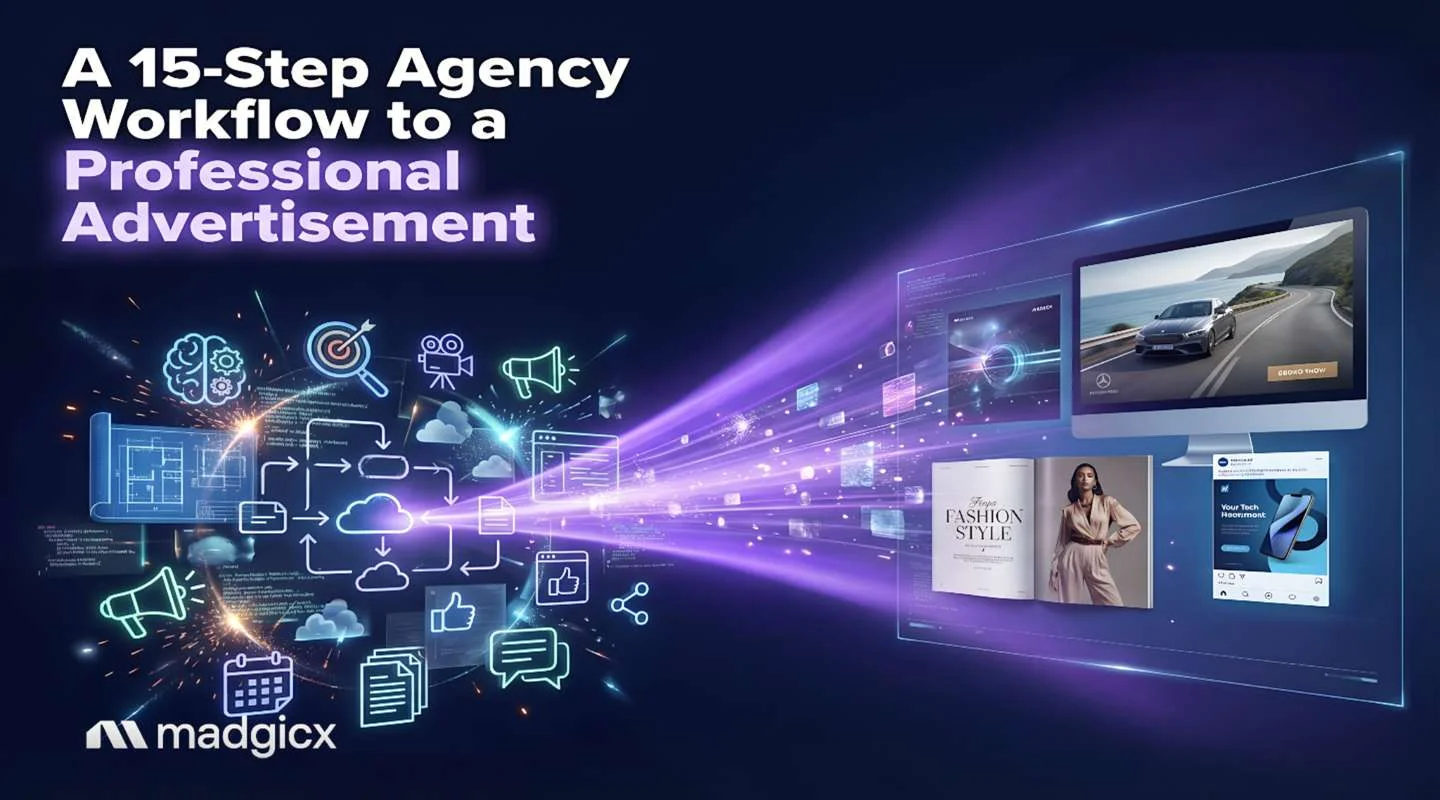
This guide is exactly that. We’ve broken down our entire process for creating a professional advertisement into a 15-step agency workflow, from initial client discovery to AI-powered optimization and reporting. This isn't just another list of tips; it's a scalable system designed to help you and your team deliver high-performing ads across your entire client portfolio.
Managing multiple clients shouldn’t mean endless design revisions and copy-paste work. Madgicx’s AI Ad Generator turns product images and top-performing ads into dozens of ready-to-test variations, so you can launch campaigns faster and scale without manual production.
What You'll Learn
- A repeatable 15-step process to manage ad creation for any client.
- How to choose the right ad platforms to maximize client budgets and ROI.
- Techniques for developing high-converting creative and copy at scale.
- How to leverage AI tools for faster diagnostics and smarter optimization.
- An efficient way to generate comprehensive, professional client reports.
The 15-Step Agency Workflow for Professional Ads
Alright, let's get down to business. This is the exact, step-by-step process we use to build and manage professional ad campaigns that make clients stick around for the long haul. Let's build your machine.
Step 1: Define the Client's Target Audience
Okay, first things first. Before we even dream of writing a headline, we have to know exactly who we're talking to. This goes way beyond "women aged 25-45." We need to get granular. What keeps them up at night? What are their secret aspirations? What was the last thing they bought online?
Start with the client's ideal customer profile (ICP) and enrich it with data from their CRM, Google Analytics, and social media followers.
Pro Tip for Agencies: Create a standardized "Audience Persona" template in a tool like Miro or a simple Google Doc. Use it for every new client. This not only saves a ton of time during onboarding but also ensures your entire team—from copywriters to media buyers—is working from the same playbook.
Step 2: Conduct Competitor & Market Research
No client exists in a bubble. We have to become spies and figure out what their competitors are up to, what's working for them, and where the gaps are. Who are their top three rivals? What messaging, offers, and creative angles are they using?
Use ad spy tools and manually browse their social feeds and websites. We’re not looking to copy them; we’re looking for inspiration and opportunities to differentiate. Maybe their ads are all sterile and corporate—that’s your chance to come in with something human and relatable.
Pro Tip for Agencies: Create a "Competitive Landscape" slide for your client kickoff meetings. Presenting this upfront shows immediate value, demonstrates your strategic thinking, and helps align everyone on the direction of the campaign before a single dollar is spent.
Step 3: Establish Campaign Goals & KPIs
We've all heard it: "We just want more leads." But that's a wish, not a goal. Our job is to turn those fuzzy wishes into cold, hard numbers. We're talking about specific Key Performance Indicators (KPIs) that directly tie back to business objectives.
- Cost Per Acquisition (CPA): How much does it cost to get one customer?
- Return on Ad Spend (ROAS): For every dollar we put in, how many do we get back?
- Conversion Rate: What percentage of people who click the ad actually take the desired action?
Pro Tip for Agencies: Manage client expectations with a tiered goal structure. For example, set "Good," "Better," and "Best" ROAS targets. A successful campaign often sees a median profit ROI of 2.5:1. Using benchmarks like this helps ground conversations in reality and positions you as the expert.
Step 4: Choose the Right Ad Platforms for Your Client
Let's not just throw every client onto Facebook and call it a day. With digital ad spend now accounting for 72.7% of the total market, spreading our bets wisely is key. The right platform depends entirely on where the client's audience actually hangs out.
- Google Ads: The king of high-intent. Perfect for service-based businesses (plumbers, lawyers) and anyone whose customers are actively searching for a solution. It’s no surprise the platform boasts an average return of $2 for every $1 spent.
- Meta (Facebook & Instagram): A powerhouse for demand generation. A powerhouse for D2C, e-commerce, and brands that need to find their audience. For brands heavily focused on this platform, a specialized Instagram ad creator can streamline the process of making visually compelling, native-feeling ads. With an average conversion rate of 8.95% for Facebook across industries, it's a powerful tool for creating new customers.
- LinkedIn: The B2B mothership. If your client sells to other businesses or professionals, you need to be here. The targeting is unparalleled for job titles, industries, and company sizes.
- TikTok: The Gen Z playground. Ideal for brands targeting younger demographics with fun, engaging, and authentic video content.
Step 5: Set a Scalable Client Budget
Ah, the dreaded budget talk. The secret is to stop talking about it as a "cost" and start framing it as the "investment" it truly is. Explain your budget allocation based on the platforms you've chosen and the goals you've set. Use industry benchmarks from the previous steps to justify your recommendations.
Pro Tip for Agencies: Never go all-in from day one. Structure your proposal with a 30 to 90-day "testing and validation" budget. This allows you to prove your methodology, gather data, and build trust before asking the client to scale up.
Step 6: Craft a Compelling Core Message
Now for the fun part—getting creative. What's the one big idea we want to plant in our audience's mind? This is your Unique Selling Proposition (USP), and it's the heart of the entire campaign. If you're brainstorming hooks and angles, exploring different ad ideas can be a great starting point.
A simple but powerful framework for this is "Hook -> Story -> Offer."
- Hook: The thumb-stopping first line that grabs attention.
- Story: The relatable narrative that builds a connection and explains the problem.
- Offer: The clear, compelling solution you're presenting.
Step 7: Develop High-Converting Creative Assets
Let's be real: your ad creative is the hero of this whole operation. It has about three seconds to stop the scroll. With 64% of all web traffic now coming from mobile devices, our designs must be mobile-first.
And if you can, use video. It’s not just a nice-to-have anymore. Video ads generate 120% higher engagement than other formats. It’s the closest you can get to putting your product directly in the customer's hands. For more inspiration, you can always check out some great advertisement examples.
Madgicx Tip: Feeling the pressure to produce endless creative variations for all your clients? Use the AI Ad Generator to create dozens of on-brand, high-quality image ads in minutes. It’s perfect for A/B testing and scaling client accounts without blowing the design budget. Simply upload a product photo or use an existing winning ad and let AI generate launch-ready ads in minutes. Try Madgicx with our 7-day free trial.
Step 8: Write Ad Copy That Sells
Great ad copy isn't about sounding clever; it's about being crystal clear. We need to lead with a strong hook that addresses a specific pain point. Don't try to say everything at once. Focus on one core benefit and drive it home with a single, powerful Call to Action (CTA).
Is your copy clear? Is it concise? Does it tell the user exactly what to do next? If you're looking for a better way to structure your copy, check out how to create a compelling advertisement link that gets clicks.
Pro Tip for Agencies: Create a "swipe file" of winning ad copy, organized by industry. This is an incredible resource for your team, especially junior members. It helps them learn what works and empowers them to write effective copy much faster.
Step 9: Build the Campaign & Confirm Technical Details
This is where the rubber meets the road. Time to dive into Ads Manager and bring this strategy to life. This step is all about precision and sweating the small stuff.
- Set up your tracking pixels, conversion events, and UTM parameters correctly.
- Double-check your audience targeting, placements, and bidding strategies.
- Ensure your ad creative and copy are uploaded correctly.
Step 10: Implement a Pre-Launch Quality Assurance (QA) Checklist
Before you hit that big green "Publish" button, stop. Have a second team member—someone who didn't build the campaign—review everything. They should follow a QA checklist to look for typos, broken links, incorrect audience settings, and proper tracking setup.
Pro Tip for Agencies: This internal QA step is non-negotiable. It’s your last line of defense. Catching a mistake here protects your agency's reputation and prevents wasted client budget.
Step 11: Launch & Monitor the Campaign
You’ve launched! But the first 24-72 hours are critical. We need to monitor performance like a hawk. Watch for any immediate red flags in your key metrics like Click-Through Rate (CTR) and Cost Per Click (CPC).
Madgicx Tip: Stop drowning in a sea of browser tabs. Use the Business Dashboard to get a real-time, cross-channel view of all your client accounts on one screen. You can see Meta, Google, and TikTok performance side-by-side, making it easy to spot issues and opportunities across your entire portfolio.
Step 12: Track & Analyze Performance with AI
A few days have passed and the data is rolling in. Now we move from monitoring to analyzing. With 87% of marketers now using AI in their workflows, leveraging AI for analysis is the new standard for efficient agencies.
Madgicx Tip: Use Madgicx's AI Chat to diagnose performance issues quickly. Just ask it questions like, "Why did my client's ROAS drop yesterday?" or "Which ad set has the highest cost per purchase this week?"
Step 13: Create an Effortless Client Report
Here we are at the task that makes even the most seasoned agency owner groan: client reporting. The solution is to automate the data aggregation so you can focus on providing strategic insights.
Madgicx Tip: This is where you become a hero. Use the One-Click Report to generate a comprehensive, client-ready report covering Meta, Google, and TikTok performance in a single click. It takes you about 30 seconds to create.
Step 14: Run A/B Tests to Continuously Optimize
A launched campaign is not a finished campaign. It's the starting line. Systematically test one variable at a time—creative, copy, headline, or audience—to see what moves the needle. Strategies like using dynamic creative are invaluable here.
Pro Tip for Agencies: Frame A/B testing as "continuous improvement" in your client reports. It shows that you're not just "setting and forgetting" their campaigns.
Step 15: Scale Winning Campaigns for Maximum ROI
Once we've found a clear, statistically significant winner from our A/B tests, it's time to pour some fuel on that fire. Carefully allocate more budget to your top-performing ads.
Madgicx Tip: Scaling requires constant vigilance. AI Marketer monitors your account 24/7 and provides actionable recommendations to shift budget from underperformers to your top ads.
FAQ Section
1. What makes a professional advertisement effective?
A professional advertisement is a perfect blend of art and science. It combines a deep, empathetic understanding of the target audience with a crystal-clear message, high-quality creative, and precise platform targeting to achieve measurable business goals.
2. How much should a client spend on advertising?
The honest answer is: it depends. As a general benchmark, many small businesses allocate around 2-5% of their revenue to advertising, while aggressive, growth-focused brands might invest up to 14%.
3. What is the best advertising platform for my clients?
There's no single "best" platform—only the best platform for a specific client. Google Ads is a must for high-intent searches. Meta is the champion of demand generation. For B2B professional services, LinkedIn is a leading platform.
4. How do we measure advertising ROI for clients?
Advertising ROI (or ROAS) is calculated by tracking the revenue generated from your ads and dividing it by the cost of the ad spend. A successful campaign often aims for a profit ROI of at least 2.5:1.
Conclusion
Creating professional advertisements at scale isn’t about working harder—it’s about building systems that remove friction from every stage of your workflow. When strategy, creative, testing, optimization, and reporting are aligned, your agency stops reacting to problems and starts operating with confidence. A repeatable process gives your team clarity, protects client budgets, and ensures every campaign is backed by data instead of guesswork.
By following this 15-step framework, you position your agency to consistently deliver high-performing campaigns while freeing up time for higher-level strategy and growth. And when you’re ready to streamline creative production, optimization, and reporting in one platform, Madgicx gives you the AI-powered tools to turn this workflow into a scalable, revenue-driving system.