What Motion's AI tagging, reports and AI teammate do today, what they don't, what the plans cost as your ad spend grows, and which alternatives fit Meta advertisers better.
Motion is a creative analytics platform for paid social ads, and every plan now includes an AI teammate called Runneth that works inside Motion and Slack. That makes it a good moment to look at what Motion does today, what it doesn't, how its pricing works as your ad spend grows, and which alternatives fit better depending on what you need from your ad data. (This is motionapp.com, not the calendar app of the same name.)
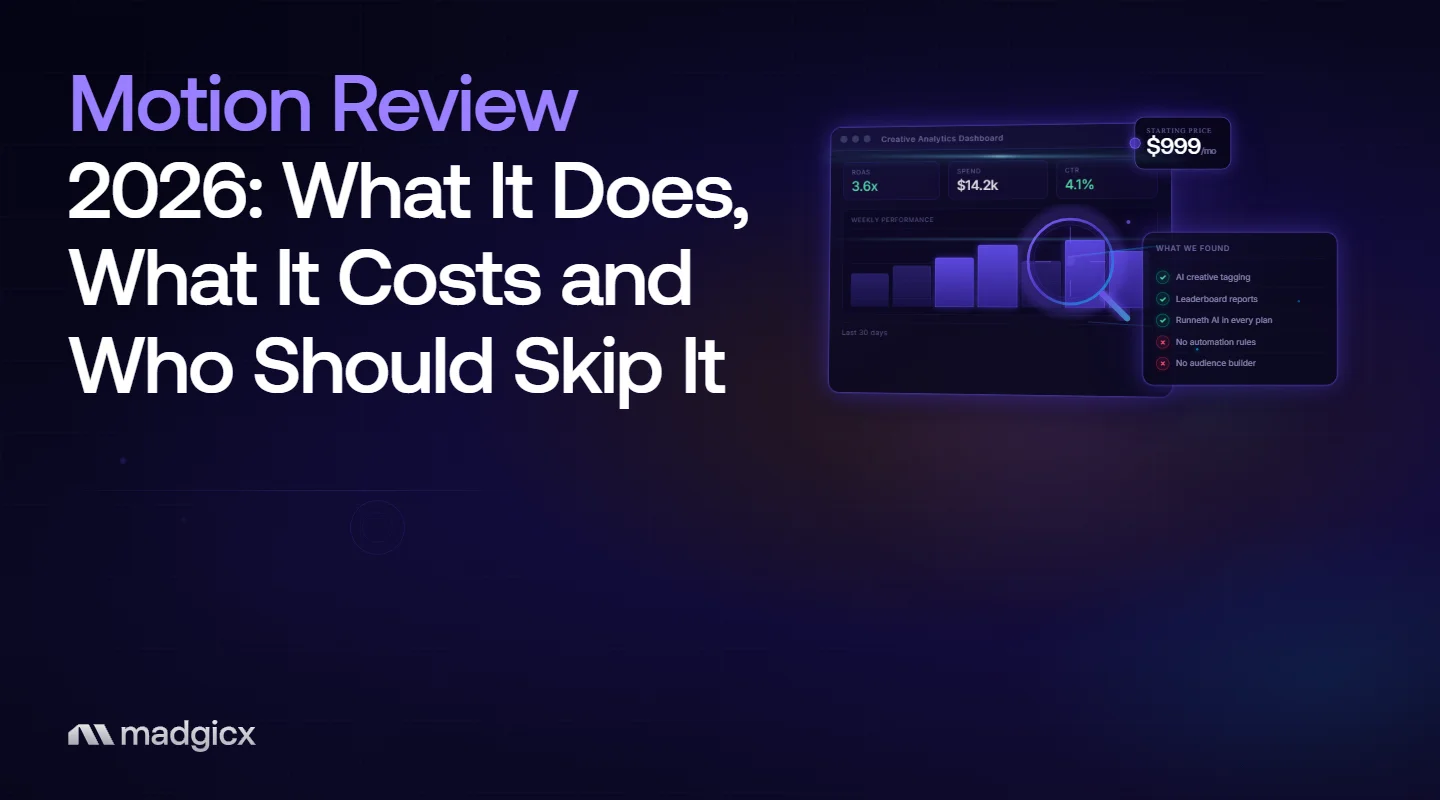
TL;DR: Motion reads your ad data, tags each creative with AI and builds reports on which hooks, formats and angles work. Its tagging is detailed and its reports are easy to share. It costs $999 a month for up to $50,000 of ad spend, with the Pro and Growth plans above that not priced publicly. Its AI teammate, Runneth, names and launches ads, but we found no audience builder, account audit, rules that change ads or help with ad comments. If most of your budget goes to Meta, Madgicx gives you AI that recommends and builds in every plan, from $45 a month.
What is Motion?
Motion is a creative analytics platform for brands and agencies running paid social. Its homepage promises to show what's working, why it's working and which ads to make next.
The product has five parts:
- Reports named Top Performing, Comparative Analysis, Launch Analysis and Creative Analytics, plus a leaderboard of top and declining ads. They update with live data, and snapshots can be shared without platform access.
- AI tagging that labels each Meta creative by asset type, visual format, intended audience, messaging theme, seasonality, offer type and hook or headline tactic. You can edit the tags on any creative.
- AI tasks that run when someone starts them, such as analysing a report, reviewing creative diversity or suggesting hook ideas, with results saved to an inbox.
- A chat that takes follow-up questions after a task.
- Runneth, an AI creative strategy teammate that works in Motion and Slack and connects to Meta, TikTok, Google Drive, Notion and other tools, included in every plan.
Its recent direction is Runneth, now in every plan as an always-on AI on its own dedicated machine. In a demo recorded in July 2026, Motion presents it as the AI brain for marketing, with knowledge files, integrations, custom dashboards and ads sent to Meta Ads Manager as paused drafts, and Runneth's site now says it launches ads.
Who is Motion for?
Motion is built for brands and agencies running paid social, mostly direct-to-consumer, who want to understand creative performance. Its AI tasks were built by DTC experts, and a July 2026 case study features a DTC brand launching more than 75 ads a week.
It's a weaker fit for teams that want the software to do the work in the ad account: its public documentation describes analysis and reports, and we found no rules that pause ads or change budgets, though its AI teammate launches ads.
What Motion can and can't do
Reports and analysis
Does: live-updating reports with a leaderboard, a launch analysis that tracks new ads, and a one-click weekly summary of a report. Reports can hide sensitive data from freelancers and agencies, and a naming convention feature groups ads in comparison reports.
Doesn't: we found no audit of targeting, demographics, geography or auctions in your ad account.
Creative
Does: its AI tagging shows which tags, hooks, formats and combinations perform, and a feature called Winning Combinations measures results across creative variables. This is Motion's clearest strength.
Doesn't: tagging covers creatives with spend in the last 90 days, or new ones, and a new ad account needs at least 10 creatives launched in that time. We found no line-by-line analysis of ad copy. Runneth's site lists generating static ads, but we found no help article or example, so output and limits are unknown.
AI tasks and chat
Does: runs analyses on request, saves them to an inbox and shares them by link, and takes follow-up questions in a chat.
Doesn't: AI tasks run only when someone starts them, though Starter's routines send reports and alerts on a schedule. The help article doesn't say which plans include AI tasks and describes no approval step.
Competitor ads
Does: its homepage says an agent finds rivals' latest ads and builds a plan to beat them. That's a homepage claim, and we opened no documentation for it.
Doesn't: we found no generation of new ads from those ads.
Launching and automation
Does: Starter lists daily and weekly routines, which the pages describe as reports and briefs sent to Slack. Runneth's site says it names ads the way you would and launches them to Meta Ads Manager, and a July 2026 demo shows them staged as paused drafts.
Doesn't: we found no rules that pause, scale or change budgets on ads, and no help article on launching, so the limits of what Runneth does in a live account aren't documented.
Audiences and ad comments
Doesn't: persona is a tag that labels a creative's intended audience, and we found no audience builder. We also found no feature that finds ad comments needing an answer or drafts replies.
Who decides what changes in your account?
- AI tags are applied automatically inside Motion, and you can edit them. The help article doesn't say tags change anything in your Meta account.
- AI tasks and the chat run only when someone starts them and give recommendations and summaries. No approval step is described.
- Runneth launches ads to Meta Ads Manager, its site says. In the July 2026 demo, it stages them as paused drafts. The user confirms the suggested ad name, and a media buyer runs QA before turning the ad on. Its help article says every integration is authorised by you, scoped by permissions and revocable at any time.
- Growth plan pipelines are built with Motion's team from signal to launched ad. Nothing public says which steps run automatically and which wait for a person.
How much does Motion cost?
| Plan | Price | What's included |
|---|---|---|
| Starter | $999 a month | Up to $50,000 of monthly ad spend, unlimited seats and ad accounts, an always-on Runneth AI, AI tags and tasks, ad leaderboard, creative analytics, Slack briefs, routines, benchmarks and MCP access |
| Pro | Not published | Over $50,000 of monthly ad spend. Everything in Starter, plus unlimited view-only guests, attribution integrations (Northbeam, Google Analytics), first-pass video QA in Slack and personalised onboarding |
| Growth | Not published | Over $125,000 of monthly ad spend. Adds a customer success manager, solutions engineering, advanced security, private Slack support and pipelines built with Motion's team |
Plans are cut by your monthly ad spend, and Pro and Growth show a button to chat with sales instead of a price. No free plan is listed. There's a free trial link, but the page doesn't state how long the trial lasts. Annual prices aren't listed.
What it costs in practice: Starter is $999 a month at any spend up to $50,000, and above that you need a sales call to get a price. With Madgicx, only your Meta spend sets the price, from $45 a month.
Is Motion worth it?
For a creative team that wants detailed tagging and reports and has the budget, Starter can be worth it. If you want the software to manage your ad account, Runneth launches ads, but we found no rules that pause ads or change budgets, and Pro and Growth prices need a sales call.
What do users say about Motion?
Motion has a 4.5 rating on G2 from 114 reviews. In its 10 most recent reviews, written between December 2025 and October 2026, users praise its creative performance analysis and tagging (7 of 10), ease of use (6 of 10), reports and dashboards (5 of 10) and insights and analysis (5 of 10). G2's own figures list an average implementation time of two months and an average return on investment of four months.
The complaints: wrong data from the AI agent or reliance on consistent ad naming (2 of 10), and missing or limited features (2 of 10). Three of the ten stated no dislike.
Motion pros and cons
Pros:
- Detailed AI tagging of creatives, with editable tags.
- Reports that update with live data and can be shared without platform access.
- Easy to use, according to 6 of its 10 most recent G2 reviews.
- A published Starter price, with unlimited seats.
Cons:
- A $999 starting price, with Pro and Growth not priced publicly.
- No rules that pause ads or change budgets that we found, and launching is described on Runneth's site, not in a help article.
- No audience builder, account audit, rules that change ads or help with ad comments that we found.
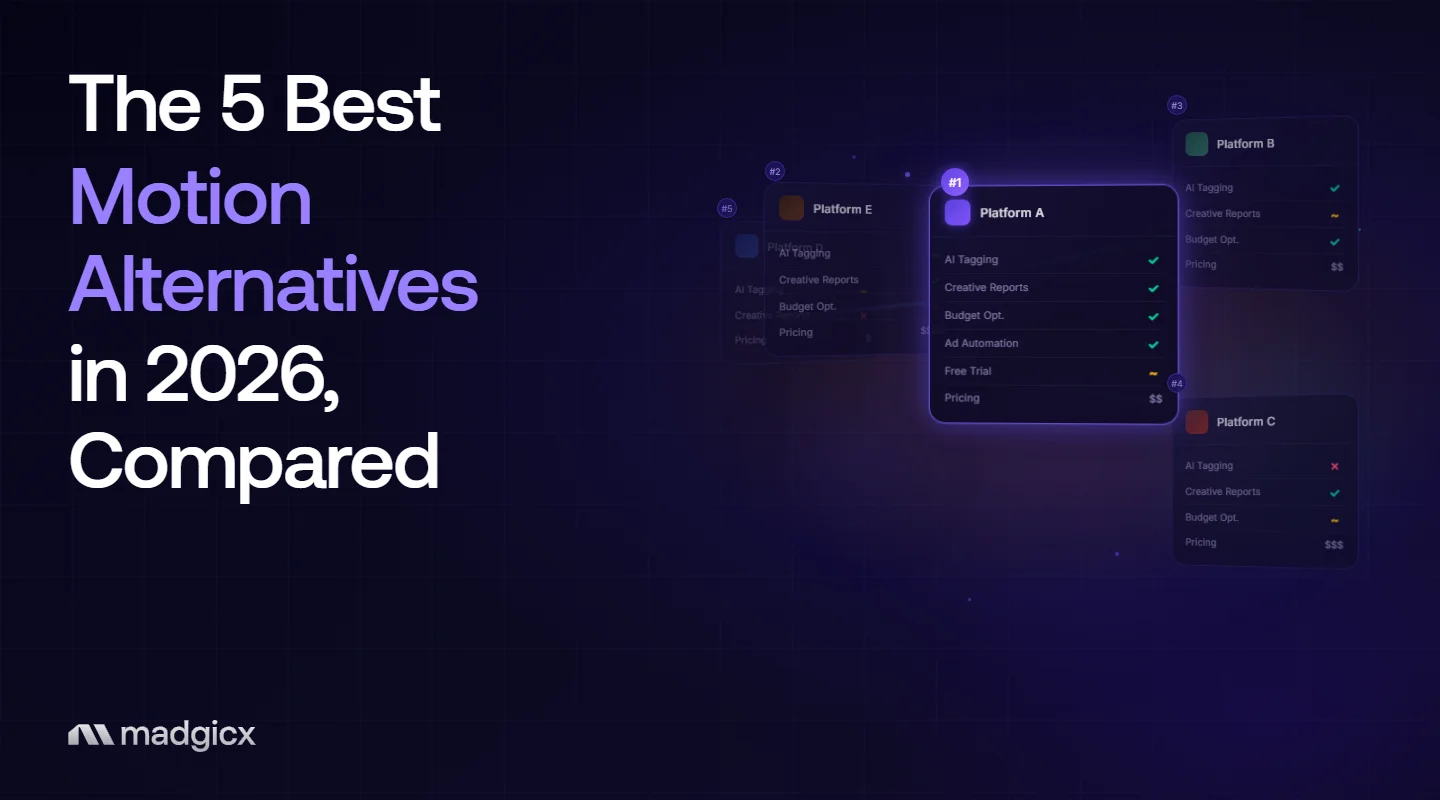
Motion alternatives
1. Madgicx Best overall
Madgicx lists the next steps for your Meta account and builds campaigns, ad sets and ads from a chat, each on your approval.
Compared with Motion: Madgicx puts its AI in every plan from $45 a month, priced by Meta spend only, and adds what we found missing in Motion: recommendations you approve, campaigns built from a chat, image ad generation from a prompt or from ads that work, analysis of which creatives and lines of copy bring results, ready-made audiences, automation rules and a full audit of your Meta account. Its reports combine Meta, Google Ads, TikTok, Klaviyo and GA4.
2. Foreplay
An ad inspiration and competitor ad tracking tool, with creative analytics on its higher plans.
Compared with Motion: far stronger at saving and tracking other brands' ads, from $59 a month, with no actions on your ad account that we saw. Creative analytics isn't in its Basic plan.
3. Atria
Creative analytics with an ad library and AI ad generation.
Compared with Motion: overlaps on creative analysis and adds an ad library and AI ad generation, from $129 a month billed annually. We found no documentation, so its features rest on its own pages.
| Motion | Madgicx | Foreplay | |
|---|---|---|---|
| Campaigns built from chat | Partly.Paused ad drafts in a demo | Yes.On your approval | No.No ad account actions seen |
| Automation rules | No.None found | Yes.Ready-made and custom | No.None seen |
| Starting price | $999/mo, by ad spend | From $45/mo, by Meta spend | From $59/mo, by users |
| Free trial | Length not stated | 7 days | 7 days, card required |
How to test Motion before you commit
- Start the free trial from the pricing page and ask Motion how long it lasts.
- Count the creatives you've launched in the last 90 days. A new ad account needs at least 10 for AI tagging to work.
- If you want Runneth to launch ads, try it on a small campaign first and check which steps wait for your approval.
- If you spend over $50,000 a month, ask for the Pro or Growth price before you plan around Motion.
- Compare the AI agent's answers with your ad account for a week, since reviewers mention wrong data and reliance on consistent ad naming.
Our verdict
Motion is a strong creative analytics tool for teams that want detailed AI tagging and reports and will act on the results themselves. If most of your budget goes to Meta and you want to act on it, Madgicx does more: recommendations you approve, campaigns built from a chat, AI image ads, creative analysis and audiences, with automation rules in one plan from $45 a month.
How we reviewed Motion
We went through Motion's website and pricing, its help articles on AI tagging, AI tasks and Runneth, the demo videos it hosts, and its 10 most recent reviews on G2. We judged it on four things:
- What it does for a Meta advertiser, capability by capability.
- Who makes changes to your ads, and when you're asked first.
- Total cost as your spend grows, including what each plan leaves out.
- What users say.
Frequently asked questions
Is Motion worth it?
For creative teams that want detailed tagging and reports, it can be. If most of your budget goes to Meta and you want AI to recommend and build, Madgicx gives you more, from $45 a month.
How much does Motion cost?
Starter is $999 a month for up to $50,000 of monthly ad spend. Pro (over $50,000) and Growth (over $125,000) aren't priced publicly, and no free plan is listed.
Does Motion use AI?
Yes. It tags creatives with AI, runs AI tasks that write recommendations and summaries when someone starts them, sends daily and weekly routines, and has a chat for follow-up questions. Every plan also includes an AI teammate called Runneth that works in Motion and Slack.
Does Motion have a free trial?
Its pricing page has a free trial link but doesn't state the length. Runneth's own site has a free start.
What is the best Motion alternative?
Madgicx is the best overall Motion alternative for Meta advertisers: recommendations you approve, campaigns built from a chat, AI image ads, audiences and automation rules, from $45 a month.