Learn how to connect Meta Ads to ChatGPT safely in 5 minutes with our complete guide. Save hours monthly with automated insights and optimization.
Picture this: It's 11 PM, and you're hunched over your laptop again, manually scrolling through Meta Ads Manager data that ChatGPT can help analyze more efficiently. You're calculating ROAS by hand, trying to spot patterns in audience performance, and wondering if that new creative is actually working or just burning budget.
Sound familiar?
Here's the thing – while you're burning the midnight oil doing manual analysis, your competitors are sleeping soundly with AI-powered systems that provide continuous optimization recommendations. The difference? They've connected their Meta ads to ChatGPT for instant insights, automated reporting, and AI-powered optimization suggestions that would take you hours to generate manually.
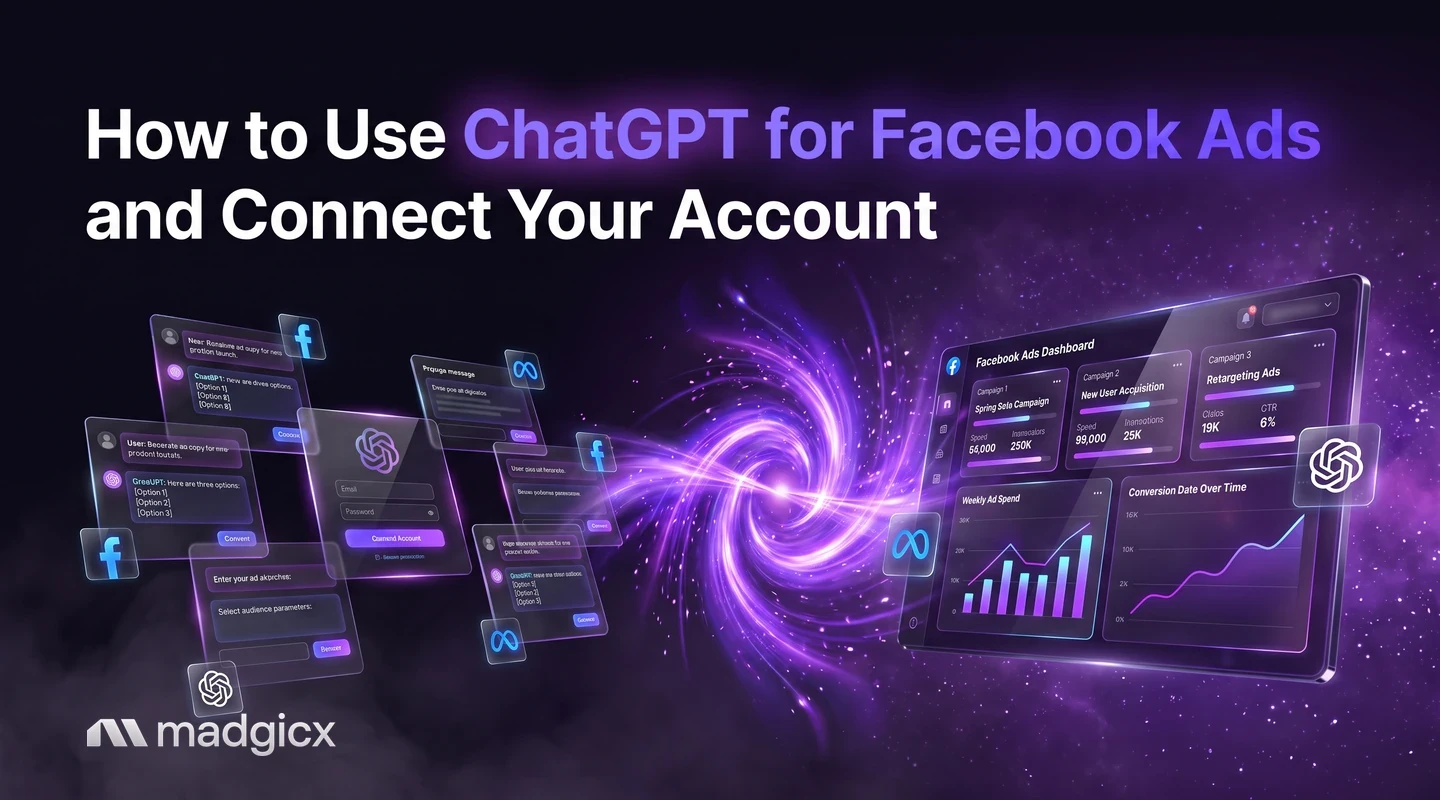
In this guide, you'll learn how to use ChatGPT for Facebook ads, and how to connect your Facebook ads account to ChatGPT so it works on your real campaign data instead of numbers you paste in. I'll show you three ways to do it, from a simple 5-minute Zapier setup (perfect if you've never touched an API) to an API build to a direct connection with the Madgicx MCP.
We'll also look at what each setup can and can't do, and how to move from insights to real campaign changes safely, with ChatGPT asking for your confirmation first.
Whether you're a complete beginner or a technical wizard, there's a method here that'll transform how you manage your ad campaigns.
Add the Madgicx MCP as a connector, sign in and ask ChatGPT for reports and audits. Every change waits for your confirmation. Included in the 7-day free trial.
How to Use ChatGPT for Facebook Ads: The Short Answer
There are two ways to use ChatGPT for Facebook ads. The first is manual: you export numbers from Ads Manager, paste them into ChatGPT and ask for analysis. The second is to connect your Facebook ads account to ChatGPT, so ChatGPT reads the account itself when you ask a question, such as which campaigns spent the most last week without purchases.
To connect Facebook ads to ChatGPT, you add a custom connector in ChatGPT that points to the Madgicx MCP server, https://mcp.madgicx.com/mcp, and sign in with your Madgicx login. It takes a few minutes. You need a paid ChatGPT plan and a Madgicx subscription or the 7-day free trial, which includes the MCP. The full steps are in Method 3 below.
What You'll Learn
By the end of this guide, you'll have a comprehensive automation workflow that:
- Connects your Facebook ads account to ChatGPT in minutes
- Compares the Zapier and API routes with a direct connection
- Understand the limitations of indirect ChatGPT connections and how the Madgicx MCP lets ChatGPT read your account and make changes after you confirm
- Bonus: ChatGPT prompts for ad copy, creative briefs and your own account data
Let's dive in and get your ads working smarter, not harder.
Why Connect Meta Ads to ChatGPT? (The 60-Hour Problem)
If you're managing Meta ads manually, you're probably spending 60+ hours every month on tasks that AI could help handle more efficiently. Think about it – how much time do you spend:
- Analyzing campaign performance data
- Writing new ad copy variations
- Researching audience insights
- Optimizing budgets across campaigns
- Creating performance reports
- Brainstorming creative concepts
According to recent data, businesses using AI automation save 10+ hours per week (40 hours monthly) on these repetitive tasks. That's an entire work week you could spend on strategy, product development, or actually growing your business instead of drowning in spreadsheets.
But here's where it gets really interesting.
Meta's own research shows that AI can improve ad recall by 6% and ad quality by 8% compared to manual optimization. When you consider that 97% of Meta's revenue comes from advertising across their 3.43 billion daily active users, you realize you're competing in an ecosystem where AI optimization isn't just helpful – it's essential.
The solution? Use AI for insights, but more importantly, use a compliant system that allows you to act on those insights safely.
Let's look at the two indirect methods first, then the direct one.
Methods 1 and 2: Zapier and the OpenAI API (The Short Version)
Zapier is the no-code route. You create a Zap with a Facebook Lead Ads or Facebook Conversions trigger, add an OpenAI step with your prompt, test it and turn it on. ChatGPT then analyzes the data each time a new lead or conversion arrives. Check Zapier's current plans for task limits before you start.
The OpenAI API is the build-it-yourself route. You create a Meta developer app with the Marketing API product, generate an access token, pull campaign results, send them to the OpenAI API with a prompt and decide how to apply what comes back. Use the current model names and examples in OpenAI's API documentation, and start with read-only operations. For API-level control without building it yourself, our automated campaign management approach covers the same ground.
Both routes send data to ChatGPT and leave the changes to you. The next method lets ChatGPT read the account directly.
Method 3: Connect Your Facebook Ads Account to ChatGPT With the Madgicx MCP
Here’s where things actually change.
While Zapier and the API let you connect Meta Ads to ChatGPT for analysis, they still leave a major gap: execution.
You can get insights. You can get recommendations. But you still have to leave your AI assistant and manually apply changes inside Meta Ads Manager.
The Madgicx MCP for Meta ads removes that gap. Instead of relying on indirect integrations, it creates a direct, API-based connection between ChatGPT and your Meta ad account, so you can both analyze and make changes from within the same conversation.
Why Madgicx MCP is different
Think of it this way:
ChatGPT tells you what to do.
Madgicx MCP lets you actually do it, without leaving ChatGPT (or any AI assistant).
With Madgicx MCP, you can:
- Read your ad accounts, campaigns, ad sets, ads and creatives, and their results for the dates you choose
- Spot inefficiencies and opportunities, such as campaigns that spend without results
- Pause and restart campaigns, ad sets and ads
- Raise or lower campaign and ad set budgets, by an amount or a percentage
All directly from ChatGPT. Every change is shown to you first, and nothing runs until you confirm it.
And most importantly, this is done through a compliant, API-based connection, not browser automation or unofficial workarounds. That means no scraping and no simulated user behavior.
Because Madgicx is an official Meta Business Partner, every interaction is handled through approved infrastructure designed to keep your account safe.
How to Connect Facebook Ads to ChatGPT, Step by Step
What you need first: a paid ChatGPT plan (custom connectors are not available on ChatGPT's free plan), a Madgicx subscription or the 7-day free trial (the trial includes the MCP), and a Facebook ad account connected in Madgicx.
- Open ChatGPT on the web at chatgpt.com and go to the connector settings. On a workspace plan, your admin may need to allow custom connectors first.
- Add a custom connector. Name it Madgicx and paste the server address: https://mcp.madgicx.com/mcp
- Choose OAuth sign-in. ChatGPT sets up the OAuth connection automatically for this server, so you don't need a client ID or a secret.
- Sign in to Madgicx. A browser window opens: log in with your Madgicx login, pick your team and approve access. The team you pick decides which ad accounts ChatGPT can use, and your password is never shared with ChatGPT.
- Turn the connector on in a chat and check it by asking: "What Madgicx team am I connected to?" ChatGPT should answer with your name and team.
- Start with a question that only reads, such as last week's results by campaign, and compare the answer with Ads Manager.
Menu names in ChatGPT change from time to time, so if the connector settings are not where you expect, look for connectors or apps under your account settings and follow OpenAI's current help article for adding a custom connector.
For Google Ads, add a second connector with the address https://mcp-google-ads.madgicx.com/mcp and the same login. The Google Ads MCP is read only, so ChatGPT can analyze your Google Ads account but changes nothing in it.
What to Ask ChatGPT First
Once connected, you don't paste data into ChatGPT any more. Ask for the job in plain words, for example:
- "Make a report for last week with a table of campaigns: spend, results, cost per result and ROAS." Our page on how to make a Facebook ads report has the full prompt.
- "Which campaigns and ads spent money last week without results?" See how to find wasted ad spend.
- "Pause the ads I listed." ChatGPT shows the exact change and waits for your confirmation before it runs.
Results come as one total per account, campaign, ad set or ad for the dates you choose. To see a trend, ask for two or more periods and compare them.
5 ChatGPT Prompts for Facebook Ads
Now that you've got your connection set up, here are five prompts designed to help improve your advertising performance. With the Madgicx MCP connected, ChatGPT can pull the campaign numbers itself, so you only need to paste the extra context it can't read, such as audience details, creative descriptions or competitor examples:
1. Performance Analysis Prompt
"Analyze this Meta ads campaign data: [paste your campaign metrics]. Identify the top 3 performance issues and provide specific optimization recommendations for:
1) Audience targeting, 2) Creative performance, 3) Budget allocation. Include confidence levels for each recommendation."
2. Creative Optimization Prompt
"Based on this ad creative performance data: [paste creative metrics], suggest 5 new ad variations that could improve engagement. Focus on: headline variations, visual elements, call-to-action optimization, and emotional triggers that resonate with [your target audience]."
3. Audience Targeting Recommendations
"Review my current audience targeting: [paste audience data and performance]. Suggest 3 new lookalike audiences and 2 interest-based audiences that could improve performance. Explain the reasoning behind each suggestion and expected performance impact."
4. Budget Allocation Insights
"Analyze my campaign budget distribution: [paste budget and ROAS data]. Recommend optimal budget reallocation across campaigns to help maximize overall ROAS. Include specific percentage changes and expected impact on total revenue.
5. Competitive Analysis Framework
"Help me analyze competitor ads in [your industry]. Based on these competitor examples: [paste ad examples or descriptions], identify gaps in my current strategy and suggest 3 unique positioning angles that could differentiate my ads."
Pro Tip: Save these prompts as templates in your ChatGPT interface for quick access. The more specific data you provide, the better insights you'll receive.
For businesses wanting these insights automatically generated and implemented, our performance monitoring agents provide similar analysis with optimization recommendations you approve.
ChatGPT Prompts for Facebook Ad Copy
ChatGPT writes new copy. The Madgicx MCP does not read the text of your existing ads, so paste in your current copy, your offer and your audience when you want variations built on what you already run. Five prompts to start with:
- Primary text: "Write five versions of Facebook ad primary text for [product], aimed at [audience]. Lead with the problem in the first line and end with a clear call to action. Keep each under 125 characters before the 'See more' cut."
- Headlines: "Give me ten headlines for [offer]. Mix benefit-led, question and proof-led styles, and keep each short enough to read on a phone."
- Variations of a winner: "Here is my best-performing ad copy: [paste]. Write four variations that keep the same promise but change the hook, the proof and the call to action."
- Tone rewrite: "Rewrite this ad copy in a [friendly, direct, premium] voice without changing the offer: [paste]."
- Objection handling: "List the five most common reasons someone would not buy [product], then write one short ad line that answers each."
Review every line before you use it, and check it against Meta's advertising policies.
Prompts That Use Your Connected Data
With the Madgicx MCP connected, these prompts need no pasted numbers. ChatGPT reads the account, and results come as one total per campaign, ad set or ad for the dates you choose.
- Spend without conversions: "Which campaigns and ads spent last week without a purchase? List them by spend and tell me what you would pause." You approve any pause before it runs.
- Week over week: "Compare last week with the week before for each campaign: spend, results, cost per result and ROAS. Which ones moved most?" The page on why performance dropped has the full prompt.
- Creative fatigue: "Which ads look like they are wearing out? Compare frequency and cost per result across the last two periods." See how to check creative fatigue.
- Budget check: "Which campaigns have the best return and room to take more budget? Show the change you would make and wait for me to confirm." See how to scale budgets after you confirm.
Creative Brief and Video Script Prompts
- Creative brief: "Write a one-page creative brief for a Facebook ad for [product]: audience, main message, three angles to test, the format for each and what a good result looks like."
- Video script: "Write a 30-second video ad script for [product] with a hook for the first three seconds, the problem, the demo and a call to action. Add a shot list."
Ask ChatGPT to base the brief on your results first: "Which of my ads are working best right now?" Then paste the angle you want to build on into the brief prompt.
Troubleshooting Common Connection Issues
Even the best automation setups can hit snags. Here is the most common one:
Authentication Errors
Problem: API connections keep failing or timing out
Solution:
- Refresh your access tokens regularly (Meta tokens expire)
- Store tokens securely and implement automatic renewal
- Use environment variables for sensitive API keys
Pro Tip: Start simple and add complexity gradually. A basic automation that works 95% of the time is better than a complex system that fails regularly.
Measuring Success: Key Metrics to Track
To ensure your Meta Ads to ChatGPT connection is actually improving your results, track these essential metrics:
ROAS Improvement Tracking
- Before vs. After ROAS: Compare 30-day periods before and after implementation
- Campaign-Level Changes: Track which campaigns benefit most from AI insights
- Time-Based Analysis: Monitor how ROAS improves as your prompts get more refined
Time Savings Calculation
- Manual Analysis Time: Track hours spent on campaign analysis before automation
- Automated Insights: Measure time saved through automated reporting and recommendations
- Strategic Time Gained: Calculate additional hours available for high-level strategy
Creative Performance Metrics
- Engagement Rate Changes: Monitor likes, comments, shares, and click-through rates
- Creative Refresh Frequency: Track how often you're testing new creative variations
- Ad Fatigue Prevention: Measure how quickly you identify and replace underperforming creatives
The goal isn't just to automate for automation's sake – it's to create measurable improvements in your advertising performance while freeing up your time for strategic growth activities.
FAQs
How do I use ChatGPT for Facebook ads?
Use it for two jobs: writing (ad copy, headlines, creative briefs, video scripts) and reading your account (reports, wasted spend, fatigue, budgets). For the second job, connect the Madgicx MCP so ChatGPT reads your results itself.
Can ChatGPT create ads for Facebook?
ChatGPT can write the copy, headlines and creative briefs. The Madgicx MCP does not create campaigns or ads, so you build and publish them in Ads Manager or another tool.
How do I find Facebook audiences with ChatGPT?
ChatGPT can suggest audience ideas and interests to test from what you tell it about your customers. The MCP does not read ad set targeting, so describe your current audiences in the prompt.
What are the best ChatGPT prompts for Facebook ads?
The ones that give ChatGPT a clear job and the context it cannot read. See the ad copy, connected data and creative brief prompts above.
How do I connect Facebook ads to ChatGPT?
Add a custom connector in ChatGPT that points to https://mcp.madgicx.com/mcp and sign in with your Madgicx login. The steps are in Method 3 above.
Do I need coding skills to connect Meta Ads to ChatGPT?
Not at all! Connecting the Madgicx MCP is a few clicks in ChatGPT's connector settings plus a sign-in, and the Zapier method requires zero coding too. If you can use Facebook and email, you can set up basic automation.
For more advanced features, some technical knowledge helps, but even then, most of the heavy lifting is done through user-friendly interfaces.
How much does it cost to run these automations?
Zapier and the OpenAI API both charge by usage, so check their current pricing pages. The MCP connection needs a paid ChatGPT plan and a Madgicx subscription, and Madgicx is free to try for 7 days. Madgicx plans are priced by monthly ad spend, starting at $45 per month.
When you consider the hours you'll save on reporting and analysis, the return can be substantial.
Is my Meta Ads data secure with ChatGPT?
OpenAI has enterprise-grade security measures, but you should never send personally identifiable information through the API. Stick to aggregated campaign data, performance metrics, and anonymized insights.
For maximum security, consider using ChatGPT for strategy and creative insights rather than raw customer data.
Can I automate bid management with this setup?
Basic ChatGPT connections can generate recommendations, but execution is still manual.
With Madgicx MCP, you can go a step further and apply changes directly from within your AI assistant. That means raising or lowering budgets, or pausing underperforming ads, without switching back to Ads Manager. ChatGPT shows you the exact change first and runs it only after you confirm. Ad set bids can be set or lowered too, for bid strategies that accept manual bids.
What’s the difference between this and standard ChatGPT setups?
Standard ChatGPT integrations are designed for analysis: they help you understand performance and suggest next steps.
Madgicx MCP adds the missing layer: execution.
It creates a direct, compliant connection between your AI assistant and your Meta ad account, allowing you to take action on insights safely, with your confirmation on every change, without relying on manual workflows or risky automation methods.
Start Automating Your Meta Ads Today
You now have three proven methods to connect Meta Ads to ChatGPT. The key is starting with the method that matches your current skill level and comfort zone.
If you're just getting started, begin with the Zapier integration. You’ll see immediate value from automated insights and can always explore more advanced setups later. For those ready to go deeper, direct API integrations offer greater flexibility and customization, but require ongoing setup and maintenance.
But here’s the real shift: while these ChatGPT connections can generate valuable insights, they still rely on manual execution. You’re also the one applying changes, switching between tools, and managing the workflow.
The Madgicx MCP removes that friction.
By creating a direct, compliant connection between your AI assistant and your Meta ad account, it allows you to move from insight to action in the same place, without relying on workarounds. Instead of just analyzing performance, you can make changes from within your AI assistant, after you confirm each one.
The choice is yours: start with insight-only setups, or move straight to a system that lets you both analyze and act. Either way, you’re about to fundamentally change how you manage your Meta ads.
Ready to stop burning the midnight oil on manual campaign analysis? Try Madgicx free for 7 days.