Why teams move away from Triple Whale, and how five alternatives compare on features, pricing, pros and cons.
Triple Whale made its name as the analytics dashboard for ecommerce brands, and that's also why teams start looking elsewhere: its price rises with your store's revenue, its AI actions sit on the higher plans, and its AI work draws on a monthly usage allowance. This guide compares five alternatives on what they do, how they differ from Triple Whale and what they cost.
What is Triple Whale, and why do teams leave it?
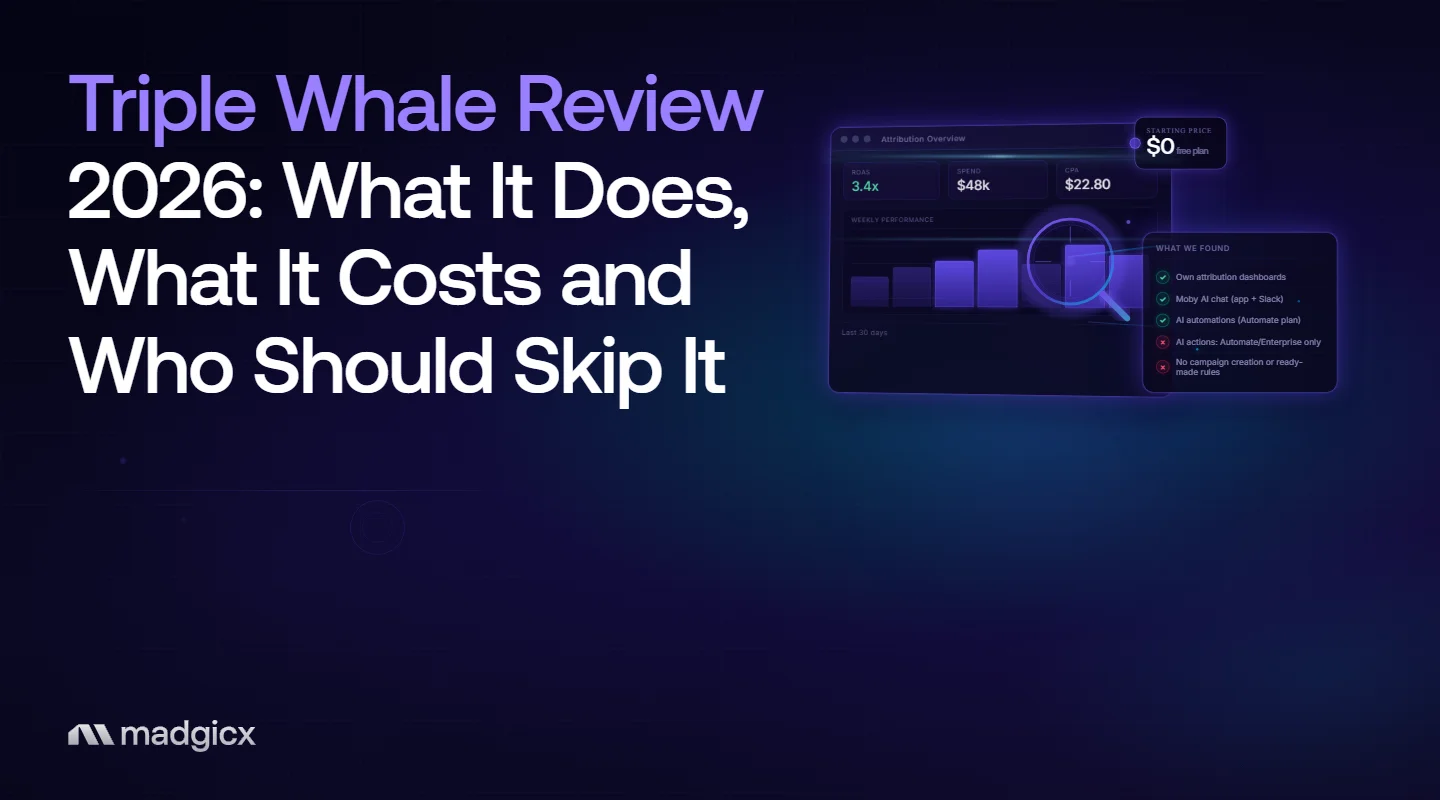
Triple Whale is an analytics platform for ecommerce brands. It brings store, ad and email data into dashboards, adds its own attribution and pixel, and has an AI chat called Moby that answers questions about your data. Moby automations send scheduled reports, flag campaigns that cross thresholds you set and, on the Automate and Enterprise plans, change budgets and pause ads.
It has a 4.5 rating on G2 from 482 reviews. These are the reasons teams give for looking elsewhere:
- A price that grows with your revenue. Plans are priced by your store's annual revenue, and price is the most common complaint in its 10 most recent G2 reviews (4 of 10).
- AI actions on the higher plans only. Automations and changes to your ads need Automate or Enterprise.
- AI work on a usage allowance. Its AI media buyer, creative director and other Moby work draw on a monthly allowance, and Moby pauses at the limit until you top up.
- Support and a learning curve, each raised in 3 of the 10 most recent reviews.
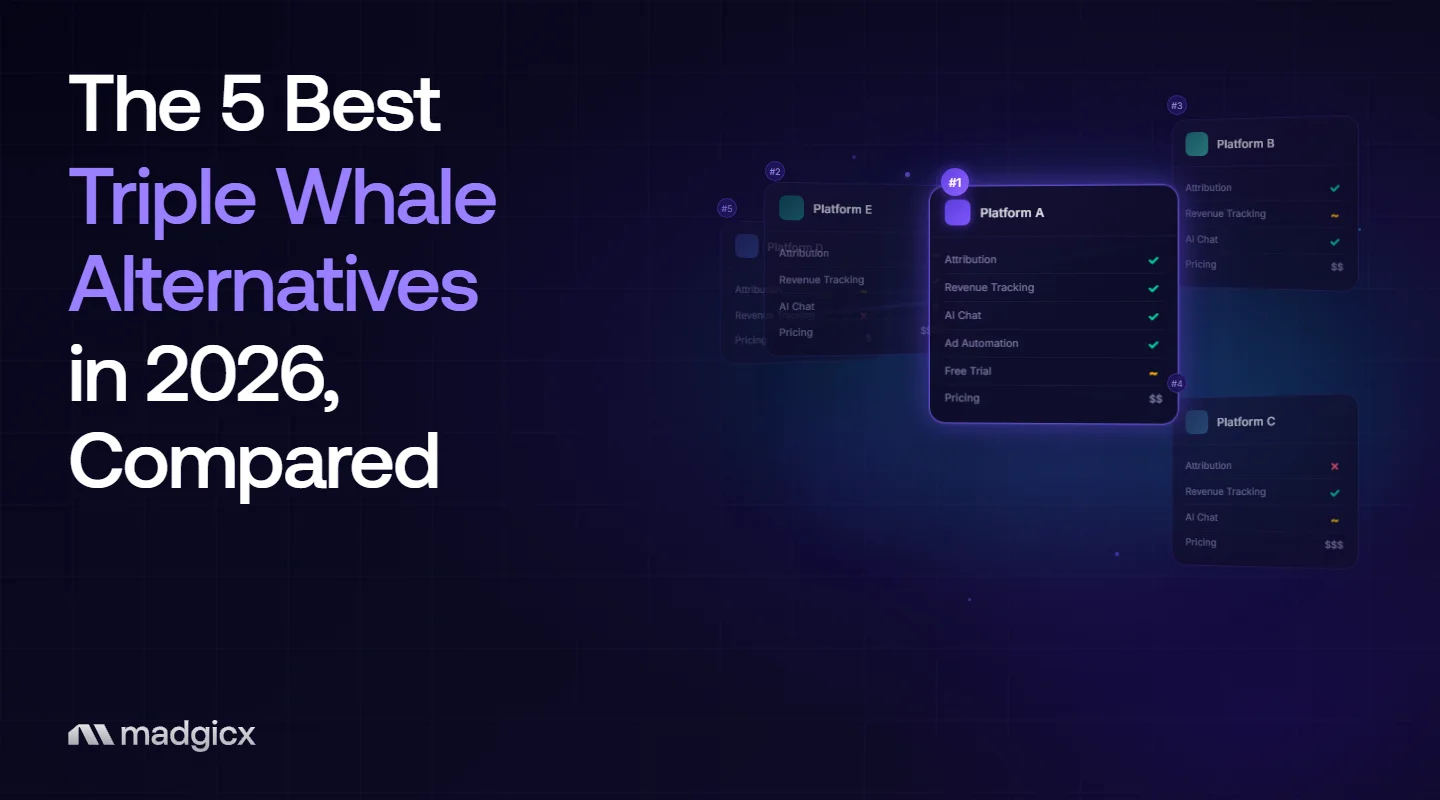
Triple Whale alternatives at a glance
| Tool | Compared with Triple Whale | Pricing model | Starting price | Trial |
|---|---|---|---|---|
| Madgicx | AI that recommends and builds, plus image ads and cross-channel reports, in every plan | By Meta spend | $45/mo | 7 days |
| Polar Analytics | A similar data stack for Shopify brands, with AI analysts and unlimited users | By store revenue | Not published | None listed |
| Northbeam | Measurement for larger budgets, with no actions on your ads | By ad spend and data volume | Varies | None listed |
| Motion | Deeper creative analytics, without store data or rules that change your ads | By ad spend | $999/mo | Free trial |
| Cometly | Attribution with one view of your ads across platforms | By pageviews | Not published | None listed |
What to look for in a Triple Whale alternative
- Whether it acts on the data or only reports it.
- Whether the AI is in the plan you'd buy, or only on a higher tier.
- What the price grows with: your revenue, your ad spend or your data volume.
- Creative in the same place as analysis, so what you learn turns into new ads.
The 5 best Triple Whale alternatives
1. Madgicx Best overall
Madgicx is an AI platform for Meta ads, used by ecommerce brands and agencies. It reviews your ad account, tells you what to do next and does much of the work once you approve it.
What it does: A list of next steps for your account, such as pausing ads that lose money or answering ad comments, which you approve or dismiss. A chat that answers questions on your account data and creates campaigns, ad sets and ads, paused until you approve. Ready-made and custom automation rules. Image ads generated from a prompt, from your own best ads or from real ads in a built-in library. Analysis of which creatives and lines of copy bring results. Ready-made and AI audiences. An account audit covering targeting, demographics, geography and auctions. Reports that combine Meta, Google Ads, TikTok, Klaviyo and GA4, shared by link or PDF.
Compared with Triple Whale: Triple Whale explains your data, and its AI changes budgets and pauses ads on its higher plans. Madgicx recommends the next step, builds campaigns from a chat and makes the ads in every plan, and its reports bring in your other channels at a price set by Meta spend only.
Pricing: One plan priced by monthly Meta spend: $45 a month up to $1,000 of spend, $129 up to $10,000 and $329 up to $30,000. Unlimited seats and ad generations, 15% off quarterly and 30% off annually, and a 7-day free trial.
Pros:
- AI recommends and builds, and nothing it proposes changes your ads until you approve it.
- The AI, rules and reports come with every plan.
- The price doesn't rise with your store's revenue.
- 4.6 on G2 from 220+ reviews.
Cons:
- Campaign management is built for Meta, while Google Ads and TikTok data appear in reports.
- Generates image ads, not video.
2. Polar Analytics
Polar Analytics is a data stack and business intelligence tool for Shopify brands and agencies.
What it does: Custom dashboards and a library of ready-made ones, custom metrics, product and margin analysis, alerts by email or Slack, AI agents that answer questions and work in Slack, and a connection for AI assistants. It also sells attribution and a pixel.
Compared with Triple Whale: the closest like-for-like option, also priced by store revenue, with unlimited users on every plan.
Pricing: Priced by annual store revenue, with no figure published. Larger setups are priced through a demo.
Pros:
- Deep custom dashboards for Shopify data.
- Unlimited users.
Cons:
- We found no rules or actions on your ads.
- No published price or trial.
3. Northbeam
Northbeam is a marketing measurement platform for brands with large, multi-channel budgets.
What it does: Dashboards across channels, a sales view sorted by campaign, ad set and ad, a tool for finding which metrics move together, and a connection for AI assistants.
Compared with Triple Whale: more focused on measurement for larger budgets, with Enterprise aimed at brands spending over $500,000 a month on ads, and no automation or AI that acts on your ads.
Pricing: Tiered by ad spend and data volume. Professional is $3,500 a month, and Enterprise is quoted.
Pros:
- Built for large, multi-channel budgets.
Cons:
- No rules, agents or actions on your ads that we found.
- No creative tools.
4. Motion
Motion is a creative analytics platform for paid social ads.
What it does: Tags every creative with AI by format, hook and angle, analyses videos frame by frame for drop-off, flags ads that are declining, answers follow-up questions in a chat, tracks competitors' ads and sends shareable reports.
Compared with Triple Whale: deeper creative analytics and ad launching through its AI teammate, but no store analytics and no rules that change your ads.
Pricing: Starter is $999 a month for up to $50,000 of monthly ad spend, with unlimited seats. Higher tiers are quoted.
Pros:
- Detailed creative tagging and video analysis.
- Unlimited seats.
Cons:
- A $999 entry price.
- Doesn't manage campaigns, and G2 reviewers say results depend on consistent ad naming (2 of 10).
5. Cometly
Cometly is an attribution platform with one view of your ads across platforms.
What it does: Attribution with switchable models, an ads view where changes can be pushed to Meta, TikTok, LinkedIn, Microsoft, Reddit and Taboola, AI suggestions on what to pause or scale, an AI chat over your data and daily summaries in Slack.
Compared with Triple Whale: also attribution-led, with more control over ads from one screen.
Pricing: Usage-based, by monthly pageviews, with 20% off annual billing. No free trial is listed.
Pros:
- Manage ads on several platforms from one view.
Cons:
- No creative tools.
- No published price or trial.
Our verdict
Madgicx is the best overall Triple Whale alternative for brands that spend mostly on Meta. It combines your ad channels in one report, then does what a dashboard can't: recommends the next step, builds campaigns from a chat and makes your ads, all in one plan from $45 a month, at a price that doesn't rise with your revenue. Try it free for 7 days alongside your current setup.
How we compared these tools
- What each tool does for a Meta advertiser, from analysis to creative and automation.
- How it compares with Triple Whale on the same jobs.
- Whether it acts on the data, and whether you approve each change.
- Total cost at different spend levels, and what the price grows with.
We went through each tool's product pages, help centre and pricing, and Triple Whale's and Motion's G2 reviews.
Frequently asked questions
What is the best alternative to Triple Whale?
Madgicx is the best overall Triple Whale alternative for brands that spend mostly on Meta: AI recommendations, campaign building from a chat, image ad generation and cross-channel reports in one plan from $45 a month.
Why do teams switch from Triple Whale?
Mostly price, which grows with store revenue and is the top complaint in its 10 most recent G2 reviews (4 of 10). Reviewers also mention support and a learning curve, and its AI actions need the Automate or Enterprise plan.
Is there a cheaper Triple Whale alternative?
Madgicx starts at $45 a month and is priced by Meta spend only, so the price doesn't rise as your store grows.
Which Triple Whale alternative can also make ads?
Madgicx generates image ads from a prompt, from your best ads or from real ads in its library, and builds campaigns from a chat, each on your approval.
Can Madgicx report on more than Meta?
Yes. Its reports combine Meta, Google Ads, TikTok, Klaviyo and GA4, shared by link or PDF.