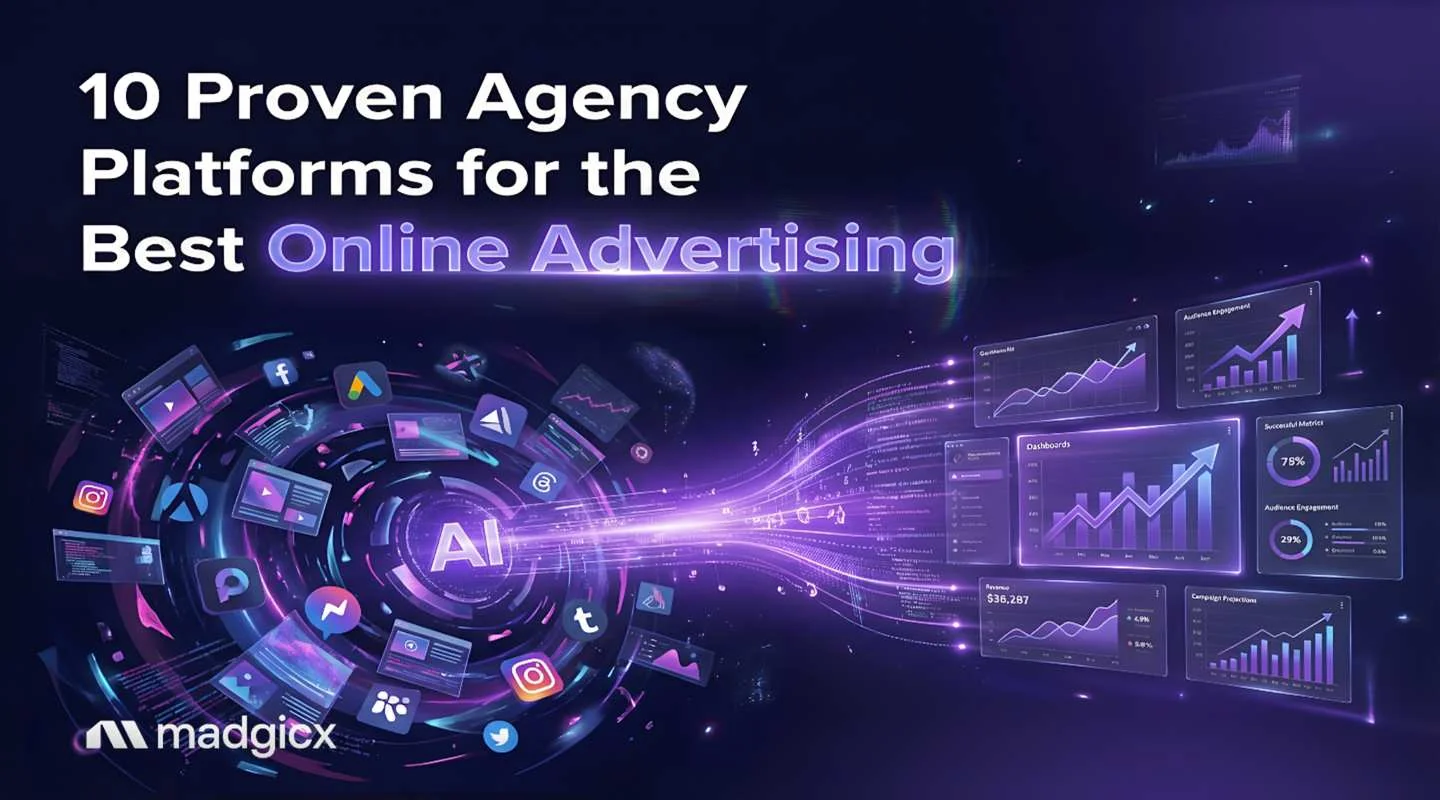
Discover the best online advertising platforms to scale client results. Learn to build the right channel mix, leverage automation, and streamline reporting.
Ever feel like you're a professional plate-spinner? You're juggling a dozen client accounts, each with a unique ad strategy across Meta, Google, and TikTok. The pressure to deliver results is immense, but the time spent compiling reports and manually optimizing campaigns is even greater.
One client wants to know why their ROAS dipped, another wants to see a full cross-channel breakdown by noon, and you’re still trying to figure out which of the 57 tabs open on your browser has the right data. Sound familiar? We get it.
With global digital ad spend projected to surpass a staggering $798 billion annually, your clients know the opportunity is massive. But it’s your job to turn that potential into profit. To achieve the best online advertising results, agencies must combine high-intent search platforms (like Google Ads) with creative-driven social channels (Meta, TikTok) and robust retargeting, all managed through a centralized system for efficient, scalable client reporting and optimization.
But which platforms should you prioritize for which client? And how can you manage it all without drowning in spreadsheets and late-night reporting sessions? This guide breaks down 10 leading online advertising platforms from an agency perspective, helping you build winning, scalable strategies for every client in your portfolio.
With Madgicx, you get the AI Marketer for 24/7 optimization and performance monitoring, Madgicx MCP to diagnose campaigns and take action directly from your AI assistant, AI Ad Generator for launch-ready creatives, and One-Click Report for live cross-channel reporting. Everything runs from one platform—so your team can execute faster and scale client results.
What You'll Learn
- How to choose the right channel mix for any client vertical or budget.
- A breakdown of 10 leading platforms and their specific use cases for agencies.
- How to build a scalable advertising strategy that you can replicate across your client portfolio.
- Bonus: A framework for streamlining cross-channel client reporting to save hours every week.
The Agency Dilemma: Choosing Where to Spend Client Budgets
"So, where should we put our money?" It’s the million-dollar question every client asks. And in a world where US digital ad spend is expected to exceed $325 billion annually, justifying your channel selection is more critical than ever.
The truth is, there’s no single "best" platform. The real magic lies in creating the right mix for each client's unique goals. This is where you, the agency expert, come in. Instead of just picking a platform, you need a framework to build a defensible, results-driven strategy.
Pro Tip: Use the "Goal-First Framework." It's simple but powerful. Map your client's primary objective to a platform category before you even think about specific channels.
- Goal: Brand Awareness? Think broad-reach social and video platforms.
- Goal: Lead Generation? Focus on high-intent search and professional networks.
- Goal: E-commerce Sales? Prioritize visual social commerce and shopping-focused campaigns.
This framework not only helps you make smarter decisions but also makes it incredibly easy to explain your strategy to clients. You’re not just spending their money; you’re investing it in the channels most likely to achieve their specific business outcomes.
10 Best Online Advertising Platforms for Agencies
Alright, let's get to the good stuff. Here are the top platforms you should have in your agency's toolkit, broken down by what they do best and how you can leverage them for maximum client success.
1. Madgicx (The Agency Operating System)
- Best for: Agencies managing e-commerce and lead-gen clients on Meta.
- Agency Use Case: Centralizing ad creation, optimization, creative analysis, and client reporting to scale operations efficiently without hiring more people.
- Key Features: AI Marketer, AI Ad Generator, One-Click Report & Business Dashboard, and Madgicx MCP for AI assistants.
- Agency Pro: Madgicx is a powerful tool for scaling. It helps junior account managers perform like seasoned optimizers by providing AI-driven insights and streamlining routine checks. Instead of spending hours digging through Ads Manager, your team can connect Madgicx MCP to their AI assistant and ask, “Which ad sets for Client X are suffering from audience fatigue?”—then get instant insights and take action on the account without leaving the chat.
- Agency Pitfall: Relying solely on platform-native tools. This can create data silos, force you to jump between a dozen tabs, and lead to hours of manual reporting. An operating system like Madgicx brings it all together, giving you a centralized view of performance for all your clients.
Start your free Madgicx trial.
2. Meta Ads (Facebook & Instagram)
- Best for: E-commerce, lead generation, local businesses—basically, almost everyone.
- Agency Use Case: The workhorse for top-of-funnel prospecting and powerful bottom-of-funnel retargeting. Its massive user base and sophisticated targeting make it a must-have for nearly every client.
- Key Ad Formats: Image Ads, Video Ads, Carousel Ads, Stories Ads, and Advantage+ Shopping Campaigns.
- Agency Pro: The sheer volume of data and targeting options is just massive. You can build highly specific audiences and leverage Meta's AI to find new customers your clients never knew they had. Nailing your messaging is key, and a strong understanding of effective Facebook ad copy is non-negotiable.
- Agency Pitfall: The biggest mistake we see is a "launch and leave" approach. With creative fatigue and audience saturation, you can't just launch a campaign and walk away. You need to constantly monitor performance and refresh creatives. This is especially true on mobile, where video is king. With video ads expected to capture over a third of digital ad budgets, you can't afford to ignore them.
3. Google Ads (Search, PMax, YouTube)
- Best for: Clients in any industry with customers who are actively searching for a solution.
- Agency Use Case: Capturing high-intent demand. When someone searches "best running shoes for flat feet," you want your client's ad to be the first thing they see. It's a powerful bottom-of-funnel conversion driver.
- Key Ad Formats: Search Ads, Performance Max, Shopping Ads, Display Ads, and YouTube Ads.
- Agency Pro: Performance Max has become a game-changer for agencies. It allows you to access all of Google's inventory from a single campaign, using AI to find converting customers across Search, YouTube, Display, and more. It's a powerful tool for scaling e-commerce clients.
- Agency Pitfall: Ignoring match types and negative keywords in Search campaigns. Without tight control, you can easily waste a client's budget on irrelevant clicks that will never convert.
4. TikTok Ads
- Best for: E-commerce brands, apps, and any client targeting Gen Z and Millennials.
- Agency Use Case: Driving massive brand awareness and viral trends. TikTok is less about polished ads and more about authentic, entertaining content that feels native to the platform.
- Key Ad Formats: In-Feed Ads, TopView, Branded Hashtag Challenges, Spark Ads.
- Agency Pro: The algorithm is incredibly powerful. A single great video can reach millions of users overnight, even for a brand-new account. It's an excellent place to test bold ad ideas and find what resonates with a younger audience.
- Agency Pitfall: Repurposing Facebook ads for TikTok. It often doesn't work. Users can sniff out a corporate, polished ad from a mile away. You need to create content specifically for the platform, which means embracing trends, using trending sounds, and keeping it real. With 65% of ad spending generated via smartphones, your vertical video game needs to be strong.
5. LinkedIn Ads
- Best for: B2B SaaS, high-ticket service providers, and clients targeting specific job titles or industries.
- Agency Use Case: Precision-targeted lead generation. It offers exceptionally precise targeting by job title, company size, industry, and seniority.
- Key Ad Formats: Sponsored Content (Single Image, Video, Carousel), Lead Gen Forms, Message Ads.
- Agency Pro: Lead Gen Forms are a goldmine for B2B clients. They pre-fill a user's profile information, making it incredibly easy to capture high-quality leads directly on the platform. The cost per lead might be higher than on Meta, but the quality is often worth the investment.
- Agency Pitfall: Treating it like Facebook. The mindset on LinkedIn is professional. Users are there to network, learn, and advance their careers. Your ad copy and creative should be value-driven and professional, not salesy or casual.
6. Amazon Advertising
- Best for: Any e-commerce client selling products on Amazon.
- Agency Use Case: Increasing visibility on the digital shelf. When customers are on Amazon, they are in "buy now" mode. Your job is to make sure your client's product is what they see and click on.
- Key Ad Formats: Sponsored Products, Sponsored Brands, Sponsored Display.
- Agency Pro: You're reaching customers at the exact moment of purchase. The conversion rates can be very high because the intent is as strong as it gets. It's a must for any client serious about their Amazon presence.
- Agency Pitfall: Only focusing on bottom-of-funnel keywords. Use Sponsored Brands and Sponsored Display to build brand awareness and target users who are browsing categories, not just searching for your exact product.
7. Pinterest Ads
- Best for: E-commerce clients in visual-heavy niches like home decor, fashion, food, and weddings.
- Agency Use Case: Driving inspiration and long-term consideration. Users on Pinterest are "planners." They're saving ideas for future purchases, making it a powerful mid-funnel channel.
- Key Ad Formats: Standard Pins, Video Pins, Carousel Pins, Shopping Pins.
- Agency Pro: The lifespan of a Pin is much longer than a post on many other social platforms. A well-performing Pin can drive traffic and sales for months, offering excellent long-term value for your client's budget.
- Agency Pitfall: Using low-quality imagery. Pinterest is all about aesthetics. Your client's advertising design needs to be beautiful, inspiring, and "pinnable." Grainy photos or boring graphics will get you nowhere.
8. Microsoft Advertising (formerly Bing Ads)
- Best for: Clients targeting an older, more affluent demographic or those in the B2B space.
- Agency Use Case: Capturing search intent at a lower cost. Microsoft Advertising often has lower CPCs and less competition than Google, making it a cost-effective way to supplement a client's search strategy.
- Key Ad Formats: Search Ads, Shopping Ads, Audience Ads.
- Agency Pro: You can easily import your Google Ads campaigns directly into Microsoft Advertising, making setup straightforward. It's a quick win you can offer clients to expand their reach with minimal effort.
- Agency Pitfall: Ignoring it completely. While it has a smaller market share than Google, its users are often highly engaged and have significant purchasing power. Leaving it out of the mix can mean leaving money on the table.
9. Native Advertising (Outbrain/Taboola)
- Best for: Clients with strong content marketing (blogs, articles, case studies).
- Agency Use Case: Top-of-funnel traffic and audience building at scale. Native ads appear as "recommended reading" on major news sites and blogs, driving traffic to your client's content.
- Key Ad Formats: Content recommendation widgets.
- Agency Pro: It's a great way to fill the top of the funnel with users who have shown interest in a relevant topic. You can then retarget this audience on platforms like Meta and Google to drive conversions.
- Agency Pitfall: Sending traffic directly to a sales page. This is the fastest way to waste your client's money. The user is in a reading mindset, so you need to send them to a valuable article or blog post, not a hard sell.
10. Klaviyo (for Email & SMS Retargeting)
- Best for: All e-commerce clients.
- Agency Use Case: Owning the customer relationship and maximizing lifetime value. While not a traditional "ad platform," it's a critical part of a scalable advertising mix. You use paid ads to acquire the customer, and Klaviyo to keep them coming back.
- Key Features: Automated email flows (abandoned cart, welcome series), SMS campaigns, audience segmentation.
- Agency Pro: Integrating Klaviyo data with your ad platforms is a pro-level move. You can create custom audiences on Facebook from your most valuable email segments (like VIP customers) and build lookalike audiences from them to find more high-value shoppers.
- Agency Pitfall: Only using it for newsletters. The real power is in automation. Setting up abandoned cart, browse abandonment, and post-purchase flows is a crucial step for any serious e-commerce client.
The Agency Framework: Building a Scalable Channel Mix
Okay, so you know the players. Now, how do you assemble your all-star team for each client? It's all about layering channels strategically.
Here’s a simple framework you can replicate across your client portfolio:
Pro Tip: For a new e-commerce client, start with the powerhouse duo: Meta Advantage+ Shopping and Google Performance Max. These two AI-driven campaign types are designed to find converters fast. Once you've established a profitable baseline and have a solid understanding of their expected ROAS, you can start layering in channels like TikTok for prospecting and Klaviyo for retention. Trust us, this is a highly effective e-commerce advertising strategy that just works.
And don't forget the power of retargeting across all of these. Research shows that customers are 70% more likely to buy from a retargeting ad. It's the glue that holds your multi-channel strategy together.
Beyond Platforms: The AI & Automation Advantage for Agencies
Managing this multi-channel mix for one client is tough. For ten? It's nearly impossible without the right systems. This is where the industry is shifting from manual, human-led optimization to AI-assisted management.
For agencies, this is your ticket to scale. Instead of hiring another account manager every time you sign five new clients, you can leverage AI to do the heavy lifting.
Tools like Madgicx's AI Marketer and AI Chat are built for this. They help your agency scale by:
- Automating daily checks: The AI monitors all your client accounts 24/7, flagging issues like budget waste or creative fatigue before they become major problems.
- Providing quick answers: Instead of a junior AM spending an hour digging for an answer, they can ask AI Chat, "Why did Client B's CPA increase by 20% yesterday?" and get a prompt, data-backed diagnosis.
- Freeing up your team for strategy: When AI helps manage repetitive tasks, your team can focus on what humans do best: high-level strategy, client relationships, and creative thinking.
This is how you grow your agency profitably. You empower your existing team to manage more clients more effectively.
The Final Hurdle: Proving ROI with Cross-Channel Reporting
You've built the perfect strategy, you're running campaigns across five different platforms, and the results are rolling in. But now comes the fun part: proving it to your client.
Pulling data from Meta Ads Manager, Google Ads, TikTok's dashboard, and Shopify is a recipe for a headache. The numbers often don't match up, attribution can be a challenge, and you spend half a day every week just copying and pasting data into a spreadsheet.
This is the final, and most critical, piece of the puzzle for agencies: centralized, cross-channel reporting. You need a single dashboard for both your internal analysis and your client-facing reports.
Pro Tip: Use blended metrics to tell the full story. Instead of getting bogged down in platform-specific attribution ("Did the sale come from Facebook or Google?"), focus on the metrics that matter to the client's business. The most important one is Marketing Efficiency Ratio (MER), which is your total revenue divided by your total ad spend. It shows the true, holistic impact of your advertising efforts.
This is exactly what tools like the One-Click Report and Business Dashboard in Madgicx are designed for. They automatically pull in data from all your key channels—Meta, Google, TikTok, Shopify, GA4, and Klaviyo—and present it in one clean, easy-to-understand dashboard. You can generate a comprehensive, professional report for your client in minutes, not hours.
Frequently Asked Questions (FAQ)
How do I justify budget allocation across different platforms to a client?
Use the Goal-First Framework we discussed. Start by aligning on their primary business objective (e.g., sales, leads). Then, present your recommended channel mix based on that goal, using industry benchmarks to support your strategy.
For example, you can explain that with video ads expected to capture over a third of digital ad budgets, allocating a portion of their budget to YouTube or Meta video is crucial for staying competitive.
What's a good way to report on cross-channel performance without spending a full day on it?
A highly scalable way is to use a centralized reporting tool. Manually exporting CSVs from each platform is not a sustainable model for a growing agency.
Use a tool like Madgicx that automatically aggregates data from Meta, Google, TikTok, and Shopify into one dashboard. You can create a shareable link to a live dashboard or a one-click PDF report, saving your team countless hours.
How much should a client spend to test a new advertising platform?
This is a great question. Advise your clients to think in terms of conversions, not just time or budget.
Instead of saying "let's test for 30 days," say "let's budget enough to get at least 50-100 conversions." This gives you a statistically significant amount of data to make a smart, data-driven decision about whether to scale the new platform or not.
How do we manage creative fatigue across multiple client accounts?
Creative fatigue is a huge challenge for agencies. The key is to have a system for rapid creative production and testing. This is where AI can be a massive help. For agencies looking to scale this process, leveraging ad creative services can also provide a steady stream of high-quality, platform-native assets.
You can use an AI Ad Generator to create dozens of ad variations in minutes, helping you fight creative fatigue without burning out your design team. Then, use an analytics tool to quickly identify winning concepts that can be adapted and rolled out for other clients in similar verticals.
Conclusion: Build Your Agency's Scalable Ad Engine
Whew, we covered a lot. But it all boils down to three key principles for building a modern, scalable agency:
- Choose a platform mix based on client goals, not just what's trendy.
- Layer channels strategically, starting with a strong foundation and expanding methodically.
- Use AI, automation, and centralized reporting to scale your operations efficiently.
So, take a moment and audit your top three clients. Are you using an optimal channel mix? Are you wasting precious hours on manual reporting that could be automated?
If you identified gaps, it's time to implement an operating system that does the heavy lifting for you. When you have the right platforms, the right strategy, and the right tools, you stop being just a service provider and become an indispensable growth partner for your clients.