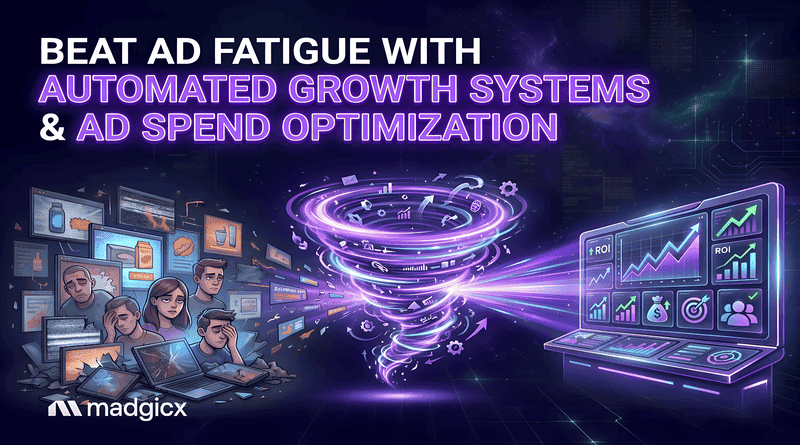
Discover how automated growth systems optimize ad spend, prevent fatigue, and boost ROAS. Learn key strategies for efficient, scalable advertising.
We've all been there. You've got a winning ad — the creative is perfect, the copy is converting, and the ROAS is climbing. You feel like you've finally cracked the code.
Then, slowly at first, things start to slide. Your click-through rate dips. Your cost per purchase creeps up. Before you know it, your star performer is bleeding money.
Sound familiar? You're not going crazy — you're dealing with Facebook ad fatigue. It's one of the most common and frustrating challenges for advertisers, and it's a bigger problem than most people account for. According to Stape.io, approximately 23% — around $20 billion — of online advertising budgets are wasted each year on unoptimized campaigns. A significant portion of that waste is driven by creative fatigue that goes undetected until it's already done the damage.
Here's the good news: it's completely manageable once you know what to look for — and with the right automated growth systems in place, you can catch it before it costs you. Let's break down what ad fatigue really is, how to spot it early, and exactly what to do to get your campaigns back on track.
Madgicx's AI Marketer monitors frequency, CTR, and CPA signals across every active ad set 24/7 — surfacing fatigue warnings as one-click actions before they drain your budget.
What You'll Learn
- What Facebook ad fatigue is and why it happens even to winning campaigns
- The key metrics to monitor and how to read them together as early warning signs
- Proactive prevention strategies using automated growth systems for ad spend optimization
- An emergency action plan to revive campaigns already hit by fatigue
- How automated tools handle the monitoring so you don't have to catch every signal manually
So, What Exactly Is Facebook Ad Fatigue?
Think of it like hearing the same song on the radio ten times a day. The first few times, you might love it. By the tenth time, you're ready to throw the radio out the window.
Facebook ad fatigue is what happens when your audience sees your ad so many times they start tuning it out — or worse, getting actively annoyed by it. This ad blindness isn't just a feeling; it shows up directly in your metrics as declining performance. Your once-effective ad becomes background noise, and you end up paying more to reach fewer engaged people.
It's the natural enemy of every successful campaign. But unlike algorithm changes or external market shifts, ad fatigue is entirely predictable — and therefore entirely preventable with the right approach. For a broader look at how automated systems help maintain campaign efficiency over time, see our guide to best growth marketing automation platforms.
How to Spot the Warning Signs of Ad Fatigue
You don't have to guess whether fatigue is the culprit behind a campaign's decline. The data tells you everything — if you know what to look for. Here are the five key signals to monitor:
- Rising Frequency. Frequency measures how many times the average person in your audience has seen your ad. Once it climbs above 3–4 for cold audiences, performance typically starts to deteriorate. Above 7–8, you're almost certainly dealing with fatigue. This is your primary leading indicator — watch it before anything else moves.
- Falling CTR (Click-Through Rate). As your audience becomes desensitized, fewer people click. A declining CTR over consecutive days on the same creative is a clear signal the message is losing its impact. The trend matters more than any single day's number — look for consistent directional movement over 3–5 days.
- Rising CPC and CPM. When CTR drops, Meta has to work harder to deliver your ad to people likely to engage, which drives up costs. A rising CPC alongside a falling CTR is a classic fatigue pattern that confirms the audience is tuning out rather than clicking through.
- Increasing CPA (Cost Per Acquisition). The bottom-line signal. If your cost per result is climbing without any change to your offer, pricing, or landing page, creative fatigue is usually the culprit. According to Understory rising CPA in an otherwise stable campaign is among the top indicators marketers cite for suspecting creative fatigue over other causes.
- Negative ad feedback. Meta tracks how often people hide or report your ad. A spike in negative feedback is a serious warning that your audience is actively annoyed — and it can damage your account's ad quality score over time, making future delivery more expensive even on fresh creative.
Pro tip: Don't look at these metrics in isolation. The real signal comes from seeing them move together. Rising Frequency paired with falling CTR and rising CPA? That's the clearest possible confirmation of ad fatigue — and a trigger to act immediately.
Getting Ahead of It: How to Prevent Ad Fatigue with Automated Growth Systems
The best way to deal with ad fatigue is to stop it before it starts. Being proactive costs far less — in budget and in stress — than rescuing a dying campaign. This is where automated growth systems make a real difference in ad spend optimization. Rather than relying on manual checks you might miss, they monitor the signals continuously and surface the right action at the right time. See how leading platforms approach this in our guide to best ad-focused growth marketing platforms.
- Set frequency-based automation rules. Configure rules to flag or pause ad sets when frequency exceeds your threshold — typically 3–4 for cold audiences, up to 5–6 for warm retargeting audiences. This stops fatigue before it becomes expensive rather than after the slide has already begun.
- Build a creative pipeline, not just a creative. Treat creative production as an ongoing process. Aim to have 2–3 fresh variants ready to rotate in at all times so you're never scrambling when an ad starts to fade. Madgicx's AI Ad Generator handles this by producing performance-trained creative batches automatically, so the pipeline stays full without requiring constant manual production.
- Rotate creative proactively, not reactively. Don't wait for performance to drop before swapping creative. Scheduled rotation — introducing new variants every 2–3 weeks on high-frequency campaigns — keeps your audience engaged rather than habituated. According to Adobe, AI-driven creative optimization can reduce wasted ad spend by up to 37% compared to static creative strategies.
- Expand your audience regularly. Fatigue is partly a reach problem. If you're showing the same ad to the same small audience, frequency climbs fast. Broader targeting or regular audience expansion gives your creative more room before hitting the saturation point. Our guide to AI tools for ad budget allocation covers how to distribute spend intelligently as you expand.
- Use AI-powered monitoring instead of manual checks. Madgicx's AI Marketer monitors frequency, CTR trends, and CPA signals across every active ad set simultaneously, surfacing fatigue warnings as one-click actions the moment they appear — so nothing slips through during a busy week.
The Emergency Plan: How to Fix Ad Fatigue Now
So it happened. You got busy, an ad went stale, and now your costs are up and your ROAS is down. First, take a breath — you can fix this. Here's the action plan:
- Pause the fatigued ad immediately. Stop the bleeding. Every additional impression on a declining ad is budget spent reinforcing a negative association with your brand in Meta's delivery system.
- Identify what was actually working. Before scrapping everything, analyze performance data at the element level. Was it the hook, the offer, the format, the audience? Preserve what had strong engagement data and rebuild from there rather than starting from a blank page.
- Refresh the creative angle, not just the image. True refreshes go deeper than swapping a product photo. Change the hook, the opening line, the format (try video if you've been running static, or carousel if you've been running single image), and the angle. Your audience has seen your exact framing — give them something genuinely different.
- Reset or expand the audience. If the ad has been running to the same audience for weeks, overlap rates are high. Duplicate the ad set with a fresh audience definition, expanded demographics, or a new Lookalike source to reach people who haven't been overexposed. For platform-level guidance on scaling into new audiences efficiently, see our overview of the best ad platforms for scaling eCommerce.
- Relaunch as a new ad set, not an edit. Editing a fatigued ad set can trigger a learning phase reset without solving the underlying problem. Launching a new ad set with fresh creative and audience gives you a clean slate and a new delivery auction.
- Monitor for 5–7 days before judging. Set clear benchmarks before launch and evaluate based on trend data, not day-one numbers. If the refresh is working, you'll see CTR recovery and stabilizing CPA within the first week.
Frequently Asked Questions
What frequency is too high for Facebook ads?
For cold (prospecting) audiences, frequency above 3–4 typically signals the start of fatigue territory — you'll often see CTR begin to drop around this point. For warm retargeting audiences, a higher threshold of 5–7 is generally acceptable before performance deteriorates significantly. These aren't hard cutoffs; always read frequency alongside CTR and CPA trends rather than pausing purely on a frequency number.
How often should I refresh my Facebook ad creative?
For campaigns running to smaller or well-defined audiences, a proactive refresh every 2–3 weeks is a reasonable baseline. For larger audiences or lower daily budgets where frequency accumulates more slowly, you may get 4–6 weeks before performance signals appear. The better approach is to monitor frequency and CTR trends continuously — or use an automated system that does it for you — rather than refreshing on a fixed calendar schedule regardless of performance.
Is ad fatigue the same as audience saturation?
They're related but distinct. Ad fatigue is about a specific creative losing its impact through repeated exposure — the fix is refreshing the creative. Audience saturation is about reaching the limits of a particular audience pool — the fix is expanding or changing the audience. In practice, you often see both at the same time on mature campaigns: the creative has fatigued within an audience that's also nearly saturated. That's why effective responses usually involve both a creative refresh and an audience reset.
Can automated growth systems fully prevent ad fatigue?
They can prevent most of the costly damage associated with it. Automated systems detect the early warning signals — frequency thresholds, CTR drops, CPA increases — faster and more consistently than manual monitoring, which means you're acting on fatigue in its early stages rather than discovering it after a week of wasted spend. What they can't do is eliminate the underlying dynamic: audiences will always eventually habituate to repeated creative exposure. The goal is catching that moment early and having fresh creative ready, not avoiding it altogether.
Your Ads Don't Have to Burn Out
Here's the thing: Facebook ad fatigue isn't a sign of failure. It's actually a sign of success — it means you found an ad that worked well enough to run at scale. The brands that manage fatigue well don't avoid it; they build systems that catch it early and respond fast.
The key is treating your ad account as something that requires ongoing attention and variety rather than a set-it-and-forget-it machine. By monitoring the right metrics, planning creative refreshes proactively, and acting quickly when signals appear, you can turn ad fatigue from a campaign killer into a routine, manageable part of your advertising process.
Leveraging automated growth systems for ad spend optimization is what makes this sustainable at scale — because the monitoring, alerting, and creative pipeline management happens automatically rather than depending on you catching every signal manually. For more on how autonomous platforms handle this layer, see our guide to autonomous media buying companies. And for a full breakdown of the AI-powered Meta ad management options available, see our guide to the best AI Meta ads management software.
Start your free Madgicx trial today and see what automation can do for you.