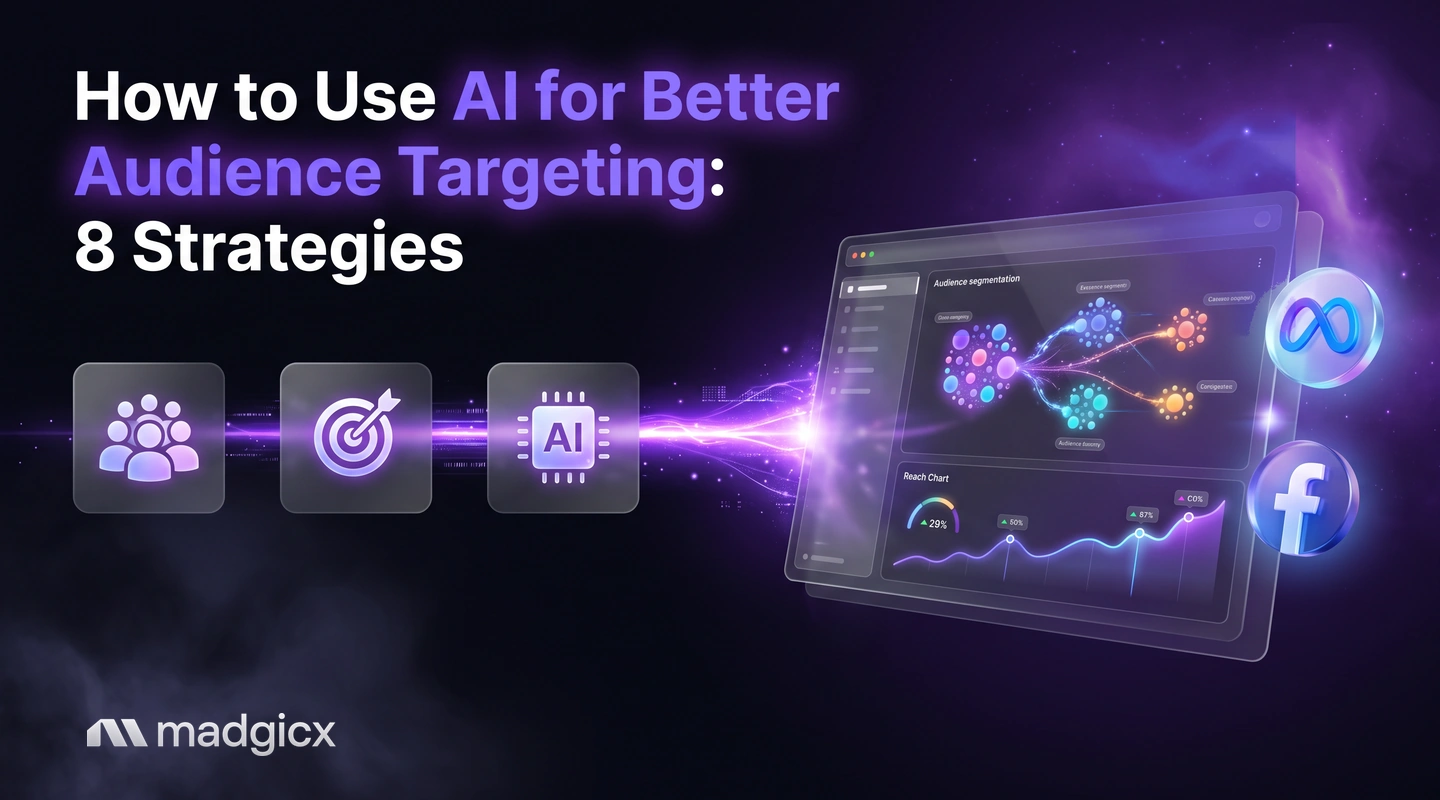
Eight strategies to use AI for better audience targeting and campaign results, from AI-built audiences and stronger signals to lookalikes, creative and a 30-day plan.
The most effective ways to use AI for better audience targeting are to let the ad platform's AI find buyers with broad, AI-built audiences, feed it stronger conversion signals, seed lookalikes with your best customers, use your own customer data, let creative do part of the targeting, and use AI to read results and prepare your next changes. Together, these move targeting from guessing interests to giving the AI the right data and testing what it finds.
Below are eight strategies with the steps for each, a 30-day plan to put them in place, and the problems that most often hold AI targeting back. The examples use Meta ads, where these tools are most mature, but the same ideas apply on other platforms.
Top Audiences shows which audiences drive results, and AI Marketer recommends targeting changes you approve.
What AI changes about audience targeting
Manual targeting meant choosing interests, ages and locations, then hoping they described your buyers. AI targeting works the other way round: you tell the platform what result you want and give it data about who already converts, and its models find more people like them. Meta describes its Advantage+ audience as using signals such as past conversions, Meta Pixel data and interactions with previous ads, and changing as it learns.
That shifts the marketer's job from picking audiences to three things: giving the AI good signals, giving it creative worth showing, and checking whether its choices actually grow the business.
8 strategies to use AI for better audience targeting
1. Let the platform's AI find your audience, and test it
Start with an AI-built audience rather than a stack of narrow interests. Meta reports that turning on Advantage+ audience lowered cost per result by 7.2% for Sales and App promotion campaigns, and by 9.7% for Traffic, Engagement and Leads. It also recommends A/B testing it against your current setup, and doesn't recommend it for retargeting.
- Run an A/B test: your best manual audience against Advantage+ audience, same budget and creative.
- Keep the winner and move budget to it gradually.
2. Feed the AI better conversion signals
AI targeting learns from the conversions it sees. If your tracking misses sales, the AI learns from a smaller, skewed group of buyers. Send purchases and leads through both the Pixel and the Conversions API, optimize for the event closest to revenue, and pass purchase values so the AI can favor higher-value buyers. Our guide to audience targeting on Facebook covers the setup side.
3. Seed lookalikes with your best customers
A lookalike audience finds new people who share characteristics with an audience you already have. Meta notes that an audience built from your best customers can give better results than one that includes all customers. Build seeds from repeat buyers or high-value customers, and test a small, close match against a larger, broader one.
4. Put your first-party data to work
Your own data is the signal competitors can't copy. Custom audiences let you target website visitors tracked by the Pixel, upload customer emails or phone numbers, use offline purchases, and build lists used only to exclude people.
- Retarget recent visitors and cart abandoners with a reminder or offer.
- Exclude recent buyers from prospecting so you don't pay to reach them again.
- Use customer lists as lookalike seeds and as exclusions.
5. Let your creative do part of the targeting
With broad AI audiences, the ad itself decides who stops scrolling. A video about saving time reaches different people than one about price. Run several distinct concepts, each speaking to a different buyer: a problem, a use case, a type of customer. The AI then shows each one to the people who respond to it, and you learn which buyer groups exist from which concepts win.
6. Score and predict who is likely to buy
Predictive scoring ranks people by how likely they are to convert or how much they are likely to spend. Online stores can use it to build value-based seeds and exclusions. Lead generation businesses can score leads in their CRM and send qualified leads back to the ad platform as conversions, so the AI optimizes for leads that turn into customers, not just form fills.
7. Scale testing without splitting your budget
AI makes testing faster, but too many small ad sets starve each one of data. When ad sets from the same advertiser compete for the same people, Meta enters the one with the best history and blocks the others, so overlapping audiences can hurt delivery. Test fewer, larger audiences, change one thing at a time, and check audience overlap before you launch a new test.
8. Use AI to read results and prepare the next move
The last step is turning results into decisions. AI analysis tools spot which audiences and ads drive results, which are tiring, and where budget is wasted, then suggest what to change. Keep a person approving the changes: you know the margins, stock levels and promotions the AI doesn't. Our explainer on AI in performance marketing covers how this works across a campaign.
A 30-day plan to put AI targeting in place
- Week 1: fix the signals. Check that the Pixel and Conversions API both send your main conversion, with values, and that events are deduplicated.
- Week 2: build your data assets. Upload a best-customers list, build a lookalike from it, and set up retargeting and exclusion audiences.
- Week 3: run the core test. Test an AI-built audience against your best manual audience, with three or four creative concepts in each.
- Week 4: read and act. Keep the winning audience and concepts, cut what lost, and plan the next test from what the results show about your buyers.
Common problems with AI targeting, and how to fix them
- The AI optimizes for the wrong people. Usually it is optimizing for an event that is easy to get, like clicks or form fills. Optimize for purchases or qualified leads instead.
- Results swing from week to week. Ad sets with too few conversions never stabilize. Combine ad sets and avoid frequent edits.
- Lookalikes stop working. The seed may be stale or too broad. Refresh it with recent, high-value customers.
- Retargeting eats the budget. Cap it as a share of spend and keep exclusions current, so prospecting keeps finding new buyers.
- No one trusts the AI's choices. Run A/B tests before switching, and review recommendations before they go live.
Find and reach better audiences on Meta with Madgicx
Madgicx is the agentic AI advertising platform for Meta ads. Its 360° Meta Audit includes targeting insights, so you can see which audiences, locations and age groups drive results, and Audience Studio builds mixed audiences from lookalikes and interests. AI Marketer audits your accounts every day and prepares recommendations you complete or dismiss, and Madgicx Cloud Tracking sends Meta the conversions browser tracking misses, so its AI targets from a fuller picture of your buyers.
For more on how AI decides what to show, read our guide to advanced AI marketing strategies.
FAQ
What strategies can marketers use to leverage AI for better audience targeting?
Use AI-built audiences and test them against manual ones, send better conversion signals, seed lookalikes with your best customers, use first-party data, let creative do part of the targeting, score likely buyers, test without splitting budget, and use AI to read results and prepare changes.
Does AI targeting work better than manual targeting?
Often, but test it. Meta reports lower cost per result with Advantage+ audience across objectives, and recommends an A/B test against your current audience to confirm it for your account.
What data does AI need to target ads well?
Reliable conversion events with values, sent through the Pixel and the Conversions API, plus first-party data such as customer lists and site visitors. The better the signals, the better the audiences it finds.
Should I still use lookalike audiences?
Yes, as seeds and tests. Build them from your best or repeat customers rather than all customers, and compare them with AI-built audiences.
How long does it take to see results from AI targeting?
Give each test at least a week and enough conversions for the ad set to stabilize. A full cycle of fixing signals, building audiences, testing and acting takes about a month.