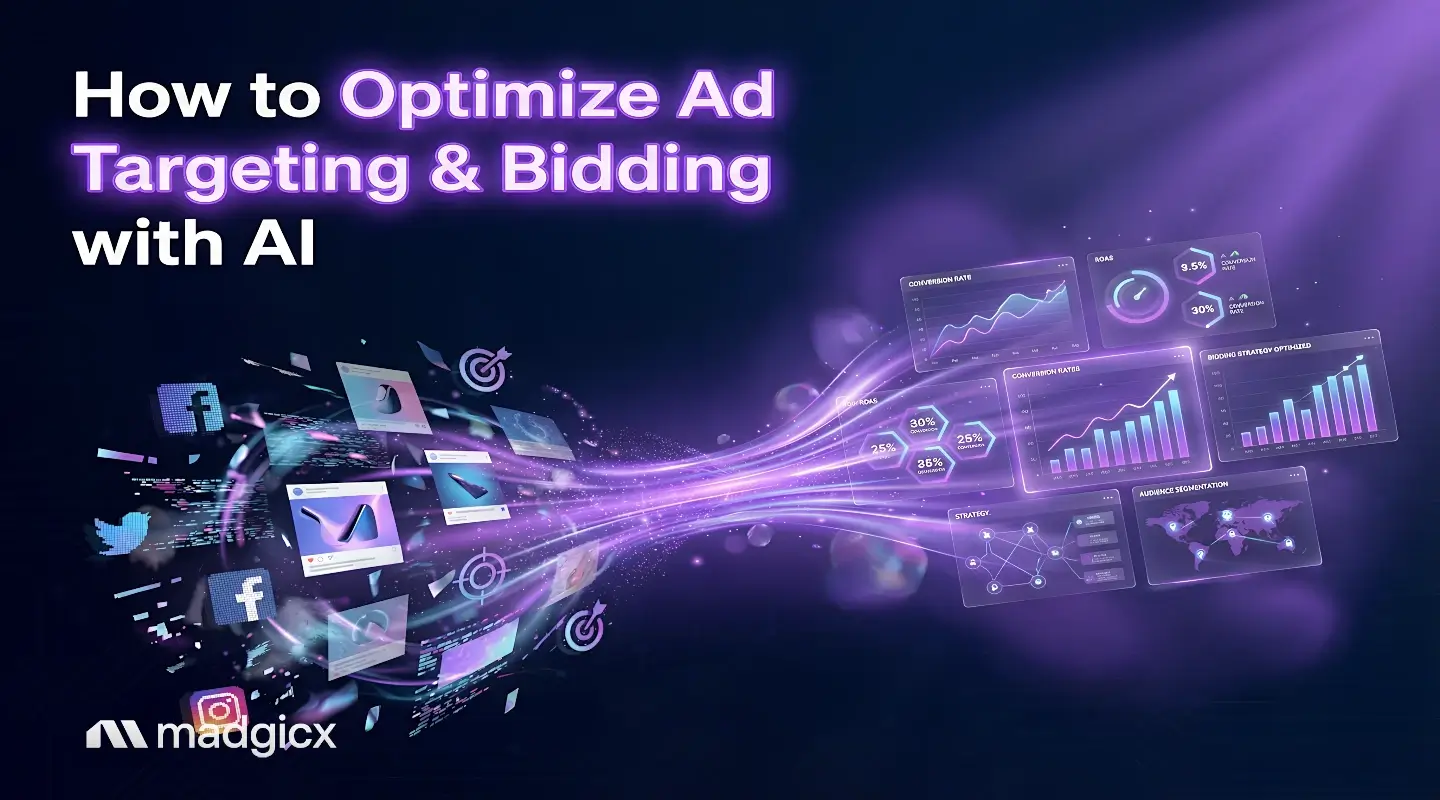
Learn to use AI for ad targeting and bidding. This guide covers predictive audiences, custom bidding, top tools, and frameworks to increase your campaign ROI.
Look, we get it. The days of setting a simple demographic target, throwing some budget at it, and watching the sales roll in are long gone. Today's advertising world is a chaotic mix of data overload, privacy walls, shrinking signal visibility, and auctions that move faster than a toddler who just found the snack cupboard.
Between iOS updates, attribution gaps, rising CPMs, and algorithm volatility, manual optimization just can't keep up. What used to work with weekly adjustments now requires real-time analysis across thousands of data points — audience behavior, creative performance, bid pressure, placement shifts, and conversion signals.
That's where AI changes the game. This approach moves beyond platform defaults by continuously analyzing performance patterns, identifying high-intent audience segments, and adjusting bidding logic based on predicted outcomes — not just historical results. In a privacy-first advertising landscape, smarter automation isn't a luxury; it's survival.
If you're still managing campaigns by hand, you're not just leaving money on the table — you're basically bringing a spork to a lightsaber fight. This guide is your lightsaber.
Madgicx’s AI Marketer continuously analyzes your Meta ad account around the clock, identifying inefficiencies, high-performing audiences, and budget optimization opportunities. Receive clear, data-backed recommendations to improve targeting, bidding, and spend allocation — helping you scale client ROAS without hours of manual auditing.
Why Manual Campaign Management Is Failing
Remember when you could just check your Ads Manager a couple of times a day? Cute.
Now, we're all navigating a digital minefield of AI-driven advertising. The sheer volume of data is overwhelming, auction dynamics change in milliseconds, and privacy updates have turned reliable targeting into a guessing game.
It's not just about complexity; it's about trust and security. According to StackAdapt, consumer comfort with AI in advertising dropped to 46% in 2024, which means we need to be smarter and more transparent with our tech.
On top of that, a staggering 58% of marketers report disruption from AI-powered bot fraud, according to DoubleVerify. Manually trying to sift through fraudulent clicks and low-quality placements is like trying to empty the ocean with a teaspoon. It's simply not possible to keep up.
AI-Powered Audience Targeting
So, where do we even begin? It starts with rethinking who we're talking to. The old playbook of targeting "women, 25-34, interested in yoga" is officially dead. AI doesn't care about static labels; it cares about behavior, intent, and predictive value.
Beyond Demographics: Predictive Segmentation in Action
You've probably heard the term, but what does it actually mean?
Predictive segmentation is basically AI playing matchmaker for your brand. It analyzes your first-party data (like from Shopify or your CRM) and real-time signals to find and group people who are most likely to convert.
Instead of you telling the algorithm who to find, the algorithm tells you who your best customers are. It connects the dots between all your data sources to build dynamic audiences of people who look, act, and think like your highest-LTV customers, a core principle of predictive audience modeling.
Meta's own Advantage+ is a perfect example of this in the wild. It's not just a "broad targeting" feature; it's a predictive engine that helps advertisers reach new pockets of customers they never would have thought to target themselves.
The Rise of Contextual Intelligence
With the death of the third-party cookie, context is king again. But this isn't your grandpa's contextual targeting. AI is now capable of multimodal analysis—understanding the content and sentiment of videos, images, audio, and text on a page.
This means your ad for running shoes doesn't just show up on a "sports blog." It shows up next to an article about marathon training tips, right at the moment of highest relevance and brand safety. It's smarter, safer, and way more effective.
AI-Driven Bidding Strategies
If targeting is about who you reach, bidding is about how much you're willing to pay for them. AI transforms this from a simple cost calculation into a sophisticated, real-time value judgment.
From CPM to qCPM: Optimizing for Quality
Let's be honest, a cheap CPM (Cost Per Mille) is a vanity metric if those thousand impressions are all from bots or accidental clicks on a dodgy mobile game. This is where AI introduces a much better metric to obsess over.
Quality CPM (qCPM) is a metric that answers the question, "Am I paying for impressions that actual humans can see in a good environment?" It calculates the cost per thousand impressions on high-quality, viewable, brand-safe, and fraud-free inventory.
AI verification tools analyze placements in real-time, filtering out fraudulent traffic and ensuring your ads are seen by real people in environments that won't damage your brand. The results are staggering. In one campaign, Colgate used this approach to increase its quality reach by a massive 92%, as reported by DoubleVerify.
A Step-by-Step Checklist for Meta AI Bidding
Ready to let AI take the wheel on your Meta bids? It's not just about flipping a switch on Advantage+. A smart strategy involves setting the right guardrails so the AI works for you, not against you. Here's a foundational checklist to get you started.
1. Set Budget Thresholds: Don't let the AI run wild. Set daily or lifetime budget caps to control spend during the learning phase.
- Why It Matters: This stops the algorithm from burning through your cash before it figures out what works. Think of it as training wheels.
2. Respect the Learning Phase: Avoid making significant changes for at least 7 days after launching a new campaign or ad set.
- Why It Matters: AI needs a consistent stream of data (around 50 conversions) to learn. Constantly tweaking things is like changing the rules in the middle of a game—it just gets confused.
3. Define Scaling Rules: Create rules to increase the budget by 15-20% every 24-48 hours if ROAS/CPA targets are met.
- Why It Matters: This lets you scale up smoothly and profitably without freaking out the algorithm and sending it back into a volatile learning phase.
4. Establish Performance Benchmarks: Set clear kill-switch rules. For example, "Pause ad set if CPA is 25% above target for 3 consecutive days."
- Why It Matters: This is your safety net. It protects your budget from underperforming ads and makes sure the AI is always working toward your business goals.
Pro Tip: This checklist is your starting point. An AI advertising platform like Madgicx doesn't just follow static rules. Its AI Marketer analyzes performance data 24/7 and adapts these rules for you, suggesting when to scale, when to pause, and where to reallocate budget for maximum impact.
Solving the Gaps: Where Most AI Tools Fall Short
Heads up: not all AI is created equal, and understanding the differences is key. Many tools are "black boxes" that make changes without explanation, operate in data silos, or require massive budgets to even get started. Here's how to spot—and solve—those gaps.
Beyond the Black Box: Interpreting AI Decisions with AI Chat
Ever had an AI tool pause your best-performing ad set and you have absolutely no idea why? This is what experts call the "model interpretability" gap, but we just call it annoying.
This is precisely why we built Madgicx's AI Chat. Instead of staring at a dashboard wondering what happened, you can just ask it like you'd ask a team member.
For example, you can type: "Why was my 'Lookalike Audience - US' ad set paused yesterday?"
AI Chat gives you a clear, data-backed answer: "This ad set was paused because its CPA increased by 40% over the last 48 hours while its CTR dropped by 25%, indicating audience fatigue." Suddenly, the black box has a voice, and you have a co-pilot you can actually trust.
Unifying Your Data: True Cross-Platform Attribution
Your customer doesn't just live on Facebook. They see your ad on TikTok, search for you on Google, and then finally buy from your Shopify store. If your AI tool only sees the Facebook data, it's making bidding decisions with one eye closed.
This is the cross-platform attribution gap. You need a single source of truth.
Madgicx's One-Click Report and Business Dashboard solve this by pulling data from Meta, Google, TikTok, GA4, and Shopify into one unified view. This allows you to make smarter, global optimization decisions based on your entire business performance, not just one siloed channel.
AI for Everyone: Effective Strategies for Small Budgets
Here's a common myth we need to bust: you don't need a Fortune 500 budget for AI to work. While more data is always better, it's not about the budget size; it's about conversion volume.
As a general rule, AI algorithms need at least 50-100 conversions per week per campaign to gather enough data to make statistically significant decisions. For many growing e-commerce brands, this is totally achievable.
Platforms like Madgicx are designed specifically for this segment, with algorithms that work efficiently to find scaling opportunities even without enterprise-level ad spend.
The Best AI Advertising Tools for Optimization
The market is flooded with AI tools for social media advertising. Here is a breakdown of the top platforms based on automation intelligence and reporting capabilities:
- Madgicx
- Best For: E-commerce & DTC Scaling
- Key Differentiator: AI Chat for quick diagnostics, AI Marketer for optimization recommendations 24/7 + Unified cross-channel live dashboard
- Cross-Platform Reporting: Yes (Meta, Google, TikTok, GA4, Shopify)
- Starting Price: Starting at $45/mo, with a free trial.
- Triple Whale
- Best For: E-commerce Analytics
- Key Differentiator: Creative reporting & LTV focus
- Cross-Platform Reporting: Yes (Limited to attribution)
- Starting Price: Starting at $149/mo
- Hyros
- Best For: Info Products & High-Ticket
- Key Differentiator: Advanced click tracking
- Cross-Platform Reporting: Yes (Attribution focused)
- Starting Price: Starts at $230/mo
- AdCreative.ai
- Best For: Creative Generation
- Key Differentiator: AI-powered ad creative
- Cross-Platform Reporting: No
- Starting Price: Starting at $21/mo
Case Studies: AI-Driven ROI in Action
- Nike (AI-Generated Content): Generated over 4.2 million views in 48 hours, a 1082% increase in organic views.
- Heinz (AI Creative Campaign): Earned over 1 billion impressions, yielding a return worth over 2500% more than the brand media investment.
- British Council (AI Content Creation): Achieved a 70% reduction in content creation costs.
- Kalshi (AI Ad Production): Produced an NBA Finals ad for ~$2,000, making it 95% cheaper than traditional production.
Frequently Asked Questions
What is the minimum budget for AI advertising tools to be effective?
It's less about the budget and more about the data. For AI to optimize effectively, it typically needs 50-100 conversions per week for the campaign it's managing. For a product with a $50 AOV, you'd be looking at an ad spend of around **$2,500-$5,000 per week**.
How does AI campaign targeting work without third-party cookies?
It pivots to first-party and contextual data. AI analyzes your own customer data (from CRM or e-commerce stores) to build a picture of your ideal customer and uses contextual intelligence to place ads based on what users are doing in the moment.
Can AI completely replace a human media buyer?
Not yet. AI is a genius at data analysis, but it lacks human intuition, strategic creativity, and brand nuance. The best approach is a partnership: AI handles the number-crunching, while humans focus on big-picture strategy.
What is the difference between platform AI (e.g., Meta Advantage+) and a third-party tool like Madgicx?
Meta Advantage+ is a specialist that only sees Meta data. A third-party tool like Madgicx is a central intelligence hub that integrates data from all channels (Meta, Google, TikTok), your store (Shopify), and analytics (GA4) for a complete business picture.
Conclusion
Welcome to the new era of advertising. Success is no longer about outspending your competitors; it's about out-thinking them.
The three pillars to build your strategy on are clear:
- Predictive targeting to find your best customers before they find you.
- AI-driven bidding to pay the right price for them, every single time.
- A unified AI tool to connect all the dots and give you the full story.
Ready to see what AI can uncover in your ad account? Try Madgicx for free today.