Discover the top Meta ads optimization tools for app installs to scale your campaigns. Learn to track your true Blended CPI and automate growth. Find your perfect tool today!
Ever had that heart-in-your-throat moment? You launch a shiny new app install campaign, your Mobile Measurement Partner (MMP) like AppsFlyer is all hooked up, and you lean back, ready for the magic.
But instead of magic, you get a horror show. Your Cost Per Install (CPI) triples overnight. You start sweating. Is the campaign a dud? Is Meta’s algorithm having a bad day?
Nope. You’re just looking at the wrong number. And trust me, we’ve all been there.
The single biggest mistake we see performance marketers make is confusing their Attributed CPI with their Blended CPI. In a world still navigating the chaos of iOS 14.5, these two numbers are worlds apart. But here’s the good news: understanding the simple math that separates them is the key to unlocking profitable scale.
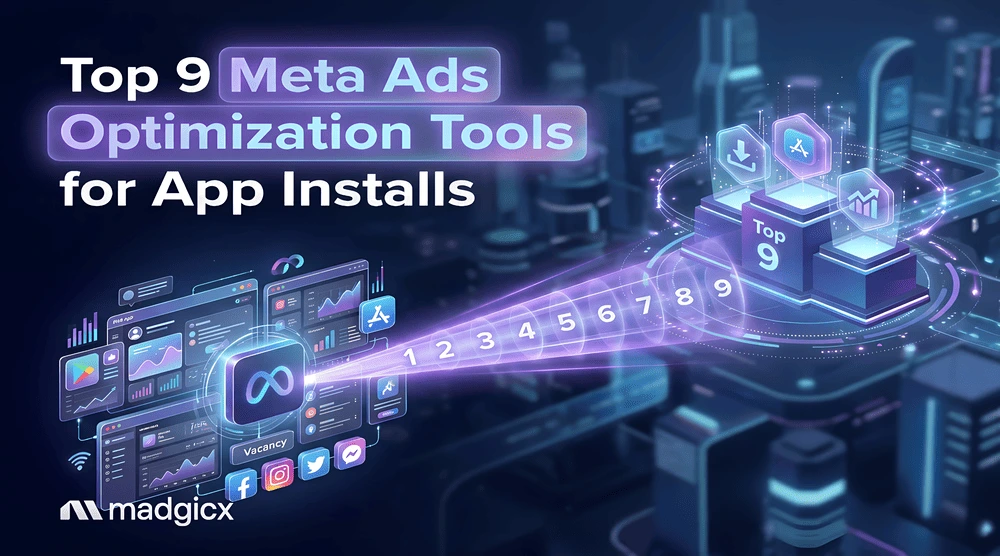
This guide won't just break down that math; we'll also walk you through the top Meta ads optimization tools for app installs that help you track what truly matters and optimize your path to growth. Because in a market where, according to Digital Applied, global mobile app install ad budgets are set to reach $94 billion by 2026, you can't afford to be guessing.
Madgicx helps streamline Meta ads optimization with 24/7 automation through AI Marketer. With Madgicx MCP, you can connect your preferred AI assistant directly to your ad account, surface campaign insights, and take action without leaving the chat.
What You'll Learn
- The difference between Attributed CPI and Blended CPI.
- How to evaluate Meta ads optimization tools for app installs.
- Which playbooks can help you scale efficiently without wasting spend.
The Formula for Clarity
The relationship between these two metrics is surprisingly simple. Your reported Attributed CPI is just your real Blended CPI divided by your Matched Attribution Rate (MAR).
Attributed CPI = Blended CPI / Matched Attribution Rate (MAR)
Let’s walk through an example. Say your goal is to acquire users for your new subscription app at a real-world cost (Blended CPI) of $3.00. But because of ATT, your MMP can only match a small percentage of your installs back to your Meta ads (a 0.3 MAR).
Here’s what your dashboard will show you:
$10.00 (Attributed CPI) = $3.00 (Blended CPI) / 0.3 (MAR)
Your dashboard screams that you’re paying $10 per install, but your e-commerce business is actually acquiring users for $3. You’re hitting your goal! Marketers who don't understand this math might pause this winning campaign, killing their scale and wondering why their growth has stalled.
The bottom line? Optimize for a stable or decreasing Blended CPI, not chase an artificially low Attributed CPI.
Don't have an MMP yet? You can estimate your Matched Attribution Rate (MAR) by looking at your Meta Ads Manager. Navigate to your campaign columns, customize them to add "Attribution Setting," and see what percentage of conversions are tracked under the 7-day click/1-day view window. While not perfect, it gives you a starting point to sanity-check your numbers.
How We Evaluated the Top Meta Ads Tools for Apps
To cut through the noise, we evaluated these platforms based on what actually matters to app marketers today. We've covered some of the best Facebook ad optimization tools before, but for this guide, we focused on solutions to the toughest problems you face. We didn't just look at feature lists; we looked for solutions to the toughest problems you face.
The Top 9 Meta Ads Optimization Tools for App Installs
1. Madgicx
Madgicx is built for marketers who want to stop guessing and start acting on clear performance signals. The AI Marketer helps automate campaign monitoring and optimization around the clock, surfacing issues and scaling opportunities as performance shifts. With Madgicx MCP, your team can connect an AI assistant directly to your ad account to analyze campaigns, uncover insights, and take action from within the chat. Add server-side tracking for stronger attribution and cleaner conversion data, and you have a performance stack built to scale with confidence.
Start your free Madgicx trial today.
2. Smartly.io
Smartly.io is strong for large teams managing high-volume creative production and cross-channel execution. It is especially useful when you need more structured workflows around automation and creative operations. For app installers scaling globally, it can be a solid option if your team already has mature media buying processes.
3. Triple Whale
Triple Whale is best known for ecommerce attribution, but some teams evaluate it for broader performance visibility. It helps centralize data and reporting so operators can make faster decisions. For mobile app advertisers, its usefulness depends heavily on whether your measurement setup matches its reporting model.
4. Hyros
Hyros focuses on attribution and revenue tracking, giving marketers a deeper view into performance across touchpoints. It is often considered when businesses want a more analytical look at source quality. App marketers should evaluate how well it handles mobile-specific install and event workflows.
5. Ryze AI
Ryze AI is positioned around AI-assisted ad creation and optimization. It can be useful for teams that want faster creative experimentation and performance feedback loops. For app installs, the key question is whether its automation depth is enough for your media buying complexity.
6. AdCreative.ai
AdCreative.ai centers on creative generation and ad variation at scale. That makes it helpful for teams fighting creative fatigue and needing more ad concepts quickly. App marketers often pair tools like this with stronger measurement platforms so they can test more efficiently.
7. Skai
Skai is an enterprise-grade platform for managing paid media across large accounts and multiple channels. It is typically attractive to teams that need governance, scale, and integrated workflows. For app install campaigns, its value comes from operational control and reporting depth.
8. Northbeam
Northbeam is well known for attribution and performance visibility across channels. It can be useful when you want stronger confidence in what is actually driving conversions. App marketers should compare its fit against their MMP and Meta reporting setup before committing.
9. Marin Software
Marin Software has a long history in digital ad management and optimization. It is generally considered by teams with more complex multi-channel buying needs. For app installs, the main evaluation point is how well it supports your mobile measurement and creative testing processes.
3 Actionable Playbooks to Solve Your Biggest App Install Challenges
Look, a great tool is only half the battle. It's useless without the right strategy. Here’s exactly how you can use automation to solve the problems that keep app marketers up at night.
Playbook 1: How to Automate Creative Rotation and Beat Fatigue
Creative fatigue rarely announces itself. Performance usually starts slipping before your team notices—CTR softens, thumb-stop rate drops, frequency climbs, and suddenly your cost per install is trending in the wrong direction.
Instead of waiting for weekly reporting cycles, set automation rules around early warning signals. For example:
- If CTR drops by 15–20% over 72 hours
- If frequency exceeds 2.5–3.0
- If CPI rises above target for 2 consecutive days
…automatically pause the asset, reduce spend, or trigger a new creative variation.
A tool like Madgicx can help automate those decisions so your best ads stay live longer and underperformers get cut faster.
Playbook 2: How to Scale Budgets Without Spiking Your CPI
One of the fastest ways to kill a profitable campaign is scaling too fast. Meta’s algorithm needs time to adjust to new spend levels, and aggressive jumps often reset learning, inflate CPIs, and destabilize performance.
A better approach:
- Increase budgets by 10–20% every 24–48 hours
- Only scale ad sets that have delivered at least 50 conversion events
- Monitor blended CPI, retention signals, and ROAS, not just install volume
Automation helps here by enforcing pacing rules. If CPI rises above threshold after a budget increase, spend can automatically stabilize or scale back until performance normalizes.
This removes emotional decision-making and helps teams scale with confidence instead of guesswork.
Playbook 3: How to Stop Wasting Spend on Overnight Traffic
Cheap traffic can be expensive when installs don’t convert into retained users.
Many app teams discover that overnight traffic produces lower engagement, weaker Day-1 retention, or poor downstream monetization—even when top-line CPI looks attractive.
Instead of spending evenly across all hours, use dayparting rules tied to actual post-install quality:
- Reduce spend during low-LTV hours
- Pause campaigns if CPI remains stable but retention drops
- Reallocate budget toward top-performing time windows by geo, device, or audience
With automation running in the background, your campaigns stay focused on install quality—not just install volume.
Frequently Asked Questions (FAQ)
What is a Mobile Measurement Partner (MMP)?
Think of an MMP (like AppsFlyer, Adjust, or Singular) as an unbiased referee. It’s a third-party platform that tracks and attributes mobile app installs and in-app events to the marketing campaigns that drove them. They help you understand which channels are delivering the most valuable users, so you know where your money is working best.
Why did my CPI go up after installing AppsFlyer or Adjust?
Great question, and it's a super common point of confusion. Your CPI didn't actually go up; your measurement just got more precise (and more complicated). This happens because of the Matched Attribution Rate (MAR). Before the MMP, you were likely looking at a blended number. Now, the MMP can only attribute a fraction of your total installs due to privacy settings, which makes the reported Attributed CPI look much higher than your real Blended CPI.
How can I improve my Event Match Quality (EMQ) on Meta?
Think of your EMQ score as how well you're feeding Meta's algorithm. The better the data, the better the results. A highly effective way to improve it is by implementing the Meta Conversions API (CAPI) and securely passing as many hashed user parameters as you can. This includes identifiers like email, phone number, and user ID, which help Meta accurately match events from your app to user profiles. A tool with Server-Side Tracking can make this much easier.
Should I still use interest targeting for app install ads?
Honestly, for Advantage+ App Campaigns, it's often best to go broad and let the algorithm do the heavy lifting. Instead of getting bogged down in narrow interest targeting, focus your energy on creating ad creatives with strong, clear contextual hooks. Your ad's message, visuals, and copy can act as the filter, calling out to your ideal audience and letting Meta's AI find users who are most likely to respond.
Conclusion: From Analysis to Action
Choosing the right optimization tool isn't about finding the one with the longest feature list; it's about finding the one that solves your most expensive problems. While our guide can help you find the best Facebook ad optimization platform for your needs, the real work starts when you stop spending your mornings in spreadsheets trying to calculate your real CPI. Stop guessing why your best creatives suddenly died.
The key to scaling your app is the powerful combination of human strategy and intelligent automation. By focusing on your true Blended CPI and using AI-powered tools to handle the day-to-day diagnostics and optimization, you can finally move from just analyzing performance to actively driving it.
This is how you win back your time and sharpen your competitive edge. Ready to see how AI can transform your app campaigns? Try Madgicx for free today.