Discover 7 practical AI use cases in ad campaigns to boost ROI and efficiency. Learn how to leverage AI for bidding, targeting and creative while avoiding common pitfalls.
The conversation around AI in advertising has shifted. Marketers are no longer asking "What is AI?" but "How can I use it to get better results today?" The search for high-level theories is over; the demand is for practical, execution-oriented playbooks that drive real performance.
And the stakes are getting higher. The generative AI in advertising market is projected to grow from $3.37 billion in 2025 to $4.18 billion in 2026, fueled by a need to do more with less in an increasingly fragmented digital landscape.
But diving in without a map can be costly. Many marketers get burned by trendy tools that don't solve core problems, pricing models that penalize growth, and automation errors that corrupt entire databases. The main challenges in performance marketing today aren't just about finding the right channels — they're about using AI intelligently enough to compound your results without introducing new risks.
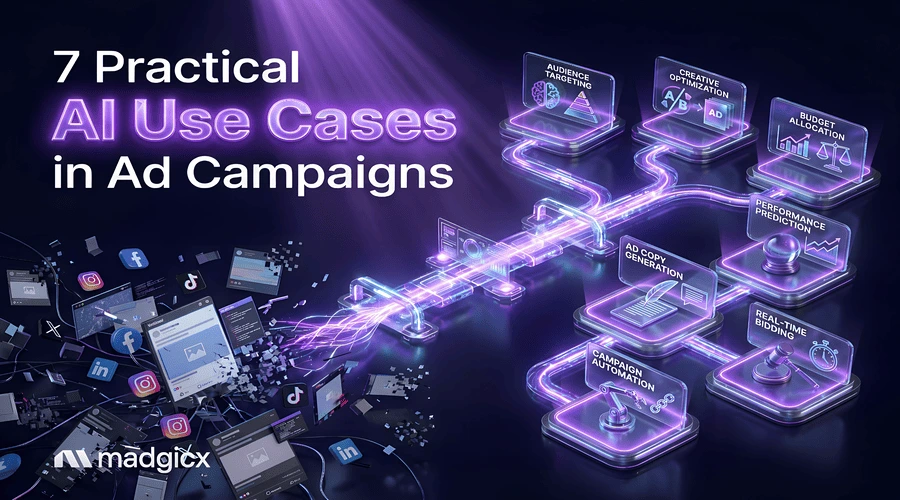
This guide cuts through the noise. We'll cover seven practical AI use cases you can implement right now, from smarter bidding to autonomous campaign management. More importantly, we'll show you how to sidestep the common pitfalls that trip up your competitors.
Madgicx combines AI-Powered Audiences, Automated Bid Management & Budget Pacing, AI-generated Creatives, and an MCP integration that lets Claude diagnose and execute campaign optimizations directly from the chat.
What You'll Learn
- 7 practical AI use cases in advertising you can implement immediately
- How AI bidding, dynamic creative optimization, and autonomous campaign management work in practice
- The 3 most costly AI pitfalls — and exactly how to avoid the
7 AI Use Cases Transforming Advertising Campaigns
1. Automated Bid Management & Budget Pacing
Going beyond the default bidding options on Meta or Google, AI-powered platforms can act as a vigilant co-pilot for your ad spend. These systems analyze performance data in real time to make micro-adjustments to your bids, reallocating budget away from underperforming assets and toward winners.
The impact is significant. AI-driven PPC bid management can reduce wasted ad spend by around 37% and increase ad ROI by roughly 50%, according to a study cited by Adobe.
How to use it:
- Let performance data accumulate before automating — AI needs sufficient historical data to make accurate predictions. Run campaigns manually for at least two weeks before enabling automated bid adjustments, so the system has a meaningful baseline to optimize from.
- Set hard performance floors — Define minimum ROAS thresholds and maximum CPA limits that trigger automatic pauses. This prevents the system from scaling spend on campaigns that haven't yet proven their efficiency.
- Separate prospecting and retargeting budgets — AI optimizes differently for cold and warm audiences. Mixing them in a single campaign muddies the learning signal and leads to suboptimal bid decisions for both. Madgicx's AI Marketer takes this further by actively identifying new high-potential audience segments you haven't tested yet, so your prospecting budget is always working toward untapped growth rather than just maintaining existing reach.
- Review automated decisions weekly — Don't set and forget entirely. Spot-check the system's actions to ensure its logic aligns with your actual campaign goals and that no rules are firing unexpectedly.
2. AI-Powered Audience & Contextual Targeting
The slow death of the third-party cookie has made first-party data and advanced targeting more critical than ever. AI excels at analyzing your existing customer data to identify hidden patterns and build high-value lookalike audiences that platforms might miss.
But it also opens the door to powerful contextual targeting. Instead of just targeting user demographics, AI can analyze the content of a webpage or video in real time to place your ad in the most relevant environment.
The results speak for themselves. According to StackAdapt, advertisers see up to 2X higher return on ad spend when using first-party data or AI-based contextual targeting compared to traditional third-party targeting. For a deeper look at the tools powering this shift, see our guide to AI optimization tools for Facebook ads.
3. Dynamic Creative Optimization (DCO)
Tired of manually testing dozens of ad creative variations? Dynamic Creative Optimization (DCO) uses AI to do the heavy lifting. You provide the components — headlines, images, videos, descriptions, and CTAs — and the AI engine mixes and matches them to find the highest-performing combinations for different audience segments.
This not only saves countless hours but also delivers better results. Data from StackAdapt shows that DCO can increase campaign click-through rates by 32% and lower cost per click by 56%. For agencies scaling creative output across multiple clients, our breakdown of AI campaign scaling tools for Meta ads covers the best options in detail.
4. Generative AI for Ad Copy and Creatives
Generative AI tools are a fantastic starting point for overcoming creative block and producing ad variations at scale. You can use them to brainstorm hooks, write initial ad copy, and even generate images or video storyboards.
However, practitioners warn that raw AI-generated copy often sounds formulaic. The best approach is to use it as a creative assistant, not a replacement for a skilled copywriter. Always have a human review and refine the output to match your unique brand voice. Madgicx's AI Ad Generator is trained on high-converting ads, giving you a powerful starting point that's already calibrated for performance. Start your 7-day free trial to try all of Madgicx's AI tools.
5. Autonomous Campaign Management
The next frontier is "agentic workflows" — AI systems that don't just execute rules but actively monitor, analyze, and optimize campaigns on their own. These autonomous agents can act as a "devil's advocate" to stress-test your campaign briefs, identify logical gaps, and report on performance anomalies before they become major issues.
In practice, this means an AI system that wakes up every morning, reviews every campaign in your account, identifies what's drifting from target, and either fixes it automatically or surfaces a prioritized action list for your team. The best implementations combine rule-based precision with AI-driven judgment — so the system handles the predictable work while escalating genuinely novel situations to a human.
Madgicx's AI Marketer is built for exactly this — continuous 24/7 campaign monitoring with automated actions and a transparent approval workflow so you stay in control. And with the Madgicx MCP for Claude, you can go even further: execute Meta ad actions directly through Claude in natural language. Brief a campaign, pull performance data, or trigger optimizations from a conversation — no tab-switching required. This is what agentic advertising looks like in practice. See how it compares to Meta's native tools in our Meta Advantage+ review.
This is where the industry is heading, moving from simple automation to intelligent orchestration.
6. Smart Frequency Capping
Ad fatigue is a major cause of wasted spend. AI can optimize ad delivery by implementing smart frequency capping that goes beyond simple platform limits. By analyzing engagement and conversion data, the system can determine the optimal number of times an individual should see an ad before it becomes ineffective.
This allows you to reinvest your budget into higher-performing inventory. According to data published by EDO, up to 35%+ of ad impressions in some TV campaigns can be reinvested into better-performing placements through smarter frequency capping alone.
7. Multi-Client Reporting Dashboards
For agencies, manual reporting is a massive time sink. AI-powered data connectors can pull metrics from hundreds of sources — ad platforms, CRMs, analytics tools — into a single, unified dashboard. This eliminates manual data entry and allows you to build multi-client reports that update automatically.
However, it's crucial to be aware of API limitations. Exceeding data source limits can cause auto-refreshes to stall, leaving your campaigns running without active oversight. Always set up alerts for connector failures so you catch data gaps before they affect optimization decisions.
The Hidden Risks of AI: 3 Pitfalls to Avoid
While the benefits are clear, community forums are filled with horror stories from marketers who adopted AI without proper oversight. Here's how to avoid the most common traps:
- Over-automating without guardrails — AI scales whatever system you give it — including your mistakes. A misconfigured rule that pauses your best campaign or overbids on a low-value audience can drain significant budget before anyone notices. Always implement hard spend caps, anomaly alerts, and a human review step for any automation touching large budgets. Start conservative and expand automation gradually as you build trust in the system's decisions.
- Trusting platform attribution blindly — Every ad platform reports conversions in its own favor. Meta will claim credit for sales that Google also claims, and both will count conversions that Shopify never recorded. Without an independent attribution layer — whether GA4, server-side tracking, or a third-party tool — you'll make budget decisions based on systematically inflated numbers. Your AI is only as good as the data it's optimizing against.
- Choosing spend-based pricing at scale — A platform charging 3% of managed spend sounds reasonable at $10K/month ($300), but becomes $15,000/month at $500K spend for the exact same features. Always model out your tool costs at 2x and 5x your current spend before signing. Flat-rate pricing models are significantly more predictable and scale-friendly for growing advertisers.
Frequently Asked Questions
What is the most practical AI use case in advertising right now?
Automated bid management delivers the fastest, most measurable ROI for most advertisers. It requires minimal creative input, works within your existing campaign structure, and produces results you can track directly in your ROAS and CPA data. If you're only going to start with one AI use case, start here.
Can AI fully replace a media buyer?
Not yet — and probably not in the way most people imagine. AI excels at executing repetitive optimization tasks faster and more consistently than any human. But strategy, creative judgment, client communication, and navigating novel situations still require human expertise. The best setups use AI to handle the execution layer so media buyers can focus on the decisions that actually require their experience.
How do I know if an AI advertising tool is worth the cost?
Start by identifying your single biggest inefficiency — wasted spend, slow reporting, creative bottlenecks, or attribution gaps — and evaluate tools against that specific pain point. Take advantage of free trials to test with your actual accounts and real campaign data. The clearest signal is whether the platform recovers more in wasted spend and team time than it costs per month. Most well-implemented AI tools pay for themselves within the first billing cycle.
What's the difference between rule-based automation and agentic AI in advertising?
Rule-based automation follows the specific conditions you define — "if CPA exceeds $50 for 3 days, pause the ad set." It's predictable, transparent, and gives you full control. Agentic AI goes further: it monitors, reasons, and acts more autonomously, identifying optimization opportunities you didn't explicitly anticipate. Madgicx's AI Marketer combines both — a rules engine for predictable control, layered with AI-driven recommendations that surface opportunities your rules wouldn't catch.
Conclusion: AI is a Tool, Not a Magic Wand
AI is transforming advertising, empowering lean teams to achieve results that were once only possible for massive agencies. It's no wonder that, according to BuiltIn, 88% of marketers are already using AI tools in their day-to-day roles.
But automation doesn't automatically improve a business; it scales the systems that already exist. The key to success is pairing powerful AI with smart human oversight. By leveraging these practical AI use cases in ad campaigns and avoiding the common pitfalls, you can build a more efficient, scalable, and profitable advertising machine.
Ready to scale your campaigns without scaling your costs? Start your free Madgicx trial today and discover an all-in-one advertising platform with predictable, flat-rate pricing.