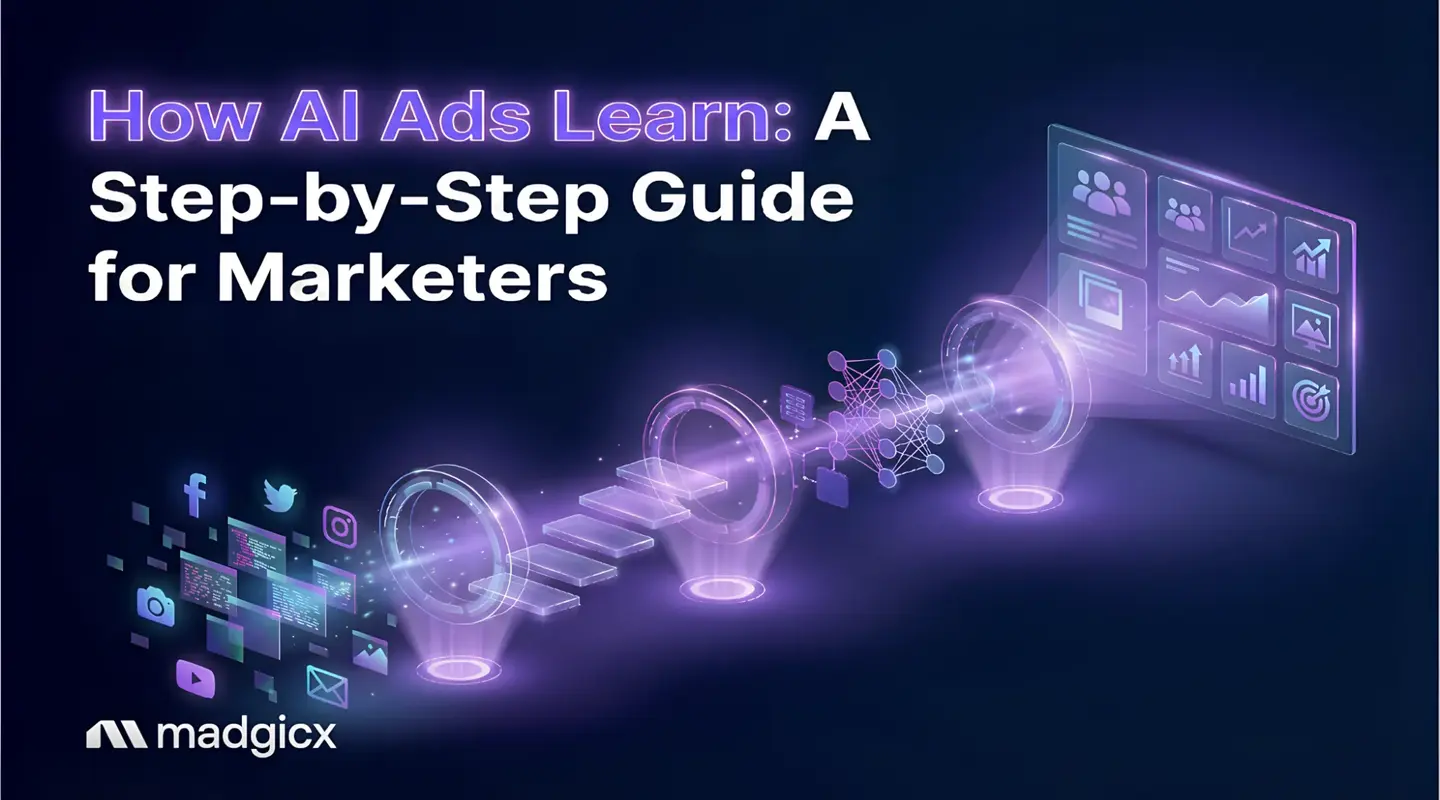
Discover how AI ad platforms learn from campaign data. This guide breaks down the machine learning process, from data collection to real-time optimization.
The rise of AI in ad tech platforms has changed the game. These systems learn from campaign data by using machine learning algorithms to analyze vast datasets of user interactions, ad performance, and conversion events. This process involves an initial training phase to establish baseline patterns, followed by a continuous optimization loop where the AI refines its predictions and bidding strategies in real-time to maximize campaign goals like ROAS or CPA.
If you've ever felt like you're wrestling with a mysterious black box that either blesses your campaigns with riches or curses them with sky-high CPAs, you're not alone. We've all been there. It can feel like you're just feeding money into a machine, crossing your fingers, and hoping for the best.
But here's the thing: it's not magic. It's math.
And with Martech360 reporting that 88% of marketers now use AI daily, understanding the "how" is no longer optional. By the end of this guide, you'll understand the exact mechanisms AI uses to learn, how major platforms like Meta and Google differ, and how to feed the machine the right data to accelerate learning and improve your campaign performance.
Madgicx is built on these exact learning principles, giving you a serious advantage. Instead of guessing, you can instantly see what's working, get plain-English advice from our AI Chat, and let our AI Marketer watch your back 24/7 to streamline optimizations.
1. The Foundation: How Machine Learning Powers Modern Ads
Before we dive into the nitty-gritty, let's get one thing straight. When we talk about "AI" in advertising, we're mostly talking about a specific field within it.
Machine learning is a branch of artificial intelligence (AI) that enables systems to automatically learn and improve from experience without being explicitly programmed.
Think of it like this: instead of giving a computer a rigid set of "if this, then that" rules, you give it a goal (e.g., "get me the most purchases for the lowest cost") and a whole lot of data. The machine then figures out the rules for itself. It identifies the subtle patterns between who sees an ad, what the ad looks like, and who ends up buying.
In advertising, this process isn't one-size-fits-all. There are three main types of machine learning doing the heavy lifting behind the scenes.
Machine Learning Types in Advertising
Supervised learning is the workhorse of ad platforms. It's what powers lookalike audiences and conversion predictions. You "supervise" the AI by giving it labeled data: "this person bought, this person didn't."
Unsupervised learning is the explorer. It's perfect for discovering new customer personas you never knew existed. It might find a cluster of late-night shoppers who love a specific product color, creating a new targeting opportunity.
Reinforcement learning is the trader. It's all about making the best decision in the moment to get the biggest reward later. This is crucial for dynamic bidding and ensuring your budget is spent as efficiently as possible.
2. The Learning Process Explained: From Zero to Optimized
So, how does an ad campaign go from a "cold start" with zero data to a finely tuned, profitable campaign? It's a cyclical process, not a one-and-done event. We call it the AI Learning Loop.
[Image: A flowchart diagram titled "The AI Learning Loop" showing a circle of four steps: 1. Data Collection → 2. Training & Pattern Recognition → 3. Prediction & Action → 4. Outcome & Feedback, which then loops back to step 1.]
Let's break down each step of this journey.
Step 1: Data Collection & Signal Processing
Everything starts with data. The AI is hungry, and it feeds on signals. These signals include:
- User Interactions: Clicks, likes, comments, shares, video view duration.
- On-Site Behavior: Page views, add-to-carts, initiated checkouts, and most importantly, purchases.
- User Attributes: Anonymized demographic data (age, location, gender), interests, and device type.
This is where high-quality tracking becomes non-negotiable. The data you send back to the platform is the raw material the AI uses to learn. Garbage in, garbage out. That's why tools like Meta's Conversions API are so critical for sending clean, reliable data directly from your server.
Step 2: The Initial Training Phase (The "Cold Start")
When you launch a brand new ad account or campaign, the AI doesn't know anything about your specific customers yet. This is the "cold start" problem.
To solve this, the AI doesn't start from a complete blank slate. It uses:
- Broad Platform Data: It leans on massive, anonymized datasets from millions of other advertisers to make initial educated guesses. It knows, for example, that users who bought skincare products in the past are generally more likely to engage with a new skincare ad.
- Initial Targeting Inputs: It uses the audience you defined (e.g., "women aged 25-40 in California interested in yoga") as its starting point.
During this phase, the algorithm is in exploration mode. It's testing different pockets of your audience to see who bites. Performance can be volatile here, which is totally normal. The key is to let it run and gather enough data to find its footing. While it varies, Admetrics finds that for many campaigns, meaningful optimization typically emerges in 7–14 days.
Step 3: Pattern Recognition & Prediction
Once the data starts flowing in, the real magic begins. The machine learning models sift through thousands of data points to find correlations.
- "Users who watch more than 75% of Video A and are on an iPhone are 3x more likely to purchase."
- "People who previously bought Product X are highly responsive to ads for Product Y."
- "Showing Ad Creative B between 7-9 PM on weekdays generates the lowest Cost Per Click."
The AI builds a complex predictive model based on these patterns. This model's job is to answer one question for every single ad impression: "What is the probability that this specific user will take the action I want (e.g., purchase) if I show them this specific ad right now?"
Step 4: The Continuous Optimization Loop
This isn't a one-time setup. The AI is constantly learning and refining its model. Every new conversion, click, or even ignored ad is a new data point that feeds back into the continuous optimization loop.
- Did the prediction work? If the AI predicted a user would convert and they did, the model is reinforced. The patterns that led to that prediction are given more weight.
- Was the prediction wrong? If the user scrolled past, the model learns from that, too. It adjusts its parameters to avoid showing that ad to similar users in the future.
This feedback loop allows the AI to adapt to changing trends, audience behavior, and even seasonality in near real-time. It's why a campaign that was performing well last week might suddenly dip—the AI is constantly adjusting its strategy based on the latest data it receives.
3. How Major Ad Platforms Learn: A Comparative Look
While the core principles are similar, the big players—Meta, Google, and TikTok—each have their own unique flavor of machine learning. The most visible difference for us marketers is the "learning phase."
The learning phase is a period where an ad platform's delivery system gathers the performance data it needs to optimize ad delivery, typically requiring a specific number of conversion events within a set timeframe.
Getting out of this phase is your first major goal. Performance is often unstable during the learning phase, but it stabilizes and improves once the AI has enough data to make confident predictions.
Here's how the platforms stack up:
Platform-Specific Learning Phase Comparison
Meta's Learning Phase: The 50/7 Rule
When it comes to machine learning for Facebook ads, Meta's system is the one most of us are familiar with. It's famous for its guideline: you need to generate about 50 optimization events (e.g., purchases) within a 7-day window to exit the learning phase, a guideline noted by industry analysts at SpiderAF.
If you don't hit this threshold, your ad set gets stuck in "Learning Limited." This means Meta's AI can't fully optimize delivery, and your results will likely be suboptimal and expensive. This is why having a sufficient budget and a well-oiled conversion funnel is so important from day one.
Google's Performance Max: The Marathon
Google's PMax is a different beast entirely. Because it's an all-in-one campaign type that runs across YouTube, Display, Search, Discover, Gmail, and Maps, its learning process is much more extensive.
According to research from Clicks in Mind, the AI needs at least 6 weeks to collect enough data and fully ramp up. It's learning not just who to target, but which channel is best to reach them on at any given moment. Patience is the name of the game with PMax.
TikTok's Rapid Learning: Built for Speed
TikTok's algorithm is built around the viral nature of its content. It learns incredibly fast, often figuring out if a creative has potential within a day or two. It prioritizes early engagement signals (watch time, shares, comments) very heavily.
The learning phase is still aiming for that ~50 conversion mark, but the feedback loop is much quicker. This is why frequent creative testing is the key to success on the platform.
4. Advanced Learning: What Happens Inside the "Black Box"
Okay, so we know the AI looks for patterns. But how? This is where things get a little more sci-fi. To find those non-obvious connections that a human analyst could easily miss, platforms use incredibly complex systems.
What are Neural Networks and Deep Learning?
Let's keep this simple. Think of a neural network as a computer system designed to work like a human brain. Instead of following rigid instructions, it tries to spot the hidden relationships in your data all on its own.
Deep learning is just using neural networks with many, many layers (hence, "deep"). These deep networks are what allow an AI to find incredibly subtle, non-linear patterns. A human might correlate "interest in hiking" with "buys hiking boots." A deep learning model might find a correlation between "people who live in a certain zip code, use an Android phone, and watch videos about gardening at night" and "high lifetime value for your brand."
It's this ability to see complex patterns that gives AI its power. And the results speak for themselves: one study found that deep learning models have increased advertising click-through rates by 15% and conversion rates by 40% by uncovering these complex user patterns.
How AI Optimizes Bids in Real-Time
When a user opens their Instagram feed, an ad auction happens instantly. Your ad is competing against hundreds of others to win that spot. This is where the AI's predictive model goes to work.
In the blink of an eye, the AI calculates an "eCPM" (effective cost per mille) for your ad, for that specific user, at that specific moment. It considers:
- Your bid.
- The predicted probability that the user will click (pCTR).
- The predicted probability that the user will convert after clicking (pCVR).
This all happens on an insane timescale. As StackAdapt notes, machine learning models assess multiple factors... and ad auctions operate on millisecond-level timeframes. The AI makes millions of these micro-decisions every day, constantly optimizing to get your ad in front of the right person at the lowest possible price.
What is Cross-Account Learning?
Here's a secret weapon the big platforms have: they don't just learn from your account. They learn from everyone's.
Meta and Google use anonymized, aggregated data from all advertisers on their platform to improve their core models. When a new advertiser in your niche starts running ads, the platform learns from their successes and failures. Those insights (in a generalized form) then help improve the algorithm for you, too. This creates a powerful network effect—the more advertisers a platform has, the smarter its AI becomes.
5. Privacy-First Learning: How AI Adapts to Signal Loss
The world of digital advertising was shaken up by Apple's iOS 14.5 update and the broader shift toward user privacy. Suddenly, a huge chunk of the data signals that AI models relied on disappeared. This was a massive challenge. So, how is AI adapting?
The Solution: Conversions API (CAPI) & Enhanced Conversions
The answer is to move tracking from the browser (client-side) to the server (server-side).
- Meta's Conversions API (CAPI) and Google's Enhanced Conversions are systems that let you send conversion data directly from your website's server to the ad platform's server.
- This creates a more direct, reliable, and robust data connection that isn't easily blocked by browser settings or ad blockers.
By implementing server-side tracking, you're giving the AI a clearer, more accurate picture of what's happening. The results can be significant: according to Hightouch, businesses using Facebook's Conversions API have seen up to 19% more attributed purchases. More data means smarter AI, which means better results.
The Power of First-Party Data
In this new privacy-centric era, your own data is your most valuable asset. As StackAdapt puts it, "first-party data serves as the foundation of predictive modelling". This includes:
- Email lists
- Customer phone numbers
- Purchase history from your CRM
- Loyalty program members
When you upload this data to ad platforms, you're giving the AI a high-quality, verified "seed" to build powerful custom and lookalike audiences. The richer, first-party data you can provide, the faster the AI will learn and the more accurate its targeting will become.
6. What Affects Learning Speed and Quality? (And How to Improve It)
You are not just a passive observer in this process. You are an active partner to the AI. The choices you make directly impact how quickly and effectively the AI can learn. Here are the biggest levers you can pull.
Budget & Event Volume
This is the big one. The AI needs data, and data costs money. To hit Meta's target of 50 events per week, you need a budget that can support it.
Pro Tip: Calculate Your Minimum Learning Budget: If your average Cost Per Purchase is $50, you'll need a weekly budget of at least $2,500 ($50 CPA * 50 events) for that ad set to have a fighting chance of exiting the learning phase. Insufficient budget is the #1 reason campaigns get stuck in "Learning Limited."
Data Quality
We can't say it enough: the quality of your data signals is paramount.
- CAPI vs. Pixel: Are you using server-side tracking to capture as many conversions as possible?
- Accurate Conversion Values: Are you passing back correct revenue data for purchase events? This is critical for ROAS-based bidding.
- Event Deduplication: Are you ensuring that a single purchase isn't being counted twice (once by the pixel, once by CAPI)?
Madgicx's suite includes server-side tracking solutions like our Conversions API Gateway to help you address these challenges and ensure your data is clean, accurate, and effective.
Account History
A brand new ad account is starting from scratch. A mature account that has spent hundreds of thousands of dollars and has years of pixel data has a massive head start. The AI can leverage all that rich historical data to inform new campaigns, leading to a much shorter and more efficient learning process.
Pro Tip: Avoid These Common Mistakes That Reset Learning
We've all felt that stomach-drop moment: a winning campaign suddenly goes back into the learning phase and performance tanks. It's beyond frustrating. To help you avoid it, steer clear of these common tripwires:
- Frequent, large budget changes. As a rule of thumb, increasing or decreasing your budget by more than 20% at once can trigger a reset. Make gradual adjustments.
- Changing the optimization event mid-campaign. Switching from "Add to Cart" to "Purchase" forces the AI to start learning from scratch.
- Overhauling your targeting completely. Adding or removing entire countries or interest groups is a significant edit.
- Swapping ad creatives. Changing the ad creative or copy is considered a major edit by the algorithm.
- Pausing a campaign for 7 days or more. When you turn it back on, the AI will likely need to re-learn.
Frequently Asked Questions (FAQ)
1. How much budget do I need for AI to learn effectively?
While platforms don't state official minimums, most experts agree that for AI to exit the learning phase quickly and effectively, you need enough budget to generate at least 50 conversion events per week. This often translates to a minimum of $5,000-$10,000 per month, depending on your cost per conversion.
2. Why did my campaign go back into the "learning limited" phase?
A campaign typically re-enters the learning phase or becomes "learning limited" if you make a significant edit. This includes changing your budget by more than 20%, altering your target audience, swapping ad creatives, or changing your campaign's optimization goal. Insufficient conversion volume is another common cause.
3. Does AI learning from one campaign help my other campaigns?
Yes, to an extent. This is called "transfer learning." The AI applies generalized insights about what works for your audience and business from one campaign to inform the starting point of another. Furthermore, all data contributes to the platform's overall "cross-account" model, which benefits all advertisers.
4. Is the Meta (Facebook) learning phase the same as Google's?
No, they are different. Meta's learning phase is shorter and more defined, aiming for about 50 events in 7 days. Google's learning period, especially for Performance Max, is much longer, often taking 6-8 weeks to fully mature because it's optimizing across multiple channels simultaneously.
Conclusion
So, there you have it. The "black box" isn't so black after all. AI learning isn't a passive process; it's an active partnership between you and the machine. It relies on a powerful feedback loop of data collection, pattern recognition, and continuous optimization.
Your job as a savvy performance marketer is to be the best possible partner to the AI. You need to feed it a steady diet of high-quality data (via CAPI and your first-party lists), provide a sufficient budget to fuel its exploration, and avoid making drastic, knee-jerk changes that reset its progress.
The better you understand these mechanisms, the better you can structure your campaigns for stable, scalable success. And if you want to get a layer deeper and understand why your campaigns are performing the way they are, tools like Madgicx's AI Chat can analyze your data and give you plain-English answers, turning complex data into an actionable strategy. Now go be the best partner to your AI you can be.