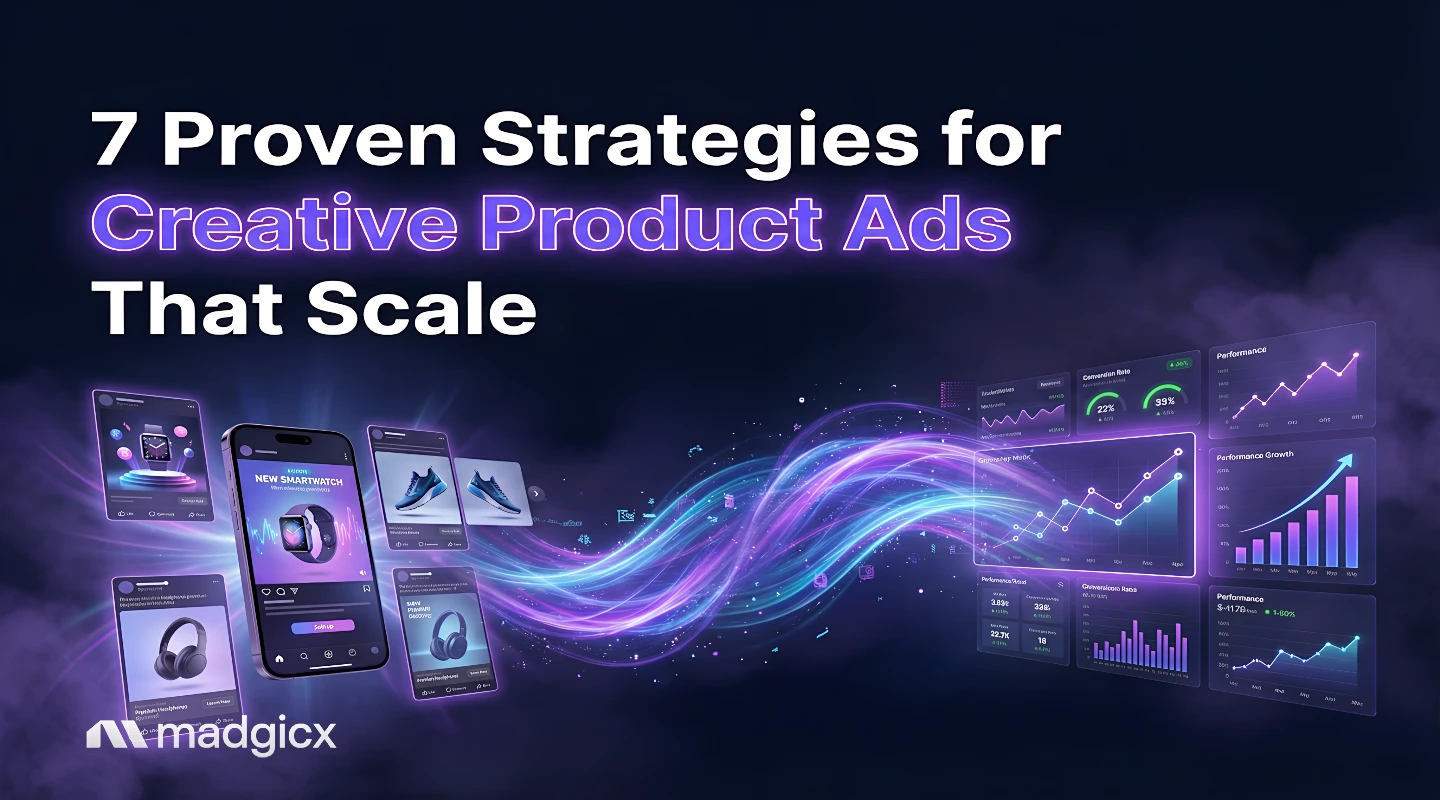
Struggling to scale? Discover 7 proven strategies for creative product ads that drive results. Learn to build a system that beats algorithmic fatigue.
You check a client’s account and see it: a 12x ROAS. The ad is a certified banger. The client is ecstatic. You do the only logical thing—you crank up the budget, ready to ride this rocket ship to the moon.
And then… 48 hours later, it’s all gone. The ROAS has plummeted to 1.5x, the CPCs have tripled, and the client is sending you panicked emails with lots of question marks.
Sound familiar? This isn’t just bad luck; it’s a systemic failure in how most agencies approach creative product ads. In an era where creative quality drives a staggering 56% of a campaign’s sales ROI, the old model of "find one winner and scale it to the heavens" is fundamentally broken. The secret isn't finding one good ad; it's building an entire creative system that helps feed the algorithm what it needs to maintain strong performance, even at scale.
This guide is your blueprint. We’re moving beyond fluffy, inspirational posts to give you a technical, repeatable framework for developing, testing, and scaling ad creative. You'll learn how to diagnose creative fatigue, build scalable testing frameworks, and report performance in a way that makes clients love you.
Let’s get to work.
With Madgicx’s AI Ad Generator, you can instantly produce batches of diverse product ad variations designed to convert. Upload a product image or repurpose an existing winning ad, and the AI generates multiple scroll-stopping creatives built around different buying triggers.
7 Strategies for Creative Product Ads That Thrive
1. The Algorithmic-First Creative Brief
Let's be honest, the traditional creative brief is a relic. It’s built around finding one "big idea," one perfect headline, one hero image. That’s like sending a single soldier to fight a war.
Modern AI-driven platforms like Meta and Google don't want one soldier; they want an entire army of variations to test and deploy. The problem? That old model leaves you totally stranded. You end up with a single ad that either works or it doesn't, with zero room to learn or pivot when things go south.
The Solution: The Algorithm-First Brief
Instead of chasing a single concept, redesign your brief to be "algorithm-first." This means you break down an ad into its core components before you even think about the final product.
Your new brief should ask for:
- 3-5 Hooks: The first 3 seconds of a video or the headline of an image ad. What are the different ways we can grab attention? (e.g., Problem-focused, solution-focused, shocking statistic, question-based).
- 2-3 Angles: The core value proposition or story. How can we frame the product's benefit? (e.g., Angle 1: Saves you time. Angle 2: The luxury you deserve).
- 2-3 CTAs: The final ask. What specific action do we want them to take? (e.g., "Shop Now," "Learn More," "Take the Quiz").
This approach prepares you for variation testing from the very beginning. You're not just creating one ad; you're creating a matrix of interchangeable parts that can be combined into dozens of potential ads.
Pro Tip: This might sound like more work, but it’s actually faster when you lean into the right tools. Use AI tools to brainstorm initial hooks and angles to get the ball rolling. You can even use a tool like Madgicx's AI Ad Generator to quickly produce image variations based on these components, letting your team focus on refining the best ideas instead of starting from a blank page.
2. The UGC-Mirror Method for Enhanced Authenticity
Your client sends you a folder of assets. It’s full of glossy, perfect, high-production-value photoshoots. You know, the kind of ad that screams, "I am an ad, please scroll past me."
This is "banner blindness," and it’s a client budget killer. Consumers are incredibly savvy and have developed a sixth sense for inauthentic marketing.
The Solution: The UGC-Mirror Method
The most powerful creative often doesn't come from a professional studio. It comes from real customers. The "UGC-Mirror" method is a simple but brutally effective way to tap into this power.
Here’s how it works:
- Analyze: Spend an hour scrolling through your client's tagged photos, TikToks in their niche, and competitor comments. Find the top-performing organic User-Generated Content (UGC). What’s the lighting like? What angles are people using? How are they talking about the product?
- Mirror: Create your own low-fidelity, authentic-looking ads that mirror that style. Use a phone camera. Use simple editing apps like CapCut or a dedicated ads design tool. Don't overthink it. The goal is to create an ad that looks like it belongs in a user's feed, not in a magazine.
This isn't about stealing content; it's about adopting the visual language of the platform. The data backs this up. One industry report found that UGC can deliver a 4.5x increase in conversion rates compared to polished, traditional ads.
Why? Because it feels real. It builds trust. And in a world where 80% of consumers are more likely to purchase from brands delivering personalized content, nothing feels more personal than an ad that speaks their language.
3. Diagnose Creative Fatigue vs. Algorithmic Fatigue
So, your star campaign is dying. The big question is: why?
Is it because the audience is sick of seeing the ad, or is it because the algorithm "lost the pocket" of converting users? Guessing wrong means you’ll apply the wrong fix—like swapping creative when you should be tweaking the audience—and waste a ton of client money.
Let's clear this up:
- Creative Fatigue: This is audience-driven. Your target audience has seen the ad too many times. They’re bored. They ignore it. This leads to a slow, gradual decline in Click-Through Rate (CTR) and a steady increase in costs.
- Algorithmic Fatigue: This is platform-driven. The AI is struggling to find new pockets of converting users at your current settings. This often happens after a significant change, like a big budget increase, and usually manifests as a sudden, sharp drop in performance—like falling off a cliff.
The Solution: A Simple Diagnostic Checklist
Before you panic-pause anything, run through this quick checklist:
- Check Frequency: In Ads Manager, look at the "Frequency" metric for the last 7 days. If it's creeping above 3-5, you can start to suspect Creative Fatigue.
- Check the CTR Trend: Look at the CTR graph over the last 14 days. Is it a slow, gentle slope downwards? That points to Creative Fatigue. Is it a sudden, dramatic drop? That screams Algorithmic Fatigue.
- Check Audience Saturation: Is your potential reach nearly maxed out? If you've shown your ad to 80% of your available audience, you're likely dealing with Creative Fatigue.
Pro Tip: Don't want to play detective? Instead of digging through columns in Ads Manager, use a tool like Madgicx's AI Chat and just ask: "Why did performance drop for this campaign yesterday?" It will analyze the data for you and provide a data-backed diagnosis, suggesting if the issue is likely creative, audience, or something else entirely.
4. The 3x2x1 Scalability Testing Framework
Here it is. The "scalability trap." You find an ad that works. You pour money into it. It breaks.
Why? Because that ad wasn't a universal "winner." It was a winner for a very small, specific pocket of users the algorithm found. When you increased the budget, you forced the algorithm to show that specific ad to a much broader audience who just didn't vibe with it.
The Solution: The 3x2x1 Testing Framework
To scale safely, you need to validate the concept, not just a single ad. The 3x2x1 framework is a structured A/B/n test designed to do just that before you risk a big budget.
Here’s the setup:
- 3 Hooks: Three different headlines or video intros.
- 2 Angles/Bodies: Two different descriptions of the value proposition.
- 1 CTA: One consistent call to action.
You combine these elements to create 6 distinct ad variations (3 x 2 x 1 = 6). Launch them all together in a single CBO (Campaign Budget Optimization) or Advantage+ campaign with a small, controlled budget.
This does two crucial things:
- It forces the algorithm to test multiple combinations and find the winning recipe of components, not just a single lucky ad.
- It proves that the core message is robust and resonates with different types of people, giving you a green light to scale the budget more confidently.
5. Cross-Platform Adaptation: Concept, Not Copy-Paste
We see this all the time. An agency gets a great video from a client and runs the exact same 16:9 landscape video on Facebook, Instagram Reels, TikTok, and YouTube.
The result? It underperforms everywhere. Every platform has its own language, culture, and user expectations. A copy-paste strategy is a recipe for wasted ad spend.
The Solution: Adapt the Concept, Not the Asset
The core message can absolutely work across platforms, but it needs to be translated into the native language of each one. Don't just copy-paste; adapt.
Let's take a durable coffee mug with the winning concept: "The last mug you'll ever need." Here’s how you’d adapt it:
- Meta (Facebook/Instagram Feed): A high-quality carousel ad. Card 1: Lifestyle shot. Card 2: Graphic highlighting its "unbreakable" feature. Card 3: A 5-star review. The copy can be a bit longer and more descriptive.
- TikTok: A re-shot vertical video. Start with a fast hook of someone dropping the mug and it not breaking. Use a trending sound. Keep text minimal and punchy. The vibe is chaotic, authentic, and entertaining.
- Google (Demand Gen/PMax): Upload clean product shots, lifestyle images, short text headlines ("Indestructible Coffee Mug"), and longer descriptions into an asset group. The AI will then mix and match to find the best combination.
6. The Creative Analytics Loop for Continuous Improvement
One of the biggest inefficiencies in agencies is the silo between the creative team and the media buyers. The designers make the ads, the media buyers run them, and the performance insights rarely make it back to the creative team.
This means the designers are flying blind, unable to learn from what’s actually working.
The Solution: The Creative Analytics Loop
Break down the silos with a simple, recurring weekly meeting: the "Creative Analytics Loop." Get your creative team and your media buyers in the same room (or Zoom call) for 30 minutes.
The agenda is simple:
- Pull up a dashboard showing creative performance from the last 7 days.
- Review the Top 3 and Bottom 3 performing creatives across key client accounts.
- Analyze why they performed that way. Dig deeper than just ROAS:
- High CTR? The hook is working. Let's make more hooks like that.
- High Video Hold Rate? The story is compelling. What can we learn from it?
- Low CPC but low conversions? We're getting their attention but failing to close.
Pro Tip: Juggling dashboards for Meta, Google, and TikTok is a challenge. Using the best software for marketing analytics, like a unified platform like Madgicx's Business Dashboard, can pull all your creative performance data into one view. This makes these review sessions incredibly fast and efficient.
7. Build a White-Label Creative Performance Report
Here's a tough truth: clients don't always understand creative testing. They log into Ads Manager, see a bunch of ads with low spend and zero purchases, and think you're wasting their money.
The Solution: A "Wins & Learnings" Report
You have to control the narrative. Proactively educate your clients on the value of testing with a simple, white-labeled creative performance report. This isn't just another data dump; it's a strategic document that showcases your value, setting you apart as a top advert company.
Stop just showing them ROAS and spend. Add a section called "Creative Wins & Learnings." Here’s a simple format:
This Week's Creative Update:
- Winning Hook: We tested three new headlines, and the hook "Tired of X?" improved our Click-Through Rate by 20% compared to the control.
- Key Learning: We learned that audiences are not responding to lifestyle images featuring models. The ads with user-generated photos are performing 3x better.
- Strategic Action: Based on this data, we are pausing the professional photoshoot ads and reallocating that budget toward the UGC-style creative.
Pro Tip: You don't have to build this from scratch every week. Use Madgicx's One-Click Report to instantly generate a beautiful, white-labeled report with all the core performance data. It turns a 2-hour reporting task into a 10-minute value-add.
Start your free 7-day trial of Madgicx’s full advertising suite and experience how AI-powered creative and analytics can transform your ad performance.
Frequently Asked Questions (FAQ)
What's the difference between creative fatigue and algorithmic fatigue?
Creative fatigue is audience-driven; they're simply tired of seeing your ad. You'll notice a slow decline in CTR and a rising frequency. Algorithmic fatigue is platform-driven; the AI is struggling to find new converters, often after a budget change, causing a sudden, sharp drop in performance.
How many ad creatives do I need per campaign?
It’s less about a magic number and more about having sufficient variation. For a testing phase, aim for at least 5-7 variations. Using a framework like the 3x2x1 model gets you 6 variations right away, which is a great starting point.
How do I scale a campaign budget without performance dropping?
The key is to not scale a single "winning" ad. First, you must prove the creative concept is robust using a structured test like the 3x2x1 framework. Once you've identified a winning combination of components, scaling that proven combination is far more reliable.
Conclusion
Creative product ads don’t scale because you found one unicorn — they scale because you built a system that consistently produces, tests, and refines new variations. When you shift from “launch and hope” to structured experimentation, creative stops being a gamble and becomes a controllable growth lever. Diagnose fatigue correctly, validate concepts before scaling, adapt assets to each platform’s native language, and close the loop between data and design. That’s how you beat algorithmic fatigue instead of reacting to it.
The agencies that win aren’t the ones with the prettiest ads — they’re the ones with the most disciplined creative engine. Build variation into your briefs, systemize testing with frameworks like 3x2x1, and treat every campaign as a feedback loop. Do that consistently, and scaling stops feeling like luck — it becomes predictable.