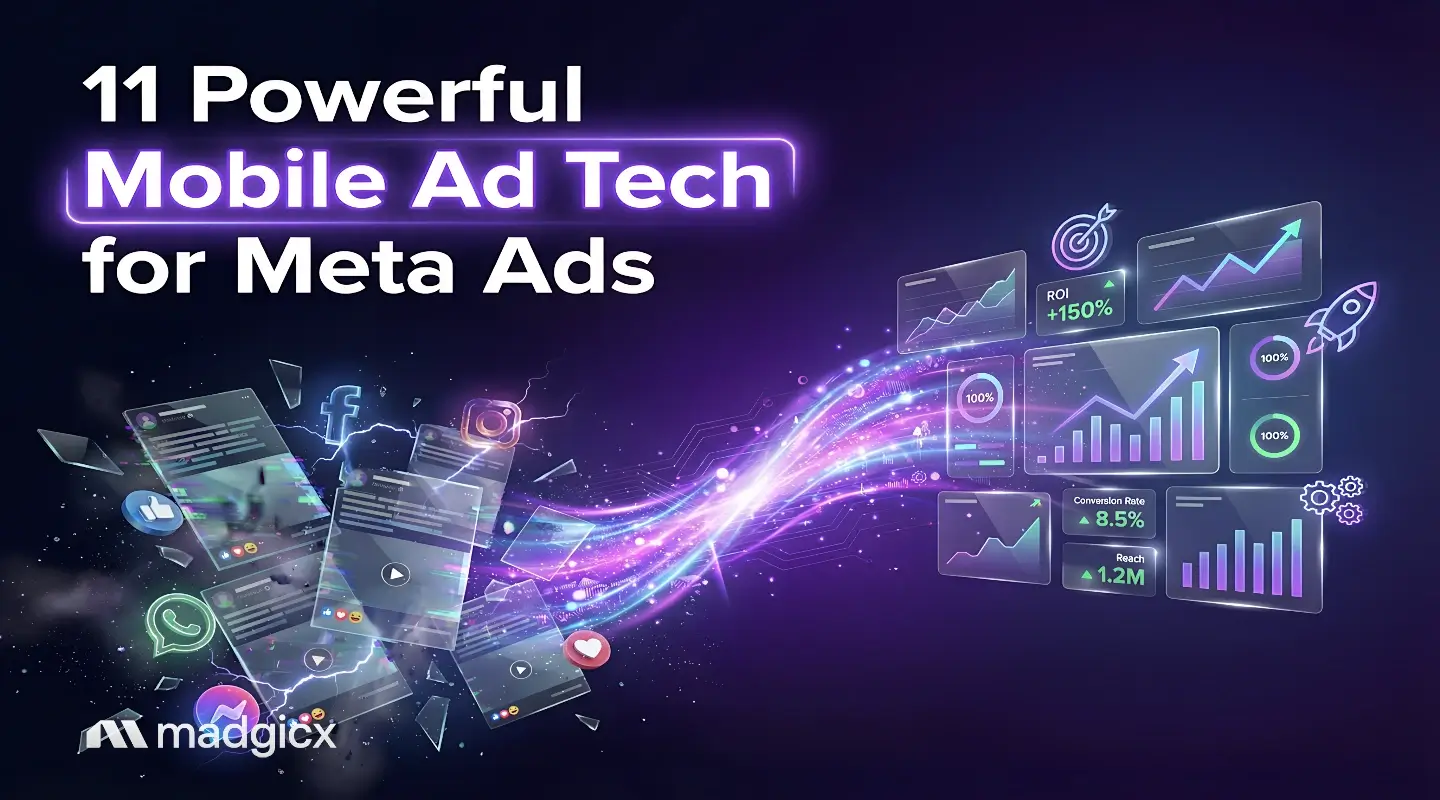
Compare 11 leading mobile-first ad tech tools for Meta ads. Find top platforms for AI optimization, attribution, and creative to enhance mobile advertising.
Let's be real for a second. If you're still thinking about Facebook ads in terms of clunky desktop placements, you're leaving a mountain of money on the table.
According to industry analysis, a staggering 94% of Meta's ad revenue comes from mobile devices. Your customers are scrolling on their phones, not sitting at a desk waiting for your ad to appear. This means the old playbook is officially obsolete.
The good news? AI-driven tools designed for this mobile world deliver a documented 20-30% higher ROI. This guide is your map to finding the right one for your business. We'll give you a clear framework for picking the right ad tech based on your ad spend, team size, and biggest performance headaches.
Let Madgicx’s AI Chat diagnose your Meta ad account in seconds and deliver instant, data-backed recommendations to fix performance issues. Then streamline your optimizations 24/7 with AI Marketer — automatically monitoring campaigns, protecting spend, and uncovering scaling opportunities to grow your mobile ROAS.
What is Mobile-First Ad Tech?
Mobile-First Ad Tech is a category of software designed specifically to optimize advertising campaigns for mobile environments, where user attention is limited and formats like Reels and Stories dominate. Think of it as your specialized toolkit for winning on the small screen. A comprehensive ad tech platform can integrate all the functions you need.
Its entire purpose is to solve the unique challenges that come with mobile advertising. You're not just fighting for clicks; you're fighting for a split-second of attention in an endless sea of content.
Research shows that on mobile, advertisers have about 0.5 seconds to capture interest before a user scrolls past. These tools are built to make that half-second count, helping you navigate vertical video formats, solve privacy-related data gaps, and keep your campaigns performing at their peak.
How We Ranked the Top Mobile Ad Tech Platforms
We didn't just throw a bunch of logos on a page. Our ranking is based on a strict methodology designed to identify the platforms that actually move the needle for e-commerce brands on Meta. Here’s what we looked for:
- AI-Driven Optimization: We focused on tools with sophisticated AI and automation capabilities, not just simple "if-this-then-that" rule builders. We wanted platforms that learn and adapt.
- Mobile-First Features: We prioritized tools built from the ground up for vertical video, rapid creative scaling, and mobile attribution. If it felt like a desktop tool with a mobile feature tacked on, it didn't make the cut.
- E-commerce Suitability: We evaluated each platform based on its ability to help drive Return on Ad Spend (ROAS) for e-commerce brands, from startups to enterprise-level stores.
- Verified User Reviews & Market Presence: We didn't just take their marketing pages at face value. We cross-referenced platform claims with industry reputation and real-world user feedback to ensure they are trusted solutions.
The 11 Top Mobile-First Ad Tech Tools for Meta Ads
Alright, let's get to the good stuff. Here are the top platforms that will help you conquer the mobile advertising landscape.
1. Madgicx
- Best for: E-commerce brands scaling with AI-driven optimization and creative intelligence.
Madgicx is a comprehensive advertising platform for serious e-commerce advertisers. It’s not just one tool; it’s an entire suite built to work together. You get AI Chat, a 24/7 analyst that helps you diagnose what’s wrong with your campaigns and how to fix it. You get a powerful AI Ad Generator to generate fresh, high-quality creatives in seconds. And you get AI Marketer, which works around the clock to provide optimization recommendations based on real-time data.
The real magic is how it connects the dots. You can figure out what's broken with AI Chat, create fresh ads to fix it with the AI Ad Generator, and then let AI Marketer manage the scaling.
It’s like having an analyst, a designer, and an optimization expert all working together, which is why it’s such a game-changer for brands in that $10k-$50k/mo range who want to grow without bloating their payroll.
Try all our AI tools for free.
2. AdStellar AI
- Best for: Rapid campaign creation with agentic AI.
AdStellar AI is a newer player that’s making waves with its "agentic AI" approach. Instead of just giving you recommendations, you give it a goal (e.g., "launch a campaign for our new product"), and its AI agents will build out the entire campaign structure, including targeting and ad copy. It’s incredibly fast for getting new campaigns off the ground, making it a great tool for agencies or brands that need to launch multiple campaigns quickly.
3. Triple Whale
- Best for: Centralized data truth and advanced e-commerce attribution.
Ever stared at your Shopify dashboard and your Ads Manager report and wondered why the numbers don't match? If so, Triple Whale is for you. It has become a leading choice for e-commerce attribution, using its own pixel to create a single source of truth for your data. This gives you a much clearer picture of your blended ROAS, customer lifetime value, and overall marketing profitability. It’s not an ad optimization tool, but it provides the clearer data that all other optimization efforts depend on.
4. Pencil
- Best for: Generating high volumes of ad creative variations with AI.
Pencil is a creative AI platform that’s all about speed and volume. You can upload your brand assets, connect your ad account, and Pencil’s AI will generate dozens of ad creative variations for you to test. It’s a fantastic solution for combating creative fatigue, which is a major killer of mobile campaigns. If your primary bottleneck is simply not having enough new ads to test, Pencil can solve that problem almost overnight.
5. Motion
- Best for: In-depth creative analytics to understand why ads perform.
While Pencil helps you generate ads, Motion helps you understand them. It’s a creative analytics platform that goes beyond simple CTR and CPA to tell you which hooks, visuals, and calls-to-action are actually driving performance. It helps you answer the question, "Why did this ad work?" so you can build a creative strategy based on data, not guesswork.
6. Smartly.io
- Best for: Enterprise brands needing creative automation at a massive scale.
Smartly.io is a leading platform for enterprise-level advertisers. If you're a global brand spending millions a month and need to manage thousands of ad variations across different regions, Smartly is built for you. It offers powerful creative automation, dynamic ad templates, and predictive budget allocation. For smaller brands, it’s overkill, but for the Fortune 500s of the world, it’s a key tool.
7. AdEspresso
- Best for: Beginners and small businesses needing a simplified ad creation workflow.
AdEspresso (now part of Hootsuite) is a solid choice for those just starting out. Its main strength is simplifying the campaign creation and split-testing process. You can easily test hundreds of variations of an ad without getting lost in the complexity of Ads Manager. While it lacks advanced AI features, it provides a friendly on-ramp for small businesses.
8. Socioh
- Best for: Automating dynamic product ads for large catalogs.
If you run an e-commerce store with thousands of SKUs, managing your dynamic product ads (DPAs) can be a nightmare. We get it. Socioh is designed to solve that specific problem. It uses AI to create thousands of on-brand dynamic ads from your product catalog, going far beyond the basic templates Meta offers to make your catalog ads look like custom-made creative.
9. Cometly
- Best for: Tracking and attribution for info-product and lead-gen advertisers.
While Triple Whale is a popular choice for e-commerce, Cometly has carved out a niche serving the info-product, coaching, and lead generation space. It helps you connect your ad spend directly to booked calls and final sales, which is often a major tracking challenge in these business models.
10. Adzooma
- Best for: Small teams looking for simple, one-click optimization opportunities.
Adzooma is a multi-platform tool that scans your ad accounts and generates a list of simple, one-click optimization opportunities. It’s not a deep strategic tool, but it’s great for busy small business owners who want a safety net to catch obvious mistakes and find quick wins.
11. The Trade Desk
- Best for: Large enterprises executing major programmatic buys beyond Meta.
The Trade Desk isn't a Meta-only tool; it's a massive demand-side platform (DSP) for programmatic advertising across the entire open internet. It allows the biggest brands with the biggest budgets to execute huge, data-driven campaigns at a scale that dwarfs what's possible within a single platform like Meta.
Mobile Ad Tech Comparison Table
Okay, that was a lot of info. To help you see how they stack up at a glance, we put together this quick comparison chart.
Key Features to Look For in Mobile Ad Tech
When you're evaluating these tools, don't get distracted by shiny objects. Focus on the core features that actually solve mobile-specific problems.
Real-Time Optimization (RTO)
Ever wonder what happens in the split-second between a user clicking a link and your ad appearing? That's where Real-Time Optimization (RTO) comes in. It's AI that works at lightning speed, analyzing data and adjusting your bids and budgets in the milliseconds it takes for a page to load. In the hyper-competitive world of mobile ad auctions, decisions made in seconds are too slow. RTO, a key feature of any modern ad tech platform for real-time optimization, allows your campaigns to adapt instantly, ensuring your budget is always spent in the most efficient way possible.
Learning Phase Management
The Meta Learning Phase is the initial period where Meta's algorithm gathers performance data to find the most efficient way to deliver an ad set. To exit this phase, an ad set typically needs to achieve at least 50 conversions per week. If it doesn't, it remains "stuck" in learning, leading to unstable performance and wasted spend. We've all been there, and it's frustrating.
Ad tech platforms like Madgicx help you exit the learning phase faster by using AI to consolidate ad sets and intelligently allocate budget, ensuring each one has the best possible chance of hitting that 50-conversion threshold.
Pro Tip: Don't spread your budget too thin across dozens of ad sets. It's better to have 3-4 well-funded ad sets that can quickly exit the learning phase than 15 underfunded ones that are all stuck in "Learning Limited." Trust us on this one.
Server-Side Attribution (CAPI)
The Conversions API (CAPI) is a Meta tool that creates a direct, server-to-server connection between a business's marketing data and Meta's systems. This improves tracking accuracy by bypassing browser-side limitations like cookie blockers and the data loss caused by iOS updates.
Let's be blunt: in today's privacy-first world, if you're not using CAPI, you're flying blind. It's no longer optional—it's the only way to get a reasonably accurate picture of what's actually working on mobile.
Creative Intelligence & Generation
On mobile, creative is the new targeting. With limited data for audience building, the ad itself does most of the heavy lifting. According to a report by LeadsBridge, 76% of customers are more likely to consider a brand with personalized messaging. This means you need a constant stream of fresh, relevant creative to prevent ad fatigue.
Tools that offer AI-powered creative optimization and generation are no longer a "nice-to-have"; they are a core part of a modern mobile advertising stack. ✨
Pro Tip: When testing new creatives, focus on the first 3 seconds. Test 3 different hooks (visuals or text overlays) against your best-performing ad body. This is the fastest way to find new winning combinations for mobile.
Frequently Asked Questions (FAQ)
How do I optimize Meta ads for mobile?
Optimizing Meta ads for mobile involves a few key steps:
- Use 9:16 Vertical Creative: Design your ads specifically for full-screen mobile experiences like Stories and Reels.
- Implement CAPI: Set up the Meta Conversions API for more accurate tracking in a post-iOS14 world.
- Use AI Tools: Leverage an ad tech platform for campaign optimization to help manage the learning phase and automate budget adjustments.
- Refresh Creative Frequently: Constantly test new images, videos, and copy to avoid ad fatigue and keep performance high.
What is the Meta Learning Phase and how do I exit it faster?
The Meta Learning Phase is the initial period where an ad set needs to get about 50 conversions per week for Meta's algorithm to stabilize. To exit faster, you need to ensure your ad sets have enough budget and a broad enough audience to hit this threshold. Ad tech platforms help by automatically consolidating ad sets and allocating budget to the most promising ones, giving them the fuel they need to exit learning quickly.
Do I still need the Meta Pixel if I use CAPI?
Yes, you absolutely do. The best practice is to use both together. The Meta Pixel captures browser-side events, while CAPI captures server-side events. Using both creates what Meta calls "Redundancy," which helps fill in data gaps and provides a more complete and accurate picture of your campaign performance.
How much ad spend do I need for an ad tech platform?
It depends on the platform, but we can break it down pretty easily:
- Under $5k/month: Beginner-friendly tools like Madgicx and AdEspresso are a good starting point.
- $10k - $50k+/month: This is the sweet spot for powerful scaling platforms like Socioh, which provide advanced AI and automation to help maximize your ROAS.
- $500k+/month: At this level, you'd be looking at enterprise systems like Smartly.io to manage campaigns at a global scale.
Your Next Move in Mobile Advertising
So, there you have it. The world of mobile advertising is fast, complex, and unforgiving. But it's also where your customers are.
Winning on mobile is no longer about having the best targeting; it's about having the best tech stack. Success requires a combination of tools for optimization (like Madgicx), attribution (like Triple Whale), and creative (like Pencil).
The first step isn't to buy a new tool—it's to diagnose your current setup. You need a clear, data-backed understanding of what's working, what's broken, and where your biggest opportunities are.
See how Madgicx works for your business. Get an instant, free AI audit of your Meta ad account and receive a concrete action plan to start scaling your ROAS today.