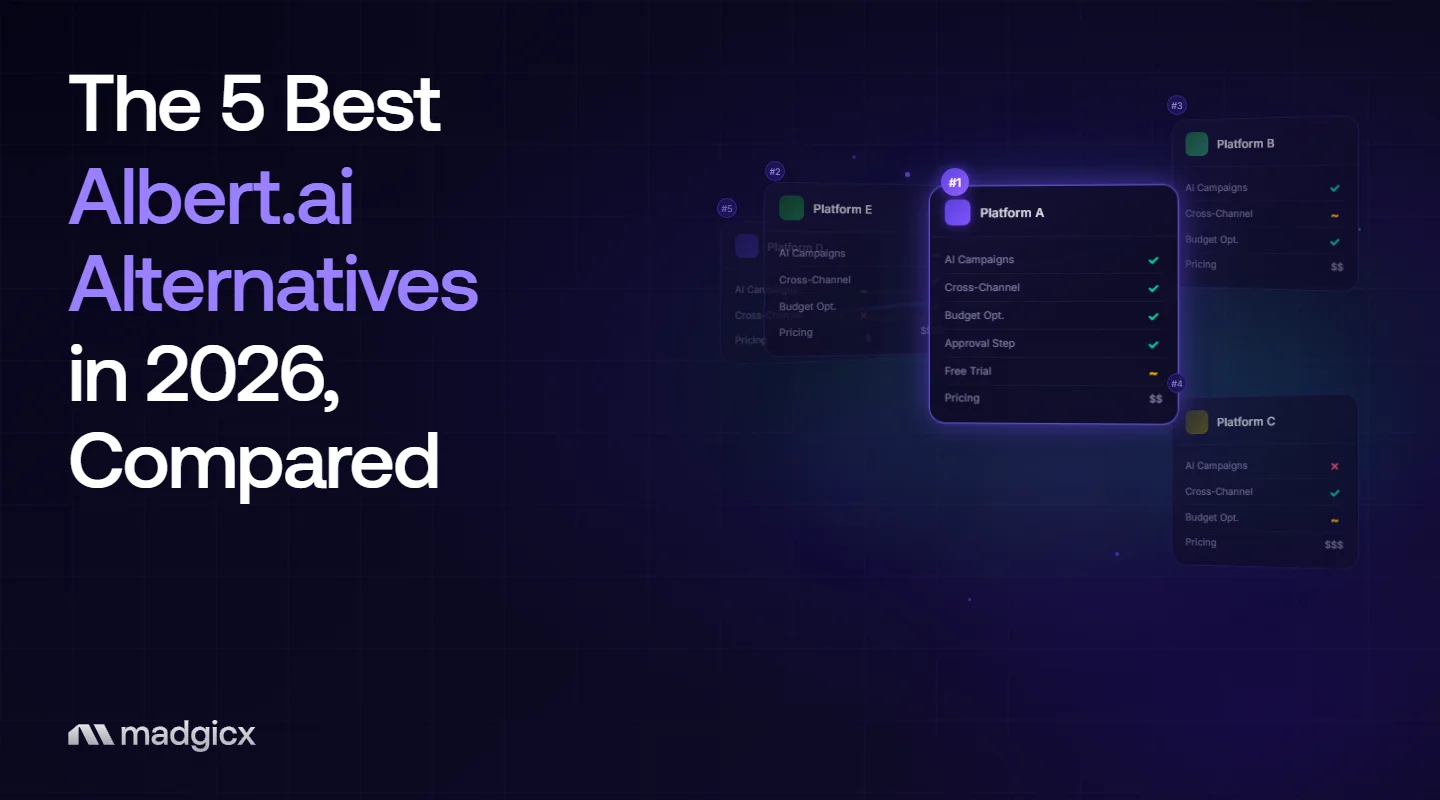
Why teams look beyond Albert.ai, and how five alternatives compare on features, pricing, pros and cons.
Albert.ai is an autonomous AI platform for paid media. It's sold by quote with no published price, it doesn't make creative or ad copy, its website doesn't say whether you can approve changes before they go live, and we found no product updates in the last 12 months. This guide compares five alternatives on what they do, how they differ from Albert.ai and what they cost.
What is Albert.ai, and why do teams look beyond it?
Albert.ai (albert.ai) is a cross-channel autonomous AI platform for paid media, owned by Zoomd. It plugs into your existing ad accounts and, according to its FAQ, adjusts budgets, bids, audiences and creative rotation toward the goals and limits you set, across channels such as Google search, Facebook, Instagram, YouTube and Bing. The FAQ gives its bid detail for search. A dedicated customer success team handles setup and support, included in the price.
Its estimate form points to larger advertisers: it asks whether you're an advertiser, agency or consultancy, and for a yearly ad budget, with bands from $100k to $500k up to over $10M. We found no recent public reviews of Albert.ai: Capterra lists one, from 2022. We also found no switching stories from former customers, so these are the limits we found rather than reasons customers gave:
- A quote instead of a price. The pricing page tells you to contact the company for a custom plan and lists no plans or prices. The FAQ describes a typical start as a three-month proof of concept.
- No creative or ad copy. The FAQ says Albert.ai doesn't develop creative or write copy. Your team supplies the ads, and it rotates them and shifts budget to the best performers.
- No stated approval step. The FAQ says changes are made within guardrails you specify. We found nothing on its website saying whether you can approve changes before they go live.
- No product updates that we found. We found no product updates in the last 12 months, and the three posts on its blog index are from 2025 or earlier.
Albert.ai alternatives at a glance
| Tool | Compared with Albert.ai | Pricing model | Starting price | Trial |
|---|---|---|---|---|
| Madgicx | AI that recommends and builds, with image ads and audiences, and changes only on your approval | By Meta spend | $45/mo | 7 days |
| Smartly.io | Image and video tools, feeds and triggers your team sets up, also sold by quote | By quote | Not published | None listed |
| Skai | Enterprise platform with an AI agent you can ask questions, and published yearly prices | By yearly ad spend | $114,000/yr | None listed |
| Pixis | A chat, agents and creative generation, with a demo request instead of a price | Not stated | Not published | None listed |
| Ryze AI | Approval cards, managed campaigns and creative generation on flat monthly plans | Flat monthly plans | $89/mo | 7 days |
What to look for in an Albert.ai alternative
- Whether you approve changes before they go live.
- Whether it makes creative, or you supply every ad.
- Whether the price is published, and what it grows with.
- Whether you can try it and see recent product updates before you commit.
The 5 best Albert.ai alternatives
1. Madgicx Best overall
Madgicx is an AI platform for Meta ads. It reviews your ad account, tells you what to do next and does much of the work once you approve it.
What it does: A list of next steps for your account, such as pausing ads that lose money or answering ad comments, which you approve or dismiss. A chat that answers questions on your account data and creates campaigns, ad sets and ads, paused until you approve. Ready-made and custom automation rules. Image ads generated from a prompt, from your own best ads or from real ads in a built-in library. Analysis of which creatives and lines of copy bring results. Ready-made and AI audiences. An account audit covering targeting, demographics, geography and auctions. Reports that combine Meta, Google Ads, TikTok, Klaviyo and GA4, shared by link or PDF.
Compared with Albert.ai: Albert.ai adjusts budgets, bids, audiences and creative rotation toward goals and limits you set, and its website doesn't say whether you can approve changes first. Madgicx recommends the next step, builds campaigns from a chat and makes image ads, and nothing it proposes changes your ads until you approve it. We found no rules builder, account audit or help with ad comments described for Albert.ai.
Pricing: One plan priced by monthly Meta spend: $45 a month up to $1,000 of spend, $129 up to $10,000 and $329 up to $30,000. Prices for higher spend levels are on our pricing page. Unlimited seats and ad generations, 15% off quarterly and 30% off annually, and a 7-day free trial.
Pros:
- AI recommends and builds, and nothing it proposes changes your ads until you approve it.
- A published price and a 7-day free trial.
- Image ads, audiences, automation rules and reports come with every plan.
- 4.6 on G2 from 220+ reviews.
Cons:
- Campaign management is built for Meta, while Google Ads and TikTok data appear in reports.
- Generates image ads, not video.
2. Smartly.io
Smartly.io is an advertising platform for large brands and agencies, with creative and media tools across many channels.
What it does: An AI studio that generates and enhances images and video and assembles video ads. Templates and a feed or spreadsheet that create, archive and update ads at scale. Triggers that switch ads on or off on performance, weather, time of day or traffic speed. Budget allocation that moves spend between selected campaigns based on performance. Insights on what works across channels, and a forecast of how effective a creative will be before launch. A set of AI agents called Synapse was announced in June 2026, with availability not stated.
Compared with Albert.ai: Smartly.io makes creative, where Albert.ai's FAQ says it doesn't, and your team sets up its templates, feeds and triggers. Like Albert.ai, it's sold by quote.
Pricing: Sold by quote, with no price published. Its site asks you to book a demo, and lists no free plan, trial or minimum spend.
Pros:
- Image and video creative tools, with templates that scale ads across formats and channels.
- Bulk ad creation and triggers that change ads on set conditions.
- 4.4 on G2 from 475 reviews.
Cons:
- No published price or trial, and G2 lists an average implementation time of 2 months.
- 5 of its 20 most recent G2 reviews mention a steep learning curve, and 4 mention bugs or publishing problems.
3. Skai
Skai is an enterprise platform for paid search, paid social and retail media.
What it does: Plans, runs and optimises media across paid search, paid social and retail media on one platform, with a press release naming Google, Microsoft, Meta, TikTok, Amazon Ads, Walmart Connect and Criteo among 300+ publishers and retail media networks. An AI agent called Celeste AI pulls together your data, publisher insights, competitive intelligence and digital shelf data, and answers strategy questions such as where to move budget. It also offers a place to design and run your own agents and workflows, and a connection for your own AI agents that's sold separately.
Compared with Albert.ai: Skai also targets large budgets, but it publishes its prices and includes an AI agent you can ask questions. We found no chat or agents described for Albert.ai.
Pricing: Priced by yearly ad spend on an annual commitment you can review after the first three months. Standard is $114,000 a year for up to $4M of yearly ad spend, Enterprise Premier is $756,000 a year for up to $35M, and Enterprise Premier+ is quoted above that. No free plan or trial is listed.
Pros:
- Published yearly prices.
- The AI agent is included in every pricing tier.
Cons:
- A $114,000 starting price and no trial.
- We found no rules, budget or bid automation or approval steps described on its pages, only a general claim of automation and optimisation.
4. Pixis
Pixis is an AI advertising platform built around Prism, a conversational AI interface for performance marketing.
What it does: Prism connects Meta Ads, Google Ads and TikTok, answers plain-English questions such as where budget is being wasted, and suggests changes to bids, budgets or creative. Its documentation lists specialised agents, and scheduled workflows that run analysis at set intervals. A creative tool called Adroom generates creative assets, and the pages we saw don't say whether it makes images, video or both.
Compared with Albert.ai: Unlike Albert.ai, where we found no chat or agents described, Pixis has a chat, agents and creative generation. Like Albert.ai, its Prism page claims continuous budget and bid adjustment, but its help wiki says you decide which suggestions to implement, and we couldn't confirm which applies.
Pricing: No price is published. The site shows a request-a-demo button instead, and we found no free plan or trial.
Pros:
- A chat over your ad data across several platforms.
- Agents and scheduled workflows, plus creative generation.
Cons:
- No published price or trial.
- Its pages don't say which changes can be pushed to an ad account, or whether any apply without your approval.
5. Ryze AI
Ryze AI is an AI agent for paid ads on Google, Meta, TikTok, LinkedIn and more, which also does SEO and website work.
What it does: An agent that reads your connected ad accounts, answers questions in a chat and can create campaigns, adjust budgets, and pause or resume, with the approvals you choose. Proposed fixes arrive in an inbox as approval cards with before-and-after numbers, and the agent applies a change only after you approve it. Managed campaigns take a budget and goal, generate creatives, build the campaigns and launch them, and a manager agent reviews them daily. Scheduled tasks send recaps by email or Slack. Ad creatives are generated from a short brief, and its pages don't say whether they are images, video or both.
Compared with Albert.ai: Ryze AI publishes flat monthly prices and offers a 7-day free trial, where Albert.ai is sold by quote. It shows approval cards for changes, where we found no approval step described for Albert.ai, and it generates creatives, which Albert.ai's FAQ says it doesn't. Its changelog lists updates through 13 October 2026.
Pricing: Flat monthly plans per workspace, not by ad spend. Paid Ads is $89 a month with unlimited ad accounts and 3 workspaces, and Agency is $279 a month plus 3,000 credits a month. Plans that add SEO and website work run from $129 to $1,499 a month. Optional managed campaigns are billed as a share of managed ad spend, 5% falling to 0.8% as daily budget grows. A 7-day free trial on Paid Ads and Agency, and 30% off annual billing in the first year, with renewals at full price.
Pros:
- Published flat prices from $89 a month, with a 7-day free trial.
- Approval cards show the numbers behind each proposed change.
Cons:
- We found no condition-based rules builder in its help centre or pricing.
- Its managed campaigns documentation says changes inside your limits happen without asking, while its other pages describe approval first, so check which changes need your sign-off.
- Monthly credit caps per workspace, and managed campaigns cost a share of ad spend.
- Only 2 reviews on G2, so there's little public feedback to go on.
Our verdict
Madgicx is the best overall Albert.ai alternative for Meta advertisers who want to approve what the AI does. It recommends the next step, builds campaigns from a chat and makes image ads, all in one plan from $45 a month, with a price you can see before you talk to anyone. Try it free for 7 days alongside your current setup.
How we compared these tools
- What each tool does for a Meta advertiser, from analysis to creative and automation.
- How it compares with Albert.ai on the same jobs.
- Whether it acts on the data, and whether you approve each change.
- Whether the price is published, and what it grows with.
We went through each tool's product pages, help centre and pricing, and Smartly.io's 20 most recent G2 reviews. We found no help centre for Albert.ai, so we used its website, FAQ and pricing page.
Frequently asked questions
What is the best alternative to Albert.ai?
Madgicx is the best overall Albert.ai alternative for Meta advertisers: AI recommendations you approve, campaign building from a chat and image ad generation in one plan from $45 a month.
Why do teams look beyond Albert.ai?
We found no switching stories, so these are limits rather than customer reasons. Albert.ai is sold by quote, its FAQ says it doesn't develop creative or write ad copy, its website doesn't say whether you can approve changes before they go live, and we found no product updates in the last 12 months.
Is there an Albert.ai alternative with a published price?
Yes. Madgicx starts at $45 a month and is priced by Meta spend only, with a 7-day free trial. Ryze AI starts at $89 a month, and Skai publishes yearly prices from $114,000. Albert.ai, Smartly.io and Pixis don't publish prices.
Which Albert.ai alternative can create ads and campaigns?
Madgicx generates image ads from a prompt, from your best ads or from real ads in its library, and builds campaigns, ad sets and ads from a chat, each on your approval.
Can Madgicx report on more than Meta?
Yes. Its reports combine Meta, Google Ads, TikTok, Klaviyo and GA4, shared by link or PDF.