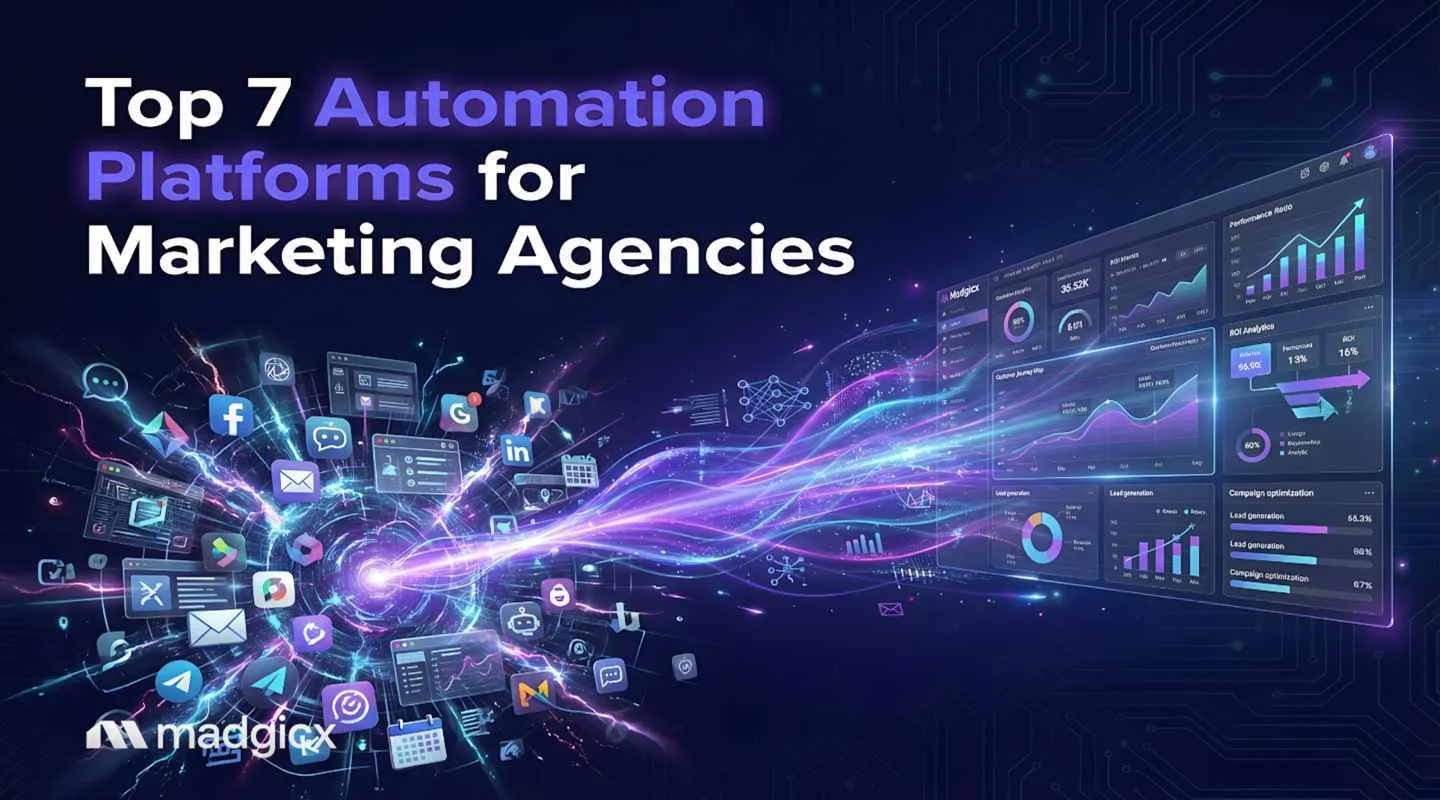
Discover the best automation platforms for marketing agencies. Learn how to choose the right tools, from workflow connectors to performance marketing software.
It's 9 PM on a Tuesday. You've just spent the last four hours wrestling with spreadsheets, pulling data from Facebook Ads Manager, Google Ads, TikTok, and GA4. Your mission? To build five different client reports that were due yesterday.
Your eyes are blurry, your coffee is cold, and you're spending way more time on admin than on the high-level strategy your clients actually pay you for. Sound familiar? Of course it does. We get it. This is the daily chaos for so many marketing agencies, and it's the single biggest barrier to scaling.
But what if you could get those four hours back? Every. Single. Day. That's where automation platforms come in. ✨
Let's get a clear definition on the table: An automation platform is software that connects your apps, data, and processes so you can replace manual, repetitive tasks with automated workflows. Think of it as the digital glue for your agency. Modern platforms use no-code builders and AI to create seamless flows between your CRM, ad platforms, and analytics tools.
The result? You reduce errors, save an incredible amount of time, and can finally scale your operations without having to double your headcount. This guide is your life raft in the sea of automation tools. We're cutting through the noise to show you exactly which platforms solve which agency-specific problems.
Let's get you out of the spreadsheet mines and back to being the strategic genius you are.
Madgicx is a performance marketing automation platform built for agencies. Generate stunning, cross-channel client reports in one click, get instant AI-powered diagnostics for any account, and streamline your optimization workflows to free up your team for strategy and growth.
What You'll Learn in This Guide
- The different types of automation platforms and which ones your agency actually needs.
- How to choose the right platform based on agency-specific criteria like client management and reporting.
- A comparison of the top 7 automation platforms with agency-focused pros and cons.
- Bonus: Proven automation recipes for client onboarding, reporting, and performance optimization.
Why Automation is No Longer Optional for Agencies
Let's be brutally honest for a second. If you're not automating, you're not just working harder—you're actively choosing to be less profitable.
In today's hyper-competitive market, automation isn't a luxury; it's the engine for scalability and the key that unlocks your agency's true potential. It's the difference between an agency that's constantly scrambling and one that's calmly scaling.
For agencies, the benefits are game-changing:
- Slash Reporting Time: Go from spending hours (or even days) manually building client reports to generating comprehensive, cross-channel dashboards in minutes.
- Scale Without Hiring: Imagine handling twice the number of clients with your current team. Automation makes this possible by reducing the repetitive tasks that bog down your account managers, from campaign setup using automated ad launch tools to final reporting.
- Improve Client Retention: When you can deliver faster insights, more transparent results, and spend more time on the strategy they hired you for, clients notice. And happy clients? They stick around.
- Reduce Human Error: Copy-paste errors in reports or budget mistakes in campaign setups can damage client trust. Automation helps ensure data accuracy and consistency.
Pro Tip: Start with Your Biggest Time-Sink
Feeling overwhelmed? Don't try to automate everything at once. Start by identifying your single most time-consuming, non-strategic task. For 9 out of 10 agencies, this is weekly or monthly client reporting. Nail that, and you'll be an automation convert for life.
Market Snapshot: The Automation Gold Rush
Still on the fence? The numbers don't lie. The Workflow Automation Market is projected to hit $77.8 Billion by 2030, growing at a blistering 23.68% CAGR. Meanwhile, the more focused Marketing Automation Market is set to reach $15.58 Billion by 2030. The takeaway is simple: your competitors are investing heavily in these tools. Standing still means falling behind.
The 4 Types of Automation Platforms Agencies Use
"Automation" is a huge buzzword, but not all automation platforms are created equal. Trying to use the wrong tool for the job is like trying to use a hammer to bake a cake—messy and ineffective.
Let's break down the four main categories in your agency's toolkit.
1. Workflow Automation (iPaaS)
These are the connectors, the digital duct tape that holds your entire SaaS stack together. They operate on a simple "if this, then that" logic.
- Examples: Zapier, Make
- Agency Use Case: A new lead fills out a form on your website (Trigger). This automatically creates a new contact in your CRM, sends a notification to the #leads channel in Slack, and adds the lead to a "Welcome" sequence in your email platform (Actions).
2. Marketing & Sales Automation
These platforms are all about managing the customer journey at scale. They focus on nurturing leads and engaging customers through automated sequences.
- Examples: HubSpot, Klaviyo, ActiveCampaign
- Agency Use Case: A user visits a client's pricing page but doesn't purchase (Trigger). This automatically enrolls them in a 3-part email sequence that addresses common objections, highlights benefits, and offers a small discount (Actions). This also extends to social media, where specific Instagram automation tools can handle direct message replies and engagement.
3. Performance Marketing Automation (Specialized)
This is where things get really interesting for us media buyers. These platforms don't just connect apps; they make intelligent recommendations within your advertising platforms to help optimize performance.
They are built to manage ad spend, analyze creative, and automate bidding strategies.
- Example: Madgicx
- Agency Use Case: An AI-powered system monitors your client's Meta ad campaigns 24/7 (Trigger). It detects that an ad set's ROAS has dropped below the target KPI and sends an alert with a one-click recommendation to pause it and reallocate the budget to a top-performing ad set (Actions). This is a core part of building a system for AI-powered advertising optimization.
4. Robotic Process Automation (RPA)
Think of RPA as the last resort for those ancient, clunky systems that refuse to play nice. You know the ones—they don't have a clean API to connect to. So, RPA uses "bots" to mimic exactly what a human would do on a user interface, like clicking, typing, and scraping data right from the screen.
It's so effective that Gartner predicts 90% of large organizations will have adopted RPA in some form.
- Examples: UiPath, Automation Anywhere
- Agency Use Case: You need to pull weekly data from an old, obscure industry website for a client report, but the site has no API (Trigger). An RPA bot can be programmed to log in, navigate to the correct page, copy the data, and paste it into a Google Sheet every Monday morning (Actions).
The Best Automation Platforms for Agencies
Alright, let's get to the main event. We've sifted through dozens of tools, evaluating them based on the features that matter most to agencies: multi-account management, critical integrations, scalability, and pricing that won't punish you for growing.
Here's our definitive list.
1. Madgicx
Overview: Madgicx is a leading performance marketing automation platform built from the ground up for agencies and e-commerce brands running paid media. It's not a generalist tool; it's a specialist suite designed to streamline the most critical parts of Meta advertising. It combines AI-powered optimization, creative intelligence, and robust cross-channel reporting that includes Google and TikTok ads.
Best for: Agencies that need to streamline ad optimization, budget management, and client reporting across dozens of accounts, with a primary focus on Meta advertising.
Key Features:
- One-Click Report: Generate beautiful, comprehensive client reports that blend data from Meta, Google, TikTok, GA4, and Shopify in seconds. Use customizable templates to standardize reporting across accounts and share live report links that update automatically.
- AI Chat: Client asking for clarification on account performance? Our conversational AI gives you instant diagnostics. Just ask, "Why did my client's ROAS drop yesterday?" and get an immediate answer.
- AI Marketer: Your 24/7 account auditor. It monitors all your client accounts, identifies performance issues, and provides one-click solutions.
- AI Ad Generator: A powerful tool for AI-powered creative generation that helps you scale ad production and optimize your entire creative workflow.
Pricing: From $45/mo, and based on your total ad spend, making it predictable and scalable for agencies. Free trial available.
2. Zapier
- Overview: Zapier is the undisputed king of workflow automation. It's the first tool most people think of, connecting over 6,000 apps with its famously simple "if this, then that" builder.
- Best for: Connecting your everyday SaaS tools for simple, linear workflows. It's an essential part of any agency's operational stack for tasks outside of ad optimization.
- Key Features: Massive app library, incredibly user-friendly interface, multi-step "Zaps."
- Pricing: Starts with a free plan. Paid plans are priced per task, which can get expensive at high volumes.
3. Make (formerly Integromat)
- Overview: Make is Zapier's more powerful, visually-oriented cousin. It allows for much more complex, branching logic, making it a favorite among users who find Zapier too restrictive.
- Best for: Agencies with more technical users who need to build sophisticated, non-linear automations that involve multiple paths and conditions.
- Key Features: A beautiful visual builder, advanced error handling, and powerful data manipulation tools.
- Pricing: Offers a generous free plan. Paid plans are priced per "operation."
4. n8n
- Overview: n8n is a "fair-code" workflow automation tool that's a dream for technical agencies. It's open-source, meaning you can self-host it for maximum control, privacy, and cost-effectiveness.
- Best for: Developer-heavy agencies that want full control over their data or need to run high-volume automations without worrying about per-task fees.
- Key Features: Self-hosting option, a node-based visual editor, and extreme customizability.
- Pricing: The self-hosted Community Edition is free. Cloud pricing is based on workflow executions.
5. Pipedream
- Overview: Built for developers, Pipedream is a serverless integration platform that lets you connect APIs with code. It's less of a no-code tool and more of a low-code platform.
- Best for: Agencies with in-house developers who need to build highly custom, event-driven automations and connect to obscure APIs.
- Key Features: Pro-code environment (Node.js, Python, Go), built-in key management, and a generous free tier.
- Pricing: Free developer tier. Paid plans are based on usage.
6. Activepieces
- Overview: A newer, open-source alternative to Zapier and Make. It's gaining traction for its user-friendly interface and the ability to self-host.
- Best for: Agencies looking for a powerful, open-source Zapier alternative that is easy to use and can be self-hosted to control costs.
- Key Features: Clean UI, self-hosting option, growing library of app "pieces."
- Pricing: Free self-hosted edition. Cloud pricing is tiered based on tasks per month.
7. Pabbly Connect
- Overview: Pabbly Connect made a name for itself by offering lifetime deals (LTDs) and pricing plans that are not based on tasks, but on the number of workflows.
- Best for: Cost-conscious agencies that want predictable pricing and don't want to be penalized for running a high volume of tasks.
- Key Features: One-time payment options, unlimited tasks on most plans, simple workflow builder.
- Pricing: Subscription plans are based on features and workflows, not tasks.
Pro Tip: Build a Hybrid Stack
You don't have to choose just one. The smartest agencies build a hybrid stack. Use a workflow tool like Zapier for your general operations (onboarding, notifications) and a specialized tool like Madgicx for your core service (ad optimization, client reporting). This gives you the best of both worlds. 🚀
How to Choose the Right Automation Platform for Your Agency
Okay, so how do you choose? Please don't just grab the first tool you see on a "top 10" list. The best platform for a solo freelancer is wildly different from the best one for a 50-person agency.
Use this agency-specific checklist to find your perfect match.
✅ Core Use Case: What's your primary goal? Are you connecting operational apps like Slack and Google Drive? You need a workflow automator like Zapier or Make. Are you trying to optimize ad performance and automate client reporting? You need a specialized performance marketing platform like Madgicx. Most agencies need both.
✅ Integrations: Make a list of your agency's core stack: ad platforms (Meta, Google, TikTok), CRM, project management (Asana/ClickUp), communication (Slack), and reporting tools. Does the platform connect to everything you need?
✅ Client Management: This is crucial for agencies. Can the platform easily handle multiple client accounts, ad accounts, and workspaces without becoming a tangled mess? A platform like Madgicx is built for this, while general tools may require complex workarounds.
✅ Scalability & Pricing Model: Look closely at the pricing. Will the cost-per-task model of a tool like Zapier become prohibitively expensive as you scale? A spend-based model (like Madgicx) or a workflow-based model (like Pabbly) might be more scalable.
✅ Team Skill Level: Is your team full of no-code power users or developers? Choose a tool that matches their skills. Zapier is great for beginners, Make is for intermediate users, and n8n or Pipedream are for the tech-savvy.
✅ Reporting & White-Labeling: Can you generate client-ready reports directly from the platform? A tool with a built-in One-Click Report is far more efficient for agencies than a tool that just pushes raw data into a Google Sheet you have to format yourself.
3 Agency Automation Recipes You Can Build Today
Theory is great, but let's make this practical. Here are three high-impact workflows you can set up this week to immediately see the ROI of automation.
Recipe 1: Automated Client Onboarding
Goal: Create a seamless, professional, and instant onboarding experience for every new client.
Trigger: A new client signs their contract in DocuSign or PandaDoc.
Actions:
- A new client folder is automatically created in Google Drive with all your standard sub-folders (Reports, Creatives, Assets).
- A private Slack channel is created (e.g., #client-acme-corp) and the key team members are invited.
- A new project is created in your project management tool (Asana, ClickUp, Trello) from a pre-built client template.
- A welcome email is sent to the client with a link to your onboarding questionnaire.
- Tools Needed: Zapier or Make.
Recipe 2: Automated Cross-Channel Performance Reporting
Goal: Eliminate manual reporting and deliver beautiful, insightful reports to clients on schedule.
Trigger: Every Monday at 8 AM.
Actions:
- Madgicx's One-Click Report automatically pulls and blends the latest performance data from your client's Meta, Google Ads, TikTok, and GA4 accounts.
- Use Madgicx's AI Chat to ask, "Give me a summary of last week's performance for Client X," and copy the key insights.
- Post a message in the client's Slack channel: "Good morning! Here is your weekly performance report with key insights. Let us know if you have any questions!" with the shareable report link.
Tools Needed: Madgicx.
Recipe 3: Proactive Performance Alerts & Optimization
Goal: Stop losing client money on underperforming ads. Catch issues before your client does.
Trigger: The Madgicx AI Marketer detects that a key campaign's ROAS has dropped 20% below the target KPI.
Actions:
- The system sends an alert to the account manager's Slack channel with a one-click recommendation to pause the underperforming ad set.
- The Slack alert reads: "⚠️ Performance Alert for Client X: The 'Prospecting - LAL 1%' ad set ROAS dropped to 1.8x (Target: 2.5x). Recommendation: Pause Ad Set."
- The alert includes a one-click link to AI Chat for a full diagnostic, which might reveal the cause is high frequency and audience saturation.
- Tools Needed: Madgicx.
Pro Tip: Document Your Workflows
As you build more automations, document them! Create a simple "Automation Library" in Notion or a Google Doc. For each workflow, note its purpose, the tools used, and the trigger. This prevents "ghost automations" and makes it easy for new team members to understand how your agency operates.
Frequently Asked Questions (FAQ)
1. What's the difference between workflow automation (Zapier) and performance marketing automation (Madgicx)?
Think of it this way: workflow automation connects different apps. It moves data between systems (e.g., when a lead comes in via Facebook, add them to a Google Sheet).
Performance marketing automation makes intelligent recommendations within an app (e.g., analyze data inside Meta Ads Manager and recommend reallocating budget). A successful agency needs both: one for operations, one for optimizing the core service.
2. How do I price automation services for my clients?
You have a few options. You can bundle it into your management fee as a powerful value-add ("Our management includes 24/7 AI-powered optimization"). Alternatively, you could charge a separate line item for "Automation & Efficiency Services" or price it based on the number of custom workflows you build and manage for them.
3. Which automation platform is best for client reporting?
For comprehensive, cross-channel paid media reporting, a specialized platform like Madgicx is purpose-built for the job with its One-Click Report.
General tools like Zapier can only push raw data to a spreadsheet or Looker Studio, which you still have to build, format, and maintain yourself. Madgicx gives you the finished product in seconds.
4. Are no-code automation platforms secure for handling client data?
Yes, reputable platforms (like all those listed here) invest heavily in security and often hold certifications like SOC 2 compliance. However, the responsibility is shared. Always review a platform's security policies, use strong passwords, enable two-factor authentication, and implement proper access controls within your agency.
Conclusion: Automate or Be Automated
The message for agencies today and beyond is crystal clear: you either leverage automation, or you'll be outmaneuvered by those who do. It's no longer a question of if, but how and how fast.
We've seen that you need a stack of different automation types—workflow tools for your operations and specialized platforms for your core service offering. The fastest path to ROI is to start with your biggest time-sink, which for most of us is the dreaded task of client reporting.
The agencies that thrive will be the ones that use these tools to work smarter, not just harder. They free up their brilliant human minds to focus on strategy, creativity, and client relationships.
So, your first step is simple. Just identify the single biggest bottleneck in your agency's day-to-day. Find a tool on this list that eliminates it. And then? Get ready to scale.