Master audience identification to reduce wasted ad spend. Our guide shows e-commerce brands how to find their ideal customers and build profitable Meta Ads.
Ever feel like you're shouting into the void with your Facebook Ads? You’ve got a fantastic product, your ad creative is on point, but your ROAS is flatter than a pancake.
We’ve all been there. It’s one of the most common frustrations for e-commerce brands. In fact, a study by SmarterHQ found that 71% of consumers feel frustrated by impersonal brand messages. If your ads aren't connecting, it's not you—it's your audience identification strategy.
But here’s the good news. This isn't another vague marketing lecture. We're about to walk you through a practical, step-by-step process for identifying your most valuable customers.
No need to guess which audiences will convert. Madgicx’s AI Marketer continuously analyzes your campaigns, uncovers high-performing audience segments, and delivers clear, data-backed recommendations—so you can scale what works and protect your budget.
By the end of this guide, you'll know how to:
- Dig for Gold: Find audience insights in your existing Shopify and Klaviyo data.
- Build Your Ideal Customer: Create a customer persona that actually improves your targeting.
- Put It to Work: Turn your research into high-performing Meta audiences.
- Use the Right Tools: Leverage the best free and paid tools for audience research.
This is the foundation of a solid audience targeting strategy. Let’s get to it.
What is a Target Audience?
A target audience is a specific group of people, defined by shared characteristics like demographics, interests, and behaviors, who are most likely to get excited about your products. For a full breakdown, you can explore our complete guide on defining a target audience.
For an e-commerce brand, this isn't just marketing theory; it's the foundation of your profitability. When you know exactly who you're talking to, everything changes. You can:
- Reduce Wasted Ad Spend: Stop showing ads to people who were never going to buy.
- Increase Conversion Rates: Your message resonates deeply, making that "Add to Cart" click a no-brainer.
- Improve ROAS: Every dollar you spend works harder, bringing more revenue back to your business. 💰
- Build Brand Loyalty: Create a real connection that turns one-time buyers into lifelong fans.
Think of it this way: personalization is power. Research from Vercel shows that companies see an average return of $20 for every $1 spent on personalization. That’s the kind of math we love.
Pro Tip: Don't confuse your "Target Market" with your "Target Audience." A target market is broad (e.g., "women aged 25-45 who like fitness"). A target audience is specific (e.g., "new moms aged 28-35 in California who follow yoga influencers on Instagram and buy sustainable activewear"). We're hunting for the second one.
5 Steps for Effective Audience Identification
Ready to find your people? Let's dive into the five-step process that will transform your advertising from guesswork to a data-driven science.
Step 1: Analyze Your Existing Customer Data
The best place to start is with the people who have already voted with their wallets. Your existing customers are a goldmine of information.
How to do it:
Your Shopify store is your first stop. Export your customer list and start looking for patterns. Where do most of your customers live? What’s their average order value (AOV)? Are they first-time buyers or repeat purchasers?
Then, pop over to Klaviyo (or your email service provider) and see who your most engaged subscribers are. Who opens every email? Who clicks on new product announcements? These are your super-fans, and they have a lot to teach you.
Your Checklist:
[ ] Exported Shopify customer list?
[ ] Identified top 3 purchasing locations (cities/states)?
[ ] Calculated Average Order Value (AOV)?
[ ] Segmented customers by purchase frequency?
Step 2: Conduct Competitor & Market Research
You don't have to reinvent the wheel. Your competitors have already spent a ton of time and money figuring out who their audience is. Let's learn from them.
How to do it:
Head straight to the Facebook Ad Library. Look up your top 3-5 competitors and study their ads. What language are they using? What images or videos are they running? What pain points are they addressing? This gives you massive clues about the audience they're targeting.
For a deeper dive, tools like Ahrefs or SEMrush can show you where their website traffic is coming from, which can reveal even more about their audience's online habits.
Pro Tip: Don't just copy their ads. Analyze the audience they're speaking to. Are they targeting bargain hunters with discount codes? Or are they appealing to a luxury market with premium branding? The answer tells you who they think their customer is, and that's the intel we're after.
Step 3: Leverage Social Media & Website Analytics
Your own digital properties are constantly collecting valuable data for you, completely free of charge. It's time to put it to use.
How to do it:
Start with your Facebook Business Page "Insights" to see follower demographics like age, gender, and location. Next, dive into Google Analytics. The "Demographics" and "Interests" reports are pure gold, showing you the affinity categories (like "Shoppers" or "Food & Dining Lovers") of your website visitors. These native Meta tools, along with Google Analytics, offer a wealth of information about your audience's online habits.
Finally, a tool like Hotjar can show you heatmaps of where people are clicking on your site, revealing what they're most interested in.
Your Checklist:
[ ] Reviewed Google Analytics Demographics report?
[ ] Checked Facebook Page Insights for follower demographics?
[ ] Identified the top 3 interest categories of your audience?
Step 4: Create Your E-commerce Customer Persona
Now we get to take all that messy data and shape it into a person. A customer persona is a semi-fictional profile of your ideal customer based on real data and research. It makes your audience tangible and helps you speak to them like a real human.
Documented personas are a common trait among companies that consistently exceed their revenue and lead generation goals, helping them generate higher-quality leads.
How to do it:
Create a simple document and give your persona a name (e.g., "Sustainable Sarah"). Then, fill in these details based on your research:
- Demographics: Age, gender, location, income, job title.
- Goals: What are they trying to achieve that your product helps with? (e.g., "Live a more eco-friendly lifestyle.")
- Pain Points: What problems are they facing? (e.g., "Finds it hard to find stylish, sustainable clothing.")
- Buying Triggers: What motivates them to purchase? (e.g., "A brand's commitment to ethical production," "Free shipping.")
Common Mistake Callout: Avoid creating a "perfect" persona. Your persona should reflect your real data, not your dream customer. If your data shows your top buyers are 45-year-old men but you want to sell to 25-year-old women, you need to be honest about that disconnect. It's better to target who's actually buying first.
Step 5: Survey Your Audience Directly
Why guess what your customers want when you can just ask them? A simple survey can provide insights you won't find in any analytics dashboard.
How to do it:
Use a free tool like Google Forms or a platform like SurveyMonkey to create a short questionnaire. Send it to your email list and post it on your social media channels. Ask questions like:
- "What's the #1 reason you chose our brand?"
- "Which other brands do you love and why?"
- "What social media platforms do you use most often?"
- "What was the biggest challenge you faced before you found our product?"
Pro Tip: People's time is valuable. Offer a small incentive, like a 10% discount code, for completing the survey. You'll likely see a significant increase in response rates, and the data you get will be worth far more than the discount. ✨
How to Find Your Audience on Meta Ads
This is where your research comes to life. You've done the work and built your persona... now what? This is the crucial step where we translate all that research into actual, high-performing audiences in Meta Ads Manager. For a deeper dive, our guide to Facebook ad targeting is a great next read.
1. Interest & Behavior Targeting
This is our starting point for reaching new people. Take the interests and hobbies from your customer persona and find them on Meta.
- Example: Your persona, "Sustainable Sarah," is interested in yoga, ethical fashion, and vegan cooking.
- Action in Ads Manager: In your ad set's "Detailed Targeting" section, start typing these in. Look for interests like "Yoga," "Sustainable fashion," and "Veganism." Meta will also suggest related interests. You can layer these to create a more specific audience (e.g., people who like "Yoga" AND "Sustainable fashion").
2. Creating High-Value Custom Audiences
Custom audiences are one of your most powerful assets. These are people who have already interacted with your brand, so they're a much warmer audience.
- Example: Your research showed that repeat customers have the highest lifetime value.
- Action in Ads Manager: Go to "Audiences" and create a "Custom Audience." Choose "Customer List" and upload the CSV file you exported from Shopify. You can create lists for all customers, top 25% of spenders, or repeat buyers. You can also create custom audiences of website visitors or Instagram engagers, which are perfect for running high-converting retargeting ads.
3. Building Powerful Lookalike Audiences
This is how you scale. 🚀 A lookalike audience is when you ask Meta to find new people who are incredibly similar to an existing custom audience. This process has become even more powerful with the rise of AI targeting for ads.
- Example: You've created a custom audience of your top 100 customers with the highest AOV.
- Action in Ads Manager: Select that high-value custom audience and choose "Create Lookalike." Start with a 1% Lookalike in your target country. This tells Meta to find the top 1% of users who most closely resemble your best customers. This is often one of the most profitable cold audiences you can build.
Pro Tip: Don't stop at 1%! Test broader lookalikes (3%, 5%) to see if you can maintain performance at a larger scale. Also, create lookalikes from different sources, like "Top 25% Website Visitors by Time Spent" or "Video Viewers (95%)." Mix it up and see what works!
Top Tools for Audience Identification
Think of this as your research toolkit. While the tools below help you find your audience, a platform like Madgicx is where you act on your findings and make the magic happen.
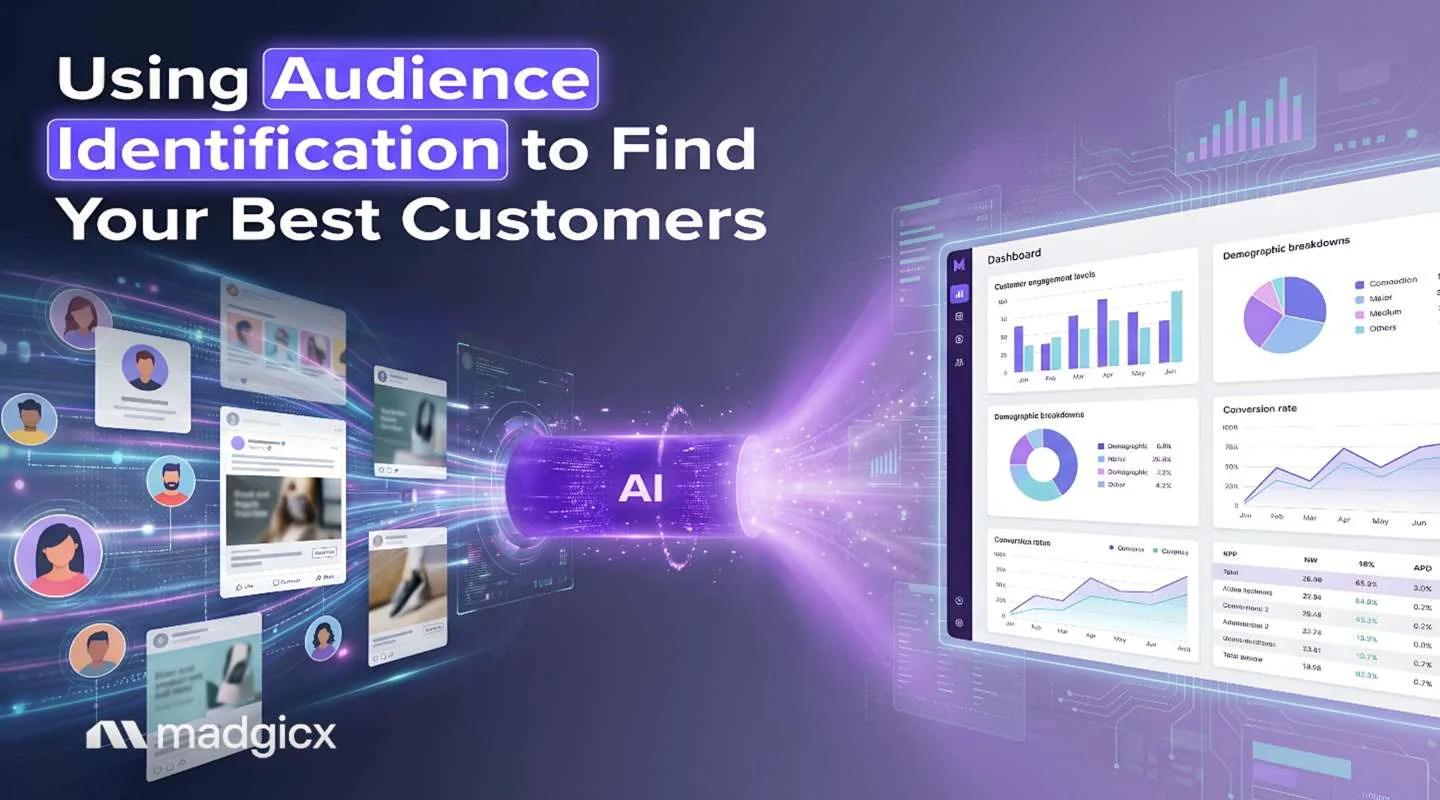
- Madgicx: Your action and optimization platform. Use AI Chat to diagnose audience performance, let the AI Marketer provide budget recommendations, automatically surface winning audience segments with minimal manual effort, and monitor everything in the Business Dashboard—so you’re consistently scaling what works and cutting what doesn’t. Try the entire Madgicx suite for free.
- Google Analytics: A key free tool for understanding who is visiting your website and how they behave.
- Facebook Audience Insights: A valuable free tool for getting Meta-specific demographic and interest data.
- Hotjar: A helpful tool for visualizing user behavior on your site with heatmaps and session recordings.
- SurveyMonkey: A user-friendly platform for creating and distributing customer surveys.
- Ahrefs/SEMrush: The heavy hitters for deep competitor analysis, keyword research, and traffic insights.
Frequently Asked Questions (FAQ)
1. How specific should my target audience be?
It should be specific enough that your messaging feels personal, but not so narrow that your audience size is too small (we usually aim for over 1 million for cold audiences on Meta). Start with your core persona and broaden out from there during testing.
2. What's the difference between a custom audience and a lookalike audience?
Think of it this way: a custom audience is made of people who already know you (like your website visitors or email list). A lookalike audience is a new group of people Meta finds who are similar to your custom audience. So, we use custom audiences for retargeting and lookalikes for finding new customers.
3. How often should I update my customer personas?
Good question! We recommend reviewing your personas at least once or twice a year, or whenever you notice a big shift in your customer base or market trends. Your audience isn't static, and your personas shouldn't be either.
4. My store is new and I have no customer data. Where do I start?
Great question, and a common one! Start with Step 2: Competitor Research. Analyze who your closest competitors are targeting. Then, build a "hypothetical" persona based on that research and test it with interest targeting on Meta. This will help you gather your first set of real customer data.
Conclusion
And there you have it. You're no longer shouting into the void. You have a clear, data-driven roadmap to find the people most likely to love what you sell. We've walked through analyzing data, researching the market, and building a persona. Most importantly, you now know how to apply that research directly within Meta Ads Manager to build audiences with a much higher potential to convert.
Your first task is simple: go analyze your existing customer data. It’s the foundation for everything else we’ve discussed. Once you've defined your new audiences, Madgicx is ready to help you launch, test, and optimize them with AI to find your winning combinations faster.