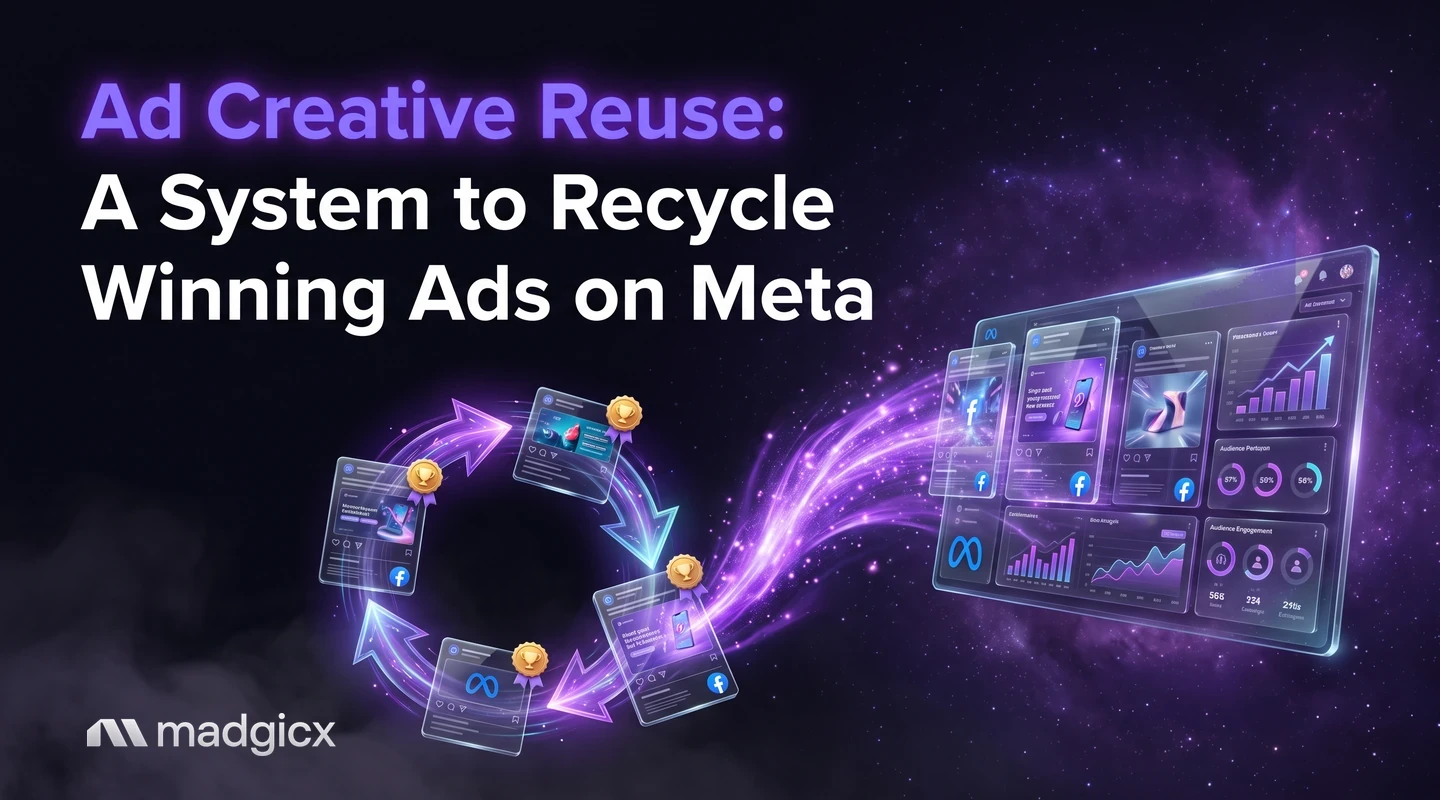
A system for reusing winning Meta ads: what qualifies, how to tag by what made it win, spotting fatigue, one-element refreshes and a copy-ready brief.
Ad creative reuse means taking an ad that already worked and getting more out of it: a new version of the winner, the same idea in a new format, or the same asset in a new audience, instead of starting from a blank page. The system that makes it work has four parts: decide what counts as a winner, tag it by what made it win, change one element at a time, and put the refresh on a calendar.
Without that system, "reuse" turns into re-uploading the same ad until the audience is tired of it. This guide gives you each part, plus a one-page brief you can copy for every refresh.
Spot winners, tag them, refresh one element and schedule it.
Why reuse fails without a system
Most teams reuse creative by memory. Someone remembers an ad that did well last quarter, finds the file and runs it again. It sometimes works, and when it does you can't say why, so you can't repeat it.
Three things usually go wrong:
- The winner was never defined. An ad with a few lucky conversions on a small budget gets treated like a proven ad.
- Nobody wrote down why it won. A file named "final_v3" says nothing about the hook, the offer or the format.
- The refresh changes everything at once. A new hook, a new image and a new offer in one go means you can't tell which change helped.
The fix is a short routine you run the same way every time. Our guide on scaling ad creative production covers the production side; this post covers what to do with the ads you already have.
What qualifies a creative for reuse
Only reuse an ad you trust. Write down a rule before you look at any numbers, so you aren't tempted to bend it for an ad you like. A workable rule has three parts:
- A result measure. Cost per result, ROAS or CPA, whichever your campaign is built around.
- A bar to beat. Your own account's target or average, not a number from someone else's account.
- Enough delivery to trust it. Pick a minimum spend and a minimum number of days, and keep both the same for every ad. Set them from your own budget: a result on a handful of conversions is noise.
If you need an outside reference for what a normal result looks like in your industry, Madgicx's Meta ads benchmarks show medians for 13 industries. For September 2026, the overall median CTR (all clicks) was 2.97% and the median CPM was $9.72. Use them as a sanity check, then rely on your own account as the real bar.
Two kinds of ad deserve reuse even if they didn't win outright: an ad that beat the bar on one placement or audience but not another, and an ad with a strong hook but a weak ending. Both give you something specific to keep.
Tag creatives by what made them win
A tag turns an ad file into a lesson. For each winner, record the elements that could have caused the result:
| Tag | What to write down | Example |
|---|---|---|
| Hook | The first line or first seconds that stop the scroll | "Still paying full price for shipping?" as the opening line |
| Proof | What makes the claim believable | A customer quote, a before and after, a review count |
| Offer | What the viewer gets, and the deadline if there is one | Free returns, a bundle, a seasonal discount |
| Format | Image, video or carousel, and the aspect ratio | Single image at 4:5, or a 9:16 video |
| Production style | How it was made | Product on a white background, phone-shot, designed graphic |
| Audience and placement | Where it won | Prospecting audience on Reels |
Keep the tags in a sheet with a link to the ad and its result. After a few weeks you can sort by tag and see patterns, such as "customer-quote proof beats designed graphics" in your account. Those patterns tell you what to reuse and what to try next.
If you use Madgicx, Creative Insights does part of this for you: it breaks down every creative, including video, to show what makes winning ads win. A new version of Creative Insights adds AI tags for hook, proof, format and production style. It's in beta; contact our support team to get beta access.
Spot fatigue before you refresh
Refresh when the ad needs it, not on a whim. Meta defines creative fatigue as what happens when an audience has seen the same creative too many times. People may be less likely to engage with the ad, which can lead to a higher cost per result.
Ads Manager can flag this for you. According to Meta's help page, it looks at recent exposures of the ad's image or video, including those from other campaigns on the same Page, and at cost per result. Then it applies two statuses:
- Creative limited: cost per result is higher than your past ads, but less than twice as high.
- Creative fatigue: cost per result is at least twice that of your past ads.
There are limits to know about. Meta says the recommendation is only available for ad sets with one creative, and not for Advantage+ catalog ads, dynamic creative or Advantage+ app campaigns. It is also not available with the sales objective before an ad set is active. For ad sets outside those rules, you need your own signals.
Watch these in your own reporting:
- Cost per result climbing for several days while the audience and budget stayed the same.
- Click-through rate sliding on an ad that used to hold steady.
- Frequency rising while results fall.
Meta's guidance for a fatigued ad is to create another ad with a new image or video that is materially different from the original. It also says keeping the original ad active instead of pausing it may maximize results, and it suggests widening the audience so you reach people who haven't seen the ad too much yet. Our post on building a creative ad system shows how to keep the next version ready before the first one tires.
Refresh one element at a time
When an ad is a winner and starting to tire, change one element and leave the rest alone. That way a better or worse result points to the change you made.
Pick from this list, in roughly this order. The hook is the cheapest thing to change and usually the most visible:
- Hook: a new opening line or first frame, with the same body and offer.
- Format: the same message in a different shape. Meta's aspect ratio guidance recommends 9:16 for Stories, Status and Reels, 4:5 for single-image ads on Facebook Feed and 1:1 for single-image ads on Instagram Feed.
- Proof: swap the testimonial, rating or demo.
- Offer: a different incentive or deadline.
- Audience: the same ad in a new audience.
Keep file names consistent so each version says what changed, for example winner-A_hook2.
A refresh brief you can copy
Fill this in before anyone opens a design tool. It takes five minutes and stops the "make it fresh" conversation that goes nowhere.
- Original ad: name, link and the result that made it a winner.
- Why it won (your best guess): the hook, proof, offer, format or style tags.
- What stays the same: everything except the one element below.
- What changes: one element, and what the new version should say or show.
- Formats needed: aspect ratios and placements.
- How we will judge it: the same result measure, minimum spend and minimum days as the original rule.
- Owner and date: who makes it and when it launches.
Build a rotation calendar
A calendar makes reuse routine. You are not scheduling refreshes by date alone; you are scheduling a check, and the check decides whether a refresh is needed.
| When | What you do | Output |
|---|---|---|
| Weekly | Check fatigue signals on your top spending ads | A short list of ads to refresh |
| Weekly | Launch the next version of each ad on that list | One changed element per ad |
| Monthly | Review winners against your rule and update the tags | The reuse library, sorted by tag |
| Quarterly | Revisit old winners that haven't run for a while | Candidates to bring back in a new audience or season |
Pick the day and the owner and put it on a shared calendar. A refresh nobody owns doesn't happen.
How reuse fits with testing
Reuse feeds testing and testing feeds reuse. Each refresh is a small test: one change against the original. Judge it with the same rule you used to name the winner, and log the outcome next to the tags. A version that beats the original becomes the new winner. One that loses tells you the element you changed mattered, which is still a useful result.
Keep a mix. Most of your new ads can be refreshes of proven winners, but leave room for ads built from a new idea, or your library will only ever repeat what you already know. Our glossary entry on creative testing explains how to structure those tests.
Reuse winning ads faster with Madgicx
The slow parts of this system are finding winners, working out why they won, and noticing fatigue in time. Creative Insights breaks down your creatives, including video, to show what makes winners win, and flags creative fatigue so you know when to refresh. Nothing changes in your account unless you decide to make the change.
When you need a new version, the AI Ad Generator makes image ads from a prompt, an image or any ad in the Meta Ad Library, so a winning idea can become a new static version quickly. Compare that with doing the same work by hand and see which fits your team.
FAQ
What is ad creative reuse?
It is running new versions of an ad that already worked, such as a new hook, format or audience, instead of building every ad from scratch. It saves production work and builds on what you know performs.
How often should I refresh a winning ad?
Refresh when fatigue shows up, not on a fixed date. Check weekly for rising cost per result, falling click-through rate and rising frequency, and refresh the ads that show those signs.
How do I know an ad creative is fatigued?
Meta defines creative fatigue as an audience seeing the same creative too many times, which can raise cost per result. Ads Manager shows a Creative limited status when cost per result is above past ads but under twice as high, and Creative fatigue at twice as high or more.
Should I pause an ad when it gets tired?
Not necessarily. Meta says keeping the original ad active instead of pausing it may maximize results while you add a new, materially different ad.
Is it okay to reuse the same ad in a different audience?
Yes, and it is one of the simplest ways to reuse a winner. Treat it as a test: same ad, new audience, judged by the same rule as the original.
How many elements should I change in a refresh?
One. Changing the hook, image and offer together means you can't tell which change helped or hurt the result.