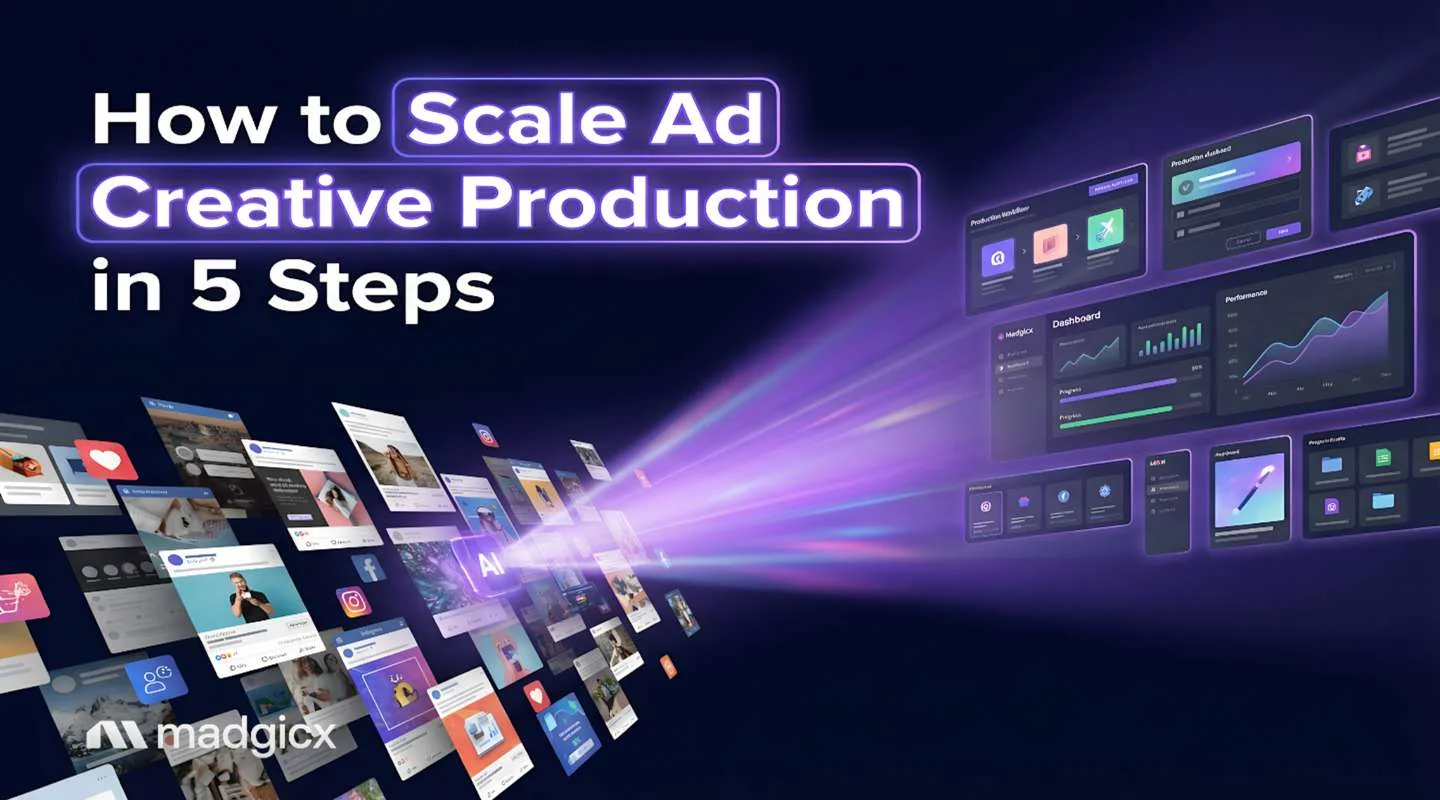
Learn how agencies scale ad creative production with automation, modular design, and agile workflows. Get the frameworks and tools to boost your output.
If you've ever felt like you're on a creative hamster wheel—churning out ads just to keep the lights on—you're not alone. The secret isn't working harder; it's about building a smarter system.
Let's be honest: creative is one of the most critical drivers of campaign performance. It's one of the most impactful levers we can pull. But as the team at Darkroom Agency put it, "Creative often becomes the bottleneck to scaling profitable growth once brands have optimized targeting and bidding."
Sound familiar? You've dialed in your audiences and your bidding strategy is humming, but you just can't produce enough fresh creative to keep performance high. This guide is your way out. We'll break down the exact frameworks and tools that turn your creative department from a bottleneck into a growth engine. ✨
Madgicx combines AI-powered creative generation with 24/7 campaign optimization. Generate hundreds of ad variations in minutes and let our AI help you allocate budget to the winners, so you can scale effectively.
The Creative Treadmill: Why Manual Production Always Fails
If you're running ads for even a handful of clients, you know the pain. The moment a winning ad starts to fade, the pressure is on. You need new concepts, new copy, and new visuals—and you needed them yesterday.
This manual, reactive cycle is a recipe for burnout and mediocre results. The core problems are almost always the same:
- Ad Fatigue: Your best ads have a short shelf life. Audiences get bored, CTRs drop, and your CPA starts climbing. Without a steady stream of new creative, you're constantly fighting a losing battle.
- Slow Turnaround Times: Traditional creative processes are painfully slow. Briefs, feedback rounds, and revisions all add up. By the time a new ad is ready, the opportunity might have passed.
- Inability to Test at Scale: You might have a hunch about what works, but can you prove it? Manually creating dozens of variations to test one hypothesis is a logistical nightmare.
- Brand Inconsistency: When you're rushing to get ads out the door, consistency suffers. Different designers and copywriters can lead to a disjointed brand presence across your campaigns.
As Darkroom Agency notes, performance marketers often need to produce "20-50 unique assets per month for a single client." Trying to do that manually isn't just difficult; it's a one-way ticket to capping your growth.
Creative Scaling 101: From Bottleneck to Growth Engine
So, we know the problem. What's the solution? It's not about hiring an army of designers. It's about fundamentally changing how you approach creative production.
So, what exactly is creative scaling? Think of it this way: it's the process of systematically cranking up the volume and variety of your ad creatives, but—and this is the important part—without a proportional increase in your team's workload or a drop in quality.
It’s about building a system, not just more ads. A huge piece of this puzzle is automation.
Creative automation is where you use technology to act like an AI assistant, generating multiple versions of an ad from a set of core components (like images, headlines, and CTAs) in minutes.
Why does this matter so much? Because effective creative directly translates to better business results. The data is clear: according to Darkroom Agency, "A 10% improvement in creative performance delivers the same results as a 10% increase in media budget."
Imagine getting a 10% budget boost for free, just by improving your creative process. That's the power we're talking about.
The Agency Playbook: 3 Core Methodologies for Scaling Creative
Scaling isn't magic; it's a methodology. Top agencies don't just throw more people at the problem. They use a combination of three core strategies to build a creative engine that’s both fast and effective. Let's break them down.
1. Adopt a Modular Creative System
Okay, this is the foundation of everything we're about to cover. You have to stop thinking of an ad as one single, static thing. Instead, picture it as a collection of interchangeable parts, like LEGOs for your campaigns. This includes everything from visuals like product shots and user-generated content (which you can even learn to make with AI) to different headline angles.
Modular creative is an approach where ads are built from reusable, interchangeable components (like building blocks) that can be programmatically combined to create a high volume of unique variations for testing.
Your modules might include:
- Visuals: Product shots, lifestyle images, UGC, illustrations
- Headlines: Different angles (benefit-driven, pain-point-focused, question-based)
- Body Copy: Short form, long form, testimonials
- CTAs: "Shop Now," "Learn More," "Get Offer"
- Overlays: "Free Shipping," "50% Off," star ratings
By creating a library of these "blocks," you and your team can assemble hundreds of unique ads without starting from scratch every single time. Having the right tools for creating graphics is essential for building this library efficiently.
2. Implement Dynamic Creative Automation
Once you have your modules, automation is how you put them together at scale. This is a game-changer, especially for e-commerce brands with large product catalogs.
Using tools that connect to your product feed (like Shopify), you can automatically pull product images, names, and prices into pre-designed templates. Facebook's own Dynamic Creative is a basic version of this, but dedicated platforms take it to another level, acting as a custom design maker that allows you to create fully branded templates. This is the key to personalized, relevant advertising at a scale that’s impossible to achieve manually. These platforms are some of the best bulk ad creation tools available for performance marketers.
3. Establish Agile Production Workflows
The old way of working—long, waterfall-style campaigns—is dead. To scale creative, you need to think like a software developer and adopt an agile approach. This means working in short, iterative cycles or "sprints."
An agile workflow looks something like this:
- Hypothesize: "We believe a UGC-style video will outperform our static product shots."
- Create: Quickly produce a small batch of ads to test this hypothesis.
- Test: Run the ads for a short period (e.g., 3-7 days) with a limited budget.
- Learn: Analyze the data. Did the UGC work? Why or why not?
- Iterate: Use those learnings to inform the next sprint. Double down on what worked and discard what didn't.
This rapid feedback loop allows you to learn and improve exponentially faster than you could with traditional 30-day campaigns.
Pro Tip: The 80/20 Testing Budget A great rule of thumb for agile workflows is the 80/20 rule. Allocate 80% of your budget to scaling proven, winning campaigns and dedicate 20% to testing new creative concepts and hypotheses. This ensures you're always exploring while protecting your core performance.
Choosing Your Toolkit: Top Creative Scaling Platforms Compared
Alright, theory is great, but you need tools to make it happen. There are many powerful AI advertising tools for agencies to consider, and choosing the right platform is critical, as it really depends on your team's structure, budget, and goals.
We've analyzed some of the top players, but Madgicx stands out as a comprehensive solution because it integrates AI creative generation with campaign optimization and diagnostics—all in one place. No more jumping between five different tabs.
The 7 Golden Rules of Creative Scaling
Having the right tools is only half the battle. You need the right processes to make them sing. Here are seven best practices that are non-negotiable for any team that's serious about scaling.
- Build a Centralized Asset Library Your modular components are useless if no one can find them. Create a single source of truth (using Google Drive, Dropbox, or a dedicated creative management platform) for all approved logos, fonts, images, video clips, and copy. Trust us, this saves so many headaches.
- Standardize Your Briefing Process Remember: garbage in, garbage out. A weak brief leads to weak creative. Create a standardized briefing template that forces the requester to provide all necessary information upfront: the core hypothesis, audience, key message, and desired outcome.
Pro Tip: The "One Thing" Brief Your brief should force the strategist to answer this question: "What is the one thing you want the viewer to think or feel after seeing this ad?" This simple question cuts through the noise and ensures every creative has a clear purpose.
- Define Your Modular Components Get your creative and media buying teams in a room and formally define your "building blocks." What are your 5 core headline angles? Your 3 primary visual styles (e.g., product-on-white, lifestyle, UGC)? Document these so everyone is working from the same playbook.
- Embrace a "Test and Learn" Mindset Not every ad will be a winner, and that's totally okay. The goal is to learn faster than your competition. Celebrate the learnings from failed tests just as much as you celebrate the wins. This cultural shift is essential for growth.
- Integrate Your Creative and Media Buying Teams Creative and media buying can no longer live in separate silos. They need to be in constant communication, ideally in daily or weekly stand-ups, to review results and plan the next sprint. This is how the magic happens.
- Develop a Creative Reporting Framework You can't improve what you don't measure. Go beyond just ROAS and CPA. Track creative-specific metrics like thumb-stop rate (3s video plays / impressions) and hook rate. Use a tool like Madgicx's Business Dashboard to see which concepts are really driving performance.
- Create a Feedback Loop for Winning Traits When an ad is a clear winner, don't just scale the budget. Analyze why it won. Was it the UGC format? The specific pain point in the headline? Document these winning traits and feed them back into your briefing process for the next round.
Proof It Works: Creative Scaling Case Studies
Still skeptical? Let's look at the receipts. 🧾 Brands that successfully implement these strategies see massive, measurable improvements.
Madgicx: The All-in-One Approach
- Challenge: An e-commerce brand was stuck in a cycle of ad fatigue, leading to a rising CPA.
- Solution: The brand used Madgicx's AI Ad Generator to create over 100 new ad variations in under an hour. They then used Madgicx's AI Marketer to automatically shift budget to the new winners.
- Results: The brand achieved a 45% reduction in CPA and discovered 3x more winning ads per week, breaking the cycle of ad fatigue for good.
Try Madgicx for yourself for free.
Hunchads & Ruokaboksi
- The Story: Finnish meal-kit company Ruokaboksi used Hunch's dynamic creative to scale their lead generation on Facebook.
- The Results: According to their case study, they produced over 1,500 creatives, leading to an 82% reduction in Cost Per Lead (CPL) and a 62% drop in Customer Acquisition Cost (CAC).
Superside & Kins
- The Story: Physical therapy provider Kins used Superside's on-demand design service to increase their creative production capacity.
- The Results: A Superside case study reports a 200% increase in CTR and a 20%-40% reduction in cost per result.
Adsmurai & Boxdigital
- The Story: Agency Boxdigital used Adsmurai’s platform to automate creative production for a leading footwear brand.
- The Results: As noted in their case study, they achieved 8x faster creative production by automating the process.
Frequently Asked Questions (FAQ)
What are the most common mistakes when scaling creative?
Oh, this is a big one. The number one mistake we see is focusing only on volume while ignoring quality and strategy. Simply making more bad ads faster won't help you. Other common pitfalls we see agencies fall into are not having a standardized briefing process and testing too many variables at once (which muddies your learnings).
Should I use a tool, an agency, or build an in-house team?
Great question. Honestly, there's no single right answer—it really depends on your stage and resources. Here’s how we break it down for our partners:
- Tool (like Madgicx): Best for lean teams and e-commerce brands who want to empower their marketers with AI without a massive budget.
- In-house Team: Best for large, mature brands that have the budget and volume to justify a dedicated creative department.
- Agency/Service (like Superside): A great middle ground for teams that have a strategy but lack the internal bandwidth for production.
How do you measure creative quality, not just performance?
Love this question, because it gets beyond just the final numbers. While your ROAS and CPA are obviously king, you can get a read on creative quality with some leading indicators. Track metrics like Thumb-Stop Rate (3-second video views ÷ impressions) to see if your ad grabs attention and Hold Rate (percentage of viewers who watch to the end) to measure engagement.
Conclusion
Let's bring it all home. To truly scale your ad creative, you have to stop thinking like a manual assembly line worker and start thinking like an architect building a system.
The path forward is clear:
- Adopt a Modular Design System: Break your ads into reusable building blocks.
- Leverage Automation Tools: Use technology to assemble and test variations at scale.
- Implement Agile Workflows: Move in short, fast sprints to learn and iterate.
This isn't just about making more ads; it's about building a sustainable engine for growth. A platform like Madgicx gives you the AI-powered tools to generate, test, analyze, and scale your ad creative, all within a single, unified dashboard.
Ready to stop the churn and start scaling? 🚀