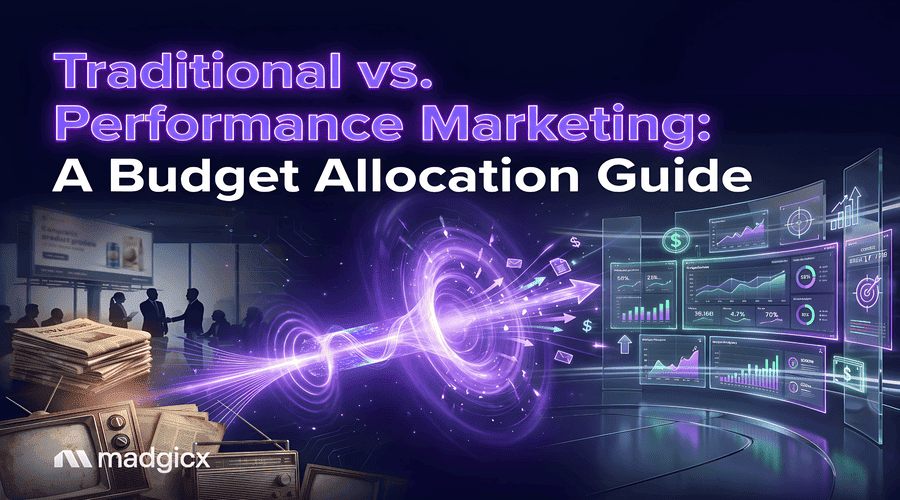
Master traditional vs. performance marketing for smart budget allocation. Learn to integrate both for a powerful "Brandformance" strategy and maximize your ROI.
Ever feel like you're throwing money into a marketing black hole? You're not alone.
Way back when, advertising pioneer John Wanamaker famously said, "Half the money I spend on advertising is wasted; the trouble is, I don't know which half." And honestly, even today, that feeling hits a little too close to home for many of us.
The marketing world can feel like a battlefield of choices. Do you go big with broad-reach traditional campaigns, or do you get granular with data-driven performance strategies? It's a massive challenge, and according to Gartner, a staggering 84% of CMOs report difficulty just developing and executing a marketing strategy. Oof.
But don't you worry. We're about to cut through all that noise. This guide is your new best friend, here to demystify the fundamental differences, financial implications, and strategic superpowers of each approach. We'll give you the tools to make smarter decisions, prove your marketing's worth, and finally figure out which half of your budget is really working.
By the end of this, you'll have a clear roadmap for allocating your budget, mastering attribution, and using AI to maximize every single dollar you spend. ✨
Not sure where your budget is driving results? Madgicx's AI Marketer helps you eliminate wasted spend, scale winning campaigns faster, and optimize performance with AI-powered insights and recommendations available 24/7.
What You'll Learn
- The core differences between traditional and performance marketing — and why they're not opposites
- The key metrics that drive performance budgets (CPA, ROAS, CAC, LTV, and more)
- ROI benchmarks across the most common marketing channels
- How to solve the attribution puzzle and stop trusting inflated platform numbers
- How to build a unified "Brandformance" strategy — and how to split your budget at every growth stage
The Strategic Divide: Traditional vs. Performance Marketing
Alright, let's get into it. Marketing jargon can be a real headache, but think of these two approaches as the two main languages of advertising. Once you're fluent, the whole world opens up.
Performance Marketing is a digital-first model where you, the advertiser, pay only after a specific, measurable action happens—like a click, a lead, or a sale. It's results-driven, obsessively measurable, and the native language of every modern media buyer.
Traditional Marketing is the classic broadcast model. You pay upfront, flat fees for exposure on channels like TV, radio, print, or billboards. The price is fixed, regardless of how many people actually see your ad and decide to buy.
The key differences come down to four things: cost model, targeting, measurement, and core assets. Performance marketing is lower risk — you pay only when an action happens, target with machine learning and real-time bids, and measure everything down to the click. Traditional marketing costs more upfront with no conversion guarantees, relies on geographic and demographic reach, and builds value in harder-to-measure things like brand equity and market authority.
The biggest difference? Performance marketing gives you a real-time feedback loop. You can test, tweak, and optimize on the fly. Traditional marketing is more like setting a billboard in stone—once it's up, it's up.
Here's a little secret the best marketers know: these two aren't enemies. The real magic happens when you get them to work together to create a "Brandformance" engine.
The Math Behind Your Marketing Budget
Okay, deep breath. We're about to do some math, but I promise it's the fun kind—the kind that makes you money. 💰 Numbers don't lie, especially when it comes to your marketing budget.
Here are the core metrics every performance marketer lives and dies by:
- CPA (Cost Per Acquisition): How much you spend to win one customer. Formula: Total Ad Spend ÷ Number of Conversions. Lower is better—but chasing CPA too aggressively can starve campaigns of the budget they need to optimize.
- ROAS (Return on Ad Spend): Revenue generated for every dollar spent on ads. Formula: Revenue ÷ Ad Spend. A ROAS of 4x means you made $4 for every $1 spent.
- CAC (Customer Acquisition Cost): Similar to CPA but accounts for all marketing and sales costs, not just ad spend. A healthy business keeps CAC well below LTV.
- LTV (Lifetime Value): The total revenue a customer generates over their relationship with you. The golden rule: LTV should be at least 3x your CAC.
- CTR (Click-Through Rate): Clicks ÷ Impressions. A signal of creative relevance—low CTR usually means your ad isn't resonating with the audience seeing it.
- CPL (Cost Per Lead): Total spend ÷ Leads generated. Critical for B2B and lead-gen funnels where the sale happens offline.
Performance marketing budgets are fluid; we move money where the data tells us it's working best. But here's a little secret you need to know: the "scaling penalty."
The scaling penalty is the painful reality that as you pour more money into your campaigns, your Customer Acquisition Cost (CAC) almost always goes up. You start reaching less relevant audiences, and competition for clicks gets fiercer.
This is where traditional marketing can actually become your secret weapon. Strong brand awareness, often built through those "unmeasurable" traditional channels, acts as an efficiency multiplier. It warms up the audience, so when they see your performance ads, they're already primed to convert, which can help lower your CAC. Brands using automated performance marketing with AI are already putting this into practice — letting algorithms handle budget routing while humans focus on strategy.
This is also where AI becomes your co-pilot. Manually shifting budgets to fight the scaling penalty is a full-time job. An AI-powered tool like Madgicx's AI Marketer provides automated, expert-level recommendations 24/7, routing your budget to the best-performing assets to maximize ROAS and maintain efficient growth.
Macro Trends & ROI Benchmarks
The marketing world never stands still. To make smart moves, you need to understand the big picture. And let me tell you, the picture is overwhelmingly digital.
The global digital advertising market is exploding. According to WordStream, it's projected to hit a mind-boggling $786.2 billion by 2026. At the same time, the SEO industry alone is now worth nearly $90 billion, showing the massive value placed on organic, long-term growth.
But not all channels are created equal. Based on data from Sender.net, email marketing leads the pack with ROI as high as 4,200%, while SEO compounds over 6–12 months at around 748%. For paid channels, Google Search Ads average around 200% ROI and Facebook Ads sit at roughly 175% — strong short-term returns, but increasingly competitive as more budget floods in.
Here's the catch: as more money floods into digital, competition drives up costs. But there's good news. AI is giving savvy marketers a serious edge. A Salesforce report found that 83% of sales teams using AI saw revenue growth, compared to just 66% of teams who weren't. This isn't just a buzzword; it's a competitive advantage.
For social channels specifically, social media advertising for performance marketing has become one of the highest-leverage plays available — especially when paired with AI optimization.
Solving the Attribution Puzzle
"My Facebook Ads Manager says I got 50 sales, but Shopify only shows 30. What gives?"
Sound familiar? If you've ever felt like your ad platforms are telling you different stories, welcome to the club. Ad networks like Meta and Google love to take credit for conversions, which often leads to duplicated, inflated numbers. To get a real sense of your performance, you need a single source of truth.
Here's your action plan:
- Set up UTM parameters on every campaign — every ad, every channel, every time. This is non-negotiable. Without UTMs, GA4 can't tell you where traffic is coming from, and you're flying blind.
- Make GA4 your primary attribution tool. It's platform-agnostic, which means it doesn't have a financial incentive to inflate your numbers the way Meta or Google do. Configure conversion events properly and let it be your referee.
- Layer in a first-party data strategy. Collect email addresses and build CRM audiences. This makes your GA4 data infinitely more valuable down the road.
But what about traditional media? Modern brands are cracking the code by looking at branded search lift, direct traffic spikes during a campaign, and blended CAC reductions in test markets. It's all about knowing how to measure marketing ROI across your entire strategy.
Reconciling all this data from Meta, Google, TikTok, and Shopify can be a challenge. That's why tools like the One-Click Report and the Business Dashboard are so powerful. They pull all your data into one consolidated view, so you can see the bigger picture without spending hours in spreadsheets. Performance marketing AI for automated reporting takes this even further — letting AI surface the insights so you don't have to dig for them.
Building a Unified "Brandformance" Strategy
So, what's the final verdict? The future of marketing isn't about choosing sides; it's about smart integration. It's about building a "Brandformance" machine.
This model uses a simple, powerful flow:
- Traditional channels build awareness. TV, radio, OOH, and sponsorships create the brand familiarity that makes people stop scrolling when they see your performance ad later. Think of it as warming the pond before you fish.
- Performance channels capture demand. Once brand awareness does its job, paid search, social ads, and retargeting convert that warm audience into paying customers — measurably and efficiently.
- Data flows back to inform both. Performance data tells you which messages and audiences are converting. Feed that insight back into your traditional creative and media planning to make both sides smarter over time.
So how should you actually split the cash?
- Early stage / bootstrapped: 80–90% performance, 10–20% brand. Your priority is proving unit economics and generating revenue. Keep spend measurable and lean on marketing automation for performance marketing to stretch every dollar.
- Growth stage: 70% performance, 30% brand. You have stable revenue and audience data. Start investing in brand channels that will lower your CAC over time.
- Scale / market leader: 50–60% performance, 40–50% brand. You're fighting for market share and mindshare simultaneously. Brand spend protects you from competitor conquest campaigns and keeps your performance efficiency high.
These splits aren't rigid rules — they're starting points. The right allocation depends on your category, competitive landscape, and seasonality. What matters is that you're making the decision intentionally, not by default.
This is where AI tools become essential. You can use Madgicx's AI Ad Generator to quickly create creative variations for both your brand and direct-response campaigns. If Claude is connected to Madgicx MCP, you can diagnose performance issues and action optimizations directly from the AI chat.
The best performance marketing platforms for Meta ad optimization can help you identify exactly where your performance budget should be working hardest — so your brand spend can focus on the gaps.
Frequently Asked Questions (FAQ)
Is performance marketing always cheaper than traditional marketing?
You'd think so, but not always. While performance marketing offers lower financial risk with its pay-for-action model, the cost per acquisition can rise significantly at scale (the "scaling penalty"). Traditional marketing, despite higher upfront costs, can lower your overall blended CAC by building brand equity that makes all your advertising more effective.
How can small businesses effectively use both marketing types?
Start with performance marketing to generate immediate ROI and gather audience data. Once you have stable revenue, strategically invest a small portion (10-20%) into targeted traditional channels like local radio or community sponsorships. Measure the impact by watching for a lift in branded searches and direct traffic.
What's the biggest mistake marketers make when comparing these two?
The biggest mistake is trying to measure traditional marketing with direct-click attribution. Traditional channels build demand and brand equity, which are harder to track but have a huge impact on downstream performance. Another mistake is ignoring the "scaling penalty" in performance marketing, which leads to unsustainable growth if you don't also invest in your brand.
My ad reports and Google Analytics don't match. Which is correct?
Ah, the classic attribution headache! We see this all the time. Ad platforms often claim credit for any conversion they influenced, leading to inflated numbers. Google Analytics 4 (GA4), when properly configured with UTM tracking, provides a more independent and unified view. Always use a single source of truth like GA4 or a consolidated dashboard like Madgicx's Business Dashboard for your core reporting.
Conclusion: Build Your Marketing Powerhouse
The debate between traditional vs. performance marketing is over. The winner is... both. The most successful businesses will be the ones that master the art of "brandformance"—integrating brand building with data-driven optimization. By understanding the unique strengths of each, leveraging a single source of truth for your data, and embracing AI, you can build lasting brand equity while driving profitable, measurable growth.
Ready to turn that marketing black hole into a predictable growth engine? Let's do it together. Madgicx gives you the AI-powered tools to unify your data, streamline your optimization, and make every dollar count.