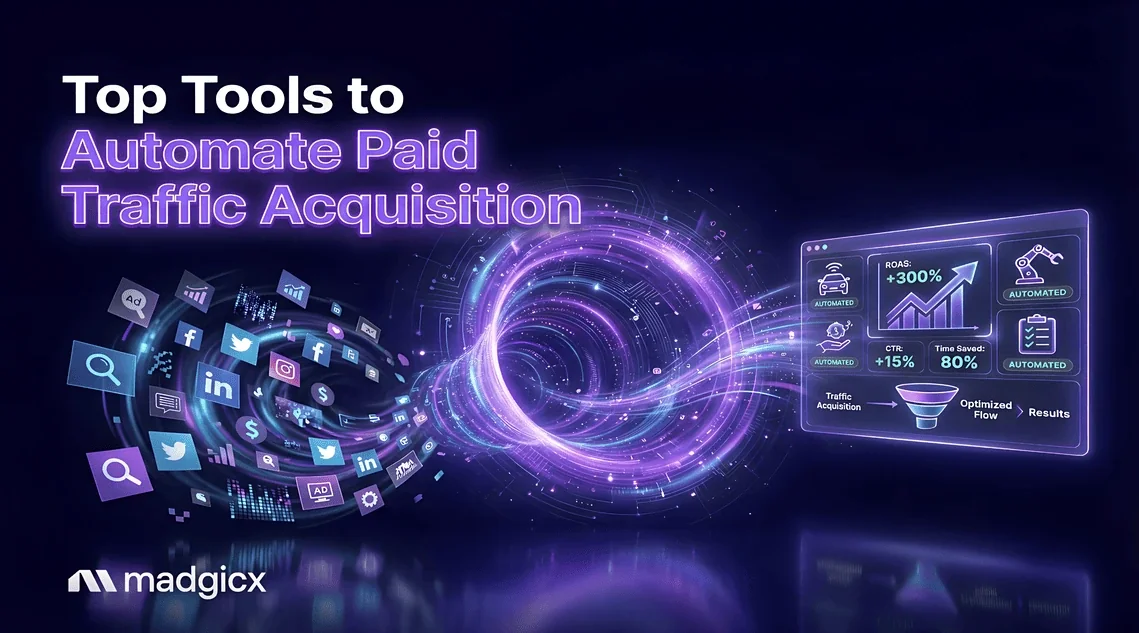
Discover the best tools to automate paid traffic acquisition. We explore AI-powered bidding, reporting, targeting, and ecommerce optimization.
We've all seen it happen: a single manager’s effectiveness gets stretched dangerously thin once they're handling more than 10-15 concurrent campaigns, a threshold where human effectiveness often starts to decline, according to industry analysis. Suddenly, they’re drowning in a sea of tabs—logging into Facebook Ads Manager, then Google Ads, then a reporting tool, then a creative analyzer, then back again.
We call this the "tool-juggle," and it’s the silent killer of agency profitability. This chaotic "Frankenstack" of single-purpose tools isn't a sign of sophistication; it's a barrier to scale.
But what if there was a smarter way? Let's break down the best PPC automation tools on the market and reveal how a unified platform can save your agency from the chaos.
Stop manually tweaking ads and start scaling what works. With Madgicx, AI handles bidding, budget allocation, and audience expansion—so you can launch, optimize, and grow campaigns without the daily grind.
The Agency Dilemma: Why Your "Automation Stack" Is a Hidden Cost
Your current tech stack probably feels necessary. You have a tool for this, a platform for that. But this fragmented approach creates a mountain of hidden costs that quietly eat away at your margins.
These costs include:
- Compounding subscription fees: $100 here, $500 there—it adds up fast.
- Time wasted context-switching: Every time a team member logs out of one platform and into another, focus is lost and momentum dies.
- Data silos: Your Google Ads data doesn't talk to your Meta Ads data, which doesn't talk to your reporting tool. You never get a single, holistic view of client performance.
This fragmentation makes true strategic insights nearly impossible to find. Consolidation isn't just about saving a few bucks; it's the key to unlocking profitable scale, which is why many agencies are now exploring unified growth platforms for paid social and search.
Top Platforms That Automate Paid Traffic Acquisition
1. Madgicx: The Unified AI Media Buying Platform for E-commerce
Okay, we’re biased, but hear us out. We built Madgicx to solve the exact fragmentation problem that holds agencies back.
It’s not just another tool; it’s an all-in-one command center designed to help you manage clients, optimize campaigns, and report on results without the chaos. It’s all about adopting a robust automation framework, leveraging the right AI media buying tools, that actually improves your performance and efficiency—not just adds another subscription to the pile.
Positioning: The all-in-one command center for e-commerce brands looking to scale efficiently.
Key Features:
- AI Marketer: Automatically audits campaigns in real time, telling you when to shift budgets, scale winners, and cutting wasted spend with a click of a button.
- Audience Launcher: Instantly builds and deploys high-performing audiences based on your data, so you’re continuously acquiring new traffic without manual setup
- AI Chat: Acts as your on-demand analyst, instantly diagnosing performance issues and answering questions about your campaigns
- One-Click Report: Your live dashboard showing exactly what’s driving revenue, so you always see the bottom line without digging.
2. Optmyzr: The Rule-Based Engine for PPC Governance
Optmyzr is a powerhouse in the PPC world, especially for agencies with deep roots in Google Ads. It excels at creating granular, rule-based automations to manage bids, budgets, and campaign structures with precision.
Positioning: A powerful tool for agencies needing granular, rule-based control, primarily for Google Ads.
The Lowdown: Its "Rule Engine" is fantastic for those who want to build intricate "if-this-then-that" logic. If you have a team of technical PPC experts who love getting into the weeds of scripting, Optmyzr gives them a massive sandbox to play in.
But Keep in Mind: Optmyzr is a specialist tool that requires significant technical setup. It’s built on a philosophy of human-defined rules, which is a different approach from the machine-learning-driven recommendations in a platform like Madgicx. This means agencies may need a separate solution for integrated client reporting across channels.
3. Cometly: The Specialist for Server-Side Attribution
In our post-iOS14 world, data accuracy is everything. Cometly has carved out a crucial niche by focusing exclusively on solving the attribution puzzle. It’s a tool dedicated to ensuring your conversion data is as clean and accurate as possible.
Positioning: An essential component for data accuracy, not a full management platform.
Here's the Deal: Cometly excels at server-side tracking and helping advertisers navigate the complexities of Meta's Conversions API (CAPI). It helps you address the "garbage-in" problem by working to improve the reliability of your conversion data, which is crucial for things like building effective campaigns on the best ecommerce retargeting platforms.
The Bottom Line: It’s vital to understand that Cometly is a foundational piece, not the whole puzzle. It provides cleaner data, but it doesn't offer optimization suggestions or campaign management. It’s designed to feed accurate data into a comprehensive platform like Madgicx, which already includes native server-side tracking to address this problem.
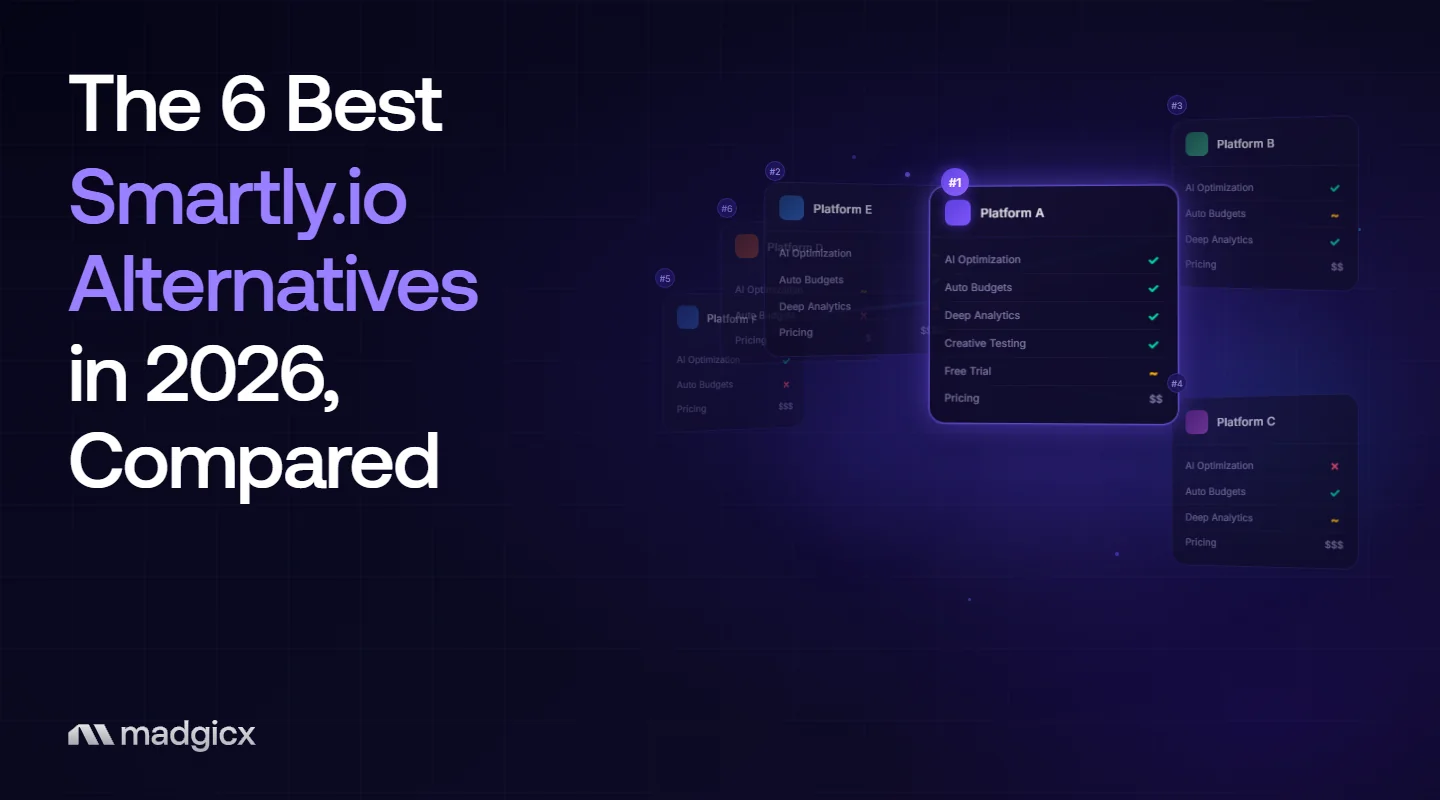
4. Smartly.io: The Enterprise Solution for Creative at Scale
If you're an agency working with global brands that need to generate thousands of creative variations, Smartly.io is a well-known leader. It’s built for creative production at an enterprise scale.
Positioning: The go-to platform for massive enterprises that need to produce and test creative variations by the thousands.
Where It Shines: Smartly.io’s creative automation capabilities are extensive. Their whole game is helping massive teams build and test creative assets way more efficiently by dynamically pulling product feeds, headlines, and images to generate countless ad permutations. In fact, AdStellar reports that users can often build and launch creatives in about one-third of the time it would take with traditional workflows.
The Catch: This power is reflected in its enterprise-level pricing and scope. Smartly.io is primarily a tool for creative production teams. In contrast, Madgicx integrates creative intelligence directly into the media buyer's workflow, making it a practical solution for most small to mid-size agencies.
5. Funnel.io: The Data Pipeline for Complex Reporting
Funnel.io is an industrial-strength ETL (Extract, Transform, Load) tool. It’s designed for agencies with dedicated data teams who need to pipe information from hundreds of sources into BI tools like Tableau or Google BigQuery.
Positioning: An ETL tool for data engineers, not marketers.
What It's For: Funnel is incredibly powerful at what it does: collecting and cleaning data from virtually any marketing source. It standardizes messy data so your data scientists can build complex, custom models.
Pro Tip: Funnel.io is not a reporting tool itself. It gets the data ready, but you still have to build and maintain the actual reports in a different platform. An all-in-one tool like Madgicx handles the data connection, visualization, and presentation in one marketer-friendly interface.
The Reality Check: This makes it better suited for agencies with dedicated data teams. Agencies seeking an all-in-one reporting solution may find other tools more direct and efficient for their day-to-day needs.
6. AdStellar AI: The Autonomous Builder for Meta Campaigns
AdStellar AI represents an interesting new direction among the many AI tools for advertising, focusing on an "agentic AI" model. It uses multiple AI agents that collaborate to build new Meta campaigns from scratch.
Positioning: An innovative AI tool focused exclusively on building new Meta campaigns.
The Big Idea: The concept is fascinating and points toward the future of AI in advertising. It takes proven elements from your ad account and uses them to construct new campaigns. Their approach is most effective for accounts spending over $10,000 per month, where there's enough data for the AI to identify clear patterns.
Where It Fits: AdStellar specializes in the campaign launch phase on Meta. For agencies needing a solution that also covers ongoing multi-channel optimization, analysis, and client reporting, a more comprehensive platform would be required.
Frequently Asked Questions (FAQ)
What is the most important feature in a PPC automation tool for an agency?
The most important feature is one that directly addresses your biggest bottleneck: scale. This typically comes down to multi-account management and efficient client reporting. The ability to create comprehensive, white-labeled reports in seconds is what truly frees up an agency to grow.
Can I use free PPC automation tools to scale my agency?
Free tools are great for starting out but aren't built for a growing agency. They lack the robust multi-client dashboards, cross-channel optimization, and scalable reporting needed to provide professional services.
How does Madgicx replace tools like Funnel.io or other PPC reporting tools?
Madgicx provides an integrated, end-to-end solution. Instead of paying for a data pipeline tool like Funnel.io and a separate dashboard builder, agencies get a ready-made solution out of the box that saves both subscription costs and countless hours of setup time.
Is a rule-based engine like Optmyzr better than an AI-driven one?
They represent different philosophies. A rule-based engine offers deep control but requires constant human maintenance. An AI-driven platform like Madgicx leverages machine learning to assist with 24/7 optimization, finding opportunities humans might miss and freeing up your strategists to focus on growth.
Stop Juggling Tools, Start Scaling Your Agency
Let's be real. Your fragmented stack of specialized tools is holding you back. It creates hidden costs, operational drag, and prevents you from delivering the strategic value your clients deserve.
The future of agency efficiency isn't in adding another tool to the pile; it's in finding a unified platform that brings your most critical functions together. For agencies trying to scale, these tools are non-negotiable. They're how you break past those frustrating growth plateaus by automating the repetitive stuff, freeing up your brilliant strategists to focus on high-impact work that actually moves the needle for clients and maximizes their paid media ROI.
Madgicx consolidates multi-channel optimization, creative intelligence, and client reporting into a single, intuitive interface. It’s designed to help your team work more efficiently so you can focus on what matters: strategy, growth, and happy clients.
Your Action Plan: Audit your current tool stack. Add up the total monthly cost and estimate the hours your team spends just moving data around. Then, start a free trial of Madgicx to see just how much time and money a unified platform can help you save. ✨