Master predictive social media advertising to forecast campaign performance and boost ROAS. Discover how to automate optimization and fight creative fatigue.
What if you could be 2.2x more likely to exceed your revenue goals? According to a study featured on Quuu, that's not a far-off fantasy. It's the reality for performance marketers who are already using predictive analytics.
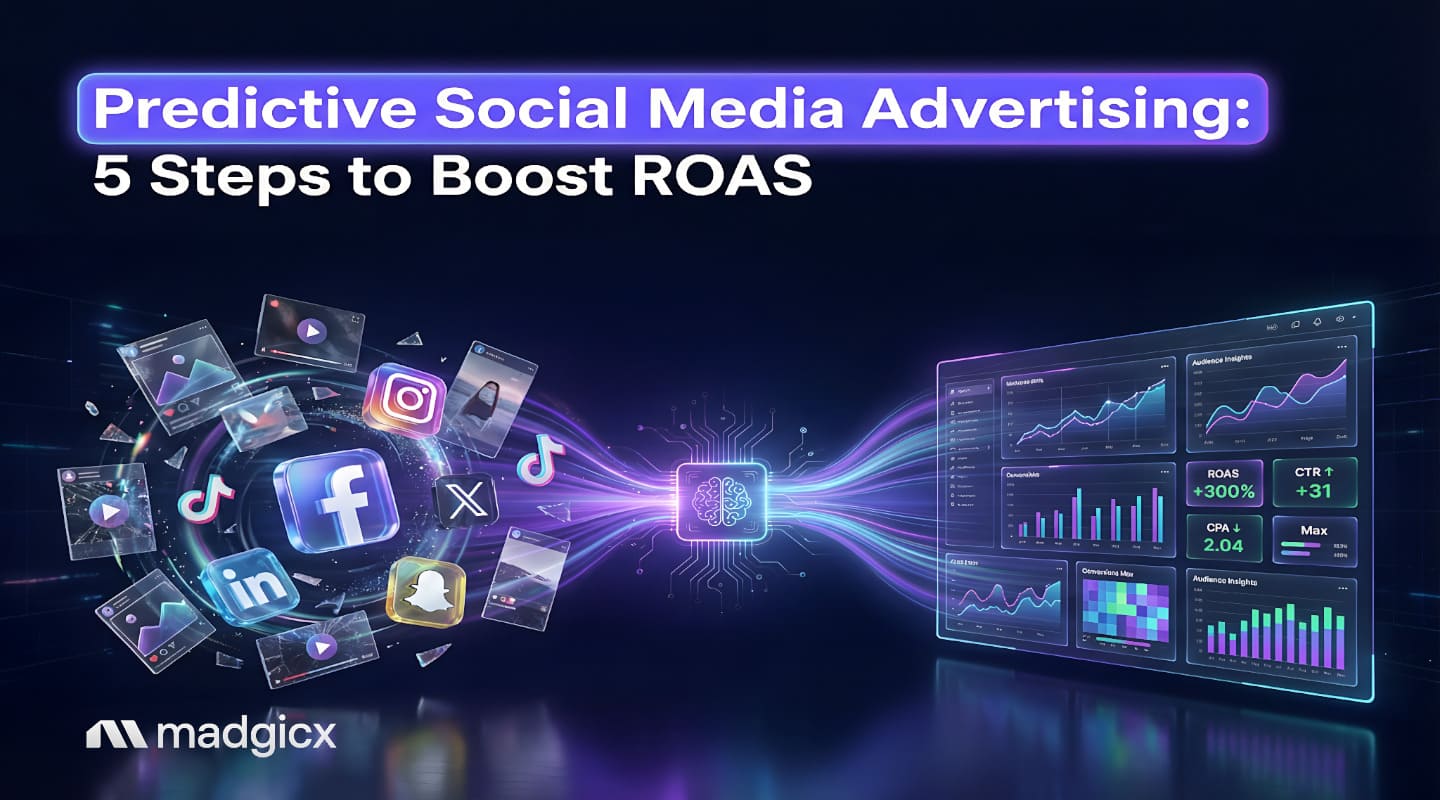
At its core, predictive social media advertising is the practice of using AI and machine learning to analyze historical and real-time data to forecast future outcomes. Instead of reacting to poor performance, it enables marketers to proactively optimize budget, targeting, and creative to improve ROAS.
Does this sound familiar? You launch a campaign, cross your fingers, and hope for the best. You spend your evenings glued to Ads Manager, trying to figure out why your ROAS suddenly decided to take a nosedive while wrestling with attribution in a post-iOS world. It's exhausting, and it feels like gambling with your ad budget.
But what if you could stop guessing and start making data-driven decisions? Here at Madgicx, we live and breathe this, using machine learning models that analyze over 500 data points to give you actionable, cross-platform insights.
This guide gives you the exact frameworks to implement predictive advertising, forecast creative fatigue before it drains your budget, and finally get a clearer picture of cross-platform attribution.
Stop reacting to poor performance. Start predicting and preventing it with Madgicx’s AI-powered platform — including AI Chat, which lets you ask questions like “Why is my CTR dropping?” and get instant, data-backed answers from your ad account.
In this guide, you'll learn:
- How predictive advertising works in a simple 5-step process.
- A real-time optimization framework to manage campaigns daily and weekly.
- How to tackle the challenges of cross-platform attribution using predictive models.
- A system to predict and mitigate creative fatigue before it impacts your ROAS.
- Bonus: A downloadable checklist for your weekly predictive optimization routine.
What Is Predictive Social Media Advertising and Why It Matters Now?
So, what exactly is this crystal ball we're talking about?
It's the game-changing shift from reactive to proactive optimization.
Think about it. The traditional way of managing ads is like driving while only looking in the rearview mirror. You see the crash after it's already happened. Predictive advertising is like having a GPS that warns you about traffic jams ahead, suggesting a faster route so you can avoid getting stuck.
This isn't just a "nice-to-have" anymore; it's rapidly becoming the standard. A staggering 86% of advertisers were already using or planning to use generative AI, signaling a massive industry shift. If you're not on board, you're already falling behind.
Pro Tip: The biggest mistake we see is waiting for performance to drop before taking action. By then, you've already wasted budget. Predictive advertising lets you act on leading indicators (like a dip in CTR) instead of lagging results (like a tanked ROAS).
How Predictive Advertising Works: The 5-Step Engine
This might sound incredibly complex, but the engine running under the hood follows a logical, five-step process. We've spent years refining this at Madgicx, and it's the core technology that powers our platform.
Let's pop the hood and see how it works.
Step 1: Data Collection
You can't predict the future without understanding the past and present. The engine's first job is to pull in data from all your critical sources to create a single source of truth. This includes:
- Meta Ads (Facebook & Instagram): All your campaign, ad set, and ad-level data.
- Google Ads: Performance data from your search and display campaigns.
- Shopify (or other e-commerce platforms): Crucial revenue, AOV, and LTV data.
- Google Analytics 4: Website behavior and user journey insights.
By getting all this data in one place, the AI finally gets the full picture of your customer journey, which is essential for making accurate predictions, especially for social media advertising for e-commerce businesses.
Step 2: Pattern Recognition
Once the data is collected, the AI gets to work. It sifts through millions of data points, looking for hidden patterns and connections that no human could ever spot on their own. It's asking questions like:
- Does this specific audience segment respond better to video ads on Wednesdays?
- Is there a correlation between a 5% drop in CTR and a 20% drop in ROAS three days later?
- Which ad creative elements consistently drive the highest conversion rates for first-time buyers?
This is where Madgicx's AI shines, identifying hundreds of these micro-signals that indicate future success or failure.
Step 3: Prediction Generation
With the patterns identified, the engine starts making forecasts. It can predict key metrics, telling you things like:
- "This new audience is projected to deliver a 3.5x ROAS over the next 7 days."
- "Warning: This ad creative is likely to experience creative fatigue within 48 hours."
- "The predicted CPA for this ad set is 15% higher than your target."
These predictions give you a powerful glimpse into the future, allowing you to make data-driven decisions with confidence.
Step 4: Automated Optimization
This is where prediction turns into action. An insight is useless if you don't do anything with it. Based on the predictions, an automation layer like Madgicx's AI Marketer provides one-click implementation for AI-driven Meta ad recommendations. It can help you:
- Reallocate budget from underperforming ad sets to predicted winners.
- Pause ads that are showing early signs of fatigue.
- Adjust bids in real-time to capitalize on high-potential opportunities.
This isn't about replacing you. Think of it as giving you a super-smart co-pilot that handles routine optimization tasks so you can focus on strategy.
See for yourself with our 7-day free trial.
Step 5: Performance Analysis & Learning
The final step is a continuous feedback loop. Every action taken and every result achieved is fed back into the system. Did pausing that ad help you avoid a drop in ROAS? Did scaling that audience lead to the predicted success? This constant learning process makes the predictive models smarter and more accurate over time.
4 Core Benefits of Predictive Ads for Your Bottom Line
Okay, the tech is cool, but what does this actually mean for your numbers? As performance marketers, we live and die by the metrics. Here's how predictive advertising helps move the needle, building on the core benefits of social media advertising.
1. Designed to Improve ROAS
This is the big one. By constantly shifting budget toward the audiences, creatives, and placements that are predicted to perform best, you can optimize every dollar spent. You're no longer spreading your budget thin and hoping for the best; you're making surgical, data-backed investments. Even Meta's own AI shows the power of this. According to Meta, their Advantage+ Placements can achieve a 4% higher CTR and a 3.8% lift in conversions, proving that AI-driven allocation works.
2. Reduce Wasted Ad Spend
How much of your budget is currently being spent on ad sets that may not be profitable? Predictive budget allocation helps you answer that question. The system identifies underperforming segments early and suggests cutting their funding before they can burn through your cash. This is critical for managing a tight social media advertising cost.
3. Save Hours Every Week
Seriously, stop spending your mornings exporting CSVs and wrestling with pivot tables. The endless cycle of manual analysis is a massive time sink. A predictive platform automates this entire diagnostic process. Instead of digging for insights, the insights are delivered to you. That's hours a week you get back to focus on what really matters: strategy, creative, and scaling your brand.
4. Address Post-iOS Attribution Challenges
Ever since iOS 14.5, attribution has been a challenge. Facebook reports 10 sales, Shopify reports 7, and you're left scratching your head. Predictive conversion modeling helps bridge this gap. By analyzing user behavior across platforms and using server-side tracking like Madgicx's Signals Gateway, the AI can more accurately attribute conversions. It helps you better understand the value of your ads, even when pixel data is incomplete.
A Real-Time Optimization Framework for Marketers
Theory is great, but let's get practical. How do you integrate this into your daily and weekly workflow? Here is the exact framework we use with our top clients.
The Daily Check-in (15 Minutes)
Your morning coffee routine is about to get a serious upgrade. Instead of diving into the chaos of Ads Manager, you start with a simple conversation. With a tool like Madgicx's AI Chat, you can simply ask:
- "What are my top 3 optimization opportunities today?"
- "Which ad sets are showing signs of fatigue?"
- "Summarize my account performance over the last 24 hours."
The AI will instantly analyze your account and give you a clear, prioritized to-do list. In 15 minutes, you can diagnose your account and be ready to execute. No more analysis paralysis.
The Weekly Sprint
This is your structured routine to stay ahead of the curve.
- Monday (Review & Adjust): Review the predictive budget pacing for the week. Are your top campaigns getting enough fuel? Make any top-level adjustments needed.
- Wednesday (Creative Refresh): Check your creative fatigue scores. Which ads are losing their punch? Use this insight to launch new creative tests with an AI tool.
- Friday (Cross-Platform Analysis): Look at your unified attribution dashboard. How did Facebook ads influence Google search performance? Use these insights to plan next week's strategy.
How to Predict and Mitigate Creative Fatigue
We've all been there. That killer ad that was crushing it last week is suddenly dead in the water. That's creative fatigue, and it's a silent ROAS-killer. Predictive advertising gives you a way to see it coming through "creative lifespan forecasting."
Instead of just looking at frequency (a lagging indicator), Madgicx's AI analyzes leading indicators like:
- CTR Decay: Is the click-through rate slowly trending downward?
- Outbound CTR vs. CTR: Is there a growing gap between people clicking the ad and people actually leaving Facebook?
- Cost Per Outbound Click: Is it getting more expensive to get someone to your landing page?
By combining these metrics, the system generates a "fatigue score" for every single ad. You can see, on a scale of 1-100, how close an ad is to burning out.
Pro Tip: Don't just watch this happen—automate it! Set up a rule in Madgicx to automatically pause any ad with a fatigue score above 80% and reallocate its budget to a fresh creative. This is one of the best AI for social media applications for maintaining consistent performance.
Addressing Cross-Platform Attribution with Predictive Models
"My Facebook ROAS is 2x, but my Google ROAS is 5x. Should I move all my budget to Google?"
This is a classic trap marketers fall into because they're looking at data in silos. The reality? Your customer's journey is messy. They might see your ad on Instagram, Google your brand a day later, and then buy after seeing a retargeting ad. Who gets the credit?
A unified dashboard with predictive modeling is a powerful way to address this. By integrating data from Meta, Google, and your store, a platform like Madgicx can stitch together the user journey. It uses predictive models to assign fractional credit to each touchpoint, giving you a clearer picture of how your channels work together.
Top Predictive Advertising Tools for Marketers
The market is full of tools, but they're not all created equal. When it comes to predictive advertising, they generally fall into three categories.
#1. Madgicx: The All-in-One Action Platform
Full disclosure: we built Madgicx because we were tired of tools that just dumped more data on our laps. We wanted a platform that would tell us what to do and help us do it. Madgicx is a comprehensive Meta advertising platform that uniquely combines:
- AI Diagnostics (AI Chat): Get instant answers and recommendations in any language.
- 24/7 AI-Assisted Optimization (AI Marketer): An AI co-pilot that audits and provides optimization recommendations around the clock.
- Integrated Creative Generation (AI Ad Generator): Create compelling ad creatives in seconds.
- Unified Cross-Platform Analytics: A single source of truth for all your advertising data.
It's a social media intelligence tool designed for performance marketers who need to move fast and drive results.
#2. General Analytics Platforms (e.g., Google Analytics 4)
These platforms are powerful for data collection. GA4 is essential for understanding website behavior. However, their primary function is reporting, not action. They show you what happened, but they don't have the built-in predictive models or automation to tell you what to do next.
#3. Enterprise Solutions (e.g., Salesforce Marketing Cloud)
These are the heavy hitters. They offer deep predictive capabilities but come with a major catch: complexity and cost. They are often designed for massive corporations with dedicated data science teams and require months of implementation, making them too slow and expensive for most e-commerce brands.
Frequently Asked Questions (FAQ)
1. How does predictive advertising help with high ad costs?
It directly combats high costs by reducing waste. Instead of spending money to "test" audiences that are likely to fail, the system allocates your budget to segments predicted to have the highest potential for success. This improves your overall account efficiency.
2. What's the difference between this and Meta's Advantage+?
Great question. The biggest difference is transparency and control. Advantage+ is a powerful "black box." With a platform like Madgicx, you get transparent insights and granular control. You can see the predictions, understand the reasoning, and set your own rules to guide the AI.
3. How much data is needed for predictive analytics to work?
Probably less than you think! Our models can start generating reliable predictions with as little as 7 days of consistent campaign data. The system is designed to learn and adapt, so its predictions become more accurate over time.
4. Can this really predict which ad creative will work best?
Yes, it can provide a strong forecast. By analyzing thousands of data points—from image elements and copy sentiment to audience response patterns—the AI can forecast the likely performance of a new creative. It's not magic; it's data science applied to creative performance.
Conclusion: Your Next Step to Proactive Performance
Let's bring it all home. If you remember anything from this guide, let it be these three things:
- You have to move from being a reactive analyst to a proactive strategist.
- You need a real-time framework to make this manageable and effective.
- You can (and should) be predicting things like creative fatigue before they happen.
The era of managing campaigns from a spreadsheet is over. It's time to embrace the future. Your next step is simple: stop analyzing spreadsheets and start asking the right questions. True predictive advertising isn't just about data; it's about AI-assisted action. That's what we built Madgicx to do.
Start your free trial and ask Madgicx's AI Chat, "Which of my campaigns have the highest potential ROAS this week?" The answer might surprise you.
Let's make this your most profitable year yet. 🚀