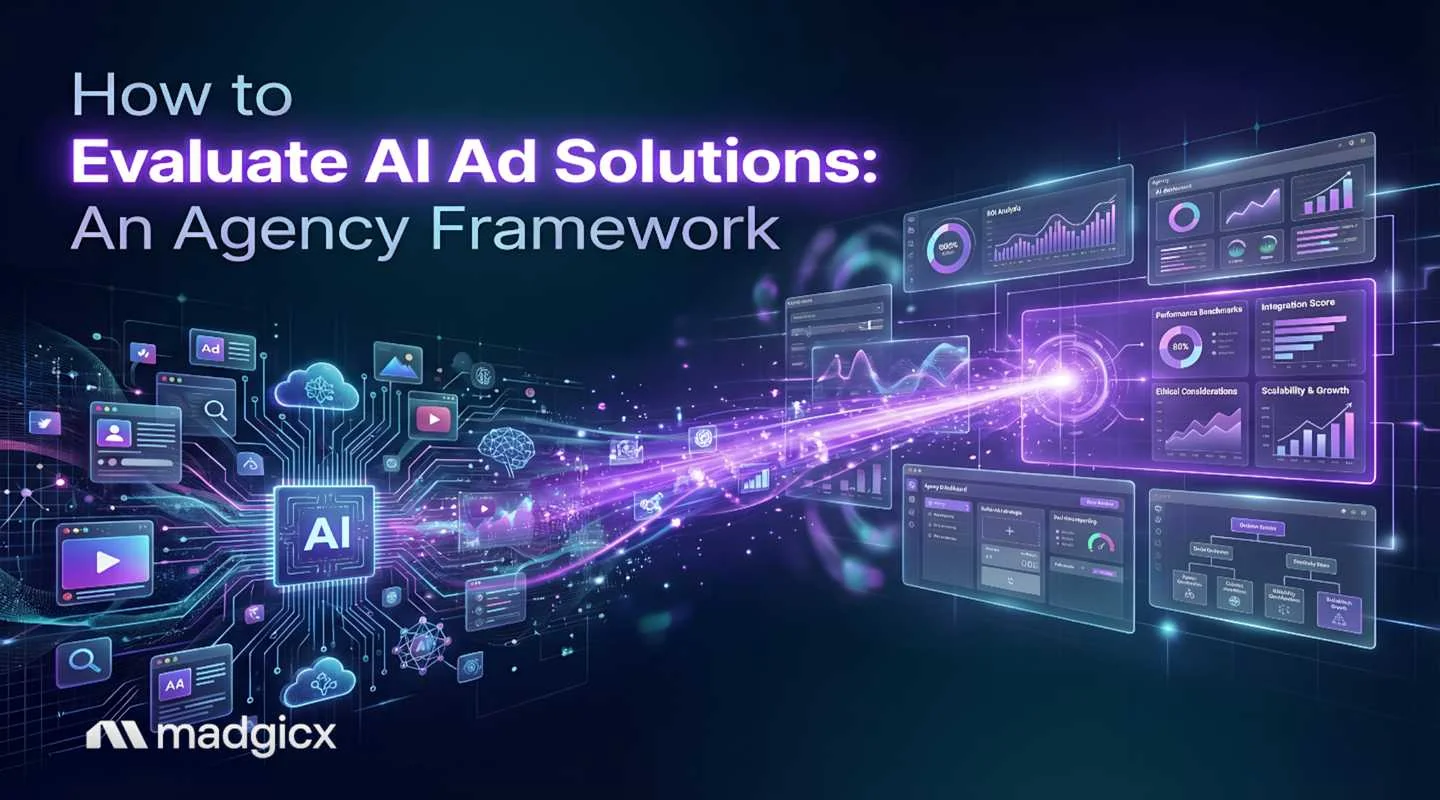
Learn how to evaluate AI advertising solutions with our 9-step agency framework. Assess capabilities and governance to choose the right partner for your clients.
Trying to pick the right AI advertising partner? You’re not alone. Agencies evaluate AI advertising solutions using a multi-step framework that assesses core technical capabilities, proven performance ROI, data security, and integration depth. The process involves defining client goals, demanding proof points like case studies, analyzing pricing models for total cost of ownership, and identifying critical red flags before platform adoption.
It’s a wild world out there. While a whopping 91% of agencies are using AI, according to StackAdapt, the story isn't all sunshine and robot-powered ROAS.
According to the IAB, over 70% of marketers have already encountered an AI-related incident like brand damage or ad pulls. Suddenly, a structured evaluation process is no longer a "nice-to-have"—it's essential for protecting your clients, your reputation, and your sanity.
So, how do you separate the game-changing AI partners from the glorified spreadsheets with a chatbot attached? We've got you. This guide provides the comprehensive 9-step framework that top agencies use to vet AI advertising solutions, complete with checklists, comparison tables, and red flags to help you choose a partner that is designed to deliver.
Tired of AI platforms that promise the world but deliver black-box results? Use Madgicx's AI Chat to get instant, data-backed diagnostics. Pinpoint what's working, what's not, and get actionable recommendations in seconds.
Introduction: The New Agency Imperative—Vetting AI Partners
Remember the good old days? When "optimizing" meant manually tweaking bids, staring at Ads Manager until your eyes crossed, and building reports in Excel that took longer to make than your morning coffee?
Yeah, me neither. The shift from manual campaign management to AI-powered advertising isn't just a trend; it's a full-blown revolution.
The data doesn't lie. According to a report, 17.2% of all marketing activities are now AI-powered, a significant jump from just 8.6% in 2022. For agencies, this isn't just about saving time. It's about survival. Clients expect more—more results, more insights, more speed—and the agencies that can't deliver are being left behind.
But jumping on the AI bandwagon without checking what's under the hood is a recipe for disaster. You wouldn't hire a new media buyer without checking their references and track record, right? The same rigorous logic must apply to your AI partners.
This 9-step framework is your new playbook for making smart, safe, and profitable decisions in the age of AI.
Step 1: Define Your Goals & Success Metrics
Before you even look at a demo, the first and most critical step is to look inward. An agency that approaches vendors with a vague "we need AI" mandate is like a client saying "we need more sales." It's not a strategy; it's a wish.
Your evaluation process must be anchored to specific, measurable outcomes that matter to your clients and your agency's bottom line. Generic goals lead to generic solutions. Instead, get granular. What problems are you actually trying to solve?
Client-Centric Goals:
• ROAS Improvement: Are you aiming for a 15% lift in Return on Ad Spend for your top e-commerce clients?
• CPA Reduction: Do you need to lower the Cost Per Acquisition for lead gen campaigns by 20% to hit profitability targets?
• Market Expansion: Is the goal to efficiently test and scale into three new international markets without tripling your team's workload?
Agency-Centric Goals:
• Creative Velocity: Do you need to go from producing 5 new ad creatives a week to 50?
• Reporting Efficiency: Is the goal to cut down the 10 hours a month your team spends building client reports?
• Strategic Capacity: Do you want to free up your senior media buyers from tedious optimization tasks so they can focus on high-level strategy?
By defining these goals upfront, you transform your vendor search from a feature-shopping spree into a targeted mission. You're no longer asking "What can your tool do?" but rather, "How can your tool help us achieve a 15% ROAS lift for our Shopify clients?" The difference is everything.
Step 2: Assess Core AI Capabilities
Once you know what you want to achieve, it's time to figure out how an AI tool will help you do it. This is where you move past the marketing fluff and dig into the core technical capabilities. Not all "AI" is created equal. Some tools are specialists, while others aim to be the Swiss Army knife in your advertising toolkit.
Key functions to look for:
• Predictive Analytics
• Budget Optimization
• Audience Segmentation
• Creative Automation
To make sense of the landscape, it helps to categorize the vendors you're evaluating.
As you can see, specialist tools are powerful in one area but can create gaps in your workflow. A creative AI can generate stunning ads, but you still need another system to optimize the budget. An optimization tool can manage your bids, but it can't help when creative fatigue sets in.
For agencies seeking to consolidate tools, an all-in-one platform like Madgicx can offer a streamlined solution. By integrating AI-powered Meta ads creative generation with 24/7 budget and bid optimization, the goal is to create a feedback loop where performance insights can inform creative strategy.
Step 3: Verify Performance & Provable ROI
Every AI vendor will promise you the moon. They'll talk about "synergy," "paradigm shifts," and "next-generation algorithms." Your job is to cut through the noise and ask one simple question: Where's the proof?
If a vendor can't provide a clear framework for measuring ROI, that's a massive red flag. The value of an AI platform should be quantifiable, not just a "feeling" that things are better.
Key ROI metrics:
• Time Saved
• ROAS Lift
• CPA Reduction
• Creative Output Increase
Tools like Madgicx's AI Marketer and AI Chat are designed to make ROI tangible through performance improvements and time savings.
Step 4: Evaluate Data Security & AI Governance
This might not be the sexiest step, but it's arguably the most important. Handing over your client's ad account data to a third-party platform is a huge responsibility. Over 70% of marketers have faced an AI incident, and for 40% of them, it was serious enough to pause or pull ads. AI Governance is the rulebook: the set of policies and processes to ensure AI is used ethically, legally, and safely.
Checklist:
• Data Handling & Privacy
• Model Transparency
• Security Protocols
Step 5: Analyze Integration & Workflow Compatibility
An AI tool that doesn't fit into your existing workflow is not a solution; it's just another problem.
Key integration points:
• API Access
• Native vs. Third-Party Integration
• E-commerce & CRM Integration
• Reporting & Analytics
Platforms like Madgicx offer integrations with Meta, Google Ads, GA4, Shopify, TikTok, and Klaviyo to provide a holistic view of your entire digital advertising insights.
Step 6: Review Pricing Models & Total Cost of Ownership (TCO)
When evaluating TCO, ask about onboarding fees, premium support charges, and API access costs. A vendor that isn't transparent about pricing is a vendor to be wary of.
| Model | Price Range | Best For | Example |
|---|---|---|---|
| All-in-One Platform | $45 – $1,000+/mo | Small to medium e-commerce agencies needing creative, optimization, and analytics | Madgicx |
| Flat-Fee SaaS | $45 – $750/mo | Small teams, self-serve, predictable costs | Omneky, Sellozo |
| Usage / Credit-Based | $5,000 – $13,000/mo | Creative-heavy agencies, high-volume testing | Superside |
| Managed / Hybrid | $10,000 – $50,000+/mo | Large enterprises needing a full-service solution | Specialized AI Agencies / Managed Services |
Step 7: Demand Proof Points & Client References
Case studies on a website are a good start, but they are marketing materials, not objective proof.
Proof Points Request Checklist:
• Industry-Specific Case Studies
• Direct Access to a Current Client Reference
• Live Demo with Your Own Data
• Technical Documentation
• Quantifiable Success Stories
Step 8: Identify Critical Red Flags
Red Flags Checklist:
• Vague answers on AI models
• No access to client references
• No data governance policy
• Over-promising results
• Lack of transparent pricing
• Poor API documentation
• High-pressure sales tactics
Step 9: Plan for Implementation & Onboarding
Before you sign, ask:
• Onboarding Process
• Dedicated Support
• Team Training
• Success Measurement
A true partner is invested in your success long after the contract is signed.
Frequently Asked Questions
What's the difference between an AI advertising tool and an AI marketing agency?
An AI advertising tool is a software platform your team uses to manage and optimize campaigns directly. An AI marketing agency provides a fully managed service using their own tools and people.
How do I calculate the potential ROI of an AI advertising platform?
Estimate time saved, project performance lift, and subtract platform costs to calculate net ROI.
What questions should I ask a vendor about data privacy and AI bias?
Ask about GDPR/CCPA compliance, data usage policies, and bias mitigation strategies.
Why do so few AI marketing providers have 'Leader' ratings from firms like Forrester?
Only 2 out of the 10 most significant providers achieved 'Leader' status due to strict evaluation criteria.
Conclusion
Choosing an AI advertising partner is one of the most important decisions your agency will make this year. By following this 9-step framework, you can move beyond the hype and make a decision based on data, proof, and a clear understanding of your goals. This process ensures you don't just buy a tool; you gain a partner.