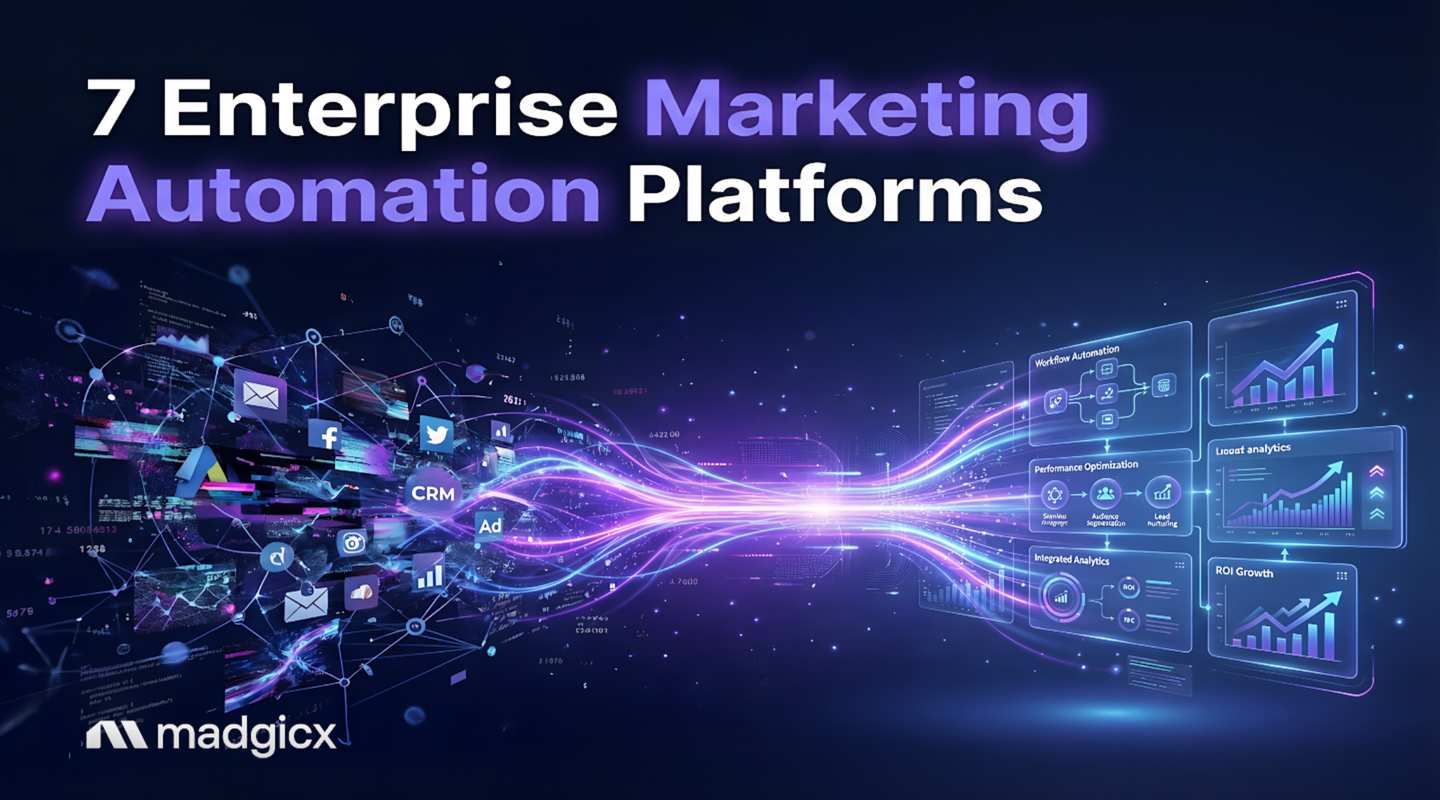
Discover the top enterprise marketing automation platforms like Salesforce, Adobe, and HubSpot. Compare features and integration capabilities.
Choosing from the leading enterprise marketing automation platforms can feel like navigating a labyrinth. You're tasked with unifying a complex tech stack, scaling personalization across millions of customer touchpoints, and proving ROI to stakeholders who live and breathe data. The pressure is immense.
Your teams are grappling with data silos. The customer journey is fragmented across a dozen different tools, leading to inconsistent experiences. You know that manual processes are capping your growth potential, but the thought of a multi-year implementation project with a seven-figure price tag is daunting. This is the core challenge of enterprise marketing: finding a solution that offers immense power without crippling your organization's agility.
You need a platform that can handle complexity, but you also need teams that can move fast, especially in performance marketing. Most guides present a false choice: either a monolithic, slow-moving behemoth or a lightweight tool that can't handle your scale.
This guide is different. We'll explore the true landscape of enterprise marketing automation platforms, from the established giants to the agile accelerators that empower specific teams within your organization to drive results.
Generate high-converting ad creative in minutes with our AI Ad Generator, then let AI Marketer optimize performance automatically around the clock. Turn live campaign data into polished client-ready reports with One-Click automation. Scale faster without adding manual work.
The Enterprise Challenge: Scaling Beyond Manual Efforts
As an enterprise grows, the manual workflows that once worked begin to fracture under the weight of complexity and scale. The core challenges aren't just about sending more emails; they're about orchestrating a seamless customer experience across a vast digital ecosystem.
This is where enterprise marketing automation becomes essential. It’s not about replacing talented marketers; it’s about empowering them with the tools to operate at scale. Research shows that marketing automation can drive a 14.5% increase in sales productivity and a 12.2% reduction in marketing overhead. For an enterprise, this translates directly to the bottom line: higher efficiency, a more consistent brand experience, and a clearer path to revenue attribution.
It’s the critical shift from managing campaigns to orchestrating intelligent, data-driven customer journeys.
Understanding the Enterprise Platform Landscape
Not all automation platforms are created equal. For enterprises, they generally fall into two categories: the all-encompassing "Behemoths" and the specialized "Accelerators." Understanding this distinction is the key to building a tech stack that is both powerful and agile.
The optimal enterprise strategy often involves a hybrid approach: using a behemoth for the core CRM and data governance, while empowering performance teams with agile accelerators for speed and innovation.
The 7 Best Enterprise Marketing Automation Platforms
We’ve reviewed the top platforms through the lens of a large, complex organization. Here are the seven that stand out for their power, scalability, and ability to drive enterprise-level growth.
1. Madgicx
- Best For: Performance marketing teams within an enterprise that need agile, AI-powered advertising optimization and unified reporting across multiple ad channels.
- Key Enterprise Features: Madgicx is the quintessential "Agile Accelerator." While larger platforms manage the core CRM, Madgicx empowers your paid media teams to execute faster and smarter.
- AI Marketer: Automatically provides 24/7 account auditing, one-click optimization suggestions.
- Use the AI Chat to get instant answers to performance questions ("Why did CPA spike on our ad account yesterday?").
- AI Ad Generator: Using the ad generator, performance teams can scale creative production and testing without relying on slower, centralized creative departments.
- One-Click Report & Business Dashboard: Consolidates Meta, Google, TikTok, GA4, and Shopify data into a single, shareable dashboard for rapid analysis and stakeholder reporting.
- Pricing: Transparent pricing that scales with ad spend, starting at $45/mo. Free trial available.
2. Salesforce Marketing Cloud
- Best For: Large enterprises deeply integrated with the Salesforce CRM ecosystem.
- Key Enterprise Features: Salesforce Marketing Cloud is the definition of an enterprise behemoth. Its power lies in its native connection to the world's #1 CRM. This allows for unparalleled personalization and journey building based on a complete view of the customer. It excels at complex, multi-stage customer lifecycle management, from lead acquisition to long-term loyalty.
- Pricing & Caveats: True enterprise-level investment. Requires a custom quote and significant budget for implementation, training, and certified specialists to operate effectively.
3. Adobe Marketo Engage
- Best For: B2B-focused enterprises, especially those already invested in the Adobe Experience Cloud.
- Key Enterprise Features: Marketo is a powerhouse for B2B marketing. Its strengths lie in advanced lead management, account-based marketing (ABM), lead scoring, and nurturing complex sales cycles. As part of the Adobe Experience Cloud, it integrates seamlessly with other Adobe products, creating a unified suite for content, analytics, and commerce.
- Pricing & Caveats: Custom quote required. Like Salesforce, Marketo is a complex system designed for mature organizations with dedicated teams to manage it.
4. HubSpot Marketing Hub
- Best For: Enterprises seeking an all-in-one platform with a strong CRM foundation and a more user-friendly interface than traditional behemoths.
- Key Enterprise Features: HubSpot has successfully moved upmarket to serve enterprise clients. Its key differentiator is its ease of use combined with powerful features. The platform offers a fully integrated CRM, marketing automation, sales tools, and a CMS. For enterprises looking for a single system of record without the extreme complexity of Salesforce or Adobe, HubSpot is a compelling choice.
- Pricing: The Enterprise plan is a significant investment, but often more accessible than its main competitors. Contact HubSpot for a custom quote.
5. Klaviyo
- Best For: Large, e-commerce-focused enterprises, particularly those built on Shopify Plus.
- Key Enterprise Features: Klaviyo is the leader in email and SMS automation for high-volume e-commerce brands. Its deep integration with Shopify allows for incredibly sophisticated segmentation and revenue-recovery flows (e.g., abandoned cart, predictive replenishment). For enterprise D2C brands where customer lifetime value is a primary KPI, Klaviyo is an essential tool.
- Pricing: Custom enterprise pricing based on profile and message volume. The ROI is often significant for high-revenue e-commerce operations.
6. Braze
- Best For: Mobile-first enterprises (e.g., fintech, streaming, delivery apps) focused on real-time, cross-channel customer engagement.
- Key Enterprise Features: Braze is built for the "in-the-moment" interactions that define modern mobile experiences. It excels at delivering push notifications, in-app messages, and other real-time communications triggered by user behavior. Its robust data architecture can handle the scale and speed required by top mobile apps.
- Pricing: Custom quote, typically based on Monthly Active Users (MAUs).
7. ActiveCampaign
- Best For: Enterprise divisions or mid-market companies needing powerful, flexible automation without the full "behemoth" price tag.
- Key Enterprise Features: ActiveCampaign hits the sweet spot between power and accessibility. Its visual workflow builder is highly intuitive, allowing teams to map out complex customer journeys with ease. While it may not have the all-encompassing scope of Salesforce, it offers a robust feature set, including a capable CRM, making it a strong choice for specific business units or for enterprises testing more agile approaches.
- Pricing: Enterprise plans are available via custom quote, offering a more affordable entry point into advanced automation.
The Enterprise Checklist: 4 Must-Have Features
When evaluating enterprise marketing automation platforms, cut through the feature lists and focus on what truly drives efficiency and growth at scale.
- Unified, Cross-Departmental Dashboards: You need a single source of truth that combines data from marketing, sales, and advertising platforms. Look for marketing tools that provide live, shareable dashboards for stakeholders, not static PDFs that are outdated the moment they're sent.
- Automated Stakeholder Reporting: Your teams should not be spending days manually compiling data for weekly or monthly business reviews. A top-tier platform must automate the entire reporting process, generating comprehensive, professional reports in minutes.
- AI-Powered Diagnostics & Insights: When performance fluctuates, you need answers fast. Platforms with AI assistants (like Madgicx's AI Chat) can analyze vast datasets and provide actionable insights in seconds, turning hours of analysis into a simple query.
- Scalable Workflow & Governance Tools: In an enterprise, consistency is key. The right platform must allow you to create, share, and enforce workflow templates for everything from campaign launches to compliance checks, ensuring brand safety and operational efficiency across distributed teams.
How to De-Risk Your Enterprise Platform Choice: A 3-Step Playbook
Choosing a new core platform is a major commitment. Use this playbook to validate your choice and ensure successful adoption.
- Step 1: The "Real Business Unit Data" Pilot. Demos are designed to look perfect. The real test is a pilot program with one business unit or product line. Use the platform with your actual data and real-world use cases to identify its true strengths and weaknesses.
- Step 2: Appoint a "Platform Champion" Team. Don't attempt a company-wide rollout at once. Designate a cross-functional team of enthusiastic, tech-savvy individuals to become the in-house experts. They will lead the pilot, document best practices, and champion adoption across the organization.
- Step 3: Pilot a Single, High-Impact Use Case. Don't try to boil the ocean. Identify one critical, measurable business problem—like reducing customer churn by 5% or improving lead-to-opportunity conversion rate—and focus the pilot on solving just that. A clear, early win is the key to building momentum and securing broader buy-in.
Frequently Asked Questions (FAQ)
How do enterprise platforms handle cross-departmental reporting?
Top enterprise marketing automation platforms act as a central data hub, integrating with your CRM, ad platforms, and analytics tools. They provide customizable, real-time dashboards that can be tailored to different stakeholders (e.g., a high-level ROI view for the CMO, granular campaign data for the marketing manager), breaking down data silos and creating a single source of truth.
What is the true total cost of ownership (TCO) for an enterprise platform?
The TCO goes far beyond the license fee. It includes mandatory implementation and onboarding fees, costs for data migration, budget for certified specialists or implementation partners, and ongoing training costs. While platforms like Salesforce and Adobe have a high TCO, agile accelerators like Madgicx offer a much lower TCO by focusing on immediate value and empowering existing teams.
How do we measure ROI on an enterprise marketing automation platform investment?
ROI is measured through a combination of "hard" and "soft" metrics. Hard ROI includes increased revenue, higher customer lifetime value, improved lead conversion rates, and reduced ad spend waste. Soft ROI includes gains in team productivity, faster campaign deployment, and improved brand consistency. On average, companies see a $5.44 return for every $1 spent on marketing automation.
How do I build a business case for investing in a new enterprise platform?
Focus on outcomes, not features. Start by benchmarking your current metrics (e.g., cost per acquisition, lead conversion rate, team hours spent on manual reporting). Then, project the potential improvements based on industry case studies, such as the potential for a 451% average increase in qualified leads. Frame the investment not as a cost, but as a direct driver of revenue growth and operational efficiency.
Conclusion: Building a More Agile Enterprise
Ultimately, scaling your marketing efforts isn't about buying the biggest, most expensive tool—it's about building a smart, integrated tech stack that balances power with agility. It’s about creating a central system for customer data while empowering your specialized teams with the best-in-class tools they need to innovate and drive results.
The right combination of enterprise marketing automation platforms allows you to orchestrate complex journeys at scale while enabling your performance marketers to make faster, data-driven decisions. This hybrid approach reduces reporting headaches, provides AI-powered insights, and delivers the measurable results that fuel sustainable growth.
Stop letting monolithic software dictate your marketing team's potential. Empower your teams with the tools they need to win.
See how Madgicx can accelerate your performance marketing teams.