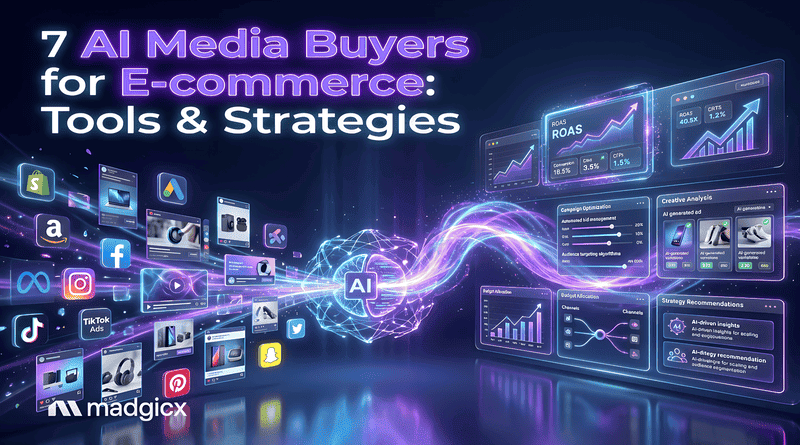
Discover how an AI media buyer can transform your e-commerce advertising. Learn about top tools, pricing, and strategies to optimize ad spend and boost ROAS.
Drowning in CSV exports, pivot tables, and conflicting attribution reports while your competitors seem to spend less and scale faster? You're not imagining it—running paid media across Meta, Google, and TikTok has become genuinely complex, and the old playbook of manual tweaks and weekly check-ins can't keep up with algorithms that update in real time.
The solution is a category of software that's quietly reshaping how e-commerce brands advertise: the AI media buyer. These platforms go well beyond simple "if-then" rules. They use machine learning to predict outcomes, shift budget toward profit, and flag creative fatigue before it tanks your ROAS—all without you having to babysit Ads Manager at midnight. If you're researching your options, this roundup of AI media buying tools for e-commerce is the most complete place to start.
Madgicx's AI Marketer monitors your Meta campaigns around the clock — flagging budget waste, spotting winners, and surfacing every optimization recommendation as a one-click action. No micromanaging.
What You'll Learn
- What separates a true AI media buyer from basic campaign automation
- Why the creative quality—not audience targeting—is now the primary performance lever
- How AI solves the four biggest paid-media pain points
- A breakdown of 7 leading AI media buying platforms for ecommerce
- A practical framework for choosing the right tool
What Is an AI Media Buyer?
An AI media buyer is an advanced software platform that uses machine learning to autonomously plan, execute, and optimize paid advertising campaigns across multiple channels. The key distinction from legacy automation is intent: where rule-based tools react to thresholds you define (pause if CPA exceeds $X), a genuine AI media buyer uses predictive models to anticipate performance shifts and act before problems compound.
In practice, this means the platform is continuously analyzing your campaign data—creative performance, audience signals, bidding efficiency, budget pacing—and surfacing specific recommendations or, in some cases, making adjustments directly. Think of it as a tireless, data-driven strategist working 24/7 to protect your return on ad spend. You can get a deeper grounding in how the technology works in this overview of AI in media buying.
The market appetite for this technology is enormous. The global e-commerce AI sector was valued at $7.25 billion in 2024 and is projected to hit $64–$75 billion by 2034, growing at a 23.6% CAGR. According to Triple Whale, 84% of e-commerce organizations now treat AI integration as a primary strategic objective—not a nice-to-have.
The Shift to Algorithmic Performance: Why Now?
Platform algorithms have evolved so far that the creative asset itself has become the single biggest lever for campaign performance. Audiences, placements, and bidding strategies are increasingly handled by the platforms' own AI—which means the differentiator is what you put in front of people, not how finely you slice your targeting.
This creates a new bottleneck. On average, only 4% of ad creative variations drive the bulk of performance results, which means you need enormous testing velocity just to find the winners. Without AI, that's unsustainable for most teams. Understanding how AI media buyers decide which creatives to scale is critical to making the most of these tools.
There's also compelling downstream evidence of impact. A recent report found that 67% of marketing and sales teams have already documented direct revenue increases from AI integration. Meanwhile, data from Digital Applied shows that shoppers arriving via AI assistants convert 42% better than traditional search traffic and generate 37% more revenue per visit—a channel that grew 393% year-over-year in Q1 2026.
AI media buyers give performance teams the infrastructure to operate at this new pace. They absorb the repetitive, data-intensive work so human strategists can concentrate on what actually requires judgment: brand direction, creative concepts, and long-term growth strategy. The benefits of AI for real-time media buying extend far beyond time savings—they compound into measurable revenue impact.
Top 7 AI Media Buying Tools & Platforms for E-commerce
Choosing the right tool depends on your budget, stack, team size, and which channels matter most to your business. Every platform below offers publicly verifiable pricing or a clear path to getting a quote.
1. Madgicx
Madgicx is built from the ground up for e-commerce brands that need performance intelligence across Meta without the complexity or cost of enterprise-grade platforms.
The platform combines three distinct AI capabilities under one roof: the AI Marketer, which audits your ad account around the clock and surfaces prioritized optimization recommendations you approve and execute with a single click; the AI Ad Generator, which turns existing winning assets into more ready-to-launch ad variations in seconds; and Madgicx MCP for Claude, which lets you ask questions about your campaigns and act on recommendations right in the conversation.
For businesses of all sizes, Madgicx offers an unusually strong combination of AI depth and accessible pricing.
Pricing: From $45/mo. Start your free 7-day trial.
2. Triple Whale
Triple Whale is the attribution and analytics platform of choice for Shopify-native brands. Its server-side pixel captures conversion data that iOS privacy changes would otherwise obscure, giving the algorithm cleaner signals to optimize against. The Moby AI assistant lets you query your store and ad data conversationally—useful for quick performance checks without digging through dashboards.
The Founders plan starts at $129/mo and scales as your AI credit usage grows, making it a natural fit for mid-size DTC brands that need better attribution before layering on more optimization tools.
3. Cometly
For brands that suspect their reported ROAS is flattering them—because Meta and Google are each claiming credit for the same sale—Cometly is designed to surface the truth. It deploys server-side tracking to pass accurate conversion events directly to ad platforms, improving the quality of the data their algorithms learn from.
Its tiered pricing (Signals at $99/mo for lower spends; Full Access at $349/mo) makes it accessible before you've scaled to significant ad budgets. The free account audit is a good starting point to quantify how much data your current setup is missing.
4. StackAdapt
StackAdapt is a programmatic demand-side platform (DSP) that covers native advertising, display, video, connected TV (CTV), and audio—channels that go well beyond the Meta and Google ecosystem. Its Ivy™ AI handles cross-channel audience activation and bidding optimization, while the platform's reporting tools give agencies the consolidated view they need across multiple client accounts.
Pricing is custom and requires a conversation with their sales team, but StackAdapt is consistently cited as one of the highest-rated DSPs for mid-market advertisers.
5. Smartly.io
Smartly.io targets enterprise-level brands with large creative production needs and multi-market campaigns. Its Dynamic Creative Optimization (DCO) engine can automatically assemble and serve thousands of ad variations—swapping product images, headlines, pricing, and CTAs based on audience signals and real-time inventory data.
If your team is regularly producing hundreds of ad variants for global campaigns, Smartly's automation pays for itself quickly. For smaller brands or tighter budgets, the enterprise pricing and onboarding complexity may be prohibitive.
6. The Trade Desk
The Trade Desk is one of the largest independent DSPs in the world, giving advertisers access to premium programmatic inventory across the open web, connected TV, digital audio, and digital out-of-home (DOOH). Its Koa AI engine predicts the value of each ad impression before bidding, helping brands reach high-intent audiences at efficient CPMs. Their Unified ID 2.0 framework provides a privacy-forward targeting solution that doesn't rely on third-party cookies—increasingly important as cookie deprecation reshapes digital advertising.
Pricing is structured as a percentage of media spend, making it most cost-effective at significant scale.
7. Pencil AI
Pencil AI is a creative-generation tool that helps teams produce more ad variations faster. Upload your existing brand assets, and the platform generates new image and video combinations—then scores each one with a predictive performance estimate before you spend a dollar testing it. This de-risks the creative process and accelerates the testing velocity that modern algorithms require.
At $14/mo entry-level pricing, it's one of the most accessible AI tools in this category, though its scope is limited to the creative generation layer rather than campaign optimization or attribution.
For a broader view of how these and similar platforms compare, see our full breakdown of the best AI media buying tools for Meta ads.
Key Challenges AI Media Buyers Solve
1. Attribution Discrepancies and Data Gaps
Ad networks run on conflicting attribution models, which means Meta, Google, and TikTok frequently each claim full credit for the same conversion. AI media buyers address this by building a unified data layer—integrating server-side tracking with first-party data from your store, your ad accounts, and your analytics platform—into a single source of truth. With clean, deduplicated data flowing in, the AI can allocate budget based on what actually drives revenue rather than what each platform's native dashboard wants you to believe.
2. Creative Fatigue and Production Bottlenecks
With platform algorithms deprioritizing stale creatives, the pressure to produce new assets constantly is real. Platforms like Madgicx's AI Ad Generator can spin up high-quality image and video variations from your existing product assets in seconds, giving you the volume of fresh creative needed to keep the algorithms fed—without a proportional increase in design resources.
3. Low-Spend Performance and Budget Protection
For brands spending under $50/day, Meta's learning phase often consumes a disproportionate chunk of the budget before delivery becomes efficient. AI platforms with robust rule-based guardrails allow you to set hard limits on underperforming ad sets—automatically pausing spend when CPA exceeds your threshold, often within the hour—so tight budgets aren't wasted on campaigns that haven't exited the learning phase.
4. Ad Account Suspension Risks
Connecting unvetted third-party tools to your ad accounts via API can trigger platform policy violations and, in worst-case scenarios, account suspensions. The safest path is to choose a Meta-certified partner that uses compliant integration protocols. Platforms built for agency use often include dual-approval workflows as an added safeguard, requiring a second review before any automated changes go live.
How to Choose the Right AI Media Buyer for Your Business
Not every platform is the right fit for every brand. Here's a quick decision framework:
By budget: If you're spending less than $10K/month on ads, start with an accessible SaaS platform like Madgicx ($45/mo) or Pencil AI ($14/mo). These deliver strong AI capabilities without the enterprise price tag. At higher spends, attribution platforms like Triple Whale or Cometly become valuable additions, and DSPs like StackAdapt or The Trade Desk become relevant once you're pushing seven figures in annual ad spend.
By channel priority: Meta-first brands get the most leverage from Madgicx, which is built specifically for that ecosystem while also connecting Google and TikTok. Programmatic-first or omnichannel brands should evaluate StackAdapt or The Trade Desk. Creative-constrained teams may want to start with Pencil AI to increase testing velocity before optimizing distribution.
By team size: Solo marketers and lean teams benefit most from all-in-one platforms that eliminate tool-switching. Larger teams with dedicated specialists might use a combination—an attribution layer, a creative tool, and an optimization platform—each doing one thing exceptionally well.
For a deeper comparison of how these platforms perform across different use cases, see the full analysis of popular AI platforms that act as a media buyer.
The Future: Generative Engine Optimization (GEO)
As more consumers use conversational AI tools—ChatGPT, Gemini, Perplexity—for product discovery, a new discipline is emerging: Generative Engine Optimization (GEO). Rather than optimizing content for search engine crawlers, GEO focuses on making your brand's information legible and trustworthy to AI models, so they cite and recommend your products when users ask relevant questions.
According to insights from ShopOS, AI models strongly favor content that is factually dense, precisely structured, and answers questions directly—product feeds with specific attributes, comparison tables, and structured FAQs outperform vague marketing copy significantly. Brands that clean up their product data and content architecture now will be better positioned as AI-referred traffic continues its rapid growth.
Frequently Asked Questions
What's the difference between an AI media buyer and standard rule-based automation?
Rule-based automation is reactive—it follows "if-then" instructions you set in advance (pause ad if CPA exceeds $50, scale budget if ROAS hits 3x). It can't adapt beyond those rules and has no predictive capability. An AI media buyer goes further: it analyzes patterns across your full account history, forecasts likely outcomes, and generates strategic recommendations based on your goals rather than a fixed script. The distinction matters most when conditions change unpredictably—a competitor enters the market, a creative goes viral, platform costs spike—situations where rigid rules fail and adaptive intelligence wins.
Do I need a large ad budget for AI media buying to work?
No. While some enterprise DSPs require six-figure monthly spends, platforms like Madgicx are built specifically for brands spending from a few thousand dollars a month upward. The minimum requirement isn't a budget number—it's having enough conversion data for the AI to learn from. Most platforms start delivering meaningful recommendations once you're generating 30–50 conversions per month. Below that threshold, strong rule-based guardrails (budget caps, CPA limits, automated pausing) provide the most value by protecting spend during the learning phase.
Can a single AI media buying platform manage Meta, Google, and TikTok simultaneously?
Yes, some can—though depth varies by platform. Madgicx, for example, pulls live performance data from Meta, Google, TikTok, GA4, and Shopify into a unified dashboard, with AI recommendations that account for cross-channel interactions. Attribution platforms like Triple Whale and Cometly also aggregate multi-channel data, though their optimization recommendations are typically less channel-specific than a dedicated AI optimization layer. Enterprise DSPs like The Trade Desk operate across entirely different inventory (the open web, CTV, audio) and don't generally connect to Meta or Google campaigns.
How quickly can I expect results after implementing an AI media buyer?
Most platforms start surfacing actionable insights immediately after connecting your ad accounts—often within the first 24 to 48 hours. Meaningful performance improvement typically takes two to four weeks, as the AI builds a baseline model of your account's patterns and starts identifying consistent optimization opportunities. The brands that see the fastest results tend to be those who act on recommendations consistently from day one rather than passively monitoring. Platforms with one-click implementation (like Madgicx's AI Marketer) compress this timeline further by removing friction between insight and action.
Conclusion
The shift to algorithmic media buying is already underway—the question isn't whether AI will reshape how e-commerce brands advertise, but how quickly your team adapts. The platforms covered here represent a spectrum of capabilities and price points, from accessible tools that any lean team can implement today to enterprise-grade infrastructure for brands operating at serious scale.
Start by identifying your biggest constraint: is it attribution clarity, creative velocity, budget efficiency, or simply the hours your team spends on repetitive optimization tasks? The answer points directly to which tool category will deliver the fastest return. For most e-commerce brands, an all-in-one platform that covers optimization, creative, and reporting in one place—at a predictable monthly cost—is the highest-leverage starting point.
Ready to see the difference AI-driven optimization makes on your ad accounts? Madgicx offers a complete suite of AI tools to audit your campaigns, generate winning creatives, and optimize budgets across Meta.
Sign up for Madgicx today and see what AI can do for your e-commerce brand.