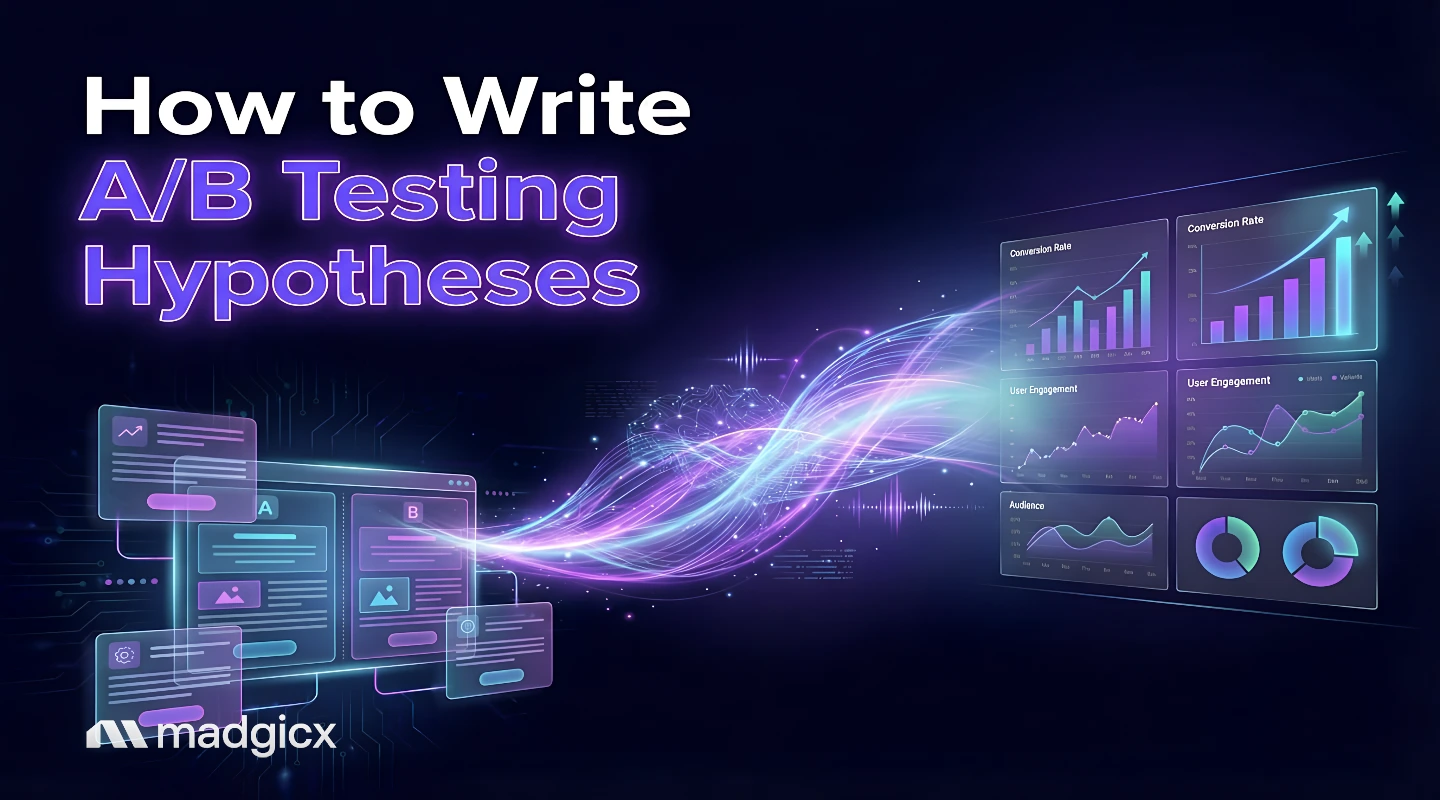
Master A/B testing hypotheses with our "If-Then-Because" framework. Get 7 Meta Ads templates and data-backed strategies to improve client results and scale faster.
Randomly tweaking ad creative and hoping for the best isn't a strategy—it's a recipe for wasted ad spend and awkward client calls. To get consistent wins, your agency needs a system built on powerful A/B testing hypotheses. A strong hypothesis transforms guesswork into a measurable action plan, justifying every dollar spent and building incredible client trust.
At its core, a strong A/B test hypothesis is a clear statement that follows a simple framework: If we implement [a specific change], then we will see [a specific metric improvement], because of [a data-backed reason].
This structure transforms vague ideas into a strategic experiment. This guide provides the agency framework for writing them effectively, complete with templates and examples to help you find your next winning ad.
With Madgicx’s AI Ad Generator, you can instantly create multiple structured variations built specifically for A/B testing, from new hooks and angles to completely different creative concepts. Launch more tests in less time, learn faster, and scale proven winners with confidence.
What You'll Learn
- The simple "If-Then-Because" formula to create clear, testable hypotheses
- How to use performance data to find the "Because" for every test
- 7 plug-and-play hypothesis templates specifically for Meta Ads
- Common mistakes that cause agencies to waste client ad spend
- Bonus: A mini-framework for reporting your A/B test results to clients
Why Vague Hypotheses Are Costing Your Agency Money
We’ve all been there. A campaign is underperforming, and the panic sets in. The immediate reaction? Throwing spaghetti at the wall to see what sticks.
"Let's test a new video!"
"What if we change the button color?"
"Try a different headline!"
This is "testing for the sake of testing," and it's a massive drain on your agency's resources and your client's budget. Without a structured hypothesis, you’re not learning anything—you’re just changing things. A vague idea leads to inconclusive results, which leads to more guessing. It’s a vicious cycle that kills efficiency and erodes client confidence.
The best in the business don't guess. They operate with a testing culture built on data, not hunches. The most important A/B testing statistics show this approach pays off. For example, according to a NudgeNow report, 40% of top Google Play apps conducted at least two A/B tests on their screenshots alone.
Pro Tip: A killer hypothesis is also a secret training tool for your junior team members. It forces them to think beyond just pushing buttons in Ads Manager and ask why they’re making a change. This is how you level up your team from tacticians to strategists.
The Anatomy of a Winning A/B Test Hypothesis
Alright, let's break down the magic formula. A powerful hypothesis isn't complicated; it's just incredibly specific. It has three core parts that work together to create a clear, measurable, and defensible test.
Here’s the "If-Then-Because" framework:
When you put it all together, you get a beautiful, actionable statement:
"If we change the primary text from a product-focused description to a customer testimonial, then we will see a 20% increase in outbound CTR, because our audience data shows that social proof is a stronger motivator than feature lists for this demographic."
How to Find Data for Your Hypothesis (The "Because" Part)
This is the secret sauce. The "because" is what separates the pros from the amateurs. A gut feeling is nice, but data wins accounts. For busy agencies managing multiple clients, finding this data quickly is paramount.
1. Use AI Chat for Quick Diagnostics
Digging through Ads Manager for insights can feel like searching for a needle in a haystack. This is where AI becomes your new best friend. Instead of drowning in data tables, you can just ask a simple question.
With a tool like Madgicx's AI Chat, you can get answers in seconds about campaign performance. Here are a few things you could ask:
- "Which ad creative in my top-of-funnel campaign has the highest hook rate but the lowest CTR?"
- "What's the primary age demographic engaging with my ads but not converting?"
- "Compare the cost per purchase between my broad audience and my 1% lookalike audience over the last 14 days."
2. Analyze Your Business Dashboard
Your clients' customers don't live in a Meta-only bubble. Using a cross-channel tool like the Business Dashboard in Madgicx, you can spot trends across all your platforms in one place. You might notice that a specific product category is trending on Google Ads but has low ad spend on Meta.
Hypothesis Idea: "If we create a dedicated campaign on Meta for our top-selling Google Ads category, then we will achieve a 25% lower cost per purchase, because we are capitalizing on proven product demand from another high-intent channel."
3. Review Audience Insights
Don't forget the data that Meta gives you for free! Dive into Facebook Audience Insights to understand the demographics, interests, and behaviors of your client's followers or custom audiences. You might discover that a large portion of your audience also likes a complementary brand or a specific influencer.
7 A/B Test Hypothesis Examples & Templates for Meta Ads
Ready to put this into practice? Here are 7 plug-and-play templates focused on e-commerce that your agency can steal and adapt for your clients today.
1. The Creative Hook Test
- Template: If we change the first 3 seconds of our video ad from [Current Hook] to [New Hook], then we will see a [Metric: X% increase in 3-second video view rate], because [Rationale: the new hook is more direct/surprising/relatable to our target audience].
- Example: If we change the first 3 seconds of our video ad from a product shot to a user-generated content clip, then we will see a 30% increase in 3-second video view rate, because authentic content resonates more strongly with our Millennial audience.
2. The CTA Copy Test
- Template: If we change our headline's call-to-action from [Current CTA] to [New, more urgent/benefit-driven CTA], then we will see a [Metric: X% increase in outbound CTR], because [Rationale: the new CTA creates a stronger sense of urgency/clarity].
- Example: If we change our headline's CTA from "Shop Now" to "Get 50% Off Today Only," then we will see a 15% increase in outbound CTR, because the new CTA highlights a time-sensitive offer. In one famous test, marketer Michael Aagaard saw a 90% increase in sign-ups just by tweaking his CTA copy.
3. The Audience Test (Broad vs. LAL)
- Template: If we allocate budget from our [Current Audience] to a [New Audience Type], then we will achieve a [Metric: X% decrease in Cost Per Purchase], because [Rationale: the new audience has shown higher purchase intent/is a more qualified data source].
- Example: If we test a broad targeting audience against our 1% Purchase Lookalike audience, then we will achieve a 20% lower Cost Per Purchase with the broad audience, because Meta's algorithm has become more effective at finding buyers without restrictive targeting.
4. The Ad Format Test (Carousel vs. Single Image)
- Template: If we change our ad format from a [Current Format] to a [New Format], then we will see a [Metric: X% increase in Add to Cart Rate], because [Rationale: the new format is better for showcasing multiple products/telling a story].
- Example: If we change our ad format from a single image to a carousel showcasing our top 3 best-sellers, then we will see a 25% increase in Add to Cart Rate, because it allows users to discover more products without leaving the app. For one brand, Swiss Gear, simply testing new product colors led to a 52% jump in sales.
Instead of manually creating every variation, use Madgicx’s AI Ad Generator to instantly produce multiple concepts that are tailored to your audience and offer. In minutes, you can generate fresh hooks and product-focused slides, and benefit-driven messaging designed specifically for structured A/B testing.
That means faster test launches, more meaningful variations, and a higher chance of uncovering the format that actually drives lift — without burning hours on brainstorming or design revisions.
Try the complete Madgicx suite for free.
5. The Landing Page Headline Test
- Template: If we align our ad headline with our landing page headline by changing it to [Matching Headline], then we will see a [Metric: X% increase in Conversion Rate], because [Rationale: it creates a more seamless and consistent user experience, reducing bounce rate].
- Example: If we change our landing page headline to match the "Effortless Style, Sustainable Fabric" headline from our ad, then we will see a 10% increase in Conversion Rate, because it reinforces the primary value proposition immediately upon arrival. TreeRing saw a 42% increase in landing page visits just by making their offer clearer.
6. The Offer Test (Discount vs. Free Shipping)
- Template: If we change our primary offer from [Current Offer] to [New Offer], then we will see a [Metric: X% increase in ROAS], because [Rationale: our customer surveys indicate a higher perceived value for the new offer].
- Example: If we change our primary offer from "15% Off" to "Free Shipping on All Orders," then we will see a 10% increase in ROAS, because our target audience is more sensitive to shipping costs than product discounts.
7. The Social Proof Test (Testimonial vs. UGC)
- Template: If we replace our [Current Social Proof] creative with a [New Social Proof Type] creative, then we will see a [Metric: X% increase in Purchase Conversion Value], because [Rationale: the new format is more authentic and builds greater trust].
- Example: If we replace our polished testimonial graphic with a raw, user-generated video review, then we will see a 15% increase in Purchase Conversion Value, because our audience responds better to authentic, unedited content from real customers.
From Hypothesis to Action: A Quick Agency Checklist
Before you hit "publish" on that next test, run your hypothesis through this quick sanity check:
[ ] Is it based on the "If-Then-Because" formula?
[ ] Is only one variable being tested? (This is critical!)
[ ] Is the expected outcome measurable with a specific metric?
[ ] Is the "because" based on data, not just a gut feeling?
[ ] Do we have a clear definition of success? (e.g., reaching 95% statistical significance)
Bonus: How to Report A/B Test Results to Clients
Winning the test is only half the battle. Use this simple four-part structure for your next report:
- The Hypothesis: Restate the original hypothesis clearly.
- The Result: Show the data. Present key metrics from Version A and Version B side-by-side.
- The Conclusion: State whether the hypothesis was proven, disproven, or inconclusive.
- The Next Step: Define the action plan. "Based on these results, we will now be rolling out the winning headline..." This continuous improvement cycle is the essence of conversion rate optimization, often managed with conversion optimization software.
Pro Tip: Save hours by using Madgicx's One-Click Report to pull data into clean, client-ready reports.
FAQ Section
What's the difference between a hypothesis and a guess?
A guess is a shot in the dark. A hypothesis is an educated, strategic shot based on clues and data.
How long should my agency run an A/B test for a client?
Run the test until you hit statistical significance (usually a 95%+ confidence level). The time depends on your client's traffic and conversion volume.
Can I test more than one thing at a time?
No! A true A/B test isolates one single variable. Testing multiple variables requires multivariate testing tools — otherwise, you won’t know what actually caused the lift (or drop) in results.
Conclusion
Strong A/B testing hypotheses are the difference between random acts of marketing and predictable performance growth. When your team consistently uses the “If-Then-Because” framework, every test becomes intentional, measurable, and defensible. You’re no longer changing ads because performance dipped — you’re running structured experiments designed to uncover clear insights and compound results over time.
That shift alone can transform how clients perceive your agency: from executors to strategic growth partners.